Blog
In a field that evolves daily, staying ahead means staying informed.
Explore in-depth articles designed to help you solve complex challenges,
maximize your machine’s ROI.
Stay ahead in a competitive market.


In a field that evolves daily, staying ahead means staying informed.
Explore in-depth articles designed to help you solve complex challenges,
maximize your machine’s ROI.
Stay ahead in a competitive market.
News | Apr-8-2026
The Mopa fiber laser represents a significant advancement in laser marking technology, offering unparalleled control and versatility for industrial applications. Unlike standard fiber lasers, its unique architecture allows for independent adjustment of pulse parameters, enabling specialized effects such as color marking on metals and gentle processing of sensitive materials. This makes the Mopa fiber laser an indispensable tool for high-end product branding, medical devices, and electronics where both aesthetics and permanent traceability are critical.
The Core Principle: Independent Pulse Control
The defining feature of a Mopa fiber laser is its Master Oscillator Power Amplifier (MOPA) design. This separates the pulse generation and amplification stages, allowing operators to precisely tune the pulse width and frequency independently of each other. This independent control is the key to its versatility, enabling everything from high-contrast, deep engraving to the subtle surface oxidation that produces permanent colors on stainless steel or anodized aluminum without inks or dyes.
Key Components of a Mopa Fiber Laser System
A complete system built around a Mopa fiber laser source integrates several high-performance components. The core is the adjustable MOPA laser source itself. It is paired with an ultra-high-speed galvo scanner to leverage its capability for both fast and precise marking, and a high-resolution F-Theta lens to maintain fine spot quality across the entire working area, which is typically 175mm x 175mm in a standard configuration. Modern systems often feature efficient integrated air-cooling and are controlled by advanced pulse-tuning software that provides intuitive access to the laser’s parameters for creating diverse marks on the same material.
Material Applications and Versatility
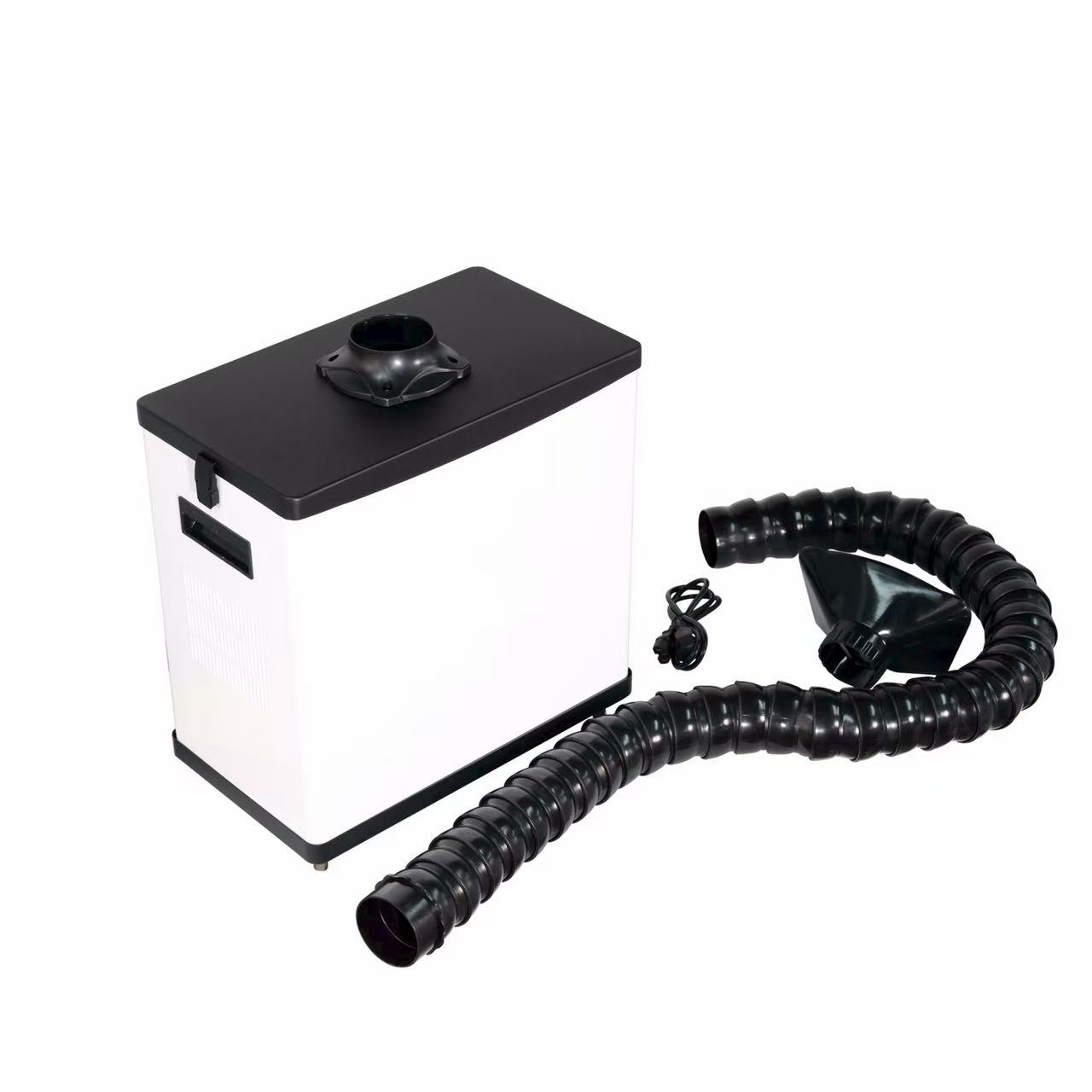
The tunable output of a Mopa fiber laser greatly expands material compatibility. It is exceptionally suitable for metals like stainless steel, aluminum, and titanium, enabling black, white, and color marking. It can also process a wide range of plastics, including ABS, acrylic, and polycarbonate, with minimal heat impact. A critical safety note is that processing materials like PVC or PTFE generates hazardous fumes, mandating the use of appropriate PPE and a high-efficiency fume extraction system, which is strongly recommended for shops working with these materials.
Technical Specifications and Performance
A standard Mopa laser marking machine configuration includes a 60W Mopa laser source, achieving marking speeds up to 7,000mm/s via 3D galvanometer beam delivery. For demanding production environments, upgrades such as a robust safety enclosure with integrated fume extraction, an industrial water chiller for higher-power continuous operation, or complete in-line production integration with automated vision systems are available to enhance stability, safety, and throughput.