Blog
In a field that evolves daily, staying ahead means staying informed.
Explore in-depth articles designed to help you solve complex challenges,
maximize your machine’s ROI.
Stay ahead in a competitive market.


In a field that evolves daily, staying ahead means staying informed.
Explore in-depth articles designed to help you solve complex challenges,
maximize your machine’s ROI.
Stay ahead in a competitive market.
News | Apr-13-2026
The 20 watt fiber laser represents a cornerstone of modern industrial marking technology, offering an optimal balance of power, precision, and reliability for a vast array of permanent identification and branding tasks. As a solid-state laser system, it utilizes a doped optical fiber as its gain medium to generate a highly concentrated beam of light at a 1064nm wavelength, which is exceptionally well-absorbed by metals and many engineered plastics. This specific power rating is engineered for applications where deep material removal is less critical than achieving high-contrast, clean, and fast marks without excessive heat input. The versatility and efficiency of a 20 watt fiber laser make it an indispensable tool for production lines requiring durable part traceability, compliance labeling, and asset management.
Typical Industrial Applications
This laser power is predominantly deployed in industrial marking and engraving. It is the go-to solution for direct part marking (DPM) in sectors like automotive, aerospace, electronics, and medical device manufacturing, where permanent, high-read-rate identifiers are mandatory for traceability. A 20 watt fiber laser can effectively mark metals including stainless steel, aluminum, anodized aluminum, and titanium, as well as certain plastics. Common tasks include engraving serial numbers on tools, branding logos on consumer products, marking barcodes on electronic components, and creating wear-resistant graduation marks on surgical instruments.
Technical Specifications and Configuration
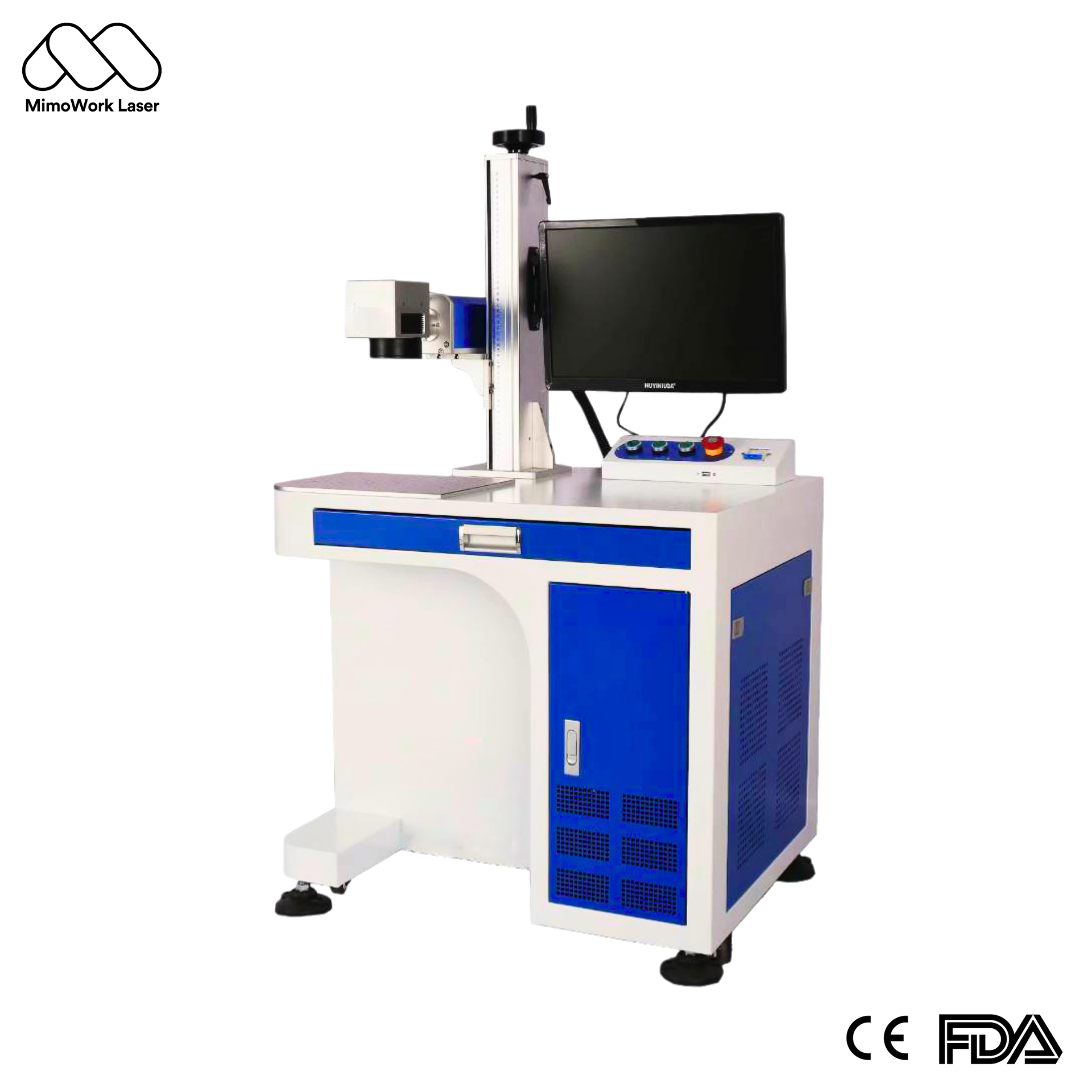
A standard system built around a 20 watt fiber laser source typically features a defined marking area, such as 70x70mm up to 200x200mm, controlled by a 3D galvanometer for beam delivery. It achieves high marking speeds, often up to 8000mm/s, ensuring minimal cycle time impact in production environments. The standard configuration includes an air-cooled laser source, making it easy to integrate without the need for complex external chillers. For enhanced functionality, systems can be upgraded with safety enclosures, fume extractors, handheld marking heads for large or fixed objects, and field-of-view lenses for marking on uneven surfaces.
Conclusion
In summary, the 20 watt fiber laser is a robust, precise, and economical workhorse for industrial marking. It delivers the permanence, speed, and flexibility required for modern manufacturing and part identification challenges. By choosing a system centered on a reliable 20 watt fiber laser, businesses invest in a durable solution that enhances product quality, ensures regulatory compliance, and streamlines production logistics with clean, consistent, and high-quality marks.
FAQ