Blog
In a field that evolves daily, staying ahead means staying informed.
Explore in-depth articles designed to help you solve complex challenges,
maximize your machine’s ROI.
Stay ahead in a competitive market.


In a field that evolves daily, staying ahead means staying informed.
Explore in-depth articles designed to help you solve complex challenges,
maximize your machine’s ROI.
Stay ahead in a competitive market.
News | Jul-3-2026
Industrial laser operations, such as welding and cleaning, generate dense smoke, metal dust, and airborne particles. These emissions are not merely a nuisance; they pose significant risks to both operator health and equipment longevity. A high-performance dust and fume extractor is therefore vital for ensuring clean, safe, and efficient operations by actively removing these harmful by-products from the work environment.
To better understand the laser machines that generate these fumes, watch this quick introduction to galvo laser technology:
What is a Galvo Laser Machine?
While both systems aim to clean air, their design and application are fundamentally different. Understanding these distinctions is key to selecting the correct equipment.
The primary distinction lies in the size and nature of the pollutants they capture. Dust collectors are engineered to handle larger, heavier particulate matter like sawdust, metal shavings, or grinding debris. In contrast, a fume extractor is specifically designed for sub-micron particles, smoke, vapors, and ultra-fine mists, such as the ink mist and powder from DTF printing or the dense smoke from laser welding.
This leads to different industrial applications. Dust collectors are common in woodworking, metal grinding, and bulk material handling. Fume extractors are essential in processes like laser welding, soldering, chemical processing, and DTF printing, where capturing visible smoke and hazardous vapors is the priority.
The method of capturing contaminated air also differs. Dust collection often uses larger hoods or enclosures to manage volumes of airborne chips. Fume extraction, especially for localized processes like welding, relies on high-vacuum, close-proximity capture arms to instantly remove fumes at the source before they disperse, requiring a powerful industrial blower.
Laser processes often generate a complex mixture of contaminants. For instance, laser cleaning produces both larger sparks/debris and fine metallic smoke. Using only a standard dust collector would allow dangerous fumes to pass through, while a basic fume extractor could be damaged by larger particulates. An effective system requires a multi-stage approach: a robust pre-filter for sparks and large debris, followed by a fine filter cartridge for smoke and sub-micron particles.
At MimoWork Laser, we advocate for a holistic approach to industrial air filtration, moving beyond standalone devices to integrated system solutions.
Our philosophy centers on creating complete, efficient air management ecosystems. This involves considering the entire workflow—from the point of fume generation to final filtration and clean air return—ensuring seamless integration with the production process for maximum safety and efficiency.
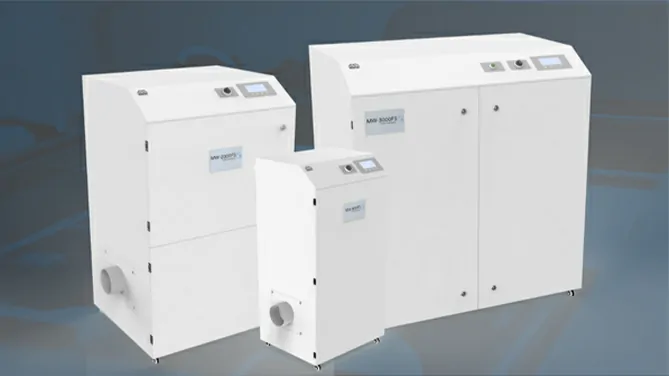
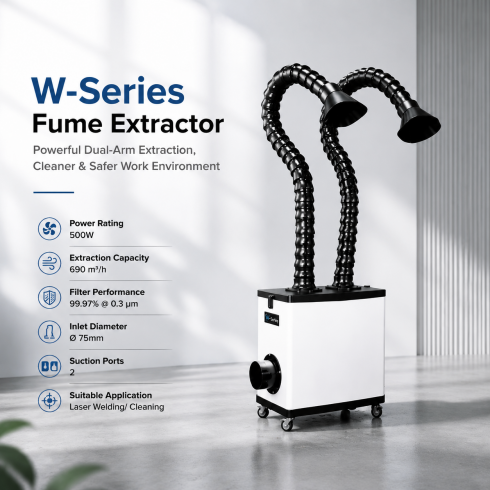
We offer specialized dust and fume extractor series tailored to specific applications. For example, our W-Series is engineered with a high-vacuum blower for the intense, localized fumes of laser welding, while the D-Series features a quiet fan and fine powder pre-filter ideal for the mist and loose powder in DTF printing environments.
Recognizing that every facility is unique, we provide customization options. This can include designing specific ducting layouts, integrating extractors directly into laser workstations or printing booths, or creating centralized filtration systems for multiple machines, ensuring the solution fits the exact spatial and operational constraints of the customer.
Analyze your process. Are you dealing primarily with heavy dust, oily smoke, dry fumes, or a combination? Particle size and composition are the most critical factors.
Based on the contaminant, decide between a dust collector, a fume extractor, or a hybrid system. For laser applications involving smoke, a dedicated fume extractor with appropriate filter stages is non-negotiable.
Calculate the required airflow (Cubic Feet per Minute) based on the capture hood/arm size and the distance from the source. Insufficient CFM will lead to fume escape.
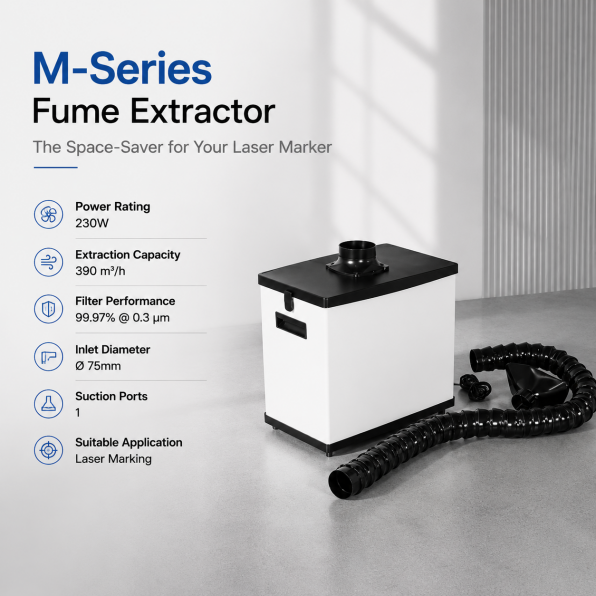
For a single laser workstation, a compact, integrated single-unit extractor like our C or M-Series is often ideal. For facilities with multiple machines, a centralized ducted system may be more efficient and cost-effective.
Our filtration solutions support a wide range of industries beyond core laser applications. This includes soldering, electronics manufacturing, and any process where improving air quality and protecting equipment is paramount. Our versatile product lines, from the portable S-Series to the industrial W-Series, can be configured to meet these diverse needs.
Optimizing costs starts with selecting the right system. Features like easy-access drawers for powder disposal (as in the D-Series) or cleanable primary metal filters (as in the W-Series) reduce downtime and consumable costs. Regular filter maintenance based on pressure gauges ensures the fan runs efficiently, saving energy.
A proper dust and fume extractor is not just a cost center; it’s an investment that delivers ROI by:
A: No. Shop-vacs are not designed for hot sparks or fine, hazardous fumes. They lack the necessary safety features, filtration efficiency, and airflow design for industrial applications.
A: It depends on usage and the contaminant load. Systems with pressure gauges provide the best indication. Primary pre-filters may need cleaning weekly, while HEPA/carbon filters may last several months to a year.
A: It protects the more expensive final filter by removing larger particles first, extends the life of all filters, and ensures comprehensive capture of different contaminant sizes.
A: It can be. Look for systems with quiet fan technology designed for continuous operation in a workshop without being disruptive, such as those implemented in certain application-specific models.
Choosing between a dust collector and a fume extractor is a critical decision that hinges on a precise understanding of your contaminants and process. For modern laser applications and similar high-precision industries, an integrated, properly specified fume extraction system is indispensable. It safeguards health, protects valuable equipment, ensures product quality, and contributes to a cleaner, more efficient, and profitable operation. By following a structured selection process and partnering with a provider that offers system-level solutions, you can implement an air filtration strategy that delivers long-term value and operational peace of mind.
News | Jun-22-2026
News | Apr-17-2026