Blog
In a field that evolves daily, staying ahead means staying informed.
Explore in-depth articles designed to help you solve complex challenges,
maximize your machine’s ROI.
Stay ahead in a competitive market.


In a field that evolves daily, staying ahead means staying informed.
Explore in-depth articles designed to help you solve complex challenges,
maximize your machine’s ROI.
Stay ahead in a competitive market.
News | Jul-9-2026
Laser marking is a clean, fast, and permanent way to imprint codes, logos, and traceability data onto a wide range of materials. But every time a laser beam interacts with a surface, it generates a plume of microscopic particles and gases. Ignoring these emissions leads to health risks, degraded mark quality, and equipment damage. A dedicated laser marking fume extractor is the engineered answer to this invisible challenge—and this guide explains why, how it works, and what to look for when selecting one.
Laser marking works by delivering concentrated thermal energy to a material’s surface. This causes rapid heating, vaporization, and sometimes combustion. The fume is a complex mixture of:
Condensed solid particles (soot, metal oxides, polymer fragments)
Gaseous compounds (volatile organic compounds, CO, NOx)
Material-specific byproducts released when coatings, paints, or additives break down
Even cold-marking techniques like UV laser marking can still generate particulate matter, because material is ablated layer by layer.
Plastics: Acrylics, ABS, and PVC (which must be avoided) can release styrene, methyl methacrylate, hydrogen chloride, and dioxins. Polycarbonate markings generate bisphenol-A and phenolic compounds.
Metals: Stainless steel and aluminum produce fine metal oxide dust. Alloys with zinc, chromium, or nickel produce fumes that are particularly hazardous when inhaled.
Coatings and anodized layers: Many products have lacquers, paints, or anodized films that break down into isocyanates, aldehydes, and other irritants.
Major Hazards of These Fumes
Health: Fine particulate matter (PM2.5) penetrates deep into the lungs and can enter the bloodstream. Gaseous VOCs cause headaches, dizziness, and long-term organ damage.
Regulatory: Workplace exposure limits (OSHA, COSHH) require control of airborne contaminants. Failure to comply can lead to fines.
Operational: Without extraction, smoke can obscure the laser path, reducing marking precision.
Many workshops initially rely on a simple window fan or ventilation duct. While this dilutes visible smoke, it rarely captures the fine, respirable fraction. A fan lacks the static pressure to overcome duct resistance, and outdoor exhaust doesn’t filter the air before release. Moreover, unconditioned outdoor air can be drawn back in, bringing temperature and humidity swings that affect laser performance.
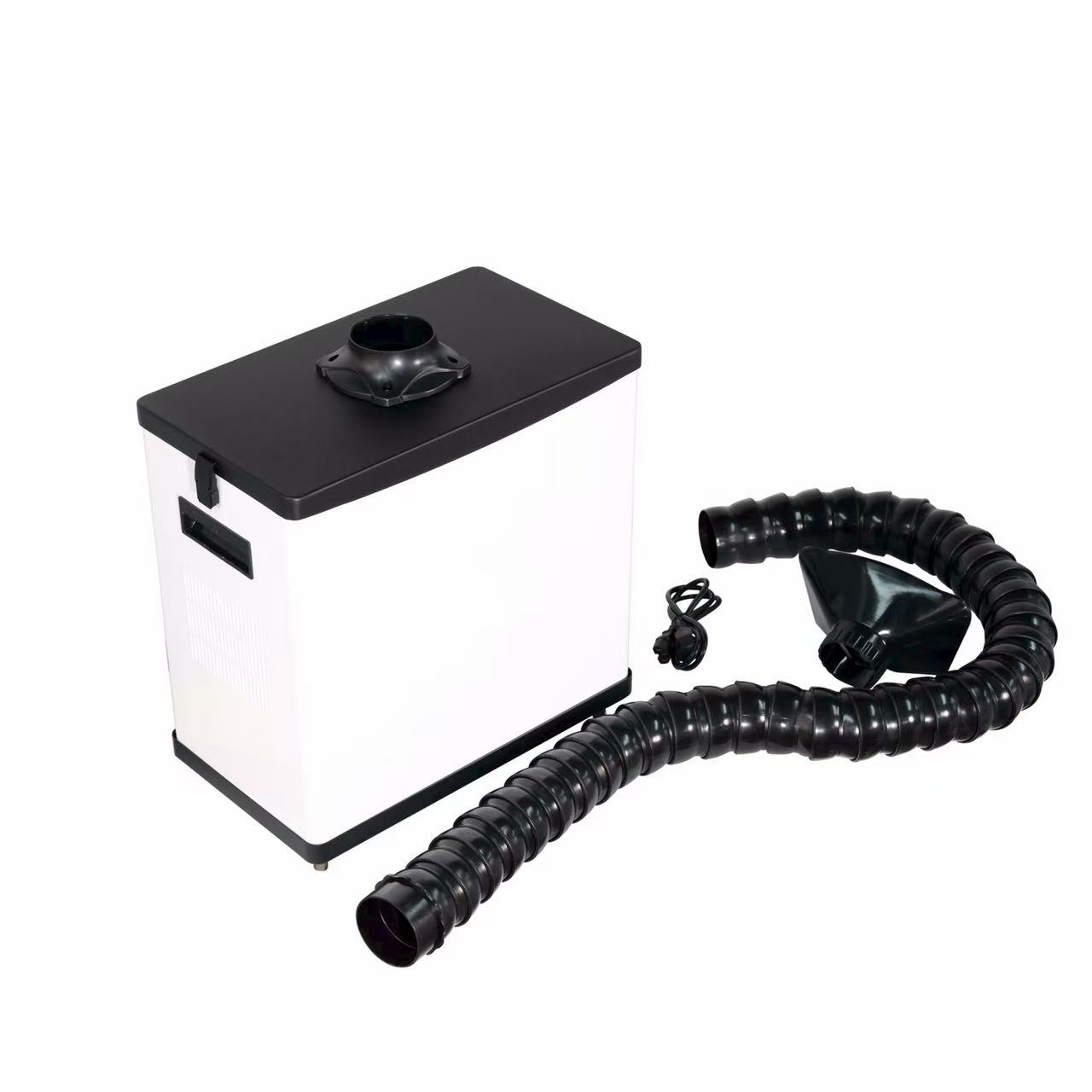
A properly designed laser marking fume extractor captures smoke at the point of generation and passes it through a sealed filtration system before releasing clean air—either back into the room or outside. This protects the operator, meets regulatory standards, and keeps the work environment stable.
By placing a capture nozzle or integrated hood close to the marking area, the extractor creates a high-velocity airflow that pulls the fume plume directly into a filter stack. This prevents smoke from spreading into the breathing zone or settling on optics. The extracted air is then cleaned in stages, removing both particles and gases.
Effective extraction begins with a well-positioned intake. For marking stations, a flexible arm with a funnel-shaped hood is often placed within 2–4 inches of the mark area. In enclosed laser markers, the extraction port is built into the machine chamber. The goal is to capture the thermally buoyant plume before it disperses.
Most industrial extractors use a layered approach:
Pre-filter: A pleated or mesh filter traps large particles (greater than 5 microns) and extends the life of the main filter.
HEPA filter: High-efficiency particulate air media captures 99.97% of particles at 0.3 microns. This stage removes the fine metal oxide dust and soot.
Activated carbon bed: A deep layer of chemically treated carbon adsorbs VOCs, odors, and acid gases through physical and chemical bonding. For laser applications that produce high VOCs (plastics, coatings), a heavy carbon stage is mandatory.
Releasing Clean Air
After the filters, the air is either recirculated into the workroom (if equipped with a HEPA/carbon combo and suitable gas sensors) or vented outside through a final clean exhaust. Recirculation saves heating and cooling energy and is common in compact job shops, but it requires rigorous filter change schedules.
No one should work in a room that smells of laser fumes. Acute symptoms like headaches and nausea are clear indicators of overexposure.
Chronic exposure to nanoparticles and carcinogenic VOCs can lead to respiratory and neurological diseases. A laser marking fume extractor is the only way to consistently keep airborne concentrations below occupational exposure limits.
Smoke inside the laser chamber acts like a dirty lens. It scatters the beam, leading to inconsistent mark depth, blurry edges, and reduced contrast.
By removing fume from the marking zone, the extractor ensures each laser pulse hits the surface with full energy and a clean optical path.
Fine dust settles on lenses, mirrors, and rail guides. This contamination increases cleaning frequency and shortens the life of expensive optics.
Fume-coated electronics can suffer overheating and premature failure. A good extraction system minimizes this invisible grit, keeping maintenance costs low.
Select a laser marking fume extractor with sufficient cubic feet per minute (CFM) for your enclosure size and marking speed. A general rule: for an open-air marking booth, aim for a capture velocity of at least 100–200 feet per minute at the laser spot. This translates to a typical bench-top unit requiring 100–200 m³/h (about 60-120 CFM). For fully enclosed machines, the extractor must achieve a number of air changes per minute to keep the chamber clear. Always check the extractor’s airflow under filter load, not just free air rating.
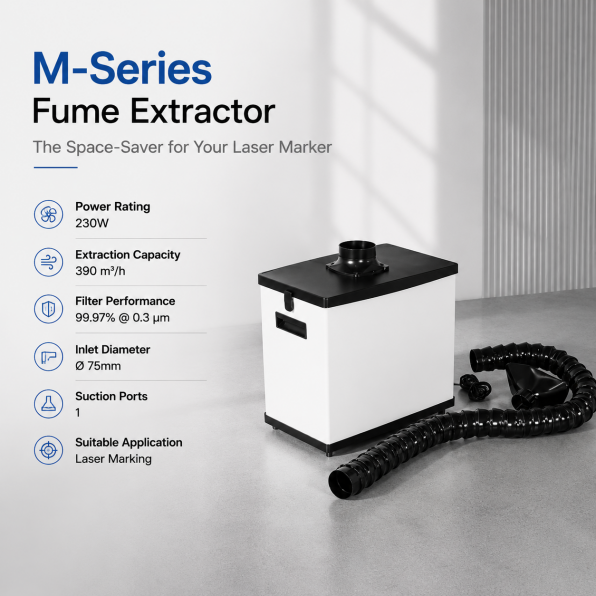
The HEPA must be certified to EN 1822 or equivalent, with a minimum efficiency of H13 (99.95% at MPPS).
Activated carbon should be specified by mass (e.g., 5 kg or more) and type (pellets with a high iodine number for broad VOC adsorption). For mixed-material marking, a custom blend of carbon and chemisorbent media is ideal.
Check if the unit has filter-condition monitoring. A differential pressure gauge or a digital alert takes the guesswork out of replacement timing.
Suitability for Your Workspace
Noise level: A quiet motor (below 60 dBA) is essential if the machine sits beside the operator.
Footprint and portability: Compact units can be placed under a bench. Wheeled carts add flexibility for shared workstations.
Serviceability: Filters should be accessible without tools, and replacements should be readily available from the manufacturer.
Technically yes, but it may violate environmental regulations and will certainly deposit visible soot on exterior walls. Without a filter, you also risk drawing outdoor air back in, creating thermal instability. A filter unit before the outlet captures the particulates and allows safer outdoor exhaust or recirculation.
Pre-filters every 1–3 months, HEPA filters every 6–12 months depending on usage, and activated carbon every 3–6 months if marking plastics. Heavy VOC applications may require more frequent carbon changes. Use the manufacturer’s pressure monitor or a timer to schedule replacements.
They often share similar filtration principles, but cutting generates a far greater volume of heavy, sticky smoke and larger particulates. A marking extractor typically focuses on fine particulate and gas-phase filtration at lower airflow, while a cutting extractor may need spark arrestors and higher capacity. However, many units handle both if airflow is sufficient.
Yes. UV lasers ablate material very finely, creating ultrafine particles that are especially easy to inhale and penetrate lung tissue. Fiber lasers marking metals produce metal fume with potential toxicity. So extraction is just as critical.
Conduct a smoke capture test with a nontoxic smoke source near the marking point. All visible smoke should be drawn into the nozzle without spilling into the room. Also, air quality monitoring with a particle counter or VOC sensor provides objective data. No odor should be detectable by the operator.
Laser marking equipment brings exceptional speed and precision, but the fumes it produces are a burden no shop should accept. By selecting a laser marking fume extractor matched to your materials and workspace, you protect your health, safeguard product quality, and keep your laser running cleanly for years. With the right extraction in place, laser marking becomes a truly clean, safe, and productive process.
At Mimowork, we understand that reliable fume control is an integral part of any laser system. Our range of laser marking machines and compatible extraction solutions are built around real-world workshop conditions, offering high filtration efficiency, quiet operation, and easy serviceability. Every unit is backed by application engineering support to ensure you get the right airflow and filter configuration from day one. We invite you to explore our website and discover how our integrated solutions can help you maintain a healthier, more efficient production floor. When you are ready to discuss your specific requirements, simply click the Contact Us button for a personalised consultation.
News | Jul-3-2026
News | Jul-3-2026
News | Apr-7-2026