Blog
In a field that evolves daily, staying ahead means staying informed.
Explore in-depth articles designed to help you solve complex challenges,
maximize your machine’s ROI.
Stay ahead in a competitive market.


In a field that evolves daily, staying ahead means staying informed.
Explore in-depth articles designed to help you solve complex challenges,
maximize your machine’s ROI.
Stay ahead in a competitive market.
News | Oct-26-2026 | Mimowork
Yes, laser welding galvanized steel is possible, but achieving a clean weld requires more than adjusting laser power. Zinc vaporizes at a much lower temperature than steel, so the zinc coating can generate vapor rapidly as the laser heats the joint. If that vapor cannot escape from the molten weld pool, it may contribute to spatter, porosity, and inconsistent weld quality. The most effective approach combines suitable joint preparation, controlled laser parameters, an appropriate joint design, and effective fume extraction.
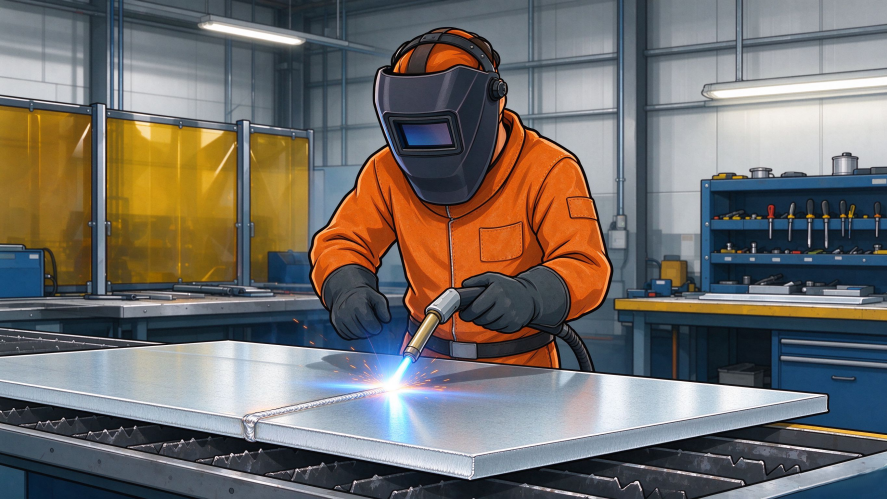
A galvanized steel sheet can look perfectly clean before welding and still produce a weld full of tiny pores. The problem is not necessarily the steel itself. It is the zinc coating sitting on its surface.
Zinc protects steel from corrosion, making galvanized sheet useful in automotive components, enclosures, ductwork, and general metal fabrication. However, zinc melts and vaporizes well before steel reaches its welding temperature.
During laser welding, the concentrated energy heats the joint rapidly. As the zinc coating vaporizes, the resulting vapor must escape from the welding area. If it becomes trapped beneath or inside the molten metal, the finished seam may contain pores or surface irregularities.
Increasing laser power is not always the answer. More energy may improve penetration in some conditions, but it can also intensify zinc vaporization and make an unstable process harder to control.
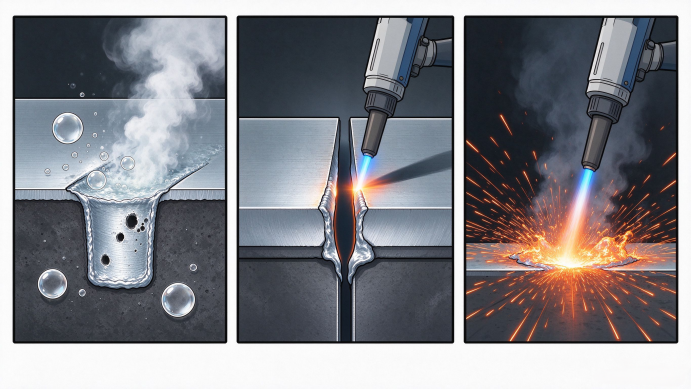
Three problems deserve particular attention when developing a reliable welding process.
1. Zinc vapor becomes trapped in the weld pool
When vapor cannot escape before the molten metal solidifies, internal pores may remain in the joint. These defects can be difficult to identify through visual inspection alone.
2. An unsuitable joint gap creates an unstable welding condition
A tightly fitted joint may restrict the escape of zinc vapor, while an excessive or inconsistent gap can cause poor bridging, irregular penetration, and uneven seams. The ideal joint arrangement depends on the sheet thickness, coating condition, and welding process.
3. Incorrect power and speed settings create an unstable melt pool
Excessive heat input may increase vaporization and spatter. Insufficient energy may result in incomplete fusion or inadequate penetration. The goal is to establish a stable processing window rather than simply maximize welding speed or power.
Start by checking the coating condition, surface contamination, sheet flatness, and joint fit-up. Oil, dirt, and inconsistent contact can introduce additional variables that make welding defects harder to diagnose.
For applications that permit coating removal near the joint, removing zinc from the immediate welding area may reduce coating-related vapor generation. However, this changes the corrosion-protection condition and may require an appropriate post-weld treatment. It is not a universal requirement or a substitute for a validated welding procedure.
Power and speed should be evaluated as a pair. A setting that works on uncoated carbon steel may not produce the same result on galvanized sheet of the same nominal thickness.
Run controlled tests using representative material. Change one variable at a time, then inspect the seam for penetration, surface spatter, and signs of porosity. Where weld integrity matters, use suitable inspection methods rather than relying exclusively on appearance.
Joint geometry influences how vapor escapes and how molten metal fills the gap. Test the actual production joint instead of relying only on flat-sheet samples.
Shielding gas can help protect the molten weld from atmospheric contamination, but it does not eliminate the zinc-vapor problem. Gas type, flow, nozzle position, and joint configuration should be validated together.
Zinc-containing coatings can generate hazardous fumes when heated. Fume control is therefore part of process planning, not an optional finishing step.
A suitable extraction system should capture emissions near the welding area without interfering with the welding operation or shielding-gas coverage. General room ventilation alone should not be assumed to provide adequate protection.
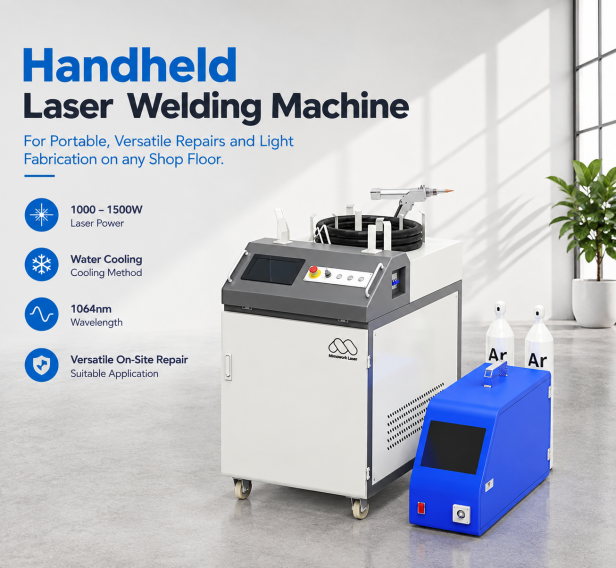
The right setup depends on the actual sheet thickness, joint geometry, required penetration, production volume, and quality standards.
| Selection factor | What to evaluate |
| Laser power | Whether the system can achieve the required penetration without excessive heat input |
| Welding mode | Whether continuous or modulated operation better suits the joint and production requirements |
| Joint fit-up | Whether the gap and alignment remain consistent across production parts |
| Shielding gas | Whether coverage protects the molten pool without disrupting the process |
| Fume extraction | Whether zinc-containing fumes can be captured effectively near the source |
| Quality inspection | Whether the inspection method can identify internal defects as well as visible spatter |
MimoWork offers handheld fiber laser welding systems with continuous or modulated operating modes and power options for different metal-fabrication applications. When selecting a Laser Welding Machine, manufacturers should consider the material type, workpiece thickness, welding requirements, and production needs. MimoWork’s published handheld welding information also identifies galvanized sheet as a material application. However, the final machine configuration and welding procedure should be confirmed against the specific workpiece and acceptance criteria to ensure reliable welding results.
Related Guide: How to Laser Weld Aluminum Alloys
Yes, it is possible, but results depend on the coating, joint design, sheet thickness, and welding parameters. Some applications can be welded with the coating in place, while others benefit from controlled coating removal near the joint. Testing is necessary to determine whether the resulting weld meets the required quality standard.
Zinc vaporizes much earlier than steel. Rapid vapor generation can disturb the molten weld pool, contributing to spatter and porosity. Joint design, heat input, and the escape path available to the vapor all affect the result.
A handheld fiber laser welder can be used for suitable galvanized-sheet applications, provided its power, operating mode, and process settings match the material and joint. A successful trial on one thickness does not automatically establish a suitable procedure for every galvanized component.
Fume extraction primarily controls airborne contaminants and helps maintain visibility around the welding area. Properly positioned extraction may also reduce smoke interference around the process, but it does not replace appropriate joint design, parameter control, or shielding.
Laser welding galvanized steel is not simply a matter of finding the right power setting. Zinc vapor, joint fit-up, and heat input interact to determine whether the weld is clean, consistent, and structurally acceptable. Manufacturers should validate the entire process on their actual components, including fume control and weld inspection, before moving to production.
If galvanized sheet is part of your manufacturing workflow, explore MimoWork’s handheld laser welding solutions to review available welding configurations and discuss a setup suited to your material and joint requirements.
News | Oct-20-2026
News | Oct-9-2026
News | Oct-5-2026