Blog
In a field that evolves daily, staying ahead means staying informed.
Explore in-depth articles designed to help you solve complex challenges,
maximize your machine’s ROI.
Stay ahead in a competitive market.

In a field that evolves daily, staying ahead means staying informed.
Explore in-depth articles designed to help you solve complex challenges,
maximize your machine’s ROI.
Stay ahead in a competitive market.
News | Nov-10-2026 | Mimowork
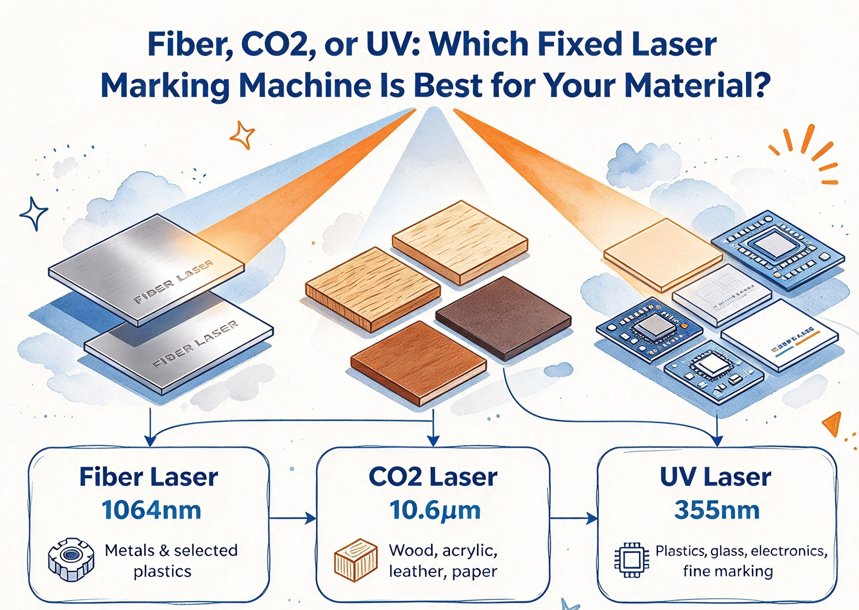
A fixed laser marking machine uses a stationary laser source and marking head to create permanent identification, text, codes, and patterns on different materials. It is widely used for product identification, traceability, and industrial branding.
Choosing between fiber, CO2, and UV technology depends primarily on material compatibility and the desired marking effect. Different wavelengths interact with material surfaces in different ways, influencing energy absorption, marking contrast, precision, and processing speed.
Fiber lasers operate at 1064nm and are commonly used for metals and selected plastics. CO2 lasers operate at 10.6μm and suit materials such as wood, acrylic, leather, and paper. UV lasers operate at 355nm and are suitable for fine marking on selected plastics, glass, and sensitive components.
| Laser Type | Wavelength | Main Materials | Typical Applications |
| Fiber | 1064nm | Metals, selected plastics | Engraving, annealing |
| CO2 | 10.6μm | Wood, acrylic, leather, paper | Surface marking, ablation |
| UV | 355nm | Selected plastics, glass, electronics | Fine marking |
These are general guidelines rather than absolute material limitations. Coatings, additives, and material composition can affect results, so sample testing is essential.
Related guide: Green Laser Marking Machine
A fiber laser marking machine is widely used for industrial metal marking because its 1064nm wavelength is well absorbed by many metallic materials, including stainless steel, aluminum, and brass.
Depending on the material and processing parameters, fiber lasers can produce permanent serial numbers, logos, product codes, and decorative patterns. Stainless steel supports annealing, surface color marking, and engraving. Aluminum can be marked on bare or anodized surfaces, while brass supports engraving and surface marking.
Fiber laser systems also support different marking processes. Annealing changes the surface color through controlled heating without necessarily removing material. Engraving removes material to create recessed marks, while etching generally produces shallower surface removal.
The appropriate process depends on marking depth, contrast, durability, and production speed. High-speed marking settings are not automatically suitable for deep engraving, which may require different parameters or multiple passes.
Fiber laser sources are solid-state systems with relatively low routine maintenance requirements. However, protective lenses, optical components, and working-area cleanliness still require regular attention to maintain consistent results.
A CO2 laser marking machine uses a wavelength of approximately 10.6μm, which is effectively absorbed by many organic and non-metal materials.
Common applications include decorative patterns on wooden products, identification marks on acrylic, graphics on leather accessories, and product information on paper packaging. Wood may develop darker marks through carbonization, while acrylic responds through controlled surface modification or material removal.
Coated, laminated, and composite materials should be tested before processing because their surface layers may respond differently from the base material.
CO2 galvo marking systems use high-speed mirrors to direct the laser beam across a marking field. This enables rapid marking of logos, packaging codes, and product information without mechanically moving the entire laser head.
Actual throughput depends on marking area, pattern complexity, material response, and laser output. A larger marking field may also involve trade-offs in spot size and optical configuration.
CO2 laser marking is a thermal process. Excessive energy can cause burning, melting, or discoloration. Manufacturers should balance laser power, scanning speed, frequency, and focus position according to the material.
For example, paper and leather require controlled energy input to prevent excessive burning, while acrylic needs parameters suited to its composition and desired finish.
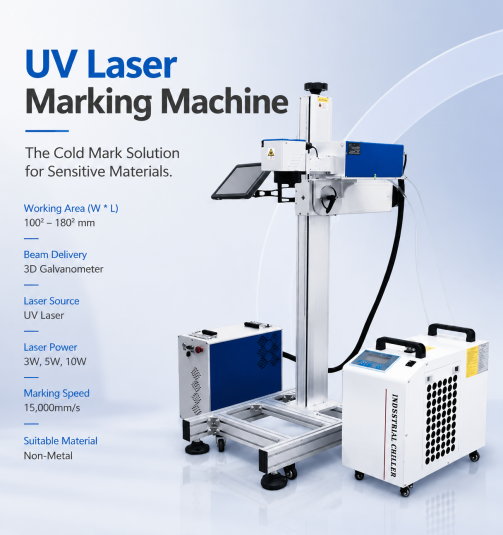
A UV laser marking machine typically operates at 355nm. Its shorter wavelength enables different material interactions from infrared fiber and CO2 lasers, making it suitable for precision applications where thermal impact needs to be minimized.
UV lasers can initiate photochemical interactions in certain materials, reducing reliance on conventional heat-driven processing. This can help minimize melting, discoloration, and deformation.
UV marking is often described as cold processing, but this term is relative. The process can still generate heat, and excessive energy may damage sensitive substrates.
UV lasers are commonly evaluated for selected plastics, glass products, electronic components, and precision parts. They can produce fine identification marks, small characters, compact product codes, and high-density QR codes.
However, not every plastic or glass type responds in the same way. Material formulation, transparency, coatings, and surface condition influence the final result.
Marking quality also depends on beam quality, spot size, optical configuration, and scanning accuracy. Testing under actual production conditions helps verify code readability and marking consistency.
The best laser marking machine for different materials depends on the substrate, required marking depth, visual contrast, precision, and production volume.
| Selection Factor | Fiber | CO2 | UV |
| Wavelength | 1064nm | 10.6μm | 355nm |
| Main Materials | Metals, selected plastics | Wood, acrylic, leather, paper | Selected plastics, glass, electronics |
| Common Processes | Annealing, engraving | Surface marking, ablation | Fine marking, surface modification |
| Main Applications | Hardware, industrial parts | Packaging, acrylic signs | Electronics, precision components |
Fiber lasers are generally preferred for metal components and permanent industrial identification. CO2 systems suit compatible non-metal materials, while UV systems are worth considering for fine marking on selected sensitive substrates.
If production involves multiple materials, identify the main processing workload first. One laser source may not deliver optimal results across every substrate.
Beyond the laser source, scanning systems, working areas, positioning devices, and automation options determine whether a machine fits your production workflow.
Galvo scanning systems direct the laser beam using high-speed mirrors, enabling rapid marking without moving the entire laser head. When evaluating a system, consider the marking field, scanning speed, optical configuration, and positioning requirements.
For curved surfaces or height variations, a compatible 3D galvo system may help maintain focus across different positions. However, this is an application-specific configuration rather than a standard feature of every machine.
A rotary attachment allows cylindrical workpieces to rotate during marking. It is useful for tubes, rings, and cylindrical containers. The appropriate setup depends on workpiece diameter, length, weight, and clamping requirements.
For batch production, enclosed workstations can support organized processing and controlled access. Systems may also integrate automated loading, conveyors, rotary positioning, and production-line identification workflows.
Safety enclosures, interlocks, and extraction systems should meet the requirements of the laser class, machine design, and applicable safety standards.
MimoWork offers fiber and RF CO2 laser marking configurations for different material-processing requirements.
MimoWork fiber laser marking systems are available in 20W, 30W, and 50W configurations, with marking fields ranging from 70 × 70mm to 200 × 200mm.
These systems can be evaluated for metal product identification, serial numbers, logos, and other industrial marking applications. The appropriate power depends on the metal, marking depth, and required processing speed.
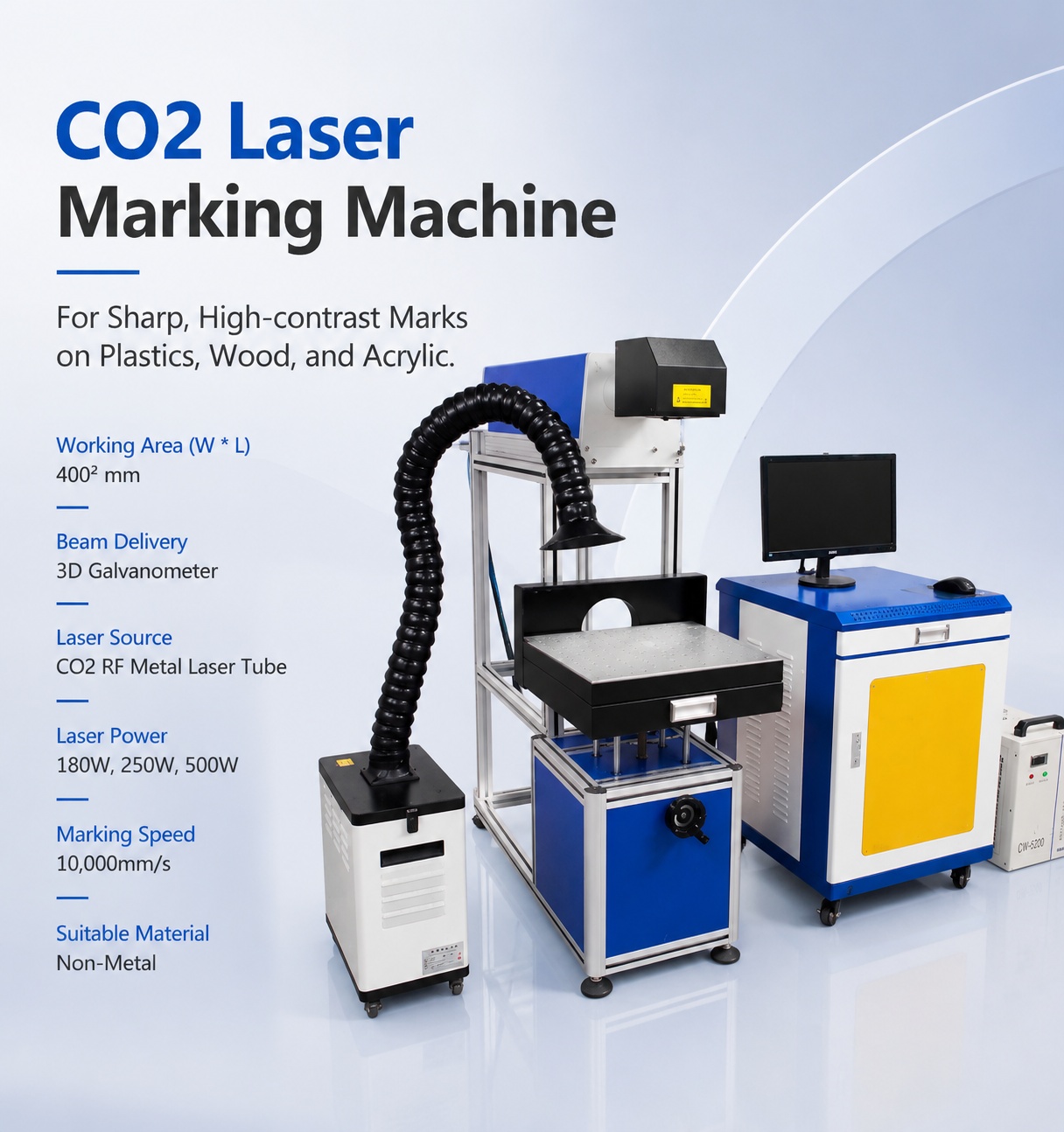
MimoWork RF CO2 laser marking configurations include 180W, 250W, and 500W options, with a 400 × 400mm marking field and a reference marking speed of up to 10,000mm/s.
These systems can be evaluated for compatible non-metal materials, including selected wood, acrylic, and other organic substrates. Material testing helps determine the appropriate output and scanning parameters.
When selecting a MimoWork system, evaluate the complete production task rather than choosing based on wattage alone.
| Configuration Factor | What to Evaluate |
| Laser source | Material compatibility |
| Laser power | Required depth and contrast |
| Marking field | Workpiece dimensions |
| Scanning system | Detail and positioning |
| Automation | Batch size and production workflow |
For applications requiring UV marking, 3D scanning, or specialized automation, confirm configuration availability with the MimoWork team.
What Are the Advantages of a Fixed Laser Marking Machine over a Handheld Model?
A fixed laser marking machine provides stable positioning and repeatable workpiece placement. It is suitable for batch processing, consistent product identification, and automated production lines. Handheld models offer greater flexibility for large or difficult-to-move workpieces.
Can a Fiber Laser Mark Wood or Glass?
Fiber lasers can mark certain plastics, depending on their composition and additives. However, wood and glass are generally not their primary applications. CO2 lasers are commonly used for wood, while UV lasers may suit selected glass and precision-plastic applications.
Why Is UV Laser Marking Called Cold Processing?
UV laser marking can produce material changes with reduced thermal impact compared with conventional heat-driven processing. However, it does not generate zero heat. Power and scanning speed still need to be controlled to prevent damage.
How Do I Choose the Right MimoWork Laser Configuration?
Start with material type, required marking effect, workpiece dimensions, and production volume. Providing material samples, marking files, and specifications to MimoWork can help identify a suitable configuration through practical testing.
Fiber, CO2, and UV lasers each offer distinct advantages. Fiber systems are widely used for metals, CO2 systems suit many non-metal materials, and UV systems support precision marking on selected sensitive substrates.
The best fixed laser marking machine is one that consistently delivers the required marking quality and production speed.
MimoWork provides different laser power and marking-area configurations for industrial applications. Share your material samples, marking files, workpiece dimensions, and production requirements with the MimoWork team to evaluate a suitable laser source and equipment configuration.
News | Oct-18-2026
News | Sep-14-2026