Blog
In a field that evolves daily, staying ahead means staying informed.
Explore in-depth articles designed to help you solve complex challenges,
maximize your machine’s ROI.
Stay ahead in a competitive market.


In a field that evolves daily, staying ahead means staying informed.
Explore in-depth articles designed to help you solve complex challenges,
maximize your machine’s ROI.
Stay ahead in a competitive market.
News | Sep-14-2026
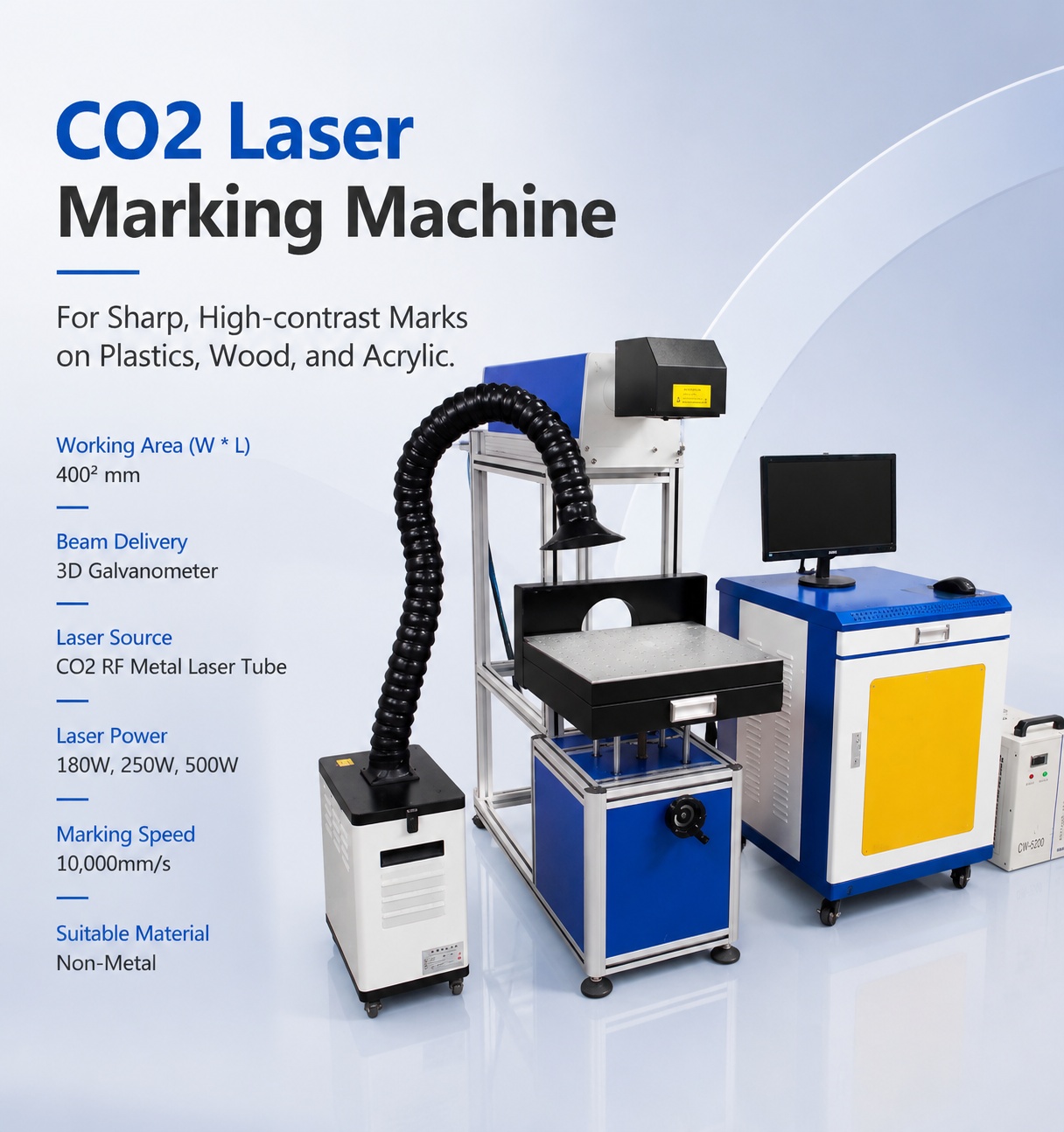
A 500W CO₂ laser marking machine is designed for industrial applications where conventional lower-power marking systems may not provide the required processing capability. While lower-power CO₂ laser systems can handle many standard marking and processing tasks, a 500W configuration provides substantially higher laser power for demanding applications.
Higher power can be useful when the application requires greater material removal, larger processing areas, or higher production throughput. However, laser power alone does not determine marking quality. The material, surface condition, focal position, optical configuration, marking speed, and required processing effect all influence the final result.
This guide explains what a 500W CO₂ laser marking machine is, what it can be used for, and when a high-power CO₂ system makes sense for industrial production.
A 500W CO₂ laser marking machine uses a high-power CO₂ laser source to process the surface of a workpiece without direct mechanical contact. The laser beam is focused onto the material, where its energy can create a visible mark, remove surface material, or produce a deeper processing effect depending on the material and selected parameters.
CO₂ lasers are commonly used for materials that interact effectively with the CO₂ laser wavelength, including many non-metallic materials and certain coated or treated surfaces. Typical applications can include wood, acrylic, plastics, leather, textiles, coated materials, and other industrial materials, depending on the specific system and processing requirements.
The main difference between a 500W configuration and lower-power CO₂ systems is the substantially higher available laser power. This can make the system more suitable for demanding industrial applications where material removal, processing area, or production throughput is more important than simple surface marking.
MimoWork’s current CO₂ laser marking range includes 180W, 250W, and 500W configurations, making 500W the high-power option within this marking category.
Related Guide: What is a Fiber Laser Marking Machine? The Ultimate Guide to Industrial Precision
The main advantage of a high-power CO₂ laser marking machine is its ability to provide greater processing capability when standard marking power is not enough.
A 500W CO₂ laser can deliver substantially more energy to the workpiece than lower-power configurations. Depending on the material and processing parameters, this can support stronger surface modification and material removal.
The actual result depends heavily on the material. CO₂ lasers are particularly relevant to applications involving materials that effectively absorb the CO₂ laser wavelength rather than being selected simply because the material requires high power.
Higher laser power can become valuable when a production process involves larger marking or processing areas.
Instead of focusing only on small serial numbers or identification codes, industrial users may require larger graphics, patterns, text, or repeated processing across multiple workpieces.
In these applications, processing efficiency and cycle time can become more important than simply achieving a visible mark.
A 500W CO₂ laser marking machine may be considered for demanding industrial applications involving materials such as wood, acrylic, plastics, leather, textiles, coated materials, and other suitable substrates.
The correct configuration depends on the material, required marking effect, workpiece size, processing area, and production volume.
The main difference between a 500W CO₂ laser and a lower-power CO₂ system is not simply the wattage. It is the level of processing capability required by the application.
| Feature | Lower-Power CO₂ Laser | 500W CO₂ Laser |
| Typical purpose | Surface marking and lighter processing | Higher-power industrial processing |
| Processing capability | Suitable for less demanding applications | Greater material removal capability |
| Typical applications | Small-area marking and identification | Larger or more demanding processing |
| Production focus | Marking quality and efficiency | Processing efficiency and throughput |
| Suitable materials | CO₂-compatible materials | CO₂-compatible materials requiring higher power |
| Power requirement | Lower | Significantly higher |
| Industrial integration | Compact marking systems | More demanding industrial configurations |
MimoWork’s current CO₂ laser marking systems include 180W, 250W, and 500W configurations. The appropriate power level should be selected according to the material, required processing effect, marking area, and production requirements.
The material is one of the most important factors when selecting a CO₂ laser marking machine.
CO₂ lasers are commonly considered for materials such as wood, acrylic, plastics, leather, textiles, coated materials, and other substrates that interact effectively with the CO₂ laser wavelength.
The suitability of a particular material depends on its composition, surface condition, thickness, coating, and the marking effect required. A material that can be processed successfully at lower power does not necessarily require a 500W system.
For this reason, manufacturers should evaluate the actual material and processing objective before selecting a 500W CO₂ laser marking machine. Application testing can help determine whether the additional power provides a meaningful production advantage.
One of the most important distinctions when choosing laser power is whether the application requires simple surface marking or more substantial material removal.
Surface marking changes the appearance of a material without removing a significant amount of material. Typical examples include text, logos, patterns, and product identification.
More intensive processing is different. The laser removes or modifies material to create a measurable change in the surface structure.
For example, a manufacturer may only need a simple mark on a suitable coated material. A lower-power CO₂ laser may already provide sufficient performance for this application.
Another manufacturer may need greater material removal across a larger processing area or may need to process a high volume of parts within a limited cycle time. In that situation, a higher-power CO₂ system can become more valuable.
This is why laser power should always be evaluated together with material, required processing effect, marking area, and cycle time.
A CO₂ laser marking system generates a laser beam from the CO₂ laser source and directs it through an optical delivery system toward the workpiece.
The focused laser beam interacts with the material surface to create text, graphics, patterns, or other programmed designs. The exact processing effect depends on the material and the selected laser parameters.
With a 500W system, the optical, thermal, electrical, and safety requirements become more demanding than those of lower-power systems. The machine therefore needs to be engineered to handle higher energy levels reliably during industrial operation.
MimoWork’s current CO₂ laser marking platform includes high-power configurations of 180W, 250W, and 500W, allowing the system to be matched to different industrial processing requirements.
The strongest reason to consider a 500W system is processing capability.
When a lower-power laser requires multiple passes or longer processing times to achieve the required result, a higher-power system may improve processing efficiency. This can be particularly important for applications involving greater material removal, larger processing areas, or high production volumes.
Another advantage is the potential to support demanding industrial workflows. Depending on the machine configuration, a high-power CO₂ laser system can be integrated with safety enclosures, positioning systems, extraction equipment, and other production equipment.
However, the additional power is only valuable when the application can make use of it. For simple marking tasks, a lower-power system may provide a more appropriate balance between processing capability and system requirements.
For many basic marking applications, yes.
If the requirement is simply to create a small logo, serial number, or other surface mark on a suitable CO₂-compatible material, a lower-power CO₂ laser may already provide sufficient processing capability.
A 500W CO₂ laser marking machine becomes more relevant when the application requires higher material removal, larger processing areas, demanding production throughput, or continuous industrial operation.
| Requirement | Is 500W Worth Considering? |
| Small-area surface marking | Usually unnecessary |
| Simple logos or text | Usually unnecessary |
| Basic identification marking | Usually unnecessary |
| Larger-area processing | Potentially |
| Higher material removal | Yes, depending on material |
| High-volume processing | Potentially |
| Demanding industrial production | Application dependent |
The goal should not be to choose the highest wattage available. The better approach is to match laser power with the material, processing effect, marking area, cycle time, and production requirements.
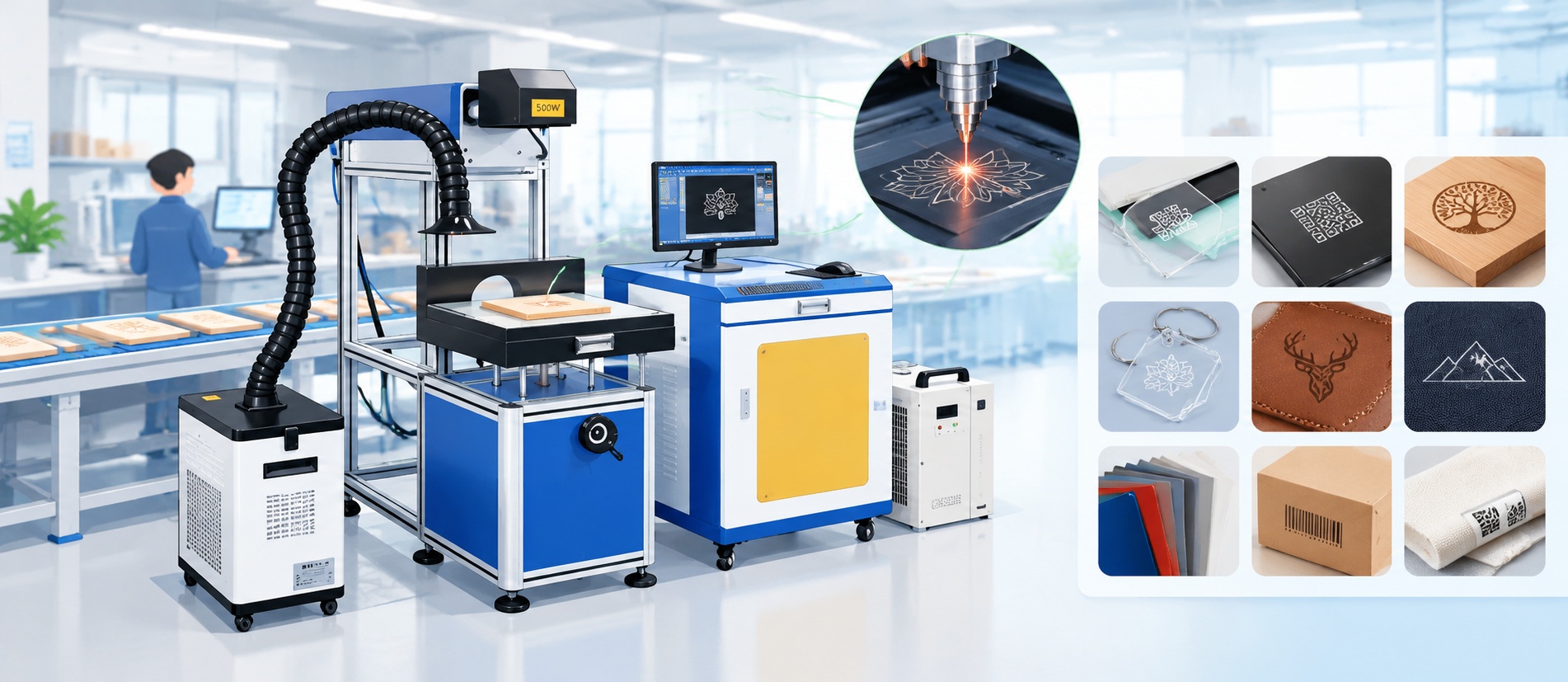
High-power CO₂ laser processing can be valuable in industries where suitable materials need efficient and repeatable processing.
Manufacturers working with plastics, coated materials, wood-based materials, acrylic, leather, textiles, and other CO₂-compatible substrates may consider higher laser power when processing requirements exceed the capability of lower-power systems.
A 500W configuration can also be considered when production volume is high and processing time becomes an important factor. In these situations, the objective is not simply to create a visible mark but to achieve the required processing effect within an efficient production cycle.
The exact machine configuration should be determined according to the workpiece material, processing area, required effect, production volume, and automation requirements.
Laser power should be the starting point, not the final decision.
The first consideration should be what processing effect you actually need. If the application only requires a simple surface mark, a lower-power CO₂ laser may be sufficient and easier to integrate.
The next consideration is the material. Different plastics, wood products, coatings, textiles, leather, and other materials respond differently to CO₂ laser energy. Surface composition and coating thickness can also influence the final result.
The processing area is equally important. A larger field of view can accommodate bigger workpieces, but optical design and beam quality must still provide the required processing resolution.
Finally, consider production integration. For industrial applications, features such as positioning, safety enclosure systems, extraction, automated handling, and in-line production integration can have a greater effect on productivity than simply increasing laser power.
A 500W CO₂ laser marking machine is not designed simply to make ordinary marking more powerful. Its main value lies in applications where higher laser energy can support greater material removal, larger-area processing, or demanding production throughput.
For standard surface marking on suitable materials, a lower-power CO₂ laser may already provide the required performance. For more intensive industrial processing, a high-power configuration can offer a meaningful efficiency advantage.
The best solution should therefore be selected according to the material, processing effect, marking size, cycle time, and production environment rather than laser wattage alone.
MimoWork develops laser marking solutions for industrial applications, with current CO₂ configurations covering 180W, 250W, and 500W. Its fiber laser marking systems, by comparison, are available in 20W, 30W, and 50W configurations for standard metal marking applications.
For applications requiring substantially different power levels or customized processing capabilities, MimoWork’s independent R&D team can develop application-specific solutions based on the required processing effect and production workflow.
CO₂ lasers are not generally selected as the primary solution for conventional bare-metal marking. Their suitability depends on the specific material surface, coating, and application. Fiber lasers are generally more closely associated with direct metal marking.
CO₂ lasers are commonly used for suitable materials such as wood, acrylic, plastics, leather, textiles, coated materials, and other substrates that effectively interact with the CO₂ laser wavelength. The actual result depends on the material composition and processing parameters.
Yes, provided the complete system is designed for industrial integration. High-power CO₂ laser systems can be combined with positioning, safety enclosures, extraction, automated handling, and other production-line equipment when required.
No. Higher power is only beneficial when the application requires greater processing capability. For simple marking tasks, a lower-power CO₂ laser may already provide sufficient performance. The correct choice depends on the material, processing effect, area, cycle time, and production volume.
A 500W CO₂ laser marking machine represents a high-power approach to industrial laser processing, particularly when the application goes beyond conventional surface marking.
Its greatest potential lies in greater material removal, larger-area processing, and demanding production environments. But more power is not automatically better. The right configuration depends on the relationship between laser power, material, processing effect, marking area, speed, and production requirements.
MimoWork’s current CO₂ laser marking range includes 180W, 250W, and 500W configurations, while its fiber laser marking systems cover 20W, 30W, and 50W for standard metal marking applications.
For manufacturers evaluating a 500W CO₂ laser marking machine, application testing should be an important step before selecting the final machine configuration. A properly matched system can provide the processing capability and production efficiency required for demanding industrial applications.
News | Sep-11-2026
News | Sep-11-2026
News | Sep-4-2026