Blog
In a field that evolves daily, staying ahead means staying informed.
Explore in-depth articles designed to help you solve complex challenges,
maximize your machine’s ROI.
Stay ahead in a competitive market.


In a field that evolves daily, staying ahead means staying informed.
Explore in-depth articles designed to help you solve complex challenges,
maximize your machine’s ROI.
Stay ahead in a competitive market.
News | Sep-11-2026
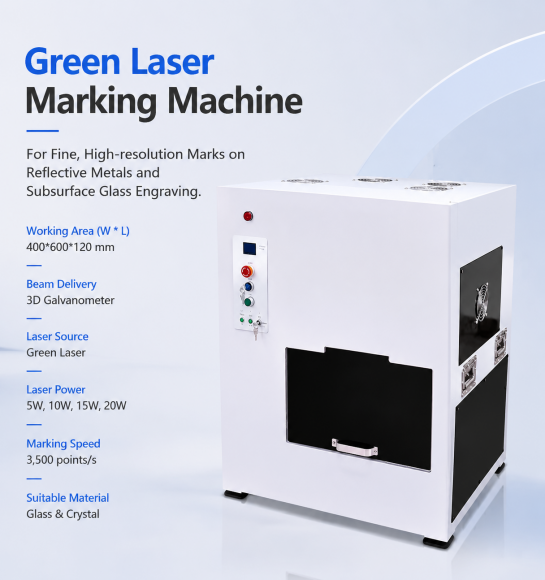
Green laser marking uses a 532 nm wavelength to process materials that can be difficult to mark with conventional infrared fiber lasers.
Its shorter wavelength provides strong absorption on certain reflective metals, sensitive plastics, and transparent materials. This makes green lasers particularly useful for applications involving copper, plastics, glass, and crystal.
Mimowork’s green laser marking machine uses a 532 nm green laser and is designed for reflective metals, sensitive plastics, and subsurface glass and crystal engraving. Current configurations range from 5W to 20W.
The main advantage of green laser marking is its interaction with materials that may respond poorly to longer-wavelength lasers.
Copper, gold, and silver are highly reflective, which can make conventional laser processing more challenging. The 532 nm wavelength can provide stronger absorption for these applications.
Green lasers can also be useful for plastics. Certain white, transparent, and sensitive plastics absorb green laser energy effectively, allowing manufacturers to create precise marks while limiting excessive thermal damage.
Plastic marking requires careful control because excessive heat can cause melting, discoloration, or deformation.
A green laser can be suitable for precision marking on selected plastics, especially when the application requires fine details and controlled heat input.
Potential applications include product identification, electronic components, packaging components, and small technical parts.
The exact result depends on the plastic formulation, color, additives, and surface properties. Testing the actual material is therefore important before production.
Copper is one of the materials where green laser technology can provide an important advantage.
Because copper has high reflectivity at common infrared wavelengths, processing can require careful parameter selection. A 532 nm green laser can achieve stronger interaction with copper, making it suitable for applications requiring precise marking on copper components.
Typical applications include electrical components, connectors, electronic parts, and other precision metal products.
For small components, the combination of a fine laser spot and controlled processing can help produce detailed marks without unnecessarily affecting the surrounding material.
Green laser marking is also well known for subsurface engraving in glass and crystal.
Instead of creating a conventional surface mark, a focused green laser can generate microscopic modifications inside transparent material. This allows text, logos, patterns, and even three-dimensional designs to be created below the surface.
The outside of the glass or crystal can remain smooth because the marking is formed internally.
Mimowork’s green laser technology is designed for 3D subsurface engraving of glass and crystal, with applications including portraits, logos, text, and decorative patterns.
Both green and fiber lasers can be used for metal marking, but their strengths are different.
| Feature | Green Laser | Fiber Laser |
| Wavelength | 532 nm | Typically 1064 nm |
| Copper | Excellent application | More challenging due to reflectivity |
| Sensitive plastics | Well suited to selected materials | Material dependent |
| Glass/crystal | Subsurface engraving | Generally not the primary choice |
| Stainless steel | Possible | Excellent |
| Typical strength | Precision and material compatibility | Fast metal marking |
A conventional fiber laser remains an excellent choice for general metal marking. Green laser technology becomes more attractive when the material itself creates a processing challenge.
Start with the material rather than the laser power.
If you need to mark copper, sensitive plastic, or transparent glass, a green laser may provide advantages that are difficult to achieve with a conventional marking system.
You should also consider the required marking size, resolution, production speed, and whether the application requires surface marking or subsurface engraving.
For glass and crystal applications, for example, the required engraving depth and three-dimensional design can significantly influence the machine configuration.
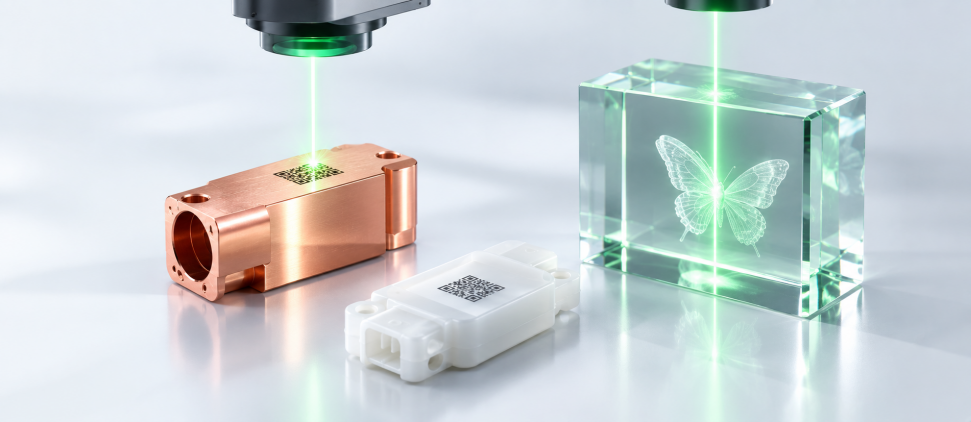
Green laser technology can be used across several precision manufacturing applications. Electronics, semiconductor components, copper parts, specialty plastics, glass products, crystal gifts, and decorative products are among the potential applications.
Its ability to process reflective and sensitive materials makes it particularly useful when conventional laser wavelengths cannot provide the required combination of precision and material response.
Related guide:What is a Fiber Laser Marking Machine? The Ultimate Guide to Industrial Precision
Green laser marking machines typically use a 532 nm wavelength.
Yes. Green lasers are particularly suitable for processing reflective metals such as copper because the wavelength can provide stronger material absorption.
Yes. Green lasers can create subsurface marks and 3D engravings inside glass and crystal without necessarily damaging the outer surface.
Neither is technology universally better. Fiber lasers are highly effective for general metal marking, while green lasers can have an advantage with reflective metals, selected plastics, and transparent materials.
Green laser marking is a specialized solution for materials that require precise and controlled laser processing.
Its 532 nm wavelength makes it particularly suitable for copper, selected plastics, glass, and crystal, while also supporting precision applications where minimizing thermal impact is important.
When choosing between green and fiber laser marking, the most important factor is the material and the required marking effect—not simply the laser’s power.
News | Sep-11-2026