Blog
In a field that evolves daily, staying ahead means staying informed.
Explore in-depth articles designed to help you solve complex challenges,
maximize your machine’s ROI.
Stay ahead in a competitive market.


In a field that evolves daily, staying ahead means staying informed.
Explore in-depth articles designed to help you solve complex challenges,
maximize your machine’s ROI.
Stay ahead in a competitive market.
News | Sep-11-2026
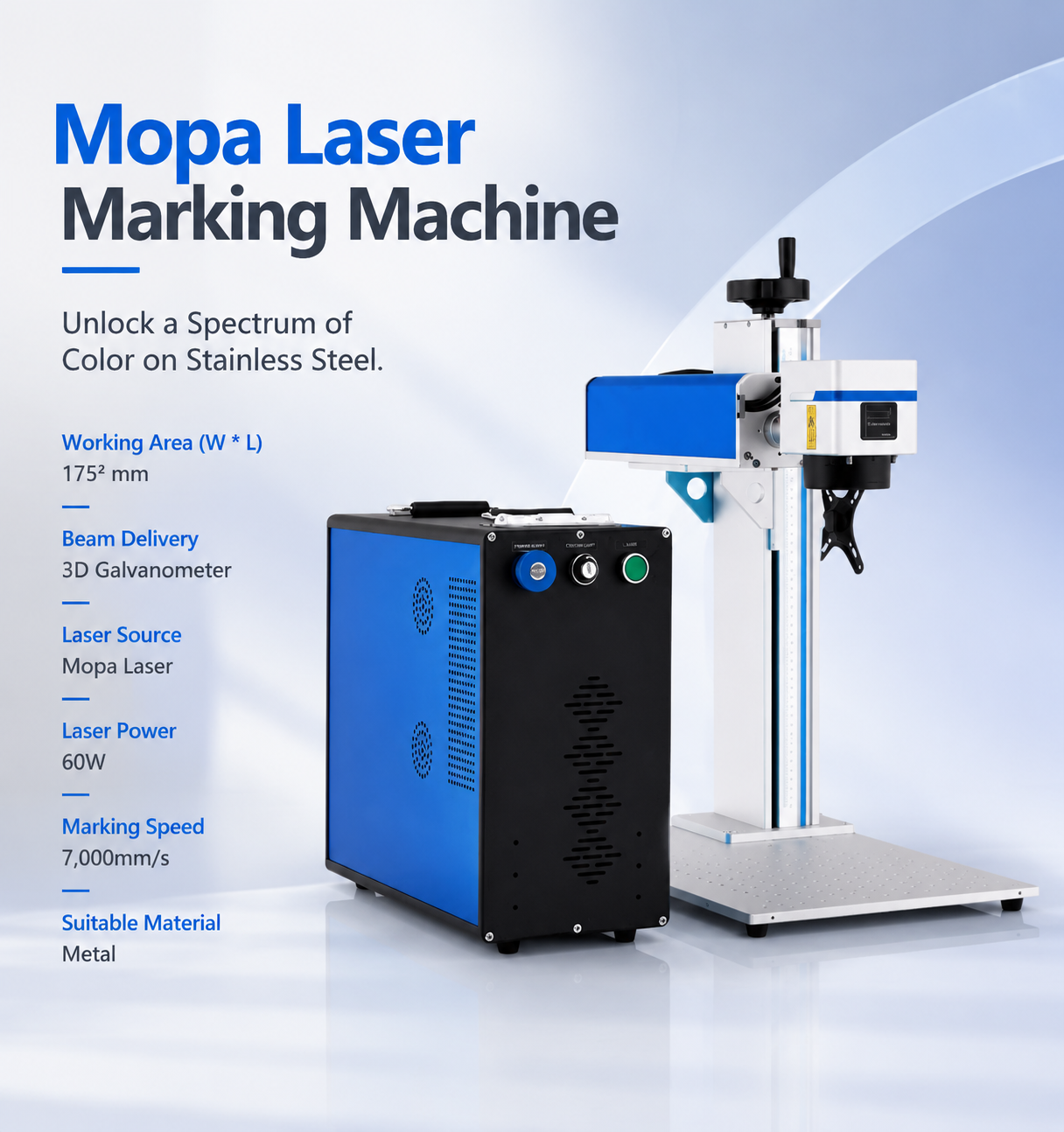
A MOPA fiber laser color marking machine can create permanent colors directly on stainless steel without using ink, paint, or other coatings. By precisely controlling laser parameters, the process modifies the surface oxide layer and produces different visual colors.
Unlike conventional fiber laser marking machine, which is mainly used for black or high-contrast marks, MOPA technology provides greater control over pulse width and frequency, making it suitable for color marking applications.
Color marking on stainless steel is based on controlled changes to the material’s surface rather than adding pigment.
When the MOPA fiber laser interacts with stainless steel, it creates a thin oxide layer on the surface. The thickness and optical characteristics of this layer affect how light is reflected, producing different perceived colors.
Laser parameters such as pulse width, frequency, power, and scanning speed influence the final result. This is why MOPA fiber lasers are particularly useful when consistent color and fine detail are required.
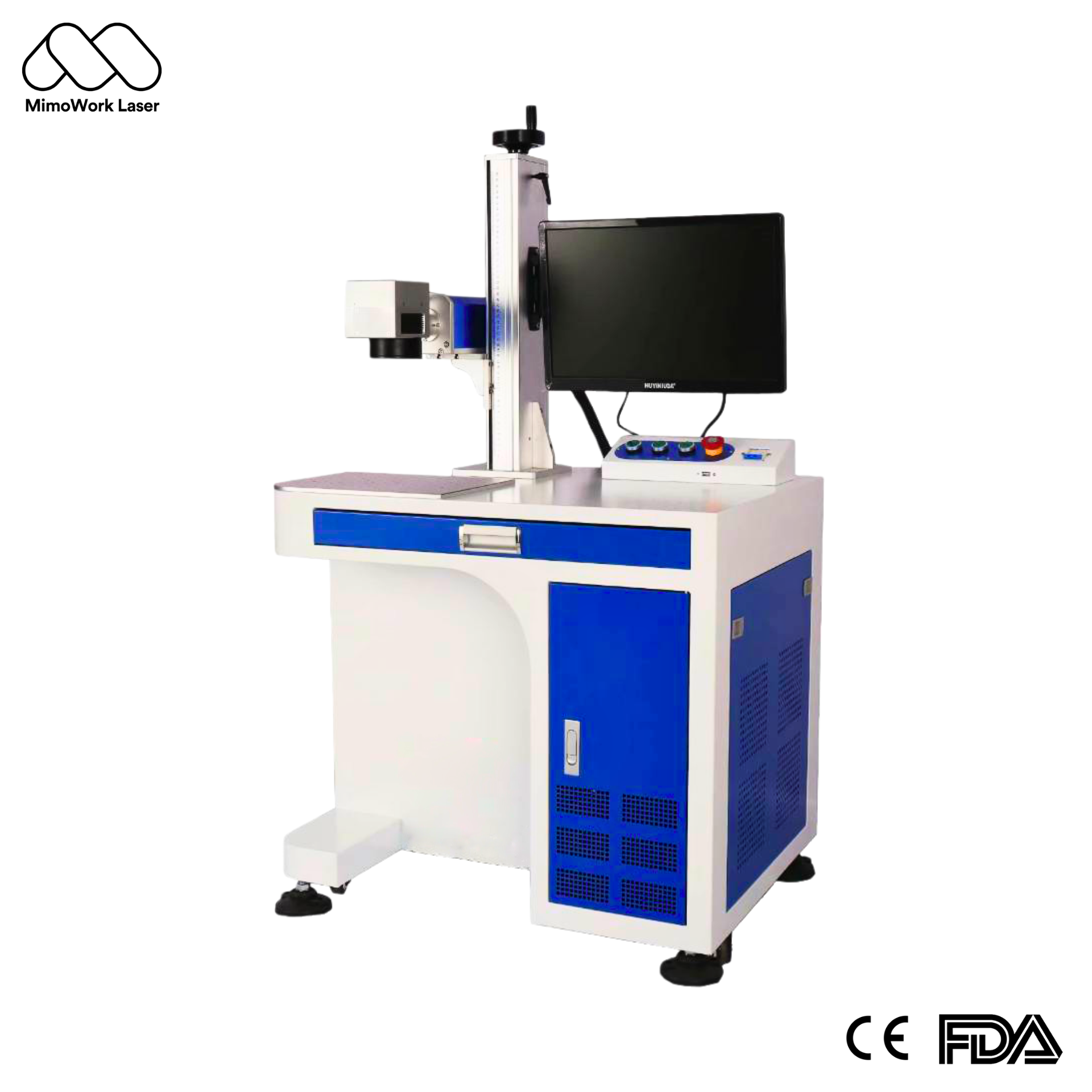
Mimowork’s MOPA laser marking solution uses adjustable pulse parameters and is designed for applications including color marking on stainless steel and anodized aluminum. Its current MOPA configuration is available with a 60W laser source and marking speeds up to 7,000 mm/s.
Start with a clean, flat stainless-steel surface. Remove oil, dust, fingerprints, and other contaminants before marking.
Surface condition can directly affect color consistency, so cleaning the workpiece is an important part of the preparation process.
Import the required logo, text, pattern, or graphic into the laser marking software.
For color applications, divide the design into different areas if multiple colors are required. Each color may require a different combination of laser parameters.
This is the most important stage of the process.
Adjust the MOPA laser’s power, pulse width, frequency, and scanning speed according to the stainless-steel grade and desired color.
There is no universal parameter setting that produces the same color on every stainless-steel surface. Different materials and finishes can respond differently, so parameter testing is recommended before production.
Before marking the final workpiece, create a parameter test grid.
Change one or more parameters gradually across different test areas and compare the resulting colors. Once the desired color is identified, record the settings for repeat production.
After confirming the parameters, position the workpiece at the correct focal distance and start the marking process.
The MOPA laser selectively processes each area of the design, creating the required color without applying an external coating.
After marking, inspect the color uniformity, edges, contrast, and fine details.
For production work, keeping the same material grade, surface finish, focal position, and laser parameters can help maintain consistency between batches.
Depending on the stainless-steel surface and laser parameters, MOPA fiber laser systems can produce colors such as black, blue, red, gold, and other shades.
The available color range should not be treated as a fixed palette. The final appearance depends on the interaction between the laser and the specific material surface.
| Parameter | Effect on Color Marking |
| Laser power | Controls energy delivered to the surface |
| Pulse width | Influences surface modification |
| Frequency | Affects laser-material interaction |
| Scanning speed | Changes heat input |
| Focus | Influences spot size and marking detail |
| Material finish | Can change the final color appearance |
A standard fiber laser is highly effective for conventional metal marking, but MOPA provides additional control over pulse characteristics.
This makes MOPA particularly useful when the application requires color marking, fine details, high-contrast black marking, or greater control over heat input.
For manufacturers producing decorative stainless-steel products, electronics, tools, kitchenware, or branded components, this additional parameter control can make MOPA a practical choice.
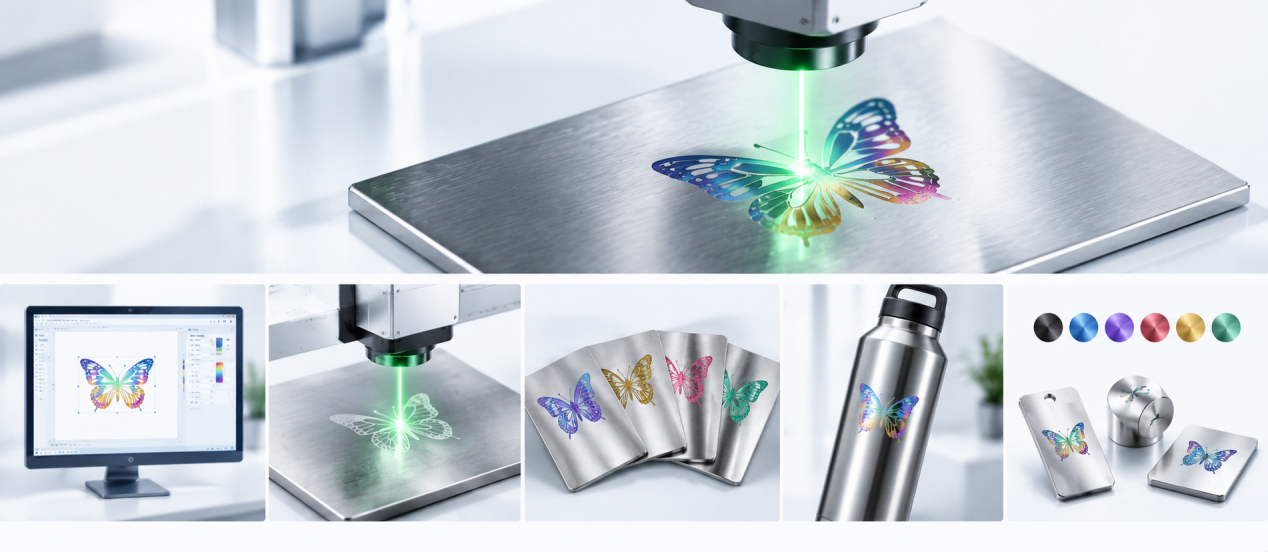
MOPA color marking is commonly considered for stainless-steel products where appearance is part of the product value. Logos, decorative patterns, product names, identification marks, and personalized graphics can all be produced directly on the metal surface.
Because the process does not require ink or labels, the finished marking can provide a clean appearance while remaining permanently integrated with the surface.
Related guide:Best Laser Marking Machine for Metal: A Professional Buyer’s Guide (2026)
Yes. MOPA fiber lasers can produce color effects on stainless steel by controlling the surface oxidation process.
No. MOPA color marking creates the visual color through controlled laser-material interaction rather than adding ink or pigment.
MOPA systems can process various metals, but color effects are highly material-dependent. Stainless steel is one of the most established applications for laser color marking.
For conventional metal marking, a standard fiber laser may be sufficient. MOPA becomes more valuable when color marking, fine control, or specialized surface effects are required.
MOPA fiber laser color marking provides a precise way to create permanent colors directly on stainless steel. The key to successful results is not simply laser power, but the careful adjustment of pulse width, frequency, speed, focus, and other processing parameters.
For applications where standard black marking is not enough, MOPA technology offers greater flexibility for creating distinctive and detailed metal markings.
News | Sep-11-2026
News | Sep-4-2026