Blog
In a field that evolves daily, staying ahead means staying informed.
Explore in-depth articles designed to help you solve complex challenges,
maximize your machine’s ROI.
Stay ahead in a competitive market.


In a field that evolves daily, staying ahead means staying informed.
Explore in-depth articles designed to help you solve complex challenges,
maximize your machine’s ROI.
Stay ahead in a competitive market.
News | Apr-7-2025
A portable laser cleaning device utilizes laser technology to eliminate contaminants from diverse surfaces.
It is manually operated, enabling convenient mobility and precise cleaning across various uses.
Cabinet & Laser Generator: The main unit housing the laser source.
Water Chiller: Maintains optimal laser temperature (use distilled water or an anti-freeze mix; tap water is prohibited to avoid mineral buildup).
Handheld Cleaning Head: The portable device directing the laser beam.
Spare Lenses: Essential for replacements if the protective lens becomes damaged.
Laser safety goggles: protect eyes from beam exposure.
Heat-resistant gloves and a standalone respirator:shield hands and lungs from fumes/particles.
Fume Extractor: Protects both the operator and the machine’s lens from hazardous emissions.
Fill the chiller with distilled water only. Add anti-freeze if operating in freezing conditions.
Never use tap water—minerals can clog the cooling system and damage components.
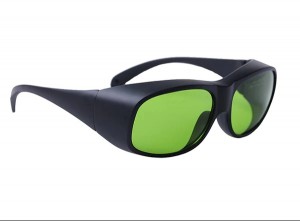
Laser Safety Goggle
Inspect the protective lens for cracks or debris. Replace if compromised.
Verify the red-light indicator is functional: If the red-light indicator is absent or not centered, it signifies an abnormal condition.
Ensure the main power switch is on before activating the rotary switch. Failure to comply can lead to uncontrolled laser activation and potential damage.
Clear the workspace of bystanders and flammable materials.
Start with manufacturer-recommended presets (power, frequency) for the material being cleaned.
Conduct a test run on scrap material to calibrate settings and avoid surface damage.
Tilt the cleaning head to minimize harmful reflections.
Maintain a consistent distance from the surface (refer to manual for optimal range).
Handle the fiber cable gently; avoid sharp bends or kinks to prevent internal damage.
This video shows that different laser-cutting fabrics need different laser powers. You’ll learn to pick the right power for your material to get clean cuts and avoid burns.
Are you confused about the power for cutting fabric with lasers?We’ll give specific power settings for our laser machines to cut fabrics.
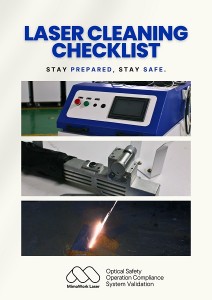
Laser Cleaning Checklist
This checklist is designed for laser cleaning operators, maintenance technicians, safety officers, and service providers (e.g., industrial, conservation, or third-party teams).
It outlines critical steps for pre-operation checks (grounding, lens inspection), safe practices during use (tilt handling, cable protection), and post-operation protocols (shutdown, storage), ensuring compliance and safety across applications.
Contact [email protected] to get this checklist for free.
Check the protective lens again for residue or wear. Clean or replace as needed.
Attach the dust cap to the handheld head to prevent contamination.
Neatly coil the fiber cable and store it in a dry, dust-free environment.
Power down the laser generator and water chiller properly.
Store the machine in a cool, dry location away from direct sunlight.
Laser cleaning is a more effective, safer, and superior technology compared to conventional cleaning methods.
Also termed as laser paint stripping and laser coating removal, this method is suitable for all kinds of metals, with steel, aluminum, and copper being the most common.
A variety of coatings can be removed, such as paint, powder coating, e-coating, phosphate coating, and insulating coating.
Laser cleaning machines effectively clean materials like wood and aluminum.
For wood, lasers target just the surface layer, preserving the material’s integrity and appearance, which is great for delicate or antique items.
The system can also be adjusted for different wood types and contamination levels.
When it comes to aluminum, despite its reflectivity and tough oxide layer, laser cleaning can overcome these challenges to effectively clean the surface.