Blog
In a field that evolves daily, staying ahead means staying informed.
Explore in-depth articles designed to help you solve complex challenges,
maximize your machine’s ROI.
Stay ahead in a competitive market.


In a field that evolves daily, staying ahead means staying informed.
Explore in-depth articles designed to help you solve complex challenges,
maximize your machine’s ROI.
Stay ahead in a competitive market.
News | Apr-27-2025
In welding processes, the choice of shielding gas significantly influences arc stability, weld quality, and efficiency.
Different gas compositions offer unique advantages and limitations, making their selection critical for achieving optimal results in specific applications.
Below is an analysis of common shielding gases and their effects on welding performance.
Applications: Ideal for TIG (GTAW) and MIG (GMAW) welding.
Effects: Ensures a stable arc with minimal spatter.
Advantages: Reduces weld contamination and produces clean, precise welds.
Applications: Commonly used in MIG welding for carbon steel.
Advantages: Enables faster welding speeds and deeper weld penetration.
Disadvantages:Increases weld spatter and raises the risk of porosity (bubbles in the weld).
Limited arc stability compared to argon blends.
Key Benefits:
Increases weld pool heat and arc stability.
Improves weld metal flow for smoother bead formation.
Reduces spatter and supports faster welding on thin materials.
Ideal For: Carbon steel, low-alloy steel, and stainless steel.
Common Use: Standard blend for MIG welding.
Advantages:
Enhances weld penetration and creates deeper, stronger welds.
Improves corrosion resistance in stainless steel.
Reduces spatter compared to pure CO₂.
Caution: Excessive CO₂ content can reintroduce spatter.
Key Benefits:
Boosts arc temperature and welding speed.
Reduces porosity defects, especially in aluminum welding.
Ideal For: Aluminum, nickel alloys, and stainless steel.
Improves weld pool fluidity and reduces bubble formation.
Perfect for carbon steel and stainless steel.
Enhances arc stability and heat control for thick materials.
Reduces weld oxidation and ensures high-quality, rapid welds.
Shielding gases are key in Laser Welding, TIG and MIG processes. Knowing their uses helps achieve quality welds.
Each gas has unique properties affecting welding results. The right choice leads to stronger welds.
This video shares useful handheld laser welding info for welders of all experience levels.
In MIG welding, Argon is non-reactive, whereas in MAG welding, CO2 is reactive, which results in a more intense and deeply penetrating arc.
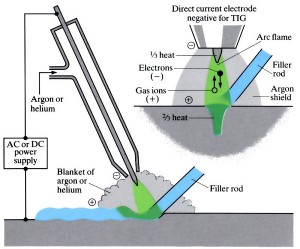
Argon is frequently utilized as the inert gas of choice in the TIG welding process.
It’s highly popular among welders since it’s applicable for welding various metals like mild steel, stainless steel, and aluminum, reflecting its versatility in the welding sector.
Additionally, a mixture of Argon and Helium can be employed in both TIG and MIG welding applications.
TIG welding demands pure Argon gas, which yields a pristine weld free from oxidization.
For MIG welding, a blend of Argon, CO2, and Oxygen is necessary to enhance penetration and heat.
Pure Argon is essential in TIG welding since, as a noble gas, it remains chemically inert during the process.