Blog
In a field that evolves daily, staying ahead means staying informed.
Explore in-depth articles designed to help you solve complex challenges,
maximize your machine’s ROI.
Stay ahead in a competitive market.


In a field that evolves daily, staying ahead means staying informed.
Explore in-depth articles designed to help you solve complex challenges,
maximize your machine’s ROI.
Stay ahead in a competitive market.
News | Nov-14-2026 | Mimowork
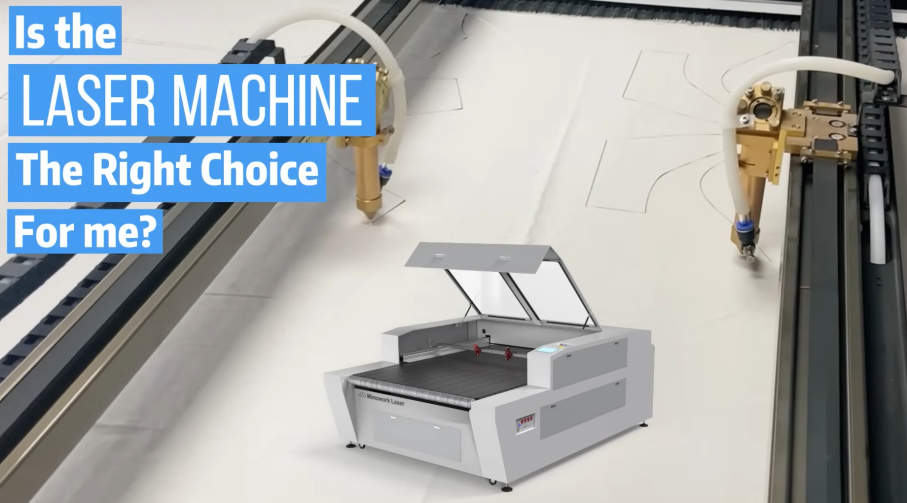
A laser cloth cutter should be selected according to the fabric being processed, the cutting method required, and the production workflow—not simply its laser power. Printed textiles, thick fabrics, foam composites, and small labels all require different cutting configurations.
MimoWork offers fabric laser cutting solutions covering roll-to-roll contour cutting, flatbed textile processing, and patch and label cutting. Understanding the differences between these machine types helps manufacturers identify the right equipment for their materials, order volumes, and production requirements.
The first step in selecting a laser cloth cutter is identifying the actual cutting task. Different textile applications require different working tables, feeding systems, and recognition technologies.
Three production requirements are particularly important.
Printed fabric contour cutting
Printed textiles often contain patterns, outlines, or registration marks that the laser must follow accurately. An HD camera recognition system can identify these visual details and guide the cutting path, reducing the need for manual alignment and individual cutting-file preparation.
Roll-based or sheet-based processing
Fabric supplied in continuous rolls generally benefits from an automatic feeding and conveyor system. By comparison, flatbed machines provide stable support for individual fabric sheets, thick textiles, and composite materials.
Large panels or small textile components
Garment panels, upholstery pieces, patches, labels, and decorative tags have different size and precision requirements. A large-format textile laser cutter provides the working area needed for larger components, while dedicated patch and label cutters are designed for smaller products.
Before comparing machine models, manufacturers should define these production requirements. This prevents selecting a machine with unnecessary capabilities or insufficient material-handling capacity.
Fabric behavior has a direct impact on laser cutting quality. Heat sensitivity, surface coatings, thickness, and structural stability all influence the cutting process.
Synthetic fabrics may experience edge melting, shrinkage, or discoloration if processing parameters are unsuitable. Thick textiles, foam, and composite materials may require a more stable working surface and appropriate laser power.
Rather than relying on general material descriptions, manufacturers should test the actual fabric under representative production conditions.
The following table connects common textile processing challenges with relevant machine configurations.
| Fabric or Production Challenge | Main Requirements | Relevant MimoWork Capability |
| Printed sublimated fabric | Camera recognition, contour identification, continuous feeding | Roll-to-roll contour cutter with HD camera and conveyor table |
| Thick textiles, foam, composites, fleece, and mesh | Stable flatbed support, suitable power configuration, optional multi-head processing | Flatbed Laser Cutter 160L/180L, 100–600W, with CCD and multi-head options |
| Small patches, labels, and tags | Compact working area, accurate positioning, optional roll-to-roll processing | Patch/Label Laser Cutter models 40–130, with 0.15mm precision |
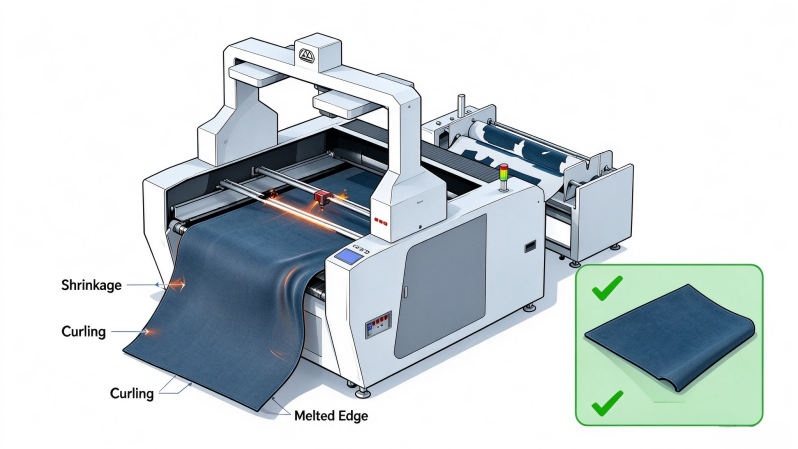
Roll-to-roll laser cutting is particularly suitable for manufacturers processing printed textiles supplied in continuous rolls.
In applications such as sublimation printing, sportswear production, and customized textile manufacturing, the cutting path often needs to follow a printed outline. Manually positioning each piece and preparing individual cutting files can increase preparation time and introduce alignment errors.
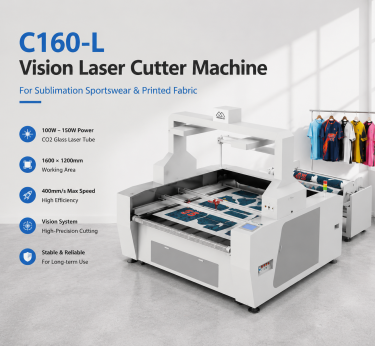
A roll-to-roll contour laser cutter combines automatic feeding, an HD camera recognition system, and a conveyor working table. The camera identifies printed contours or registration features, allowing the laser to follow the required cutting paths.
MimoWork’s Contour Laser Cutter 160L/180L is designed for this production route. It supports CO2 glass or RF metal laser sources, with 100W and 150W options.
Fabric arrives in continuous rolls rather than individual sheets.
Printed patterns or outlines need to be recognized before cutting.
Frequent artwork changes make manual positioning and cutting-file preparation inefficient.
The material is suitable for conveyor-based feeding.
Continuous processing is more important than handling thick, rigid, or layered materials.
For manufacturers producing printed garments, sportswear, flags, and customized textile products, camera-assisted contour cutting can simplify the transition from printing to cutting.
Flatbed laser cutting is a better fit when the fabric is thick, layered, or unsuitable for continuous roll feeding.
Unlike conveyor-based systems, a flatbed machine provides a stable working surface for positioning individual textile pieces. This makes it suitable for applications involving foam, fleece, mesh, composite textiles, and other materials requiring consistent support.
MimoWork’s Flatbed Laser Cutter 160L/180L offers power configurations from 100W to 600W and working areas up to 1800mm × 3000mm.
Optional CCD camera and multi-head configurations can also be considered according to the production task.
Working area
Start with the largest fabric panel or component that needs to be processed. MimoWork offers working-area configurations including 1600mm × 3000mm and 1800mm × 3000mm.
Laser power
Power should be matched to material thickness, cutting requirements, and desired processing speed. A higher wattage specification does not automatically guarantee better cutting results for every textile application.
Multi-head configuration
For suitable repetitive cutting tasks, multi-head processing may help increase production capacity. Its value depends on the layout, material utilization, and order volume.
CCD camera options
If the fabric contains printed patterns or positioning marks, a CCD camera configuration may help improve alignment and cutting consistency.
Working table and extraction
The table structure should support the material properly, while the extraction system should be suitable for the fumes generated during processing.
Machine specifications are useful for initial comparisons, but they should always be evaluated in the context of actual fabric processing.
For textile manufacturers, cutting precision affects pattern alignment, seam allowance, and downstream assembly. Cutting speed influences production capacity, but the actual result depends on fabric characteristics, cutting geometry, and machine configuration.
MimoWork’s published specifications provide a starting point for comparing its different textile laser cutting systems.
| Machine Type | Cutting Precision | Cutting Speed |
| Contour Laser Cutter 160L/180L | 0.15mm | 1–1200mm/s |
| Flatbed Laser Cutter 160L/180L | 0.1mm | 1–600mm/s |
| Patch/Label Laser Cutter | 0.15mm | 1–500mm/s |
Several additional factors should be considered when interpreting these numbers:
A machine with a higher maximum speed is not necessarily the most productive option. Consistent cutting quality, reduced repositioning, and fewer processing errors can be more valuable over an entire production cycle.
A suitable laser cloth cutter is not defined by its machine specifications alone. The software, recognition system, feeding structure, cooling, and upgrade options also influence how well the equipment performs in daily production.
Before purchasing a fabric laser cutting machine, manufacturers should clarify the following details.
| Evaluation Point | What to Confirm | Why It Matters |
| File compatibility | Supported formats such as AI, BMP, PLT, DXF, and DST | Ensures compatibility with existing design and production workflows |
| Camera recognition | HD industrial camera and contour recognition capabilities | Reduces manual alignment for printed fabric |
| Feeding system | Conveyor, automatic feeding, or manual flatbed loading | Determines material handling and production continuity |
| Working table | Conveyor, honeycomb, or flatbed structure | Affects material support and processing suitability |
| Cooling system | Appropriate industrial water chiller configuration | Supports stable machine operation |
| Optional configurations | CCD, multi-head, and marking options | Allows equipment to accommodate different production requirements |
Manufacturers should also request sample cutting tests using their own materials and representative design files. This is one of the most practical ways to evaluate edge quality, dimensional consistency, and the suitability of a proposed machine configuration.
A laser cloth cutter is primarily designed to cut textile materials into specific shapes and dimensions. A fabric laser engraving machine focuses on creating surface patterns, marks, or decorative effects. Some laser systems can support different processing applications depending on their configuration.
Yes. A camera recognition laser cutter can identify printed contours or registration features and guide the cutting process. This is particularly useful for sublimated textiles and customized printed fabric products.
Neither is universally better. Roll-to-roll systems are suitable for continuous fabric feeding and printed contour cutting, while flatbed machines are more appropriate for thick, layered, or sheet-based materials.
The required power depends on fabric composition, thickness, cutting speed, and the desired edge quality. Rather than selecting the highest available wattage, manufacturers should conduct material tests to determine the appropriate configuration.
Laser cutting can produce sealed edges on many synthetic fabrics because the heat melts and fuses the fibers along the cutting line. However, the result depends on the fabric composition and processing parameters. Natural fibers and mixed textiles may behave differently, so sample testing is recommended.
Manufacturers should test the actual production fabric and inspect edge quality, dimensional accuracy, contour recognition, feeding stability, and cutting consistency. Testing representative designs is more useful than evaluating a machine using only simple straight-line cutting samples.
Choosing a laser cloth cutter is ultimately a production decision rather than a simple comparison of machine specifications.
Manufacturers processing printed textiles should prioritize camera recognition and automatic roll feeding. Those working with thick fabrics, foam, or composites should focus on flatbed support and suitable power configurations. Businesses producing patches, labels, and small textile components may benefit from dedicated compact cutting systems.
MimoWork provides different fabric laser cutting configurations for these production requirements, including contour, flatbed, and patch/label laser cutters. By matching the machine structure, recognition technology, and processing capabilities to the actual material and order profile, manufacturers can build a more suitable and consistent textile cutting workflow.
News | Oct-31-2026
News | Sep-8-2026
News | Sep-1-2026