Blog
In a field that evolves daily, staying ahead means staying informed.
Explore in-depth articles designed to help you solve complex challenges,
maximize your machine’s ROI.
Stay ahead in a competitive market.


In a field that evolves daily, staying ahead means staying informed.
Explore in-depth articles designed to help you solve complex challenges,
maximize your machine’s ROI.
Stay ahead in a competitive market.
News | Oct-31-2026 | Mimowork
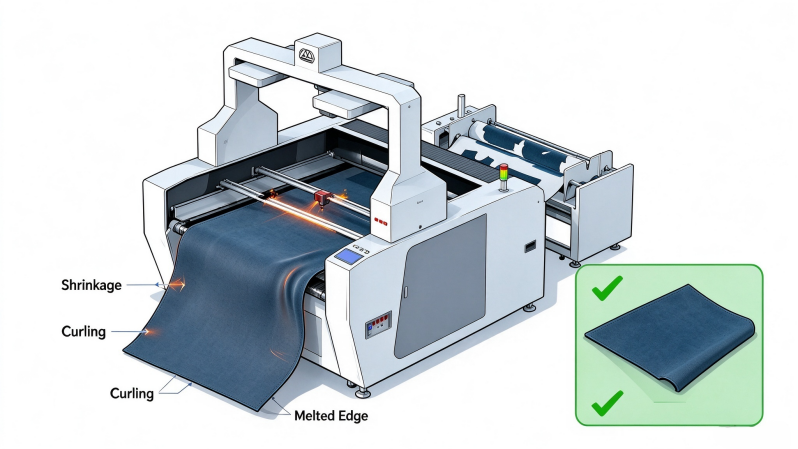
Scuba fabric can shrink, curl, or distort during laser cutting when heat causes its synthetic fibers to soften, contract, or melt. The risk depends on the fabric’s fiber composition, knit structure, thickness, and any finishing treatments. To reduce distortion, verify the material composition, test different speed and power combinations, keep the fabric flat without stretching it, and use effective fume extraction. Always test a sample before cutting a full production layout.
Scuba fabric is commonly a thick, smooth double-knit textile made from synthetic fibers, often polyester blended with elastane. However, the exact composition varies between suppliers, so two fabrics sold under the same name may react differently to laser heat.
Unlike a woven fabric that may fray along a cut edge, synthetic scuba knit can soften, melt, or contract when exposed to excessive heat. The challenge is to separate the material cleanly without allowing the surrounding knit structure to deform.
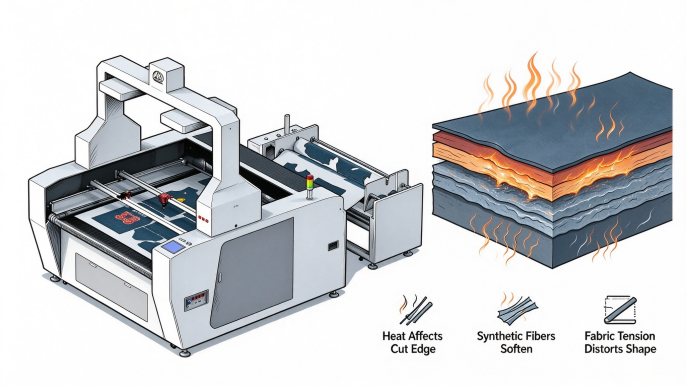
A laser concentrates energy along the intended cut path, but heat can also affect the material immediately beside it. If the energy input is too high or the cutting process allows excessive heat to accumulate, the edge may become stiff, curled, wavy, or visibly narrower than expected.
This matters when cutting garment panels, fitted clothing, sportswear, and other products that rely on accurate dimensions. Even a small change along multiple edges can affect how pieces align during sewing or assembly.
Many scuba fabrics contain thermoplastic fibers such as polyester, sometimes blended with elastane. When heated, these fibers may soften, melt, or change shape rather than simply burn away.
A cut edge that appears sealed is not necessarily a good edge. If the material has contracted significantly, the result may have a hard ridge, a glossy melted border, or a different width from the original cutting path.
The appropriate settings therefore depend on the actual fiber blend. Do not assume that every scuba fabric can use the same parameters.
Not every dimensional problem is caused by heat alone. If the fabric is stretched while being loaded, held under tension, or pulled unevenly across the cutting area, it may relax into a different shape after processing.
This is particularly relevant to stretch-knit materials. A piece may measure correctly while secured on the worktable but become shorter or wider after it is released.
When you laser cut scuba fabric, compare the material before and after cutting under the same relaxed conditions. This helps distinguish thermal contraction from distortion caused by handling and tension.
Scuba textiles can vary in thickness, density, and surface construction. Raised areas, folds, or uneven contact with the worktable may change the cutting conditions across the panel.
If some sections cut cleanly while others show melted edges or incomplete separation, inspect the material’s flatness and consistency before increasing power. A higher setting may solve an incomplete cut in one area while worsening heat damage elsewhere.
The goal is not simply to cut through the textile. It is to achieve complete separation while minimizing the heat transferred into the surrounding fabric.
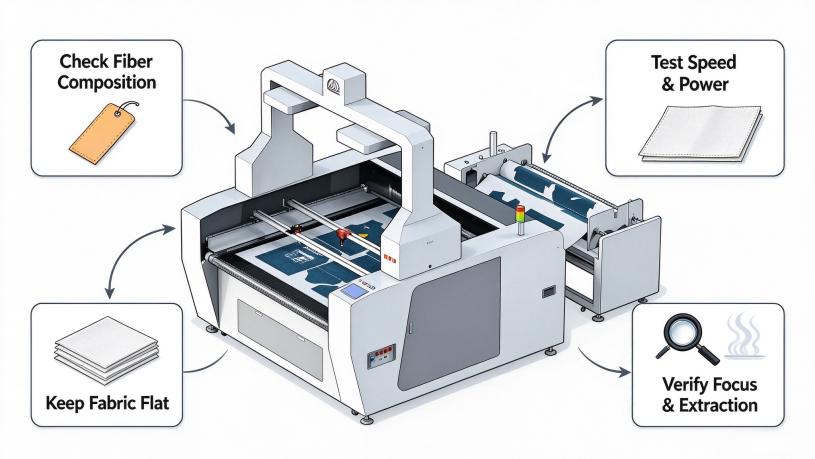
Ask the supplier for the fabric’s fiber content and, where available, its technical data sheet. Confirm whether the material contains polyester, elastane, nylon, or other fibers, and check for coatings, laminations, or special finishes.
These details matter because different synthetic fibers and fabric constructions respond differently to heat. A setting that works on a polyester-rich sample may not produce the same edge on a different blend.
If the material composition is unknown, treat the first test as a material-identification and process-validation step rather than moving directly to production.
Excessive energy can melt a wider area around the cut line. Start with a small test piece and evaluate several combinations of speed and power.
A practical testing sequence is:
Record the best result so the same material can be processed consistently.
Increasing speed may reduce the time heat is applied to a particular area, but speed alone does not determine the result. If the laser moves too quickly to cut through the fabric, incomplete separation may create additional problems during handling.
Likewise, reducing power too far may require repeated passes, which can expose the same edge to more heat. Test the combined effect of speed and power rather than changing settings based on appearance alone.
Before cutting, allow the fabric to relax according to the supplier’s handling recommendations. Lay it flat and remove folds or wrinkles without pulling the knit into shape.
Avoid securing stretch fabric under excessive tension. The objective is to keep the material stable, not to stretch it until it appears perfectly flat.
For larger panels, inspect the entire cutting area. If the fabric shifts, curls, or lifts during processing, the resulting dimensional variation may be mistaken for thermal shrinkage.
Incorrect focus can affect the effective energy density at the material surface. On thicker textiles, inconsistent surface height can also contribute to uneven cutting results.
Follow the machine manufacturer’s focusing procedure and confirm that the fabric remains at a consistent height across the work area. If one section cuts differently from another, check for material variation and height differences before making a large power adjustment.
Long cutting paths, closely spaced shapes, and small corners can produce different results from isolated straight cuts. When many cut lines are concentrated in a small area, heat may accumulate around the surrounding material.
If the edges are clean on a simple test line but distort on a dense production layout, test the actual pattern. Pay particular attention to narrow bridges, small cutouts, tight curves, and adjacent pieces.
Adjust the cutting strategy and parameters only after checking the full design. A successful straight-line test does not guarantee that a tightly nested pattern will behave the same way.
Laser processing synthetic textiles can generate fumes and airborne contaminants. Use an appropriate extraction system and follow the machine manufacturer’s guidance for airflow and work-area ventilation.
Airflow should support safe fume removal without unnecessarily disturbing lightweight fabric. Check that the material remains flat and stable during processing, especially when cutting large, thin, or stretchable panels.
Do not assume that a sealed edge means the material is safe to process. Confirm the fabric composition and any applied finishes before laser cutting.
The appearance of the cut can help narrow down the cause. Use this table to guide your next test rather than immediately increasing or decreasing power.
| Cutting problem | Possible cause | What to check |
| Fabric becomes smaller after cutting | Thermal contraction or relaxation of stretched fabric | Compare relaxed dimensions before and after processing |
| Edges curl or form a hard ridge | Excessive heat or melting of synthetic fibers | Test lower heat input and inspect the fiber blend |
| Cut edges look glossy or fused | Local melting along the cut line | Adjust speed and power through controlled tests |
| Some areas cut through while others do not | Uneven thickness, inconsistent focus, or changing material height | Check fabric flatness, focus, and material consistency |
| Pattern dimensions vary after unloading | Fabric tension or movement during cutting | Load the fabric without stretching and compare relaxed measurements |
| Distortion appears around dense shapes | Local heat accumulation | Test the actual layout, especially tight corners and closely spaced cuts |
A small sample should represent the actual production material and design. Testing a different fabric from the same supplier may not reveal the problems that occur with the final batch.
First, measure the relaxed fabric. Mark a reference length and width on a sample, then record the dimensions before processing. Avoid measuring the textile while it is stretched.
Second, test straight lines and curves. Straight cuts reveal basic edge quality, while curves and corners show whether the material distorts around more complex paths.
Third, inspect both the edge and the surrounding surface. Look for hard melted borders, curling, discoloration, incomplete cuts, or changes in the dimensions of the cut piece.
Finally, measure the sample again after it has cooled and relaxed. Use the same measurement method as before cutting. This helps reveal whether the material has contracted or simply changed shape while it was held on the worktable.
If dimensional accuracy is critical, repeat the test using material from another section of the roll. Differences in thickness, stretch, or finishing can affect repeatability.
A CO2 Laser Cutter can be used for many textile-cutting applications, including suitable synthetic fabrics. Whether it is appropriate for a specific scuba material depends on its composition, thickness, construction, and the required edge quality.
For apparel panels and other dimension-sensitive parts, evaluate more than cutting speed. Edge consistency, repeatability, usable cutting area, extraction requirements, and the ability to process the actual fabric without unacceptable distortion all matter.
Before selecting a machine, prepare representative samples and define acceptable limits for edge quality and dimensional variation. This makes it easier to compare equipment configurations against real production requirements rather than relying on a general claim that a laser can cut fabric.
Related guide:How to Laser Cut Fabric Without Fraying: A Complete Guide to Clean Textile Cutting
Laser cutting may create a fused or sealed edge on some thermoplastic synthetic textiles. The result depends on the fiber blend and cutting conditions. A sealed edge is not automatically a clean edge, because excessive melting can cause stiffness, curling, or dimensional changes.
The fibers may contract or relax during processing even when the cut line appears smooth. Fabric tension can also affect the final dimensions. Compare relaxed measurements before and after cutting to determine whether the issue is thermal contraction or handling-related distortion.
Not immediately. First check focus, fabric flatness, thickness, and the consistency of the material. Then adjust speed and power in controlled tests. Excessive power may improve separation but increase melting and deformation around the cut.
No. Fiber composition, knit structure, thickness, and finishes can differ between products. Establish a tested setting for the actual fabric and verify it again when the supplier, material batch, or construction changes.
Scuba fabric shrinkage is not always a simple power-setting problem. Thermal contraction, fabric tension, uneven thickness, and heat accumulation can all affect the final dimensions. Identifying the cause before adjusting the machine helps prevent repeated trial and error.
For manufacturers processing stretch-knit textiles, MimoWork’s laser cutting solutions can be evaluated against the fabric composition, working area, cutting pattern, and edge-quality requirements of the application. Testing the actual material before production is the most reliable way to determine whether a particular configuration meets those requirements.
News | Oct-13-2026
News | Sep-1-2026