Blog
In a field that evolves daily, staying ahead means staying informed.
Explore in-depth articles designed to help you solve complex challenges,
maximize your machine’s ROI.
Stay ahead in a competitive market.


In a field that evolves daily, staying ahead means staying informed.
Explore in-depth articles designed to help you solve complex challenges,
maximize your machine’s ROI.
Stay ahead in a competitive market.
News | Oct-30-2026 | Mimowork
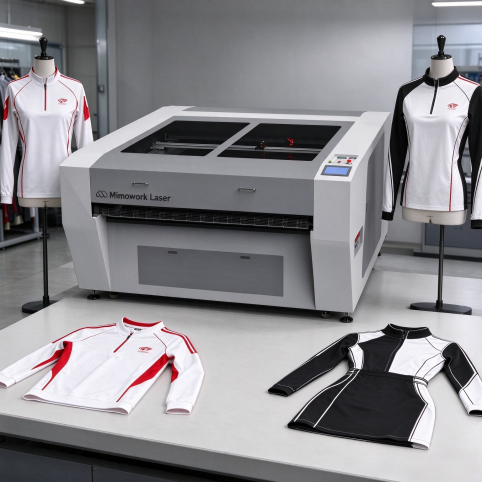
A CO2 laser cutter configured as an apparel laser cutter can reduce edge fraying on compatible synthetic delicate fabrics by melting and sealing fibers along the cut line. However, natural fibers such as cotton may char instead of forming a sealed edge. The best results depend on fabric composition, heat input, cutting speed, and testing with the actual production material.
A garment panel can look perfect on the cutting table and still create problems later. Loose threads appear during sewing, curved edges become uneven, and printed graphics no longer align with the garment pattern. When these defects affect an entire production batch, the cost extends beyond wasted fabric to rework, delayed orders, and inconsistent product quality.
An apparel laser cutter, most commonly a CO2 laser cutter for textile work, can help address these problems, particularly when processing synthetic textiles and intricate garment designs. But laser cutting is not a universal fix for every fabric. The real challenge is finding a process that delivers clean edges without excessive melting, discoloration, or unnecessary production time.
A CO2 laser cutter directs a focused infrared beam along a programmed cutting path without applying the mechanical pressure of a blade. When the beam cuts compatible thermoplastic fibers, localized heat melts the material along the edge. After cooling, the fused fibers can form a boundary that resists unraveling.
This can be particularly useful for polyester sportswear, sublimated garments, synthetic mesh, and selected nylon textiles. Digital cutting powered by a CO2 laser cutter also makes it easier to produce complex contours, small openings, and repeated garment patterns without manufacturing a physical cutting die.
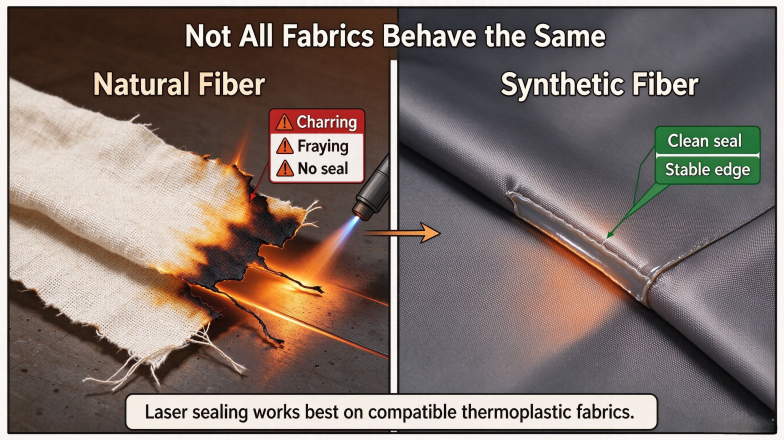
The important distinction is that laser cutting can seal certain synthetic fabrics, but it does not automatically seal every textile.
For manufacturers, the goal is not simply to obtain a cut edge. It is to achieve an edge that remains stable during handling, sewing, washing, and normal garment use.
✓ Best Choices: Reliable Edge Sealing
Polyester sportswear, sublimated polyester, nylon, and polyester mesh are promising candidates. These thermoplastic fabrics can melt and fuse under a CO2 laser beam, locking fibers together to reduce fraying.
⚠️ Use Cautiously: Variable Results
Polyester-cotton blends, coated technical fabrics, and thin stretch synthetics require sample testing. Mixed fiber reactions can cause partial charring, inconsistent sealing, or coating damage.
✕ Poor Fit: No Self-Sealing and Higher Risk
100% cotton, linen, rayon, and viscose do not reliably form self-sealing edges through melting. Additional overlock finishing may still be necessary.
💡 Important: Material compatibility alone does not guarantee a clean cut. Test the actual fabric and finish before production.
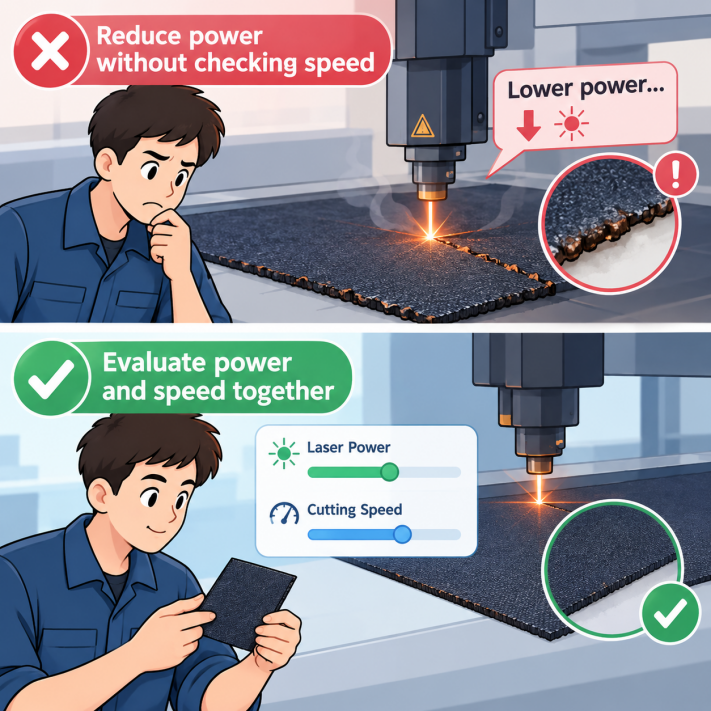
⚠️ Common Mistake: Reducing Power Without Checking Cutting Speed
A common mistake is to reduce laser power whenever a fabric shows signs of melting. If the beam no longer cuts through the material cleanly, the operator may need to slow the cutting head or repeat the cut. That can increase heat exposure instead of solving the problem.
➜ Recommended Approach: Evaluate laser power and cutting speed together. Start with a representative sample, confirm complete separation, and inspect the edge for discoloration, excessive fusion, and incomplete cuts.
Thin textiles can shift or wrinkle during cutting. This affects dimensions and can create defects when garment panels need to match each other precisely.
A suitable worktable and material-holding method help stabilize the fabric. For continuous production, a conveyor-fed configuration paired with a CO2 laser cutter can support roll processing, provided that the fabric feeding and tension-control arrangements suit the material.
A clean cut does not guarantee a correctly aligned garment. Sublimated sportswear, for example, requires the cut path to follow the printed design. Extra care is required because excess heat from the CO2 laser cutter can scorch or distort sublimated prints.
When print placement varies or patterns change frequently, manual alignment can become a bottleneck. A vision laser cutter can identify printed contours and guide the cutting path, reducing dependence on manual tracing.
An edge that looks acceptable immediately after cutting may still fail during sewing or garment assembly. Test the sample under the same handling conditions used in production.
For demanding applications, assess whether the edge remains flexible and whether the material shows signs of distortion. This is especially important for garments that require stretch, repeated movement, or a soft edge against the skin.
Stacking fabric can increase output in some conventional cutting workflows, but laser processing introduces heat-related considerations. The upper and lower layers may not receive identical cutting conditions from a CO2 laser cutter.
Single-layer processing can be a useful starting point when edge quality is critical. Multi-layer laser cutting should be validated using the actual fabric and the required finish before production capacity is estimated.
The right configuration depends on the size of the garment components, whether the material is printed, and the expected production volume. These MimoWork models use CO2 laser systems designed for textile cutting applications.
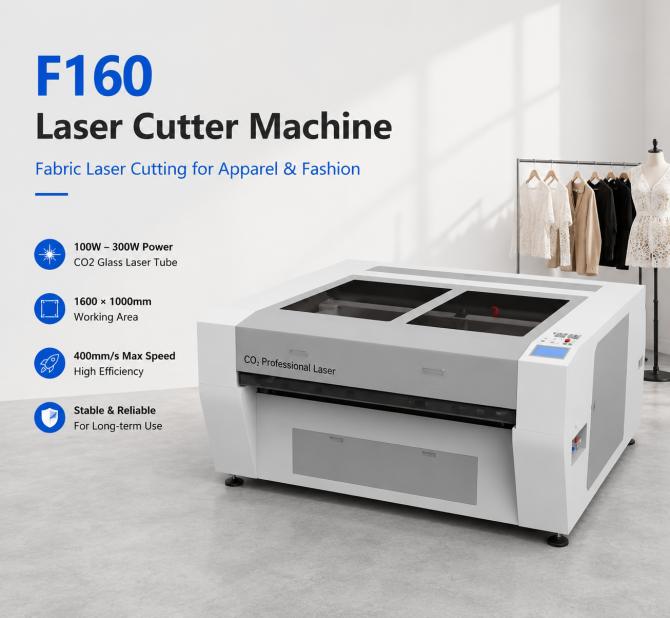
The F160 has a listed working area of 1600 × 1000 mm and CO2 laser power options from 100W to 300W. It is worth evaluating for garment manufacturers that need a flexible cutting platform for fabric panels and larger patterns.
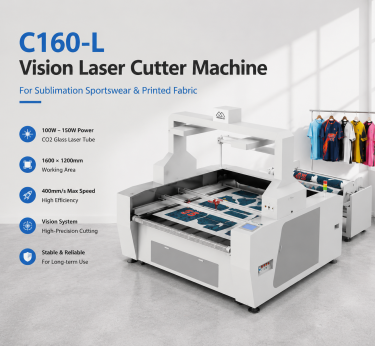
For printed sportswear and sublimated fabrics, the C160-L Vision configuration is designed to identify printed contours and guide cutting. Its listed working area is 1600 × 1200 mm, with 100W–150W laser power options. This makes it relevant when print alignment is a major source of production waste.
The F180-L has a listed working area of 1800 × 1300 mm and CO2 laser power options from 150W to 600W. It is designed for industrial textile processing, including selected technical fabrics. Manufacturers should confirm material compatibility, feeding requirements, and actual cutting performance with MimoWork before ordering.
Review MimoWork’s Laser Cutting Solutions and request a configuration based on the fabric type, roll width, pattern dimensions, and production target.
Related guide:How to Laser Cut Fabric Without Fraying: A Complete Guide to Clean Textile Cutting
Laser cutting and mechanical knife cutting address different production requirements. The right method depends on fabric composition, edge quality, pattern complexity, and the number of layers being processed.
| Production Requirement | Laser Cutting (CO2 Laser Cutter) | Mechanical Knife Cutting |
| Synthetic edge sealing | Possible on compatible fabrics | Generally produces a mechanically cut edge |
| Heat-sensitive textiles | Requires careful testing | Avoids laser-related thermal damage |
| Intricate patterns | Supports detailed digital contours | Depends on blade and cutting-system capabilities |
| Printed fabric | Can integrate vision recognition | Depends on registration capabilities |
| Multiple fabric layers | Requires validation of heat and cut consistency | Often suitable for workflows that prioritize thick layer stacks |
| Edge finishing | May reduce finishing work on suitable synthetics | Additional finishing may be required |
Laser cutting is attractive when detailed patterns, non-contact processing, and sealed synthetic edges are important. Knife cutting remains a strong option when thermal effects are unacceptable or the production workflow depends on cutting multiple layers.
It can eliminate long-term fraying on suitable thermoplastic synthetics if the laser parameters are correctly adjusted. For other fabric types, it may deliver only partial improvement or no sealing effect, especially with natural fibers.
It can if the heat input is unsuitable. Excessive melting, discoloration, and incomplete cuts are possible. Test the actual fabric and inspect the edge before approving the process on your CO2 laser cutter.
Not always. Vision recognition is particularly useful for printed fabrics and sublimated sportswear where the cut must follow an existing graphic. Plain fabric with straightforward digital patterns processed on a standard CO2 laser cutter may not require it.
It can replace or complement conventional methods for suitable materials and patterns. The decision depends on fabric compatibility, layer count, edge requirements, production volume, and downstream operations.
An apparel laser cutter built on CO2 laser cutter technology is most useful when it solves a specific production problem: fraying synthetic edges, inaccurate intricate cuts, printed-pattern misalignment, or excessive manual handling. Edge quality should be evaluated alongside cutting speed because a fast cut that creates stiff or discolored edges can increase downstream costs.
MimoWork offers fabric-cutting solutions for apparel, printed textiles, and industrial materials. Explore the MimoWork Laser Cutting Solutions to identify a suitable configuration for your application.
LightBurn Software Documentation. Laser Types & Material Processing Guidance.
OSHA (U.S. Occupational Safety and Health Administration). Industrial laser safety and workplace hazard control resources.
News | Sep-25-2026