Blog
In a field that evolves daily, staying ahead means staying informed.
Explore in-depth articles designed to help you solve complex challenges,
maximize your machine’s ROI.
Stay ahead in a competitive market.


In a field that evolves daily, staying ahead means staying informed.
Explore in-depth articles designed to help you solve complex challenges,
maximize your machine’s ROI.
Stay ahead in a competitive market.
News | Oct-9-2026
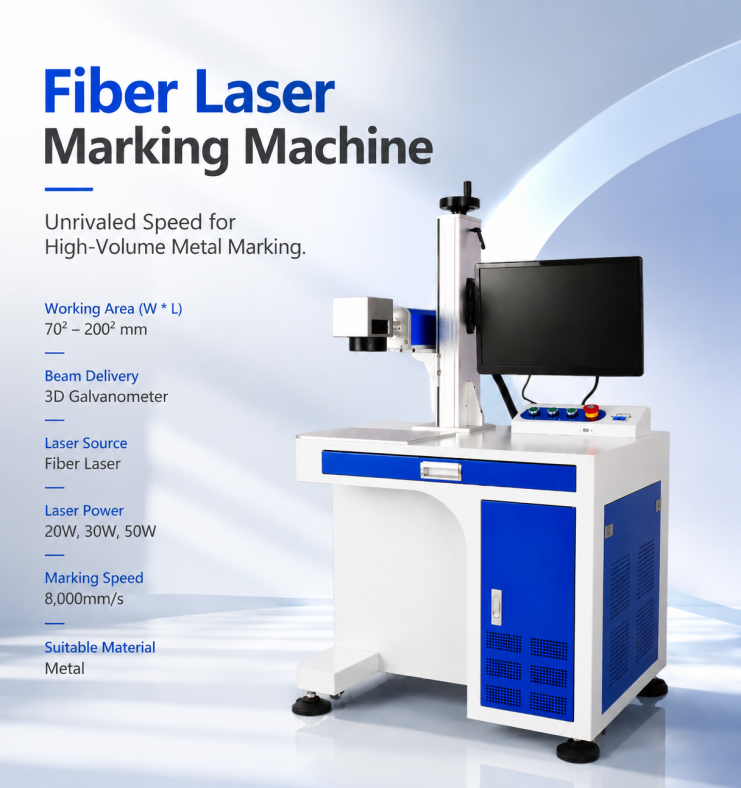
Quick Answer: An enclosed fiber laser marking machine is a fiber laser marking system built inside a protective enclosure to create a more controlled operating environment. It is commonly used for permanent marking on stainless steel, aluminum, titanium, and other metal components, including serial numbers, QR codes, barcodes, logos, and product identification. When choosing a system, buyers should look beyond laser power and compare the enclosure design, working area, marking speed, laser source, galvo system, extraction, and the type of marking required.
A fiber laser marking machine uses a focused laser beam to modify the surface of a material without physical contact. On metals, the process can create permanent identification marks, codes, logos, text, or decorative patterns with high repeatability.
The word enclosed, however, describes the machine format rather than the laser source itself.
Instead of leaving the marking area open, an enclosed system places the work area inside a protective housing. The enclosure can include a viewing window, access door, safety interlock, control system, and fume extraction connection.
This configuration is particularly useful when the machine will be operated regularly in a shared production environment. Rather than treating laser safety as something that depends primarily on operator behavior, the machine can incorporate physical and engineering controls into the workstation.
OSHA notes that a fully enclosed beam path can be used as an engineering control for high-power laser systems when the enclosure is appropriately designed and equipped with safeguards such as interlocks.
That does not mean every enclosed machine has identical safety performance. Buyers should still verify the manufacturer’s safety documentation, enclosure design, interlock configuration, laser classification, and applicable regional requirements.
The main reason to choose an enclosed configuration is not simply appearance.
For many businesses, the more important benefit is creating a controlled marking workstation.
An open fiber laser marker provides excellent access to the workpiece, which can be useful for large or irregular components. However, the open design also requires more consideration of the surrounding work area, operator access, laser safety procedures, and installation environment.
An enclosed system places the marking operation inside a defined processing area.
This can be especially useful for:
The enclosure can also make the production process more repeatable. The operator loads the part, positions it, closes the enclosure, runs the marking file, and removes the finished component.
For industrial applications, that repeatability can matter more than having an open machine that is slightly easier to access.
Fiber lasers are primarily associated with metal marking.
Typical applications include stainless steel, aluminum, titanium and other industrial metal components. Depending on the material and processing parameters, they can produce identification marks, serial numbers, barcodes, QR codes, logos and other permanent graphics.
The important point is that marking is not the same as cutting.
A fiber marking machine normally changes or removes a controlled area of the material surface rather than cutting through a sheet. The required laser power and processing parameters are therefore very different from those used for fiber laser cutting.
For many manufacturers, the objective is not to remove as much material as possible. Instead, the objective is to create a mark that is:
Permanent + readable + repeatable + visually consistent.
That is why a 20W or 30W marking system can be highly useful even though it is nowhere near the power range associated with industrial fiber cutting machines.
Laser power is one of the first specifications buyers compare, but higher power does not automatically mean better marking.
The correct power depends on the material, marking depth, required contrast, graphic complexity, and production volume.
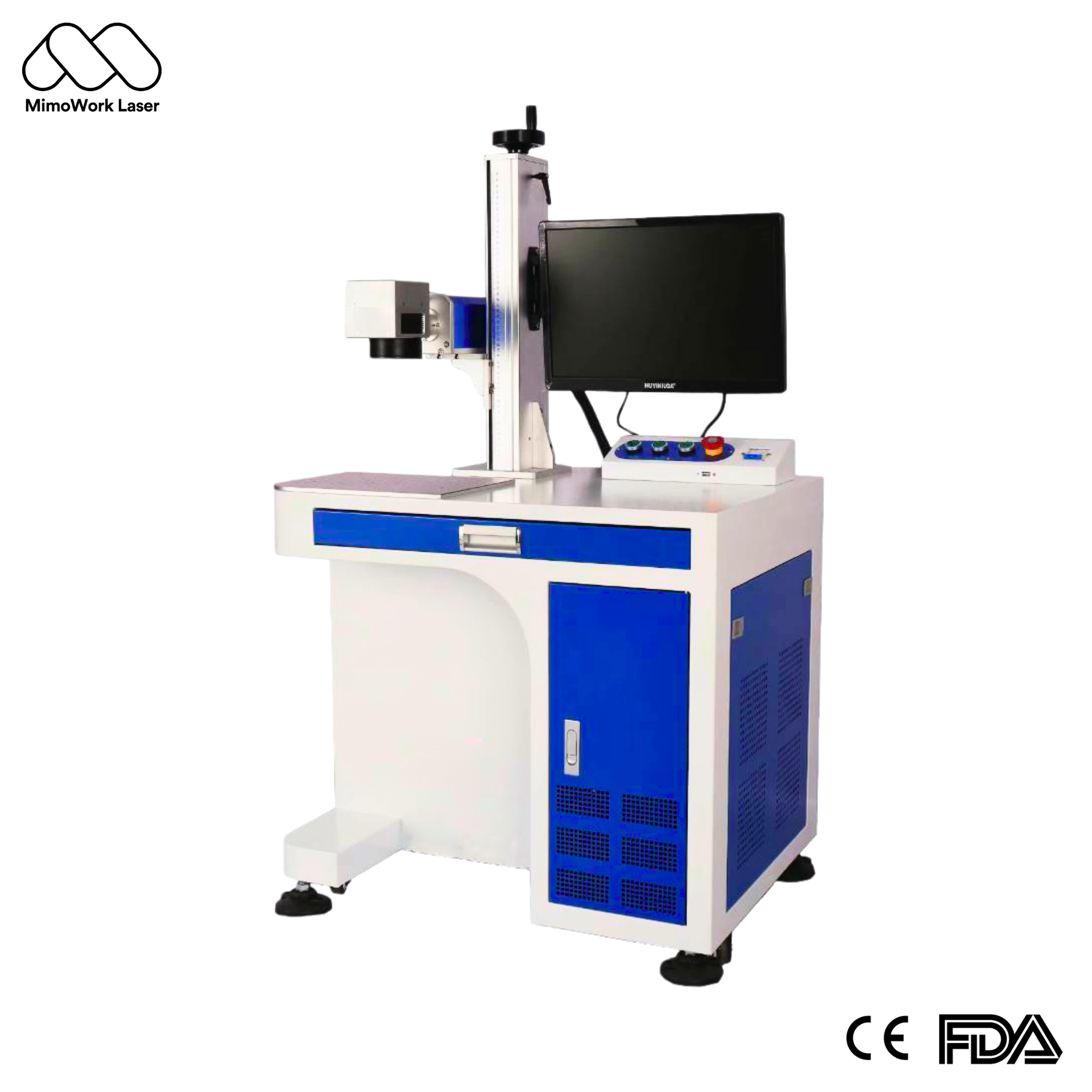
MimoWork’s current fiber laser marking configurations include 20W, 30W and 50W options, with working areas ranging from 70 × 70 mm to 200 × 200 mm and marking speeds of up to 8,000 mm/s, depending on configuration.
| Fiber Laser Power | Typical Buying Consideration | Suitable Direction |
| 20W | Standard identification and surface marking | Serial numbers, logos, QR codes, basic metal marking |
| 30W | More processing capacity and productivity | General industrial marking, larger production volumes |
| 50W | Higher throughput or deeper engraving requirements | Production marking and applications requiring more material removal |
| 60W MOPA | Advanced pulse control rather than simply higher power | Color marking, specialized stainless steel effects, demanding metal applications |
A buyer should therefore avoid asking only:
“What is the most powerful laser?”
A better question is:
“What laser power can produce my required mark within my required cycle time?”
For a small batch of simple serial numbers, 50W may provide little practical advantage over a lower-power configuration. In a high-volume production environment, however, the additional processing capacity may justify the investment.
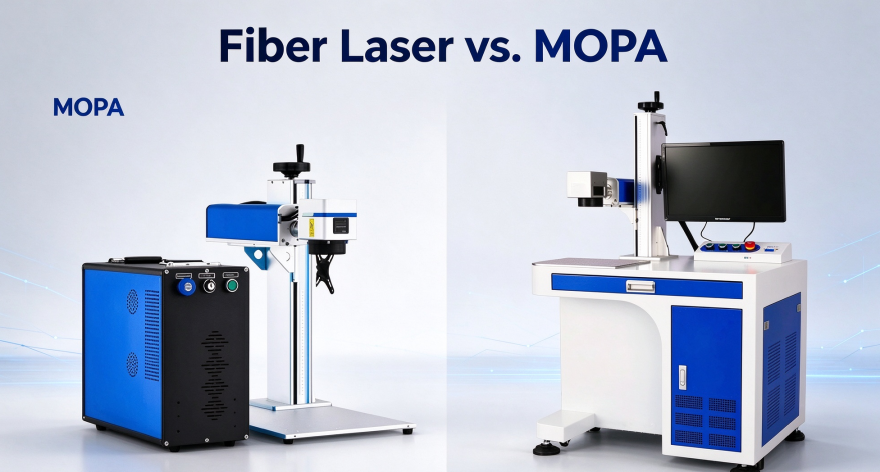
MOPA is still a fiber-laser technology, but it gives the operator greater control over pulse characteristics.
That additional control becomes valuable when the desired marking effect goes beyond conventional black or surface identification marks.
For example, MOPA technology can be useful for certain color-marking effects on stainless steel and for controlled black marking on aluminum. It can also provide more flexibility when heat input and surface appearance need to be carefully managed.
MimoWork’s current MOPA fiber laser marking machine uses a 60W MOPA source, 175 × 175 mm working area, 3D galvanometer system and up to 7,000 mm/s marking speed.
This creates an important distinction:
Standard fiber is often selected for straightforward industrial marking.
MOPA becomes more interesting when the marking effect itself is part of the product requirement.
If your production only requires serial numbers, barcodes and standard logos, a conventional fiber system may already provide everything necessary.
If you need color effects, specialized contrast or greater pulse control, MOPA deserves closer consideration.
The enclosure should be evaluated as part of the complete marking system rather than as an independent accessory.
The access door should be integrated with the machine’s safety system so that opening the enclosure does not simply leave the laser operating normally.
FDA documentation identifies protective housing and safety interlocks among the important safety provisions for laser products.
The exact requirements depend on the laser product and applicable regulations, so buyers should ask for the manufacturer’s compliance information rather than assuming that every enclosed system meets the same standard.
An enclosed marker still needs to allow operators to monitor the process.
The viewing window should therefore be appropriate for the laser wavelength and safety requirements of the system. A normal transparent window should not be assumed to provide laser protection simply because it blocks visible light.
Laser marking can generate smoke, particles or fumes depending on the material and surface treatment.
For standard bare-metal marking, emissions may be relatively limited, but coated materials, plastics and certain surface treatments can require much more attention to extraction.
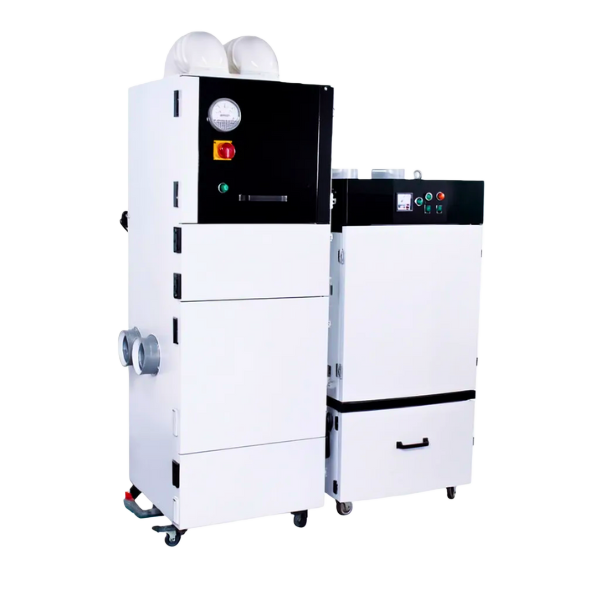
MimoWork also provides fume-extraction solutions designed for laser processing, allowing extraction to be considered as part of the overall workstation rather than an afterthought.
The enclosure needs to fit the way parts are actually loaded.
If operators mark hundreds of small components every day, an efficient loading arrangement may be more important than having an oversized marking area.
If the workpieces are large or irregular, an open or customized configuration may make more sense.
The marking field determines how large the design can be processed in one setup.
MimoWork’s fiber laser marking systems currently offer marking areas from 70 × 70 mm to 200 × 200 mm, depending on configuration.
A larger field can be useful for larger logos, multiple parts positioned within one cycle, or larger workpieces.
But there is a trade-off.
When the marking field increases, the optical configuration also changes. Buyers should therefore consider the relationship between field size, focal characteristics, marking resolution and the actual size of the graphics.
If almost every part you mark contains a 30 × 20 mm serial-number area, buying a very large marking field simply because it sounds more capable may not improve your production.
Instead, look at the largest design you routinely mark.
The galvo system is one of the reasons laser marking can achieve very high scanning speeds.
Rather than physically moving the entire laser head across every line of the design, galvanometer mirrors rapidly steer the laser beam across the marking field.
MimoWork’s fiber and MOPA marking systems use 3D galvanometer configurations.
For buyers, the practical question is not simply whether the machine says “3D Galvo.”
Ask what type of workpieces you need to mark.
If every component has a flat surface, the benefit of a 3D configuration may be different from an application involving curved or uneven surfaces.
This is another reason application testing is useful before purchasing a machine.
| Feature | Enclosed Fiber Laser | Open Fiber Laser |
| Processing environment | Controlled and contained | More open |
| Operator access | More restricted during operation | Easier physical access |
| Safety integration | Enclosure can incorporate interlocks | Requires greater attention to controlled access |
| Fume management | Easier to integrate extraction | Depends heavily on installation |
| Small-part production | Well suited | Also possible |
| Large/irregular parts | May require customized enclosure | More flexible |
| Production workstation | Suitable for standardized workflows | More flexible for specialized applications |
There is no universal reason to choose one format for every application.
An enclosed configuration makes particular sense when the machine will operate as a dedicated workstation and operator protection, repeatability and process control are important.
An open system can be more practical when the parts are too large for a standard enclosure or when the operator needs unrestricted physical access to the workpiece.
Related Guide: What is a Fiber Laser Marking Machine? The Ultimate Guide to Industrial Precision
An appropriately designed enclosure can restrict access to hazardous laser radiation during normal operation and can incorporate engineering controls such as protective housing and interlocks. However, the word “enclosed” alone does not guarantee a particular safety classification. Buyers should verify the manufacturer’s safety design, laser classification and compliance documentation for the intended market.
Fiber lasers are widely used for permanent marking and engraving on metals such as stainless steel, aluminum, titanium and other industrial metal components. Common applications include serial numbers, QR codes, barcodes, logos and product identification. The achievable marking depth and appearance depend on laser power, material and processing parameters.
Choose according to the material, required marking depth, production volume and cycle time rather than power alone. A 20W system can be suitable for standard identification marking, while 30W and 50W configurations provide additional processing capacity for higher productivity or deeper engraving requirements. MimoWork currently offers 20W, 30W and 50W fiber configurations, while its MOPA system uses 60W for applications requiring greater pulse control.
Buying a laser marking machine in 2026 is less about finding the machine with the highest specification and more about matching the complete system to the marking process.
For metal components, fiber laser technology provides a strong foundation for permanent identification, serialization and industrial marking. An enclosed configuration adds a more controlled workstation environment, while MOPA technology can extend the range of marking effects when standard fiber processing is not enough.
The enclosure, laser power, marking field, galvo system, extraction and loading method should therefore be considered together.
For buyers comparing MimoWork with other laser manufacturers, the same principle applies: start with the material and marking requirement, then select the laser source and machine configuration around the actual production workflow.
MimoWork’s current fiber and MOPA laser marking solutions provide different combinations of power, marking area and processing capability, giving manufacturers a practical starting point for matching the system to their application.
News | Sep-11-2026