Blog
In a field that evolves daily, staying ahead means staying informed.
Explore in-depth articles designed to help you solve complex challenges,
maximize your machine’s ROI.
Stay ahead in a competitive market.


In a field that evolves daily, staying ahead means staying informed.
Explore in-depth articles designed to help you solve complex challenges,
maximize your machine’s ROI.
Stay ahead in a competitive market.
News | Jun-22-2026
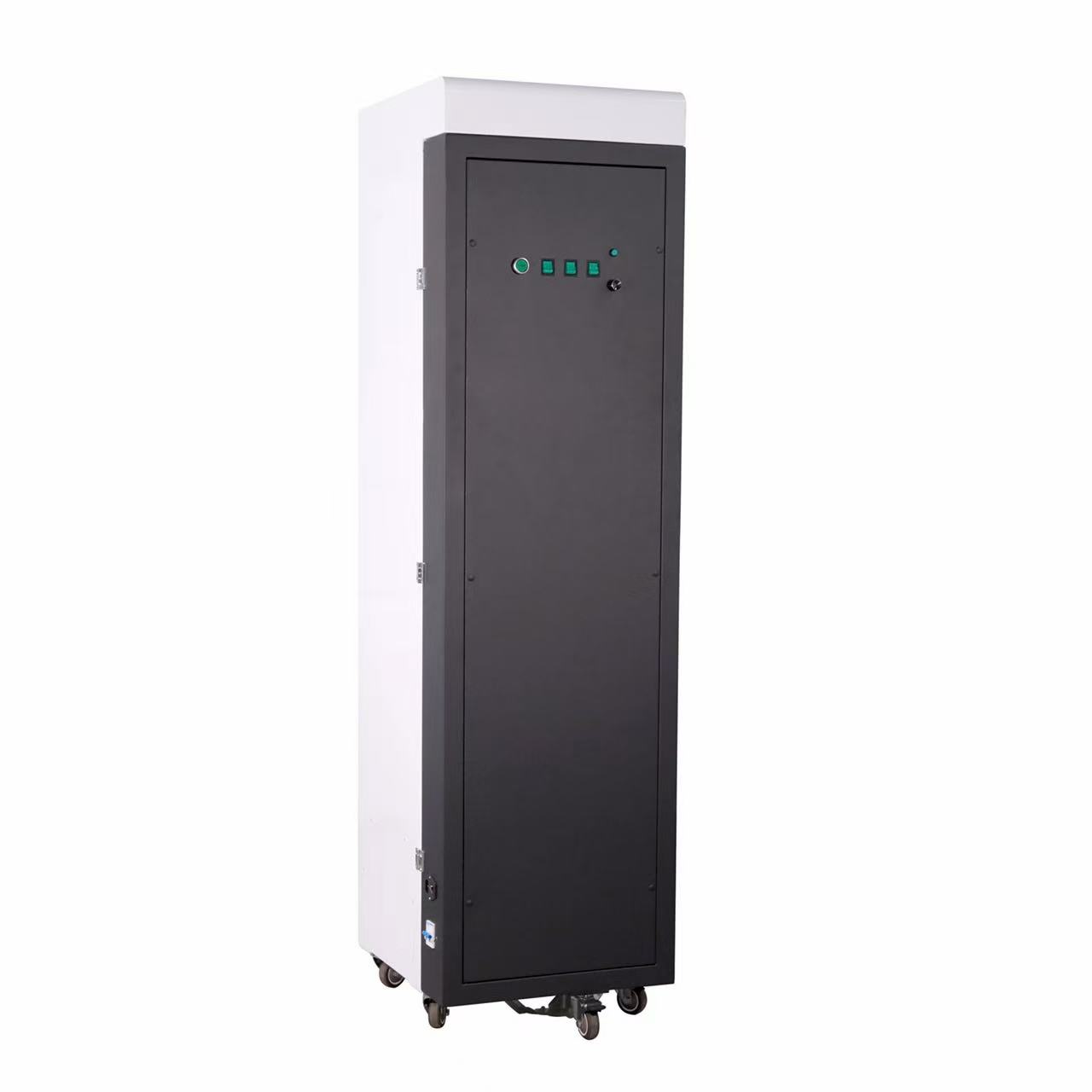
Run a laser engraver or cutter for more than a few hours, and you’ll notice it — the smell, the haze, the residue that ends up on your lens no matter how often you clean it. None of that is incidental. It’s the byproduct of the exact process that makes the machine useful and ignoring it has consequences that show up in your equipment, your finished parts, and eventually your health.This guide looks at what’s actually in laser fumes, why a basic fan doesn’t solve the problem, and how Mimowork’s fume extraction lineup is built around the reality that different materials and machine types produce very different airborne hazards.
The composition depends heavily on what you’re cutting or engraving, but it’s never “just smoke.” CO₂ laser processing of organic materials — wood, acrylic, leather, plastics — produces dense, often sticky smoke loaded with volatile organic compounds (VOCs) and odor-causing byproducts. Fiber laser cutting of metals generates something entirely different: fine, abrasive metallic dust suspended in the air. Laser welding and cleaning produce their own mix of metal vapor, spatter particles, and shielding gas residue.
The common thread is that none of it is something you want lingering in a workspace, on a workpiece, or inside a laser’s optical path.
Smoke and particulates don’t just disappear into the air around your machine — a lot of it settles. Residue redepositing onto a workpiece mid-process causes staining and discoloration that often means rework. On the equipment side, it’s worse: soot and fine dust drift back onto the laser’s lens and internal optics, gradually degrading mark or cut quality and requiring more frequent cleaning and maintenance than should be necessary.
Beyond the equipment side, there’s the question of what’s in the air your team is breathing. Operating without proper extraction exposes personnel to airborne particulates and fumes — some of which, depending on the material, pose real health risks with repeated exposure. A dedicated extraction system is what keeps a workshop compliant with workplace air quality standards, including OSHA requirements.
Mimowork’s extractors aren’t single-filter boxes. The filtration stack is built in stages, with each stage targeting a different objective. A pre-filter handles large debris and bigger particles first — this protects the finer filters downstream from clogging prematurely. For particulate matter, a HEPA filter captures 99.97% of airborne particles down to 0.3 microns, which covers the soot and fine residue generated by marking plastics, coated metals, and most engraving processes.
For odors and VOCs — the kind of smell that lingers on wood, acrylic, or leather after a cutting job — deep-bed activated carbon filtration is used to neutralize the chemical compounds that a particulate filter alone won’t catch. The C-Series, for example, combines a pre-filter for large debris with a specialized main filter for sticky resins and smoke, plus an optional activated carbon stage for odor — a setup specifically engineered for the byproducts of burning organic materials.
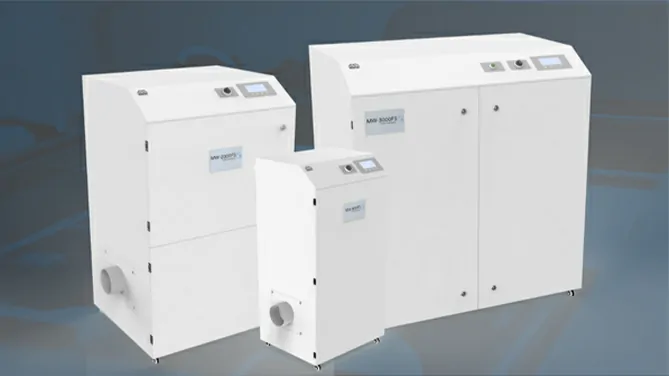
Not every laser process produces the same fume profile, and Mimowork’s lineup reflects that directly rather than offering one generic box:
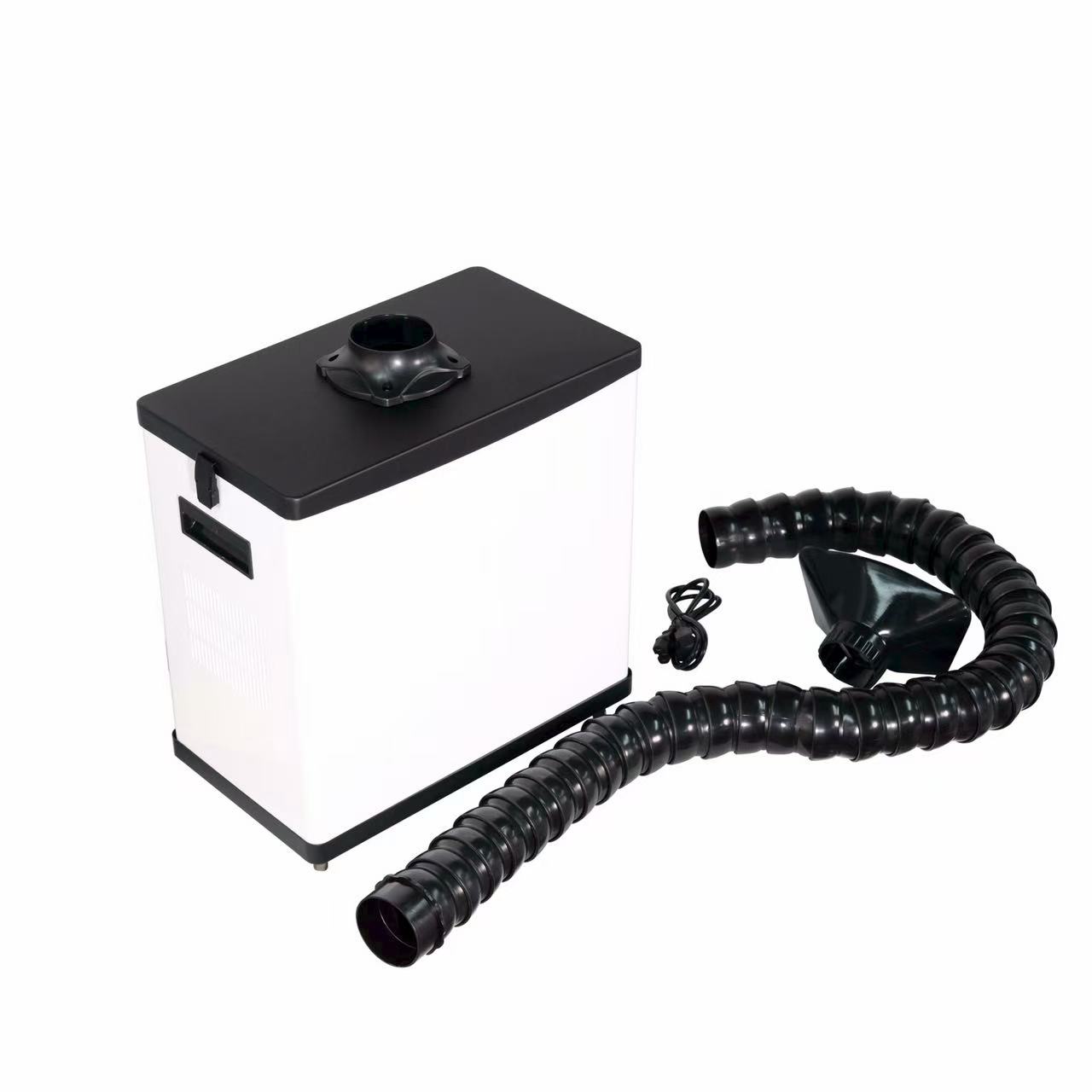
• C-Series — the standard for CO₂ laser engraving and cutting of non-metals like wood, acrylic, and leather. High-volume, sticky-smoke capable filtration designed for continuous operation.
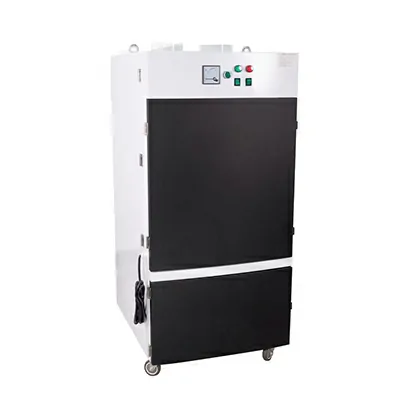
• F-Series — engineered for fiber laser metal cutting, where the challenge is dense, abrasive metallic dust rather than smoke.
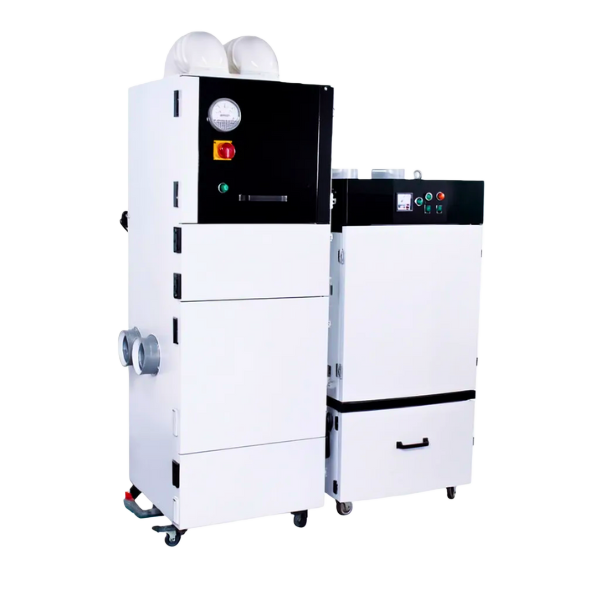
• W-Series — for laser welding and laser cleaning, where fume plumes are intense and localized. Delivers an extraction capacity of 690 m³/h with a precision articulated arm for positioning directly over the weld seam or cleaning path.
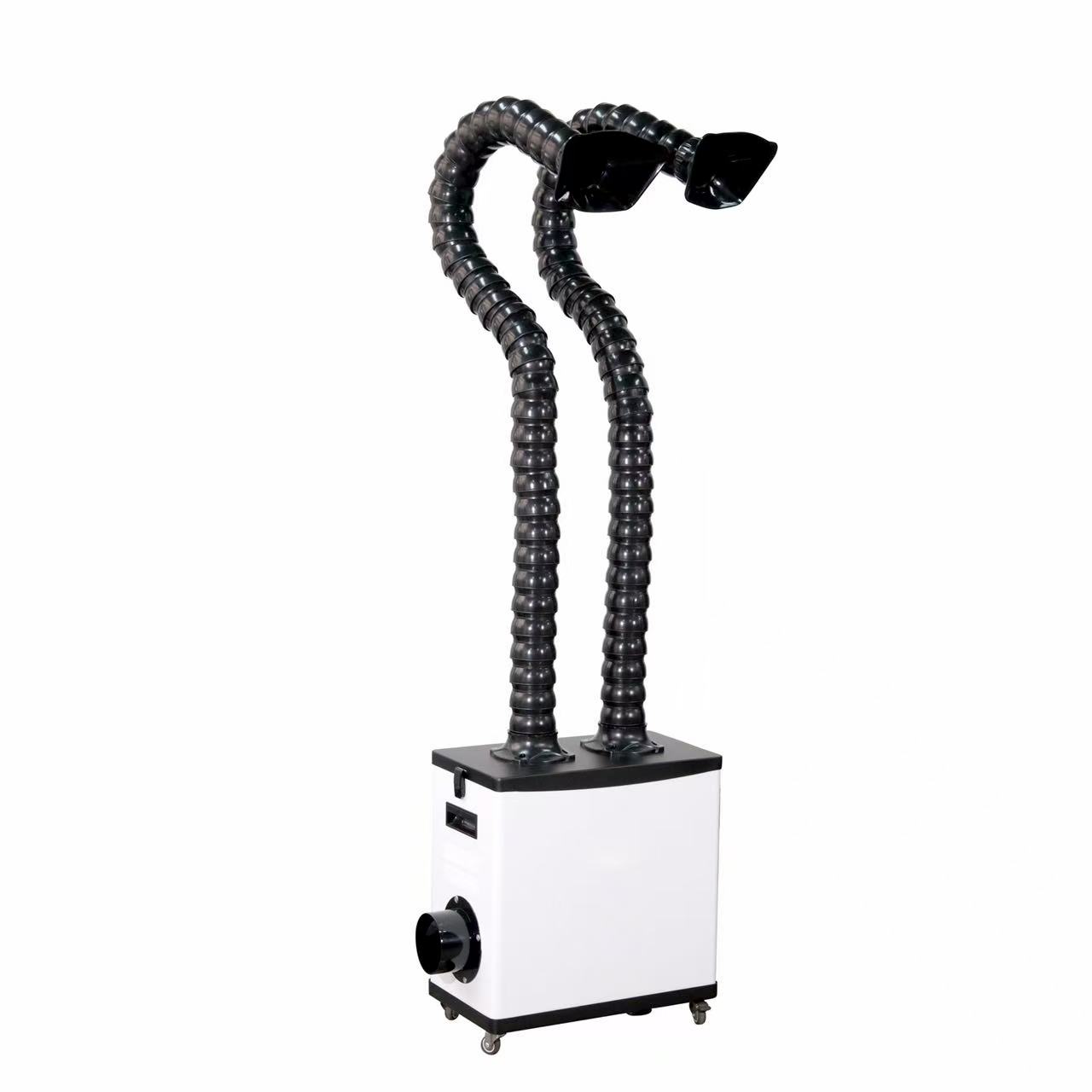
• D-Series and S-Series — purpose-built for DTF and sublimation printing applications, addressing the specific chemical byproducts those processes generate.
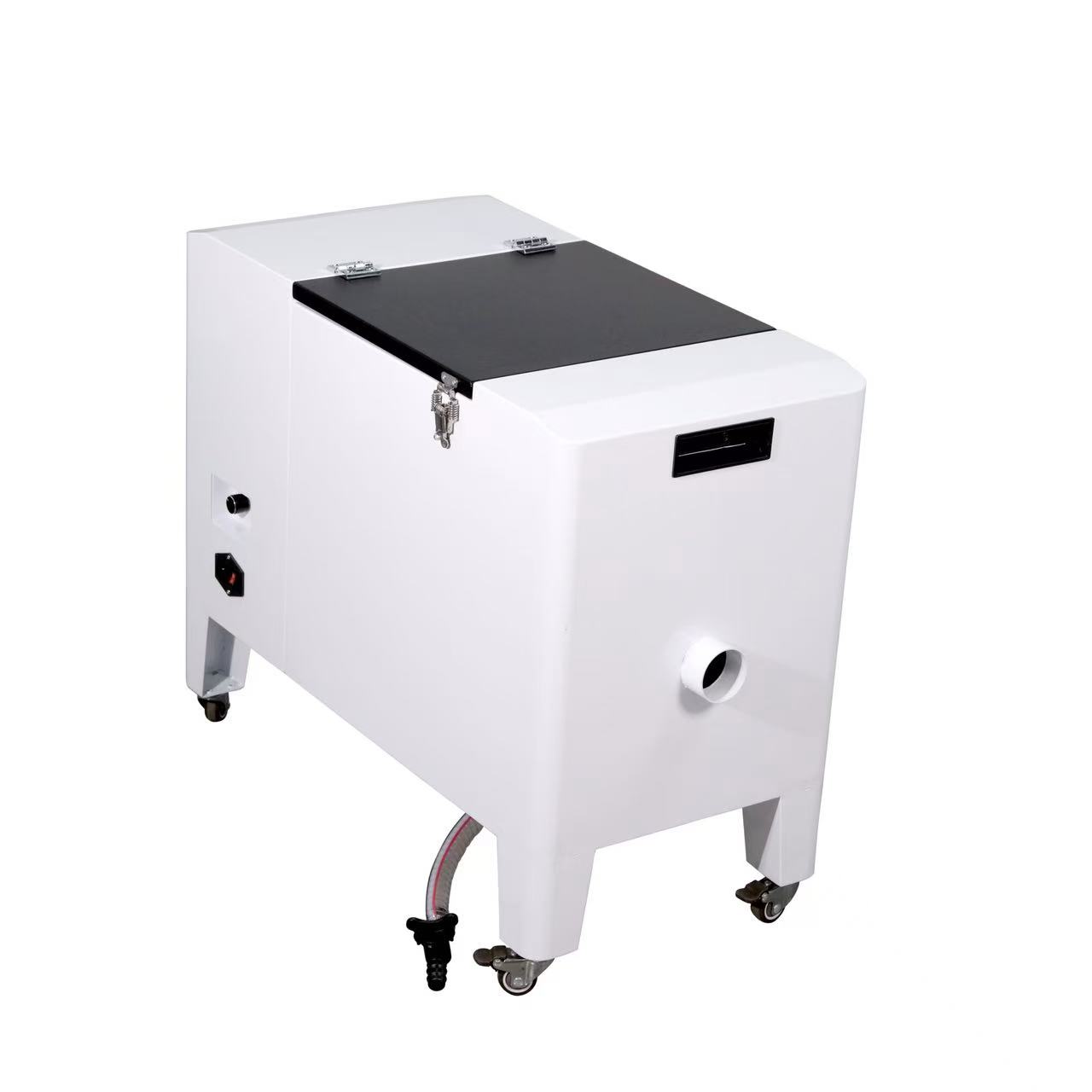
A fume extractor running at full power around the clock is both noisy and wasteful. Mimowork’s systems include a variable frequency drive (VFD) that lets the operator adjust suction to match the job — ramping up for heavy smoke during deep cutting, and dialing back for light engraving work to save energy and reduce filter wear. A filter saturation indicator removes the guesswork around maintenance timing, giving a clear visual or audible signal when a filter actually needs replacing rather than relying on a fixed schedule. Acoustical silencers are also available where noise matters — shared buildings, multi-machine shops, or simply long production runs where constant fan noise becomes a real fatigue factor.
Cutting or engraving synthetic fibers and printed fabrics produces a combination of fine particulate and chemically distinct fumes — often more pungent and persistent than what comes off natural materials. The C-Series’ combination of high-capacity particulate filtration and activated carbon addresses both halves of that problem: capturing the airborne fiber dust while neutralizing the chemical odor that synthetic materials tend to release under laser heat.
Leather cutting and engraving generate a notably strong, acrid odor along with sticky smoke residue — anyone who’s running a leather job without adequate extraction knows the smell tends to stick around the shop for hours afterward. The same pre-filter-plus-activated-carbon configuration that handles synthetic fabrics is effective here, too, removing both the particulate load and the persistent odor associated with leather processing.
Acrylic produces some of the most pungent fumes in CO₂ laser processing — the smell is distinctive, and the VOC content is significant, which is exactly what activated carbon filtration is designed to neutralize. Wood prototyping and sample work generate a different challenge: high particulate volume and tar-like residue that, if not captured efficiently, ends up coating both the workpiece and the machine’s internal components. The C-Series’s robust filtration is built for exactly this kind of high-volume, continuous-operation demand.
The starting point is always the same question: what type of laser are you running, and what are you putting through it? Processing non-metal materials with a CO₂ laser paths the way for our high-capacity flatbed fume extractors. Fiber laser metal cutting points toward the F-Series. Marking-specific setups, regardless of laser type, are usually better served by the compact M-Series. Welding and cleaning applications need the W-Series’ targeted arm-based extraction. If your shop runs more than one process, it’s worth mapping out which machines generate which kind of fume before settling on a configuration.
Mimowork’s extractors aren’t rigid, fixed configurations. Options such as articulated extraction arms, VFD speed control, acoustical silencers, and additional activated carbon stages can be added based on your specific workspace and process needs. A shop running mostly light engraving has very different requirements from one running continuously deep cutting down. The base unit doesn’t have to be a compromise between the two.
Because the profiles vary so much by material and process — and because workspace layout, duct runs, and machine placement all factor into what actually works — the most reliable path is getting a direct recommendation rather than guessing from a spec sheet. Mimowork’s team can walk through your specific setup and recommend the series and configuration that fits.
It depends on how different those materials are. If you’re working across a range of non-metals — wood, acrylic, leather, various plastics — the C-Series’ multi-stage filtration (particulate plus activated carbon) is built to handle that variety, since the common factor across these materials is organic smoke and VOCs. Where it gets more complicated is mixing fundamentally different processes — say, CO₂ engraving and fiber metal cutting on the same line. In that case, the fume profiles are different enough (organic smoke vs. abrasive metal dust) that a single extractor optimized for one will underperform on the other. The honest answer is to flag your full material range when discussing configuration, since that determines whether a single unit covers it or a dual setup makes more sense.
Yes — this is part of what the VFD and control integration are designed for. Rather than running the extractor continuously, regardless of whether the laser is active, the system can ramp up suction when the laser is cutting or engraving and reduce it during idle periods. This isn’t just about convenience; it directly reduces filter wear and energy use over the unit’s lifetime, particularly in shops where the laser isn’t running 100% of the time.
This comes down to total airflow demand versus the unit’s extraction capacity, and the practical feasibility of ducting multiple machines into a single system. The W-Series, for instance, is rated at 690 m³/h — whether that’s sufficient for multiple machines depends on each machine’s output and configuration. For shops with several machines running different processes (a CO₂ engraver and a fiber cutter, for example), a shared system isn’t always the right call, since the filtration needs differ. This is very much a case-by-case configuration question worth discussing directly.
Yes — odor control is a core part of the design, not an afterthought. The activated carbon stage is specifically there for this: deep-bed activated carbon filtration neutralizes the VOCs and odor-causing compounds that particulate filtration alone doesn’t address. This is especially relevant for materials like acrylic, leather, and certain plastics, where the smell is often the first thing people notice — and the last thing to go away without proper carbon filtration.
A fume extractor isn’t an add-on you bolt onto a laser system as an afterthought — it’s part of what makes the system actually usable in a real workspace, day after day, without degrading your equipment or your air quality. The right configuration depends entirely on what you’re processing: organic non-metals require activated carbon and high-volume particulate handling; metal cutting requires filtration designed for abrasive dust; and welding or cleaning requires targeted, high-capacity extraction at the source.
If you’re not sure which series fits your setup, Mimowork can walk through your specific machines and materials and recommend a configuration that actually matches your shop.