Blog
In a field that evolves daily, staying ahead means staying informed.
Explore in-depth articles designed to help you solve complex challenges,
maximize your machine’s ROI.
Stay ahead in a competitive market.


In a field that evolves daily, staying ahead means staying informed.
Explore in-depth articles designed to help you solve complex challenges,
maximize your machine’s ROI.
Stay ahead in a competitive market.
News | Jul-3-2026
Choosing the right laser marking machine for metal is one of the most important investment decisions a manufacturer, jewelry workshop, or industrial parts supplier will make. Metal marking demands precision, permanence, and repeatability, and the wrong machine can mean wasted material, slow throughput, or inconsistent results. This guide breaks down how metal laser marking works, what to compare before buying, and how to match a machine to your production needs.
A metal laser marking machine uses a focused, high-energy laser beam to create permanent marks on a metal surface without physical contact. Unlike printing or stamping, the laser beam alters the surface at a microscopic level, producing marks that resist abrasion, chemicals, and heat.
Fiber lasers are widely regarded as the metal-friendly laser source because of how the beam interacts with metallic surfaces.
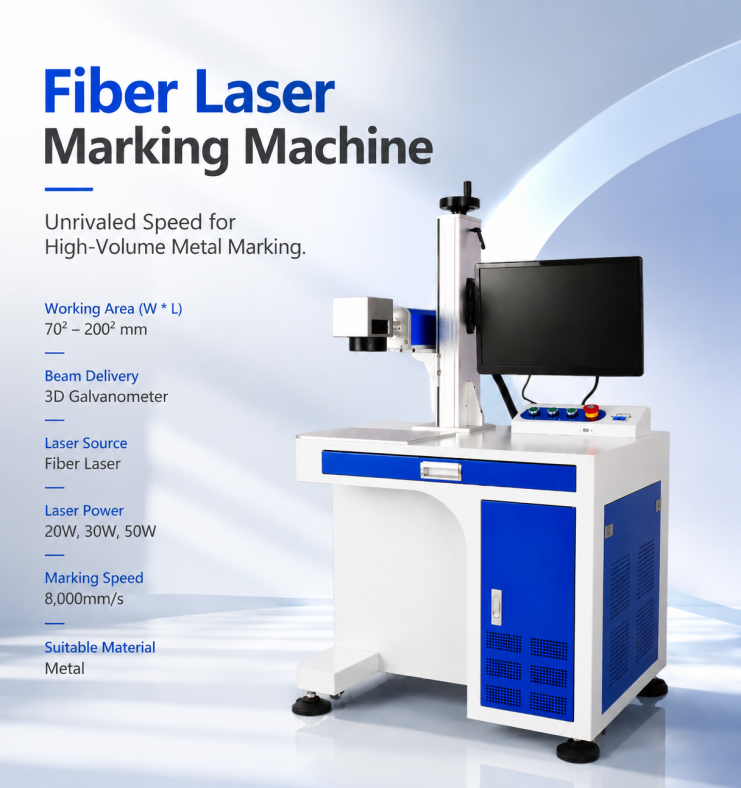
Metal laser marking is used across a wide range of industries because the marks are durable and traceable.
Before diving into technical specifications, watch this comprehensive guide on how to choose a fiber laser marking machine:
Not all laser marking systems are built the same way, and the differences directly affect mark quality, speed, and the metals you can process.
This is the most fundamental comparison buyers need to understand before purchasing. Fiber lasers are tuned specifically for high absorption by metal, while CO2 lasers are generally categorized as non-metal processing systems, although certain CO2 configurations (commonly available in 180W, 250W, and 500W power options) can also process metals such as stainless steel, aluminum, titanium, copper, gold, and silver depending on the specific application and settings.
| Primary classification | Metal | Non-metal (with select metal compatibility) |
| Common power range | Lower power for marking, higher for deep engraving | 180W / 250W / 500W |
| Best suited for | A fiber laser marking machine for stainless steel components, tools, jewelry | Non-metal materials, plus select metals under specific conditions |
| Mark permanence on metal | Very high, deep and resistant | Varies depending on metal type and settings |
It’s worth clarifying that handheld marking is typically offered as an upgrade or variant configuration of a fiber laser marking machine, rather than a fully separate product category.
| Standard desktop/galvo system | High repeatability, automated workflow, ideal for flat or small parts | Limited to the fixed working table size |
| Handheld upgrade/variant | Marks large or fixed objects on-site, flexible positioning | Requires more operator skill for consistent depth |
When evaluating any laser marking machine for metal, the technical specifications determine whether the machine fits your production reality.
Different metals respond differently to laser energy, and understanding this helps set realistic expectations for mark contrast and durability.
| Stainless steel | Dark, high-contrast permanent mark | Industrial parts, nameplates |
| Aluminum | Light-toned, requires power control | Electronics housings, signage |
| Brass/Copper | Visible depth, good contrast | Decorative items, hardware |
| Titanium | Color-variable marks | Jewelry, medical devices |
While fiber and CO2 lasers cover most metal marking needs, two additional laser types exist for more specialized requirements and may be relevant depending on your material mix.
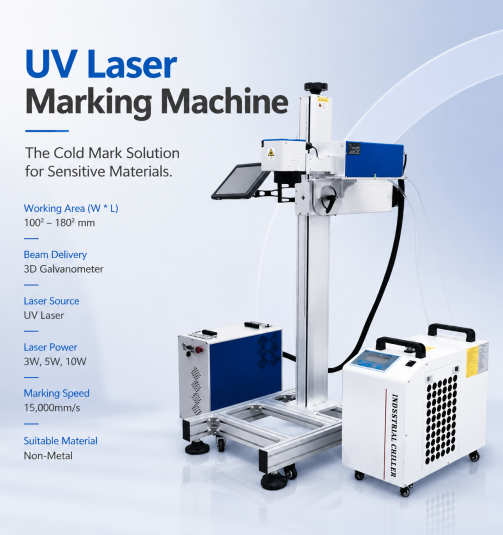
UV laser marking machines are positioned as a cold-marking solution, meaning they generate minimal heat during processing. This makes them suitable for plastics, precision electronics, and medical devices where heat damage must be avoided.
Green laser marking machines are designed for fine, high-resolution marks on highly reflective metals as well as sensitive semiconductor materials such as silicon wafers and IC chips, where standard fiber lasers may not provide adequate control.
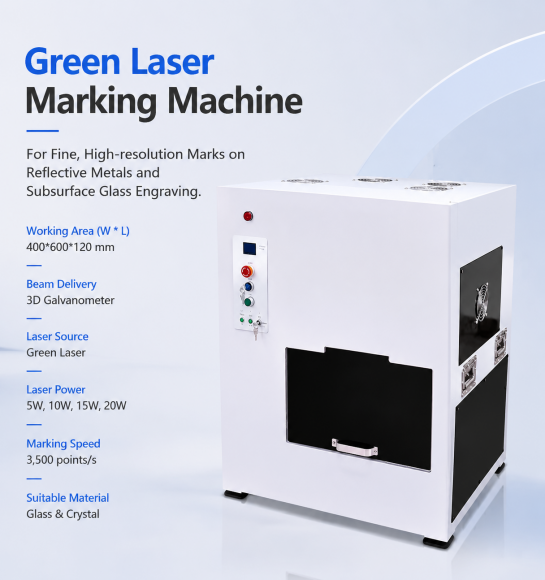
A laser marking machine for metal jewelry and tools serves very different end markets, but the underlying technology and selection criteria overlap significantly.
For these applications, beam precision and the ability to handle small, curved, or reflective surfaces matter more than raw power.
Jewelry makers use fine-detail fiber laser systems to engrave rings, pendants, and watches with personalized text, logos, or decorative patterns.
Custom gift and promotional product businesses use metal marking machines to add names, dates, or logos to metal items such as pens, keychains, and plaques.
Matching machine capability to your actual production needs prevents both overspending and underperformance.
Reliable after-sales guidance, including software setup and parameter troubleshooting, significantly reduces downtime once the machine is in production.
Pre-sales consultation helps match laser parameters to your specific metal types and mark requirements before you commit to a purchase.
Customizable working tables and modular laser options, including upgrades like handheld configurations, allow the machine to adapt as your product range grows.
Yes, many fiber laser systems classified primarily for metal are also compatible with non-metal materials such as ABS, acrylic, polycarbonate, nylon, leather, glass, and ceramics, making them suitable for workshops with mixed-material production.
For most identification marks, barcodes, and logos, lower-power fiber lasers are sufficient. Higher power is only needed for deep engraving or very high-speed production lines.
Handheld configurations, typically offered as an upgrade to a standard fiber laser system, provide excellent flexibility for large or fixed objects, but the standard desktop/galvo configuration generally offers higher repeatability for batch production due to fixed positioning.
Some CO2 laser systems, commonly available in 180W, 250W, and 500W power options, can process certain metals such as stainless steel, aluminum, titanium, copper, gold, and silver, although CO2 lasers are generally categorized as non-metal processing equipment. Fiber lasers remain the standard choice for dedicated metal marking.
Surface marking changes the oxide layer color without removing significant material, while deep engraving physically removes material to create a tactile, raised or recessed mark, typically requiring more power and slower processing speed.
Choosing the right laser marking machine for metal comes down to matching laser type, power, and configuration to your actual material and production needs. Fiber lasers remain the standard for dedicated metal work, such as a fiber laser marking machine for stainless steel or a fiber laser engraver for metal jewelry, while CO2 systems (180W/250W/500W) can handle select metals, and UV or green lasers suit more specialized, heat-sensitive applications.
If your production spans both tools and jewelry, a versatile laser marking machine for metal jewelry and tools often offers better long-term value than a single-purpose system. Smaller workshops should also factor in the handheld metal laser marking machine price as a flexible upgrade option, and decide early whether your work requires a deep engraving laser marking machine for metal or simple surface marking.
Before ordering, discuss your metal types, marking depth requirements, and expected volume with the supplier, and request a sample test or live demo whenever possible to avoid costly mismatches down the line.
News | Jun-30-2026
News | Jun-15-2026
News | Jun-5-2026