Blog
In a field that evolves daily, staying ahead means staying informed.
Explore in-depth articles designed to help you solve complex challenges,
maximize your machine’s ROI.
Stay ahead in a competitive market.


In a field that evolves daily, staying ahead means staying informed.
Explore in-depth articles designed to help you solve complex challenges,
maximize your machine’s ROI.
Stay ahead in a competitive market.
News | Aug-5-2026
Do you really need a laser welding fume extractor for your welding operation?
Many manufacturers ask this question when they start using laser welders.
After all, laser welding produces less visible smoke than traditional welding.
Laser welding generates a concentrated fume plume that standard ventilation simply cannot handle fast enough. Without proper source capture, fine metal particles stay airborne—affecting weld visibility, filter life, and operator health.
This guide covers what to look for in a welding fume extractor, how laser welding differs from other processes, and why localized high-vacuum extraction outperforms general ventilation for precision applications.
When choosing a welding fume extractor, many people focus first on one specification: airflow capacity.
But is a higher airflow rating always better?
Not necessarily.
Effective fume extraction is not only about moving more air. It is about capturing fumes at the exact point where they are generated.
This is especially important for laser welding, where fumes are concentrated around a small weld pool. A well-designed extractor should provide:
A professional laser welding fume extractor should work as part of the welding process—keeping the weld area clear while helping operators maintain consistent results.
A common question is:
“How much airflow is enough for laser welding?”
The answer depends on your application.
Laser welding produces a concentrated fume plume around the weld pool. Instead of extracting air from the entire workshop, the system should focus suction directly at the welding point.
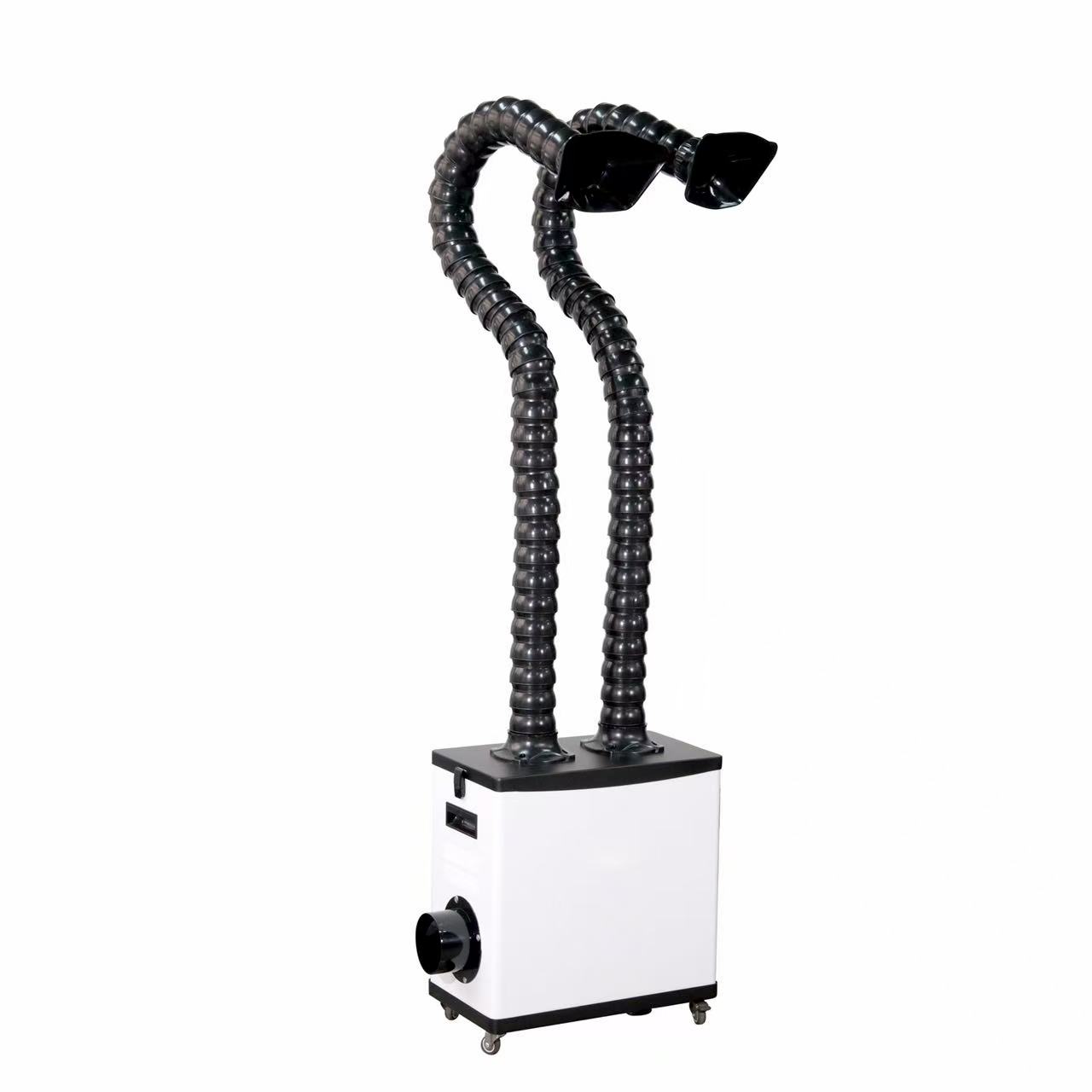
The MimoWork W-Series uses a high-vacuum industrial blower with an extraction capacity of 690 m³/h.
This allows the extractor to:
Visible smoke is only part of the problem.
During laser welding, the process generates extremely fine metal particles and fumes that may remain suspended in the air even when the workspace appears clear.
This means that simply removing visible smoke is not enough. A reliable welding fume extractor needs an effective filtration system to capture different particle sizes and maintain cleaner air around the welding area.
A professional system typically combines multiple filtration stages:
With proper filtration, the extractor not only improves workplace cleanliness but also helps protect operators and maintain a more stable welding environment.
Many workshops already have ventilation.
So:
“Why buy a welding fume extractor if my workshop already has air circulation?”
Because they solve different problems.
General ventilation moves air throughout the room.
A welding fume extractor captures contaminants before they spread.
For laser welding, source capture is usually the better solution.
Laser welding creates less visible smoke than traditional welding, but it still produces fine metal fumes and particles. Because the laser energy is concentrated in a small area, fumes are released directly from the weld point.
A dedicated laser welding fume extractor captures these fumes before they spread, helping maintain a cleaner workspace and safer operation.
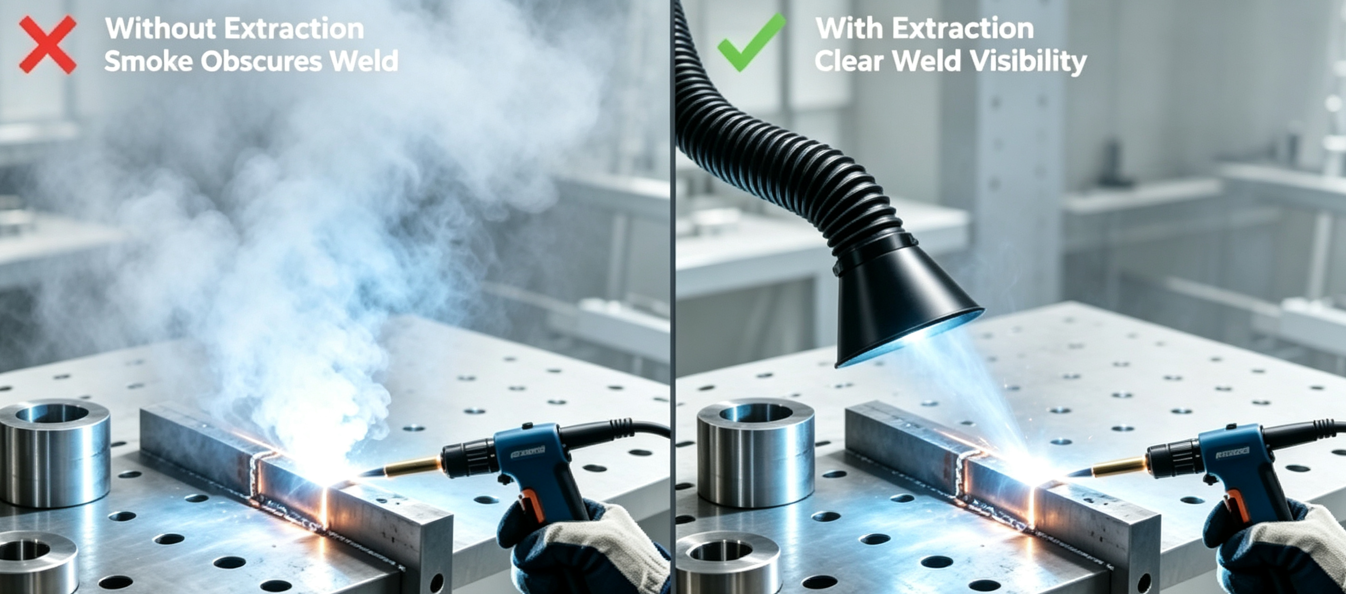
Smoke around the weld point can affect visibility during precision welding. This makes it harder to monitor the process and achieve consistent results.
A fume extractor removes smoke as it is generated, keeping the welding area clear and improving operator control.
General ventilation moves air around the workshop, but it may not capture fumes quickly enough.
A source capture system places the extraction arm close to the weld point, collecting fumes before they enter the workspace. This provides more effective protection for operators and equipment.
Without proper extraction, fine metal particles can settle on machines, tools, and work surfaces.
A professional welding fume extraction system removes airborne particles during operation, helping reduce buildup and keeping the production area cleaner.
| Feature | General Ventilation | Basic Fume Extractor | W-Series (MimoWork) |
| Capture method | Room air dilution | Near-source | Pinpoint source capture |
| Fine particle filtration | No | Partial | 99.97% @ 0.3μm |
| Arm positioning | N/A | Fixed | Articulated, counter-balanced |
| Laser welding suitability | Poor | Limited | Optimized |
For laser welding applications, source capture is generally more effective than relying only on room ventilation because fumes are removed before they spread.
The MimoWork W-Series Fume Extractor is designed for laser welding and laser cleaning applications where precise fume control is required.
Unlike general ventilation systems, the W-Series focuses on pinpoint extraction, capturing fumes directly at the weld point or cleaning area.
It combines:
to help maintain clear visibility and cleaner working conditions during laser processing.
The W-Series uses a high-vacuum industrial blower to provide strong localized suction at the end of the extraction arm.
This helps capture rising fumes quickly and prevents smoke from obscuring the weld pool or operator’s view.
The W-Series uses a two-stage filtration design:
Primary Particulate & Spark Arresting Filter
Captures larger particles, welding spatter, sparks, and debris generated during laser cleaning.
Fine Dust & Fume Filter Cartridge
Captures fine particulate and smoke from laser welding and cleaning processes.
With 99.97% filtration efficiency at 0.3 μm, the system helps maintain cleaner air around the workstation.
The industrial-grade articulated arm allows precise positioning directly at the weld seam or cleaning path.
With a heat-resistant capture hood, it helps achieve effective source capture in demanding laser processing environments.
The W-Series is suitable for:
It is designed for applications requiring localized extraction, clear visibility, and reliable fume control.
Yes. A fume extractor is recommended for laser welding to remove harmful fumes, fine metal particles, and smoke generated during the welding process.
Laser welding creates localized but high-temperature vaporization that can produce airborne contaminants, especially when processing metals such as stainless steel, aluminum, and coated materials. A properly sized fume extraction system captures these particles at the source, helping maintain a cleaner and safer working environment while protecting operators and equipment.
The extraction arm should be positioned as close as possible to the welding area without interfering with the operation — typically within a few inches (around 10–20 cm) of the fume source.
Capturing fumes at the source is more effective than trying to remove smoke after it spreads into the workspace. An adjustable extraction arm allows operators to position the nozzle directly above the weld point for efficient fume capture.
The best fume extractor for laser welding should provide high-efficiency filtration, flexible source capture, and reliable performance for continuous industrial use.
A dedicated welding fume extractor for laser welding helps remove fine metal particles, maintain a cleaner workspace, and support consistent welding performance. By considering factors such as filtration efficiency, extraction capacity, and application requirements, manufacturers can select a system that matches their production needs.
Ready to eliminate welding smoke from your laser workstation? The W-Series is available in multiple configurations for handheld laser welding, laser cleaning, and industrial fabrication. [Get a Free Configuration Recommendation →]
News | Jul-9-2026
News | Jul-24-2026