Blog
In a field that evolves daily, staying ahead means staying informed.
Explore in-depth articles designed to help you solve complex challenges,
maximize your machine’s ROI.
Stay ahead in a competitive market.


In a field that evolves daily, staying ahead means staying informed.
Explore in-depth articles designed to help you solve complex challenges,
maximize your machine’s ROI.
Stay ahead in a competitive market.
News | Aug-14-2026
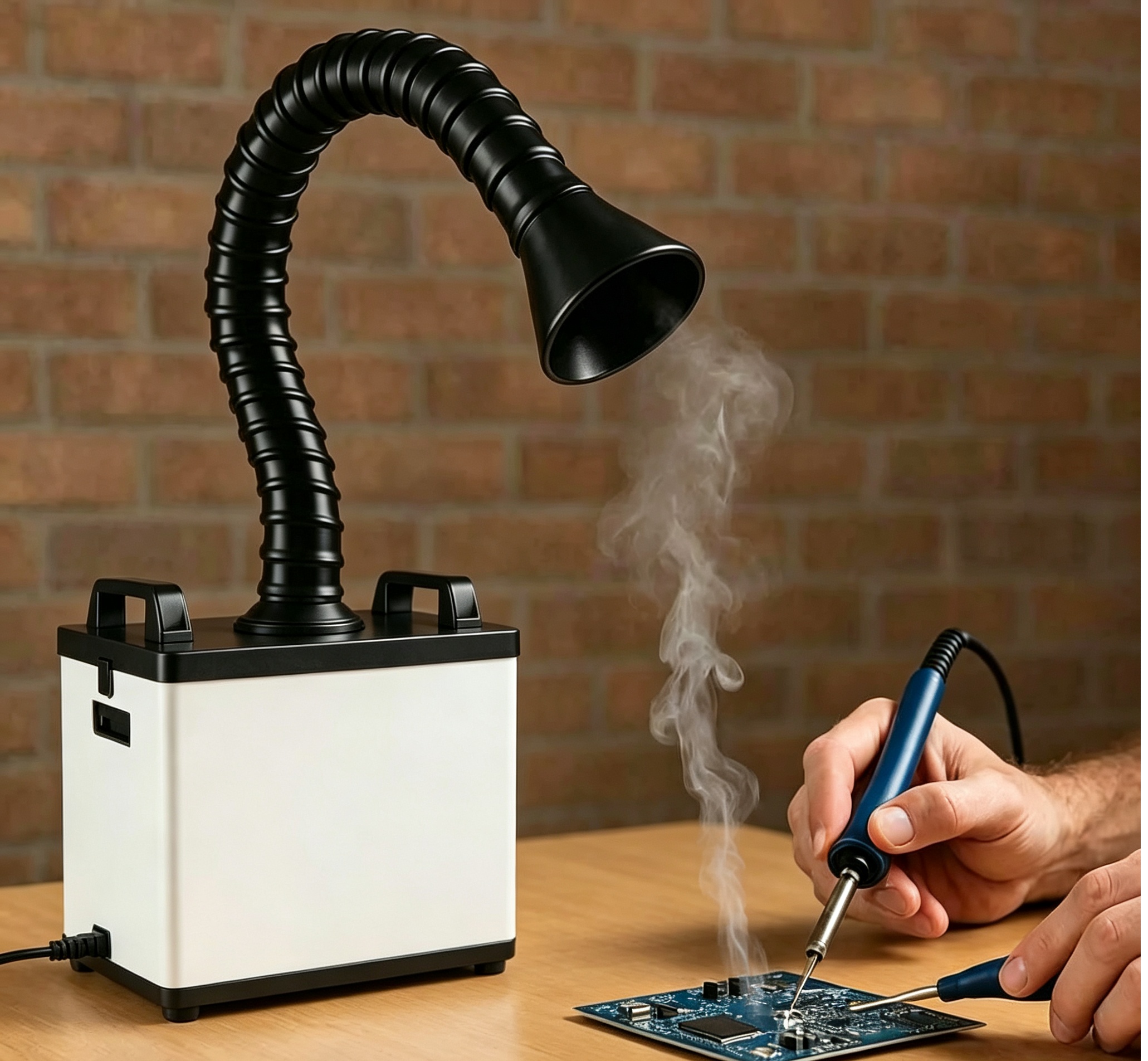
The short answer is yes.
Soldering smoke may look harmless because the amount produced during each operation is small. However, during repeated soldering work, operators can spend hours near the source of these emissions.
Using a Benchtop Fume Extractor or local extraction system helps remove contaminants directly from the source, making it suitable for soldering stations, PCB repair, and electronics manufacturing environments.
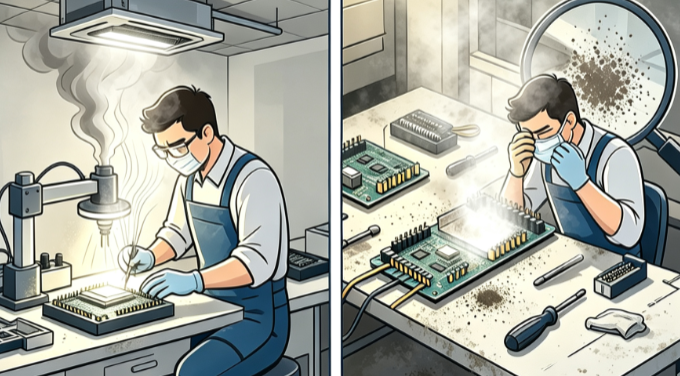
A common misunderstanding is:
“A small amount of smoke means a small problem.”
But in precision manufacturing, even small amounts of airborne contamination can create unnecessary issues.
Over time, uncontrolled soldering fumes may lead to:
Operators working close to soldering stations may notice smoke, odors, or discomfort during long production hours.
Smoke particles can settle on:
For manufacturers working with precision equipment, keeping the workspace clean helps maintain stable production conditions.
This is why localized extraction has become a common solution in electronics manufacturing and laboratory environments.
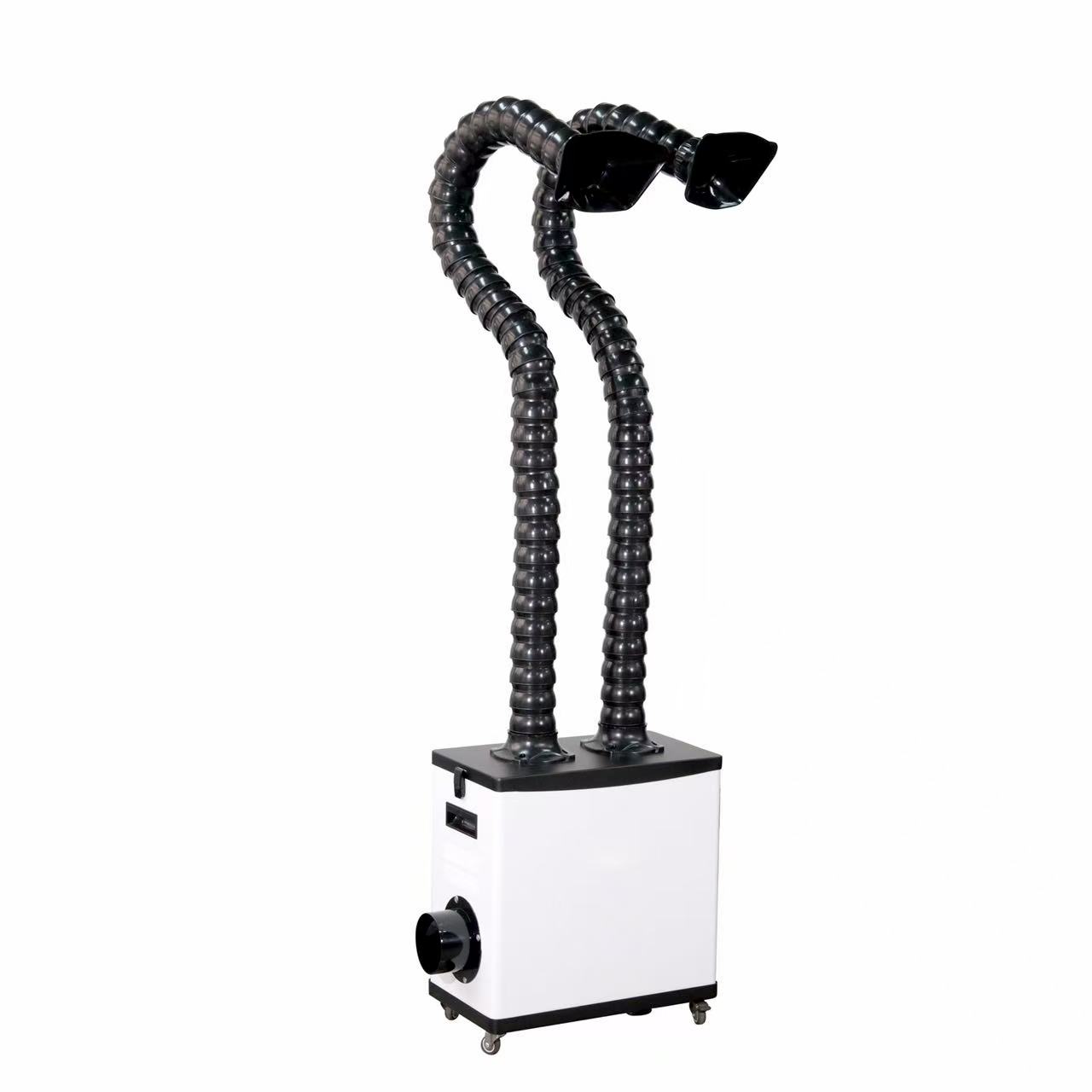
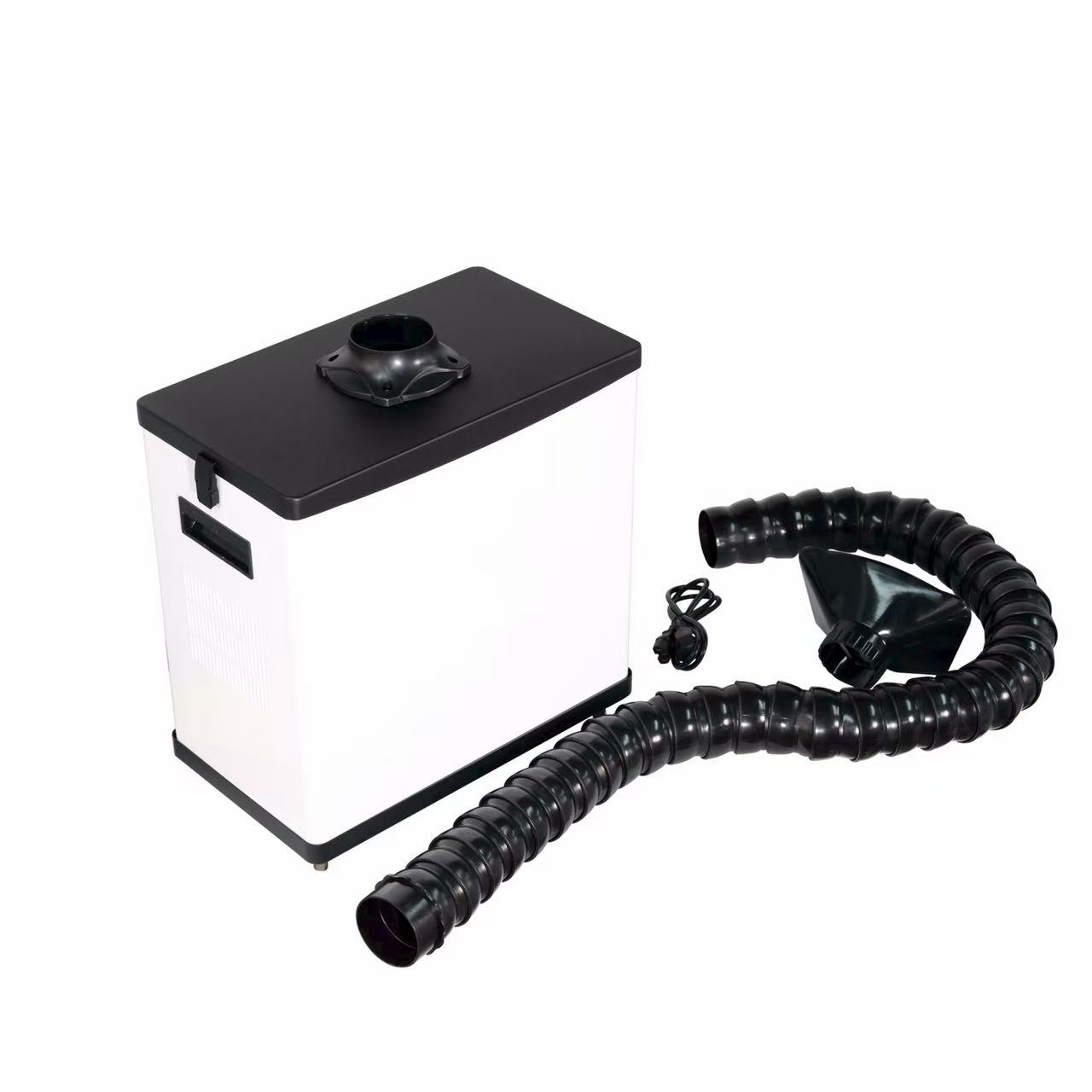
A Tabletop Fume Extractor is essentially a small air filtration system designed to solve one specific problem:
Capture contamination before it reaches the surrounding workspace.
Instead of waiting for smoke to spread through the room, the extractor pulls contaminated air directly from the source, filters it, and returns cleaner air.
Compared with traditional ventilation systems, tabletop extraction provides several advantages:
Typical applications include:
| Application | Common Contaminants | Recommended Solution |
| Electronics soldering | Flux smoke, fine particles | Benchtop Fume Extractor |
| Fiber laser marking | Metal smoke, fine residues | Fiber Laser Marking Fume Extractor |
| Laser engraving | Material smoke and odors | Laser Engraving Fume Extractor |
| Laboratory processing | Various airborne particles | Compact extraction system |
Think of a fume extractor as a three-step protection system.
The extraction arm is positioned close to the source.
The goal is simple:
Remove fumes before they enter your breathing zone.
This is especially important for laser marking and soldering because emissions are created very close to the operator.
The contaminated air passes through multiple filtration stages.
A professional system usually includes:
Pre-Filter
Captures larger particles and protects the main filter.
HEPA Filter
Captures fine airborne particles generated during soldering and laser processing.
For laser applications, a HEPA Filter Laser Fume Extractor helps remove small particles produced during engraving and marking.
Activated Carbon Filter
Helps reduce odors and gaseous contaminants generated from certain materials.
After filtration, cleaner air is returned to the workspace.
This creates a cleaner workstation environment without requiring large ventilation infrastructure.
Many users focus on laser power, marking speed, and machine accuracy when choosing a laser system.
But there is another factor that is often overlooked:
What happens to the smoke generated during laser processing?
When a laser interacts with a material surface, it removes material through heat. Depending on the material, this process can release:
For occasional use, the impact may seem minor. However, for companies operating laser marking systems every day, uncontrolled smoke can gradually affect both the working environment and equipment cleanliness.
This is especially important for:
A dedicated Fiber Laser Marking Fume Extractor helps capture airborne particles directly from the marking area, reducing contamination before it spreads.
A common question from laser users is:
“Do I really need a fume extractor for my laser?”
The answer depends on your application.
If your laser process creates visible smoke, residue, or odor, extraction should be considered.
Laser smoke can create several challenges:
During laser engraving or marking, airborne particles may settle on:
Over time, this creates additional cleaning requirements.
Laser systems rely on precision optical components.
Particles generated during processing may accumulate around sensitive areas, increasing maintenance needs.
For manufacturers running high-frequency laser marking operations, keeping the processing area clean helps maintain consistent performance.
Even when smoke levels appear low, operators working near the laser for several hours may notice:
A properly selected extraction system helps create a cleaner and more comfortable production environment.
A compact fume extraction system is not limited to one industry.
It is commonly used wherever a localized process creates smoke or airborne particles.
Electronics production is one of the most common applications.
During soldering, operators often work only a few centimeters away from the smoke source.
A Benchtop Fume Extractor is commonly used for:
The advantage is simple:
Each workstation gets its own extraction solution without requiring a large factory ventilation system.
Fiber laser marking is widely used for permanent identification and traceability.
Common applications include:
However, the marking process can generate fine particles depending on the material.
For example:
| Material | Possible Emissions |
| Stainless steel | Fine metal particles |
| Aluminum | Smoke and surface residues |
A Fiber Laser Marking Fume Extractor helps remove these emissions directly during processing.
Laser engraving is popular in both small workshops and professional manufacturing.
Materials such as:
A Laser Engraving Fume Extractor helps control these emissions and keeps the engraving area cleaner.
For desktop laser systems, a compact extractor is often more practical than installing a permanent exhaust system.
Choosing a fume extractor is not just about buying the largest airflow system available.
The right solution depends on:
Different processes create different types of contamination.
| Application | Main Concern | Recommended Extraction Type |
| Soldering | Flux smoke and particles | Benchtop Fume Extractor |
| Fiber laser marking | Fine metal particles | Fiber Laser Marking Fume Extractor |
| Laser engraving | Smoke and odors | Laser Engraving Fume Extractor |
A system designed for soldering may not always be ideal for laser applications.
Choosing according to the actual process is the first step.
Airflow is important, but filtration quality matters just as much.
A good extraction system should consider:
For laser processing, a HEPA Filter Laser Fume Extractor provides an important filtration stage for capturing fine airborne particles.
A fume extractor is equipment that runs alongside your production process.
Important features include:
A system that is easy to maintain helps reduce unexpected downtime.
This is a common question for small and medium manufacturers.
The answer depends on your production environment.
| Feature | Tabletop Fume Extractor | Traditional Ventilation |
| Capture method | Captures fumes at source | Removes air after spreading |
| Installation | Simple setup | Requires ductwork |
| Flexibility | Easy to move | Fixed installation |
| Best for | Workstations and small production areas | Large factories |
For companies operating individual laser marking stations or small production cells, localized extraction is often the more practical option.
When choosing a fume extractor for laser marking, many users are looking for the same things:
The MimoWork M-Series Fume Extractor was developed for this type of application.
Rather than replacing large industrial ventilation systems, the M-Series focuses on one specific requirement:
Capturing laser-generated smoke directly around the marking workstation.
Space is often limited around laser marking equipment.
A large extraction system may not be practical for:
The M-Series features a compact design that allows it to be placed close to the laser workstation.
This makes integration easier while keeping the working area organized.
Laser marking produces very small particles that may not be visible during operation.
The M-Series uses multi-stage filtration designed to capture these contaminants.
Key filtration performance:
| Specification | M-Series Performance |
| Filtration efficiency | 99.97% at 0.3 μm |
| Extraction capacity | 390 m³/h |
| Inlet diameter | Ø75 mm |
| Application | Laser marking |
For fiber laser marking applications, this filtration capability helps reduce smoke residue and maintain a cleaner processing environment.
The M-Series is designed around the needs of laser marking users.
This helps maintain:
With a compact structure and dedicated inlet design, the system can be integrated into laser marking workstations without major changes to existing equipment.
Yes.
A properly selected Tabletop Fume Extractor can capture soldering smoke, flux residues, and airborne particles generated during electronics assembly and repair.
For professional environments, local extraction is recommended because it removes fumes close to the source instead of allowing them to spread throughout the room.
Yes, especially for frequent laser processing.
Laser marking may generate smoke particles and residues depending on the material being processed.
A Fiber Laser Marking Fume Extractor helps reduce airborne contamination and protect sensitive equipment such as optical components.
It depends on the application.
For small workstations, laboratories, and desktop laser machines, a tabletop extractor can provide effective localized extraction.
For large-scale industrial production, it may be combined with existing ventilation systems.
Filter replacement depends on:
1. Operating hours
2. Material type
3. Smoke concentration
4. Production frequency
Regular filter inspection helps maintain stable airflow and filtration performance.
Laser cutting and engraving create more than just amazing designs. They also produce smoke, particles, and residues that can affect your workspace, your equipment, and your overall working experience.
A good filtration system helps you stay focused on creating, while taking care of the air around you.
For makers, small businesses, and professional workshops, the Mimowork M-Series Fume Extractor offers a reliable way to keep your laser workspace cleaner and more comfortable. It’s designed to deliver efficient smoke extraction while fitting smoothly into your laser workflow.
Explore the Mimowork M-Series Fume Extractor and create with confidence →
Have questions about fiber laser marking fume extraction or need help finding the right setup for your machine? Reach out to us — we’re always happy to help you build a cleaner and safer laser workspace.
News | Jul-9-2026