Blog
In a field that evolves daily, staying ahead means staying informed.
Explore in-depth articles designed to help you solve complex challenges,
maximize your machine’s ROI.
Stay ahead in a competitive market.


In a field that evolves daily, staying ahead means staying informed.
Explore in-depth articles designed to help you solve complex challenges,
maximize your machine’s ROI.
Stay ahead in a competitive market.
News | Oct-8-2026
The best fume extractor for soldering depends less on the size of the soldering station than on how often you solder, where the fume is generated, how close the extraction point can be positioned, and what type of filtration the process requires.
For occasional bench soldering, a compact source-capture system may be sufficient. For repeated PCB assembly or electronics production, extraction should be designed around the actual soldering workflow rather than simply placing a fan near the operator. Rosin-based flux fumes can enter the breathing zone quickly, which is why local extraction is generally more meaningful than simply increasing room ventilation.
For a professional workstation, the key factors are capture position, airflow under real operating conditions, filtration stages, filter maintenance, noise, and the ability to keep the extraction point close to the soldering operation.
Soldering produces relatively small visible plumes compared with laser cutting or conventional welding. That often creates the impression that a large extraction system is unnecessary.
The problem is that the visible amount of smoke does not tell you how effectively the contaminants are being controlled.
During hand soldering, flux is heated directly at the joint. The resulting plume rises from a very small source and can move directly toward the operator’s breathing zone. The UK’s Health and Safety Executive specifically identifies rosin-based solder flux fume as a significant occupational asthma hazard and recommends effective fume extraction as part of exposure control.
That makes soldering extraction fundamentally different from general workshop ventilation.
A room fan may move a large volume of air, but it does not necessarily capture the plume before it reaches the operator. A source-capture extractor works differently: it attempts to intercept the contaminant close to the soldering point.
This distinction is particularly important for businesses where soldering happens for several hours per day.
The most important specification is not necessarily the highest advertised airflow.
A soldering fume extractor has to solve a capture problem.
Imagine a technician soldering a PCB at a fixed bench. The fume is generated at the tip of the iron, rises vertically, and begins to disperse. If the extraction inlet is positioned too far away, the system may still move plenty of air, but much of that airflow comes from the surrounding workspace rather than through the fume plume.
This is why extraction distance, hood geometry and airflow direction matter.
A useful soldering extraction system should provide:
| Selection Factor | Why It Matters for Soldering |
| Source capture | Removes fume before it reaches the operator’s breathing zone |
| Stable airflow | Helps maintain consistent capture during repetitive work |
| Fine-particle filtration | Important for airborne particulate generated by flux and soldering |
| Activated carbon or suitable gas-phase filtration | Useful when odor and gaseous contaminants are part of the process |
| Flexible positioning | Allows the inlet to follow different PCB sizes and working angles |
| Filter monitoring | Helps prevent operation with an overloaded filter |
| Low operating noise | Important for electronics assembly and inspection environments |
| Easy maintenance | Reduces the chance that operators bypass or neglect extraction |
The right configuration therefore depends on the complete workstation rather than one specification on the nameplate.
One of the most important decisions is where the extraction point should be located.
There are two common approaches: extraction around the soldering area and extraction directly at or very close to the soldering tool.
Tip extraction can be highly effective because it captures the plume immediately where it is generated. Research published in The Annals of Occupational Hygiene found that on-tool tip extraction performed strongly among the local exhaust approaches studied, while also emphasizing that system design, positioning and maintenance affect performance.
However, tip extraction is not automatically the best solution for every workstation.
A technician may work across a large PCB, move between components, or use different tools during the same operation. A fixed tip-extraction setup can become restrictive if the workflow requires frequent movement.
A small extraction hood or articulated source-capture arm can provide more flexibility.
The practical question is therefore:
That question is more useful than simply asking for the extractor with the largest airflow rating.
For occasional soldering, repair work, prototyping, maker work or a small electronics bench, the system should not unnecessarily dominate the workspace.
The extractor should be close enough to the soldering point to capture the plume without obstructing the operator’s hands, lighting or inspection equipment.
Compact source extraction is particularly useful when:
In this situation, buying a large industrial extraction system simply because its airflow number is higher can create unnecessary noise, space requirements and operating cost.
The better approach is to match the extractor to the actual contaminant load and capture geometry.
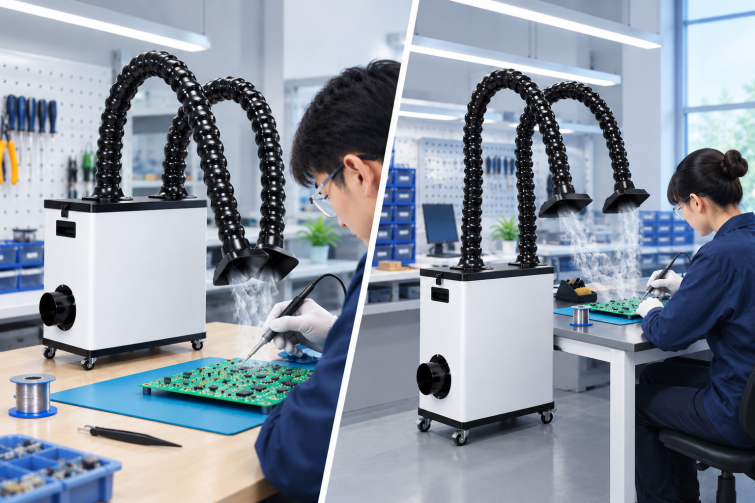
Electronics repair creates a different requirement from occasional hobby soldering.
A repair technician may repeatedly move between components, boards and connectors. The extraction point therefore needs to remain effective while the work position changes.
This is where flexible source capture becomes valuable.
The operator should not have to choose between good visibility and good fume capture. An articulated arm, adjustable hood or similar positioning system can be placed close to the soldering area while leaving the technician sufficient access to the PCB.
For production environments, maintenance also becomes part of the selection decision.
A filter that is difficult to inspect or replace may eventually become a production problem. If the system does not provide a clear indication of filter loading, operators may continue using it after performance has declined.
Related Guide: High-Performance Fume Extractors for Laser Engravers: Protect Your Health & Machine
Not necessarily.
HEPA filtration is associated primarily with particulate capture. Soldering emissions can contain both particulate and gaseous components, depending on the solder, flux and process.
This is why the filtration architecture should be evaluated rather than simply looking for the word “HEPA.”
For example, a system can use particulate filtration as one stage while incorporating additional filtration for gaseous contaminants or odors where appropriate.
The correct filtration depends on the materials being heated.
Rosin-based flux is different from soldering operations involving other flux chemistries, coatings, adhesives or contaminated components.
If the process changes, the extraction requirements can change with it.
Consider two workstations.
The first has a powerful fan positioned several feet away from the operator.
The second has a lower-capacity extraction system with the inlet positioned close to the soldering point.
The first system may move more total air, but the second may have a better chance of capturing the plume before it disperses.
This is the basic principle behind local exhaust ventilation.
HSE guidance emphasizes that soldering fume can rise into the operator’s breathing zone and recommends local extraction. Its more detailed guidance also explains that LEV design should account for factors such as workpiece geometry, working position, solder type, frequency of soldering, iron temperature and interference from room air currents.
In other words, airflow must be considered together with capture geometry.
There is no single airflow number that makes an extractor suitable for every soldering operation.
The required extraction depends on:
| Variable | Effect on Extraction Requirement |
| Distance from source | Greater distance generally makes capture more difficult |
| Soldering frequency | Continuous production creates a different exposure profile from occasional repair |
| Number of operators | Multiple simultaneous sources may require a larger system |
| Workpiece size | Large assemblies can require a different hood arrangement |
| Iron temperature | Higher temperatures can increase fume generation |
| Room airflow | Doors, fans and HVAC can disturb the plume |
| Hood design | A poorly positioned hood can waste available airflow |
| Filter loading | Pressure drop can change as filters accumulate contaminants |
For this reason, selecting a fume extractor based solely on m³/h can be misleading.
The real objective is effective capture at the source under actual operating conditions.
For businesses, the buying decision should extend beyond initial equipment cost.
A low-cost extractor can become expensive if filters need frequent replacement, the unit is too noisy for continuous work, or operators cannot position the inlet correctly.
A more useful procurement comparison is:
| Buying Question | Why It Matters |
| Where is the fume generated? | Determines capture strategy |
| How many operators solder simultaneously? | Determines system capacity |
| How many hours per day? | Influences durability and maintenance |
| What flux is used? | Influences filtration requirements |
| Is the work stationary or mobile? | Determines hood or arm configuration |
| Is noise important? | Critical in inspection and electronics environments |
| How is filter loading monitored? | Helps maintain extraction performance |
| Can the system be integrated into the workstation? | Affects operator acceptance and productivity |
This is particularly important for manufacturers that are expanding from prototype work into repetitive production.
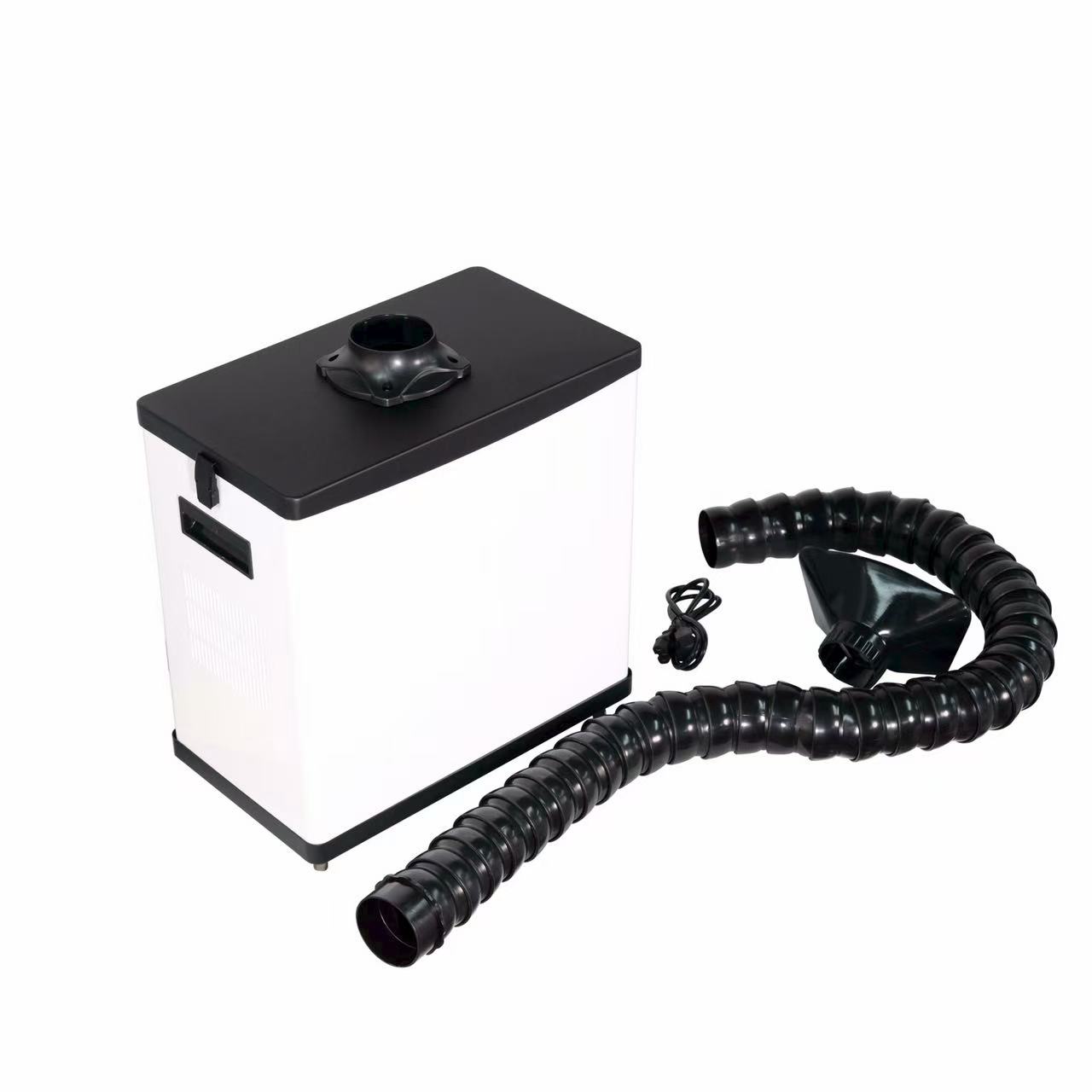
MimoWork approaches fume extraction by matching the extractor to the process instead of treating every application as the same.
For compact source-extraction requirements, the M-Series provides a small-footprint configuration with a listed extraction capacity of 390 m³/h and filtration performance of 99.97% at 0.3 μm. Its design is primarily positioned for laser marking applications, so businesses considering it for soldering should confirm the exact contaminant and filtration configuration rather than assuming that every laser extractor is automatically a soldering extractor.
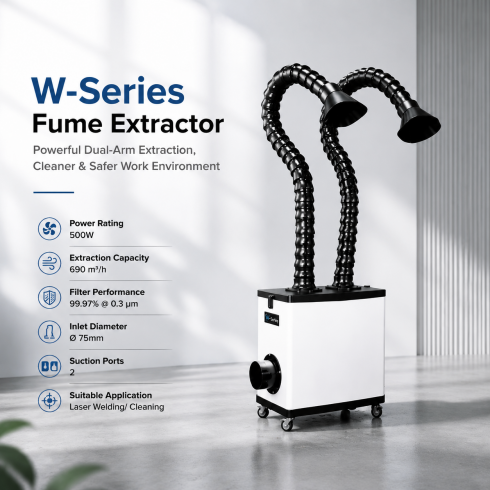
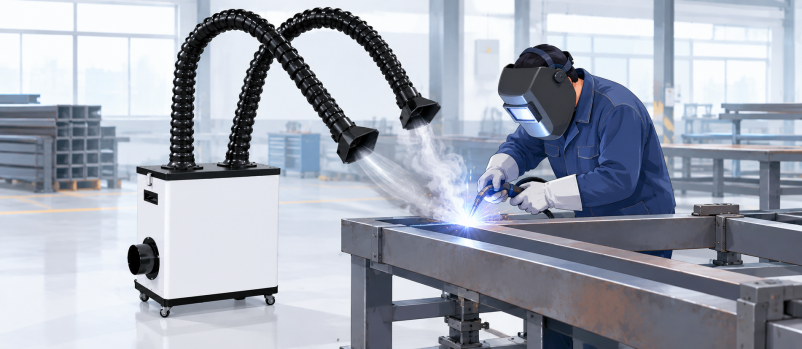
For larger non-metal laser processes, MimoWork’s C-Series is positioned around CO₂ cutting and engraving applications, while the W-Series is specifically designed for laser welding and cleaning.
That distinction is important: the best fume extractor is the one whose capture and filtration design actually matches the process.
For soldering, PCB repair or electronics production, MimoWork can assess the workstation, contaminant type and extraction position to determine whether a suitable configuration can be adapted or whether another extraction architecture is more appropriate.
Positioning can determine whether an extractor works well in practice.
The extraction inlet should be close enough to intercept the plume while avoiding interference with the operator’s hands, tools and visual field.
A common mistake is placing the hood behind the operator or too far above the board.
If the fume has already passed through the breathing zone, capturing it later does not provide the same source-control benefit.
Room fans should also be considered carefully. A strong cross-draft from an open door or HVAC outlet can push the plume away from the extraction inlet.
This is why the final setup should be tested under actual operating conditions rather than installed purely from a floor plan.
An extractor is not a set-and-forget device.
Filters gradually accumulate captured material. As loading increases, pressure drop can change and the effective performance of the system can decline.
For production environments, maintenance should therefore be part of the purchasing decision.
Operators should know:
A system that is easy to maintain is more likely to remain effective over its service life.
Opening windows or using a room fan may move air but does not necessarily capture the plume at the source.
A high airflow number does not compensate for an extraction inlet that is badly positioned.
Different fluxes and soldering materials can generate different contaminants. Filtration should be selected around the actual process rather than the word “soldering” alone.
The best fume extractor is one that provides effective source capture close to the soldering point and uses filtration appropriate to the solder and flux being processed. For occasional bench work, a compact system may be sufficient, while repetitive electronics production may require a more engineered local exhaust setup.
If soldering generates fumes, particularly from rosin-based flux, effective local extraction is an important exposure-control measure. HSE specifically recommends fume extraction and keeping the operator’s head out of the fume plume.
A HEPA filter addresses particulate filtration, but soldering emissions can include gaseous components as well. The complete filtration system should therefore be selected according to the solder, flux and process rather than assuming HEPA alone is sufficient.
Choosing the best fume extractor for soldering is ultimately a source-capture decision.
A compact hobby workstation, an electronics repair bench and a production PCB assembly line can all require different extraction strategies. Instead of starting with the biggest fan or the cheapest desktop unit, start with the actual fume source, operator position, soldering frequency and filtration requirement.
For businesses, the most useful extractor is one that remains effective after installation, can be positioned correctly, is practical to maintain and fits naturally into the production workflow.
News | Oct-7-2026
News | Sep-25-2026
News | Sep-30-2026