Blog
In a field that evolves daily, staying ahead means staying informed.
Explore in-depth articles designed to help you solve complex challenges,
maximize your machine’s ROI.
Stay ahead in a competitive market.


In a field that evolves daily, staying ahead means staying informed.
Explore in-depth articles designed to help you solve complex challenges,
maximize your machine’s ROI.
Stay ahead in a competitive market.
News | Sep-30-2026
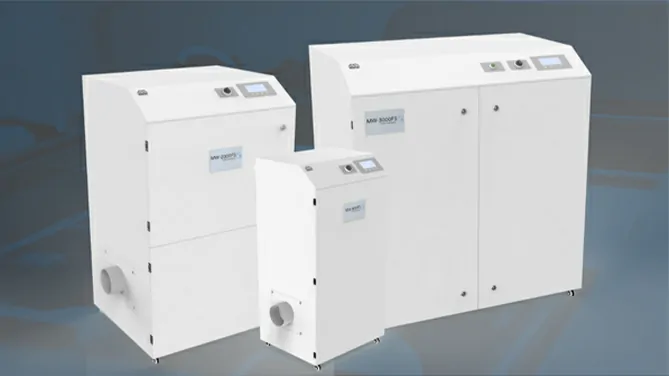
Choosing the right Fume Extractors system is not simply about selecting the highest airflow or the largest motor.
For laser processing, the better starting point is the actual application:
Material → Contaminant → Capture Point → Airflow & Pressure → Filtration → Operating Load
A CO2 laser cutting wood, a fiber laser processing metal, and a laser welding system may all require extraction, but the required laser fume extractor configuration can be completely different.
The material being processed, the type of contamination generated, the size of the working area, and the production schedule all influence the ideal extraction setup.
For example:
The right fume extraction system should be matched to the process rather than selected only by laser power.
The first step in choosing a laser fume extractor is understanding what your laser process actually produces.
Laser power affects processing speed, but it does not directly determine extraction requirements. Two machines with similar power ratings can create very different airborne contaminants depending on the material, processing method, and operating conditions.
When selecting a system, consider:
A small engraving operation and a continuous industrial production line may both use lasers, but the extraction demands are not the same.
Different materials release different types of contaminants during laser processing.
Wood and MDF can generate smoke, fine particles, and odors. Acrylic and plastics may release smoke and material-specific vapors. Leather and textiles can create organic smoke and residue. Metal processing can generate very fine particles, especially during welding or cleaning.
This is why a laser fume extraction system should be selected around the application.
Before comparing machines, identify:
| Factor | Questions to Consider |
| Material | What materials are processed regularly? |
| Process | Cutting, engraving, welding, or cleaning? |
| Workpiece | What is the size and shape of the part? |
| Production | How many hours does the system run each day? |
| Capture | Where is the contaminant generated and collected? |
| Airflow path | What hoses, ducts, or ports are required? |
This information provides a more accurate basis for choosing extraction equipment than simply comparing motor power.
Laser processing removes material through heat. During this process, smoke, particles, fumes, and residues can become airborne.
Without suitable extraction, contaminants may remain inside the machine enclosure or spread into the working environment.
A properly designed fume extraction system helps:
The extraction requirement depends heavily on what the laser is doing.
A laser cutter removing material from wood creates a different challenge from a laser welder producing concentrated metal fumes. Likewise, a laser cleaning process removing rust or coatings may require a different filtration approach.
The goal is not simply to move air. The goal is to capture and filter the contaminants generated by the specific process.
There is no single extraction solution for every laser application.
The correct system depends on the contaminant type, capture method, and production requirements.
| Laser Application | Typical Contaminants | Main Extraction Consideration |
| CO2 laser cutting | Smoke, fine particles, odors | Machine connection and particle filtration |
| Laser engraving | Fine dust, smoke, odors | Fine filtration and airflow control |
| Fiber laser processing | Fine metal particles | High-efficiency particle filtration |
| Laser welding | Concentrated metal fumes | Close-source capture |
| Laser cleaning | Dust, coating residue, oxides | Capture efficiency and filter loading |
The same workshop may require different extraction strategies for different laser operations.
For enclosed CO2 laser machines, extraction is usually connected directly to the cutting area.
The purpose is to remove smoke and particles as soon as they are generated rather than allowing them to accumulate inside the working chamber.
A fume extractor for laser cutting and engraving should be evaluated based on:
For applications such as wood, acrylic, MDF, leather, and textiles, particle filtration is important, but buyers should also consider odors and material-specific emissions.
For more focused information about particle-focused extraction solutions, see the related guide on laser dust collector systems.
A laser dust collector is typically discussed when the main requirement is collecting dust and particles from cutting or engraving operations. It is especially relevant for applications where particulate removal is the primary concern.
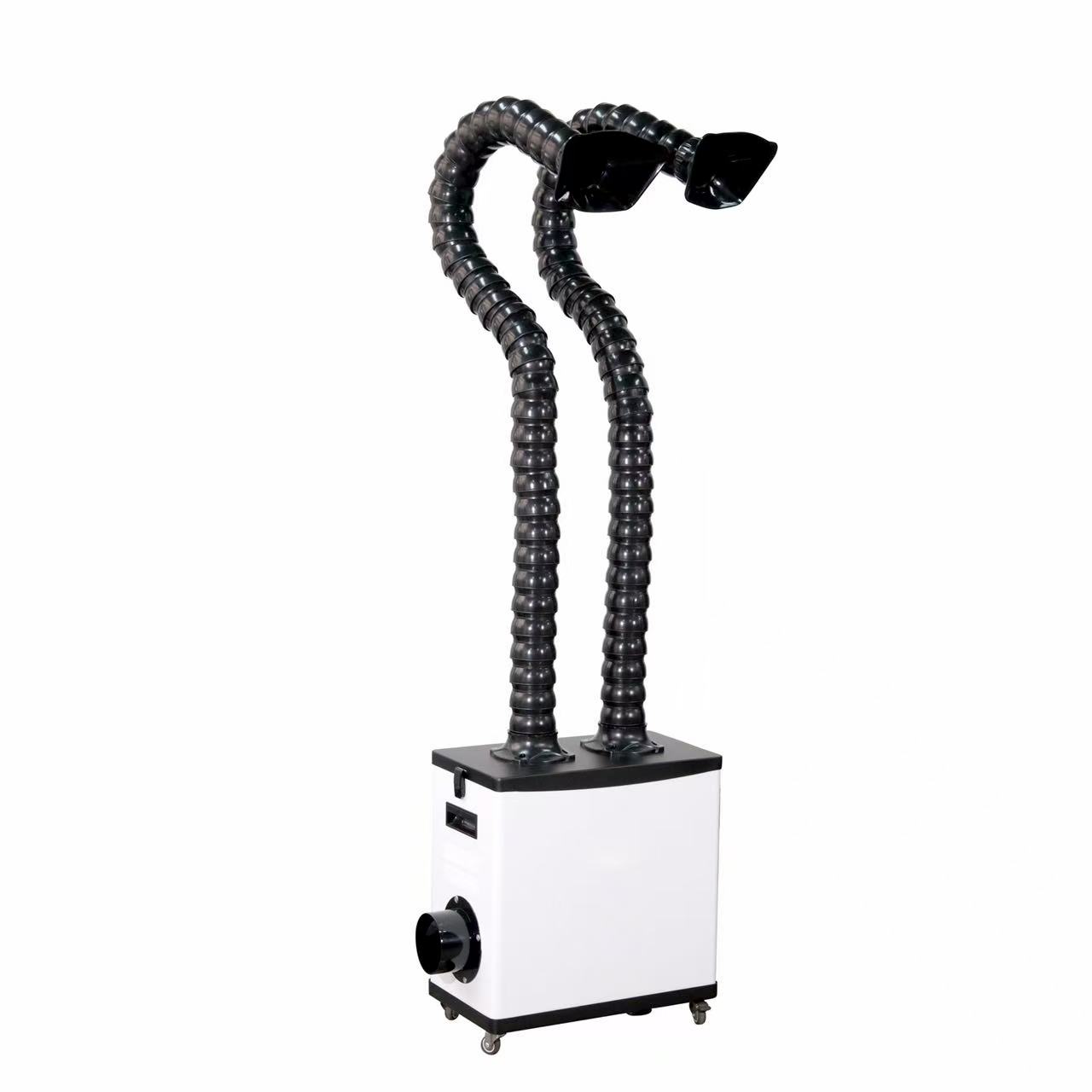
Laser welding creates a different extraction challenge compared with enclosed laser cutting.
Instead of a large working chamber, contaminants are often generated at a concentrated welding point. This makes capture position extremely important.
A welding exhaust fume extractor is designed around this type of localized emission source.
Important considerations include:
When welding fumes are generated close to the workpiece, capturing them before they disperse is generally more effective than relying on general room ventilation.
For detailed selection factors, a dedicated welding exhaust fume extractor guide can provide more application-specific information.
Related Guide: Welding Exhaust Fume Extractor: How to Choose the Right Fume Extraction System for Laser Welding?
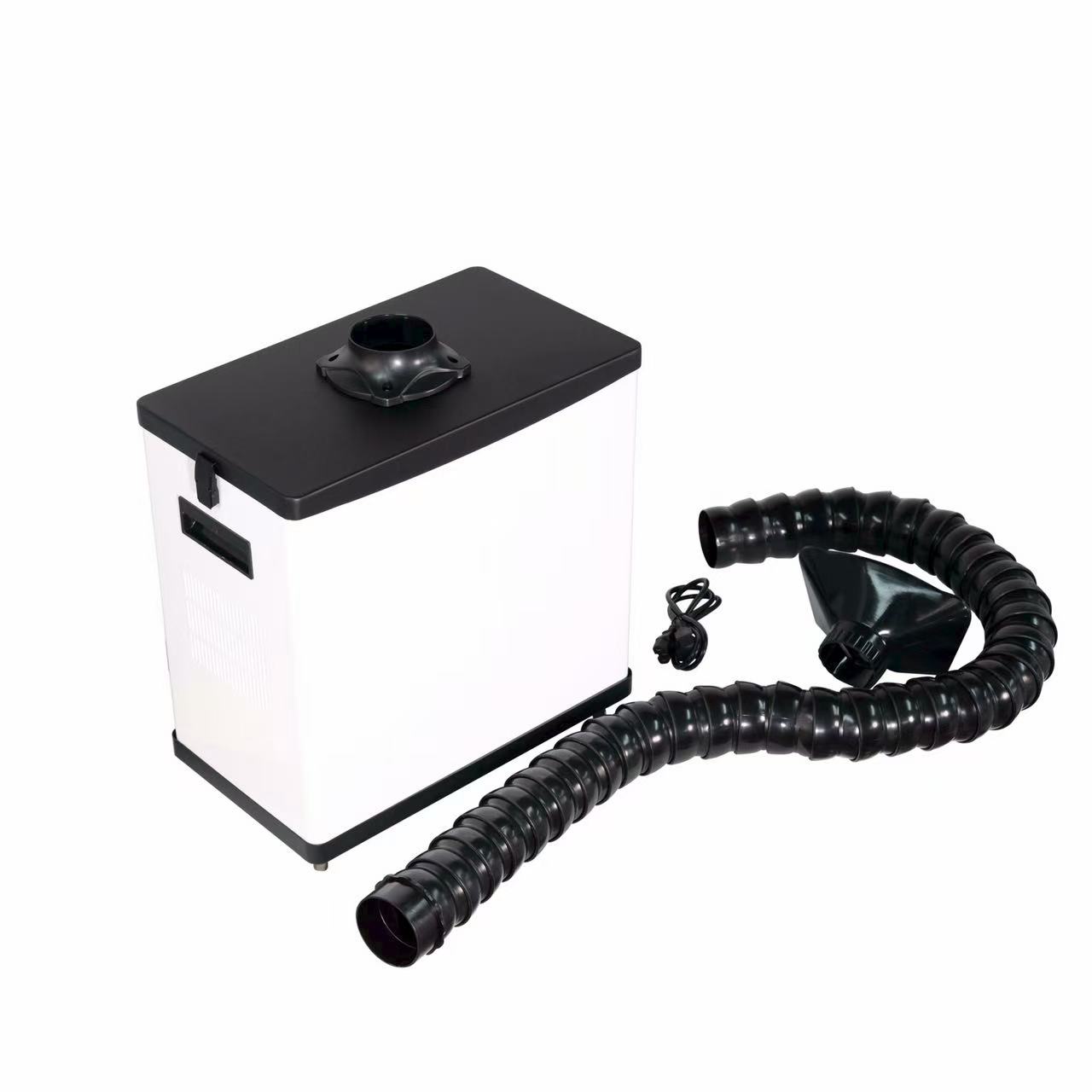
Some production environments process multiple materials or operate different laser systems in the same workspace.
In these situations, a dust and fume extractor may be a more suitable approach.
A dust and fume extractor focuses on handling both particulate contamination and smoke generated during processing.
However, the name alone does not determine performance.
The important questions are:
A system designed for one type of contamination may not automatically be suitable for every laser process.
Related Guide: Dust and Fume Extractor for Laser Processing: Applications, Selection & Technical Guide
Many buyers compare extraction systems by maximum airflow alone.
However, maximum airflow does not always represent real working performance.
Once a system is installed, airflow is affected by:
A fan that performs well under open conditions may deliver different results once connected to an actual laser machine.
Two extraction units may have similar airflow ratings but perform differently in production.
For example:
One system may operate with a short connection and clean filters.
Another may operate through longer ducting, multiple bends, and filters already collecting contaminants.
The available airflow at the capture point may not be the same.
When comparing an industrial fume extractor, consider:
The practical question is not:
“How much air can the fan move?”
It is:
“How much extraction performance remains under my actual working conditions?”
The filtration system should match the contaminants generated by the laser process.
A laser fume extractor used for wood cutting, metal welding, and laser cleaning may require different filter configurations because smoke, dust, fumes, and odors have different characteristics.
A complete extraction system may include several filtration stages:
Pre-filters are designed to capture larger particles before they reach finer filtration stages.
This helps reduce the load placed on high-efficiency filters and can improve overall system operating stability.
For applications such as laser cutting and engraving, pre-filtration can be useful because larger dust particles may be generated together with smoke.
Many laser processes generate fine airborne particles that require high-efficiency filtration.
This is particularly important for:
When comparing filtration specifications, buyers should look beyond a single efficiency number.
Consider:
The filter should be evaluated together with airflow, operating hours, and contaminant type.
Particle filtration and odor control solve different problems.
Some laser materials can generate noticeable odors or gaseous compounds during processing. In these cases, an activated carbon stage or another gas-phase filtration method may be required.
Do not assume every laser process needs the same filter combination.
The correct configuration depends on:
Material → Emission Type → Required Filtration → Operating Conditions
An industrial fume extractor needs to perform consistently under real production conditions.
For occasional use, a compact extraction unit may be enough.
For factories running laser equipment for multiple shifts, extraction performance, maintenance, and operating cost become much more important.
Before purchasing, evaluate the following factors.
The first question is always:
What are you processing?
Examples:
Different materials create different contaminants.
A powerful extractor cannot fully compensate for poor contaminant capture.
Consider where the extraction happens:
The closer the capture point is to the emission source, the more effectively contaminants can be removed.
Airflow determines how much air the system can move.
Static pressure determines how well the system maintains airflow when resistance is introduced.
Resistance can come from:
For production systems, both values should be considered together.
A lower initial price does not always mean lower operating cost.
Check:
A system that requires frequent downtime may create additional production costs.
Extraction systems often operate near workers.
Consider:
A practical installation plan helps maintain long-term performance.
MimoWork develops extraction solutions based on different laser processing requirements.
Instead of selecting equipment only by airflow rating, the system should match:
MimoWork offers extraction configurations for applications including laser cutting, engraving, welding, and cleaning.
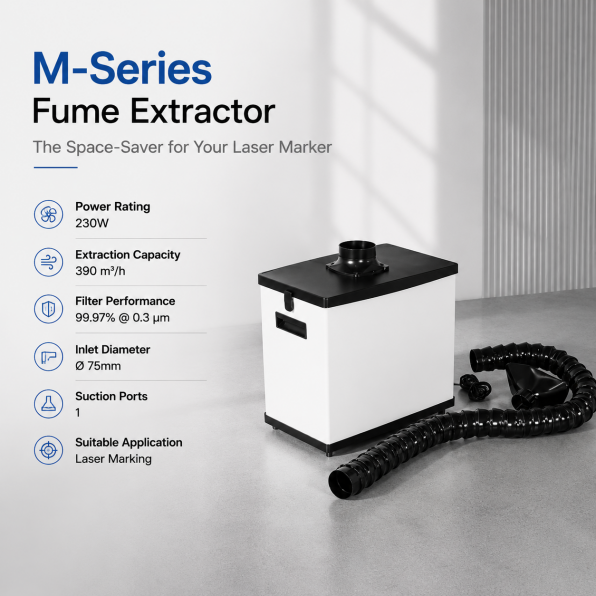
The M-Series is designed for laser cutting and engraving applications where smoke, dust, and fine particles need to be removed from the processing area.
It is suitable for applications such as:
| Specification | M-Series |
| Power | 230W |
| Airflow | 390m³/h |
| Filtration Efficiency | 99.97%@0.3μm |
| Connection Diameter | Ø75mm |
| Extraction Ports | 1 port |
| Typical Applications | Laser cutting and engraving |
For buyers comparing a laser fume extractor for CO2 laser applications, the M-Series provides a compact extraction option focused on smoke and particle removal.
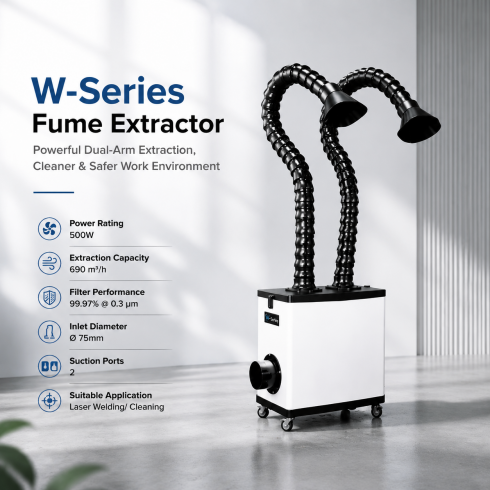
The W-Series is designed for applications where concentrated fumes and fine particles are generated, including laser welding and laser cleaning.
Compared with typical laser cutting applications, these processes may create different contaminant profiles and require stronger source extraction.
| Specification | W-Series |
| Power | 500W |
| Airflow | 690m³/h |
| Filtration Efficiency | 99.97%@0.3μm |
| Connection Diameter | Ø75mm |
| Extraction Ports | 2 ports |
| Typical Applications | Laser welding and laser cleaning |
For industrial environments, the W-Series provides a configuration option for users looking for a more focused industrial fume extractor solution.
Before requesting a quotation, compare the system based on your actual process.
| Buying Factor | What to Check | Why It Matters |
| Material | Wood, acrylic, leather, metal, coatings | Determines contaminant type |
| Process | Cutting, engraving, welding, cleaning | Changes extraction requirements |
| Capture Point | Port, enclosure, arm, hood | Affects collection efficiency |
| Airflow | Working airflow, not only maximum airflow | Indicates practical extraction ability |
| Static Pressure | Resistance handling capability | Determines performance with ducts and filters |
| Filtration | Particle and gas-phase stages | Determines what contaminants can be captured |
| Filter Capacity | Loading and replacement cycle | Affects maintenance cost |
| Installation | Space, ducts, connections | Influences real-world performance |
This checklist helps buyers compare extraction systems based on production needs instead of comparing only specifications.
Most laser processes generate airborne contaminants that require proper extraction consideration.
Whether you need a specific fume extraction system depends on:
Laser cutting, engraving, welding, and cleaning may require different extraction approaches.
Start with the material and machine setup.
For laser cutting applications, consider:
A fume extractor for laser cutting and engraving should be selected based on the complete processing environment rather than laser power alone.
It depends on the filtration design and contaminant types.
A system used for wood cutting may not automatically be suitable for metal welding or coating removal.
If a workshop processes different materials, confirm that the filtration configuration matches all intended applications.
The difference mainly depends on the type of contamination being targeted.
A dust collector is generally focused on particulate removal.
A broader fume extraction system may be designed for smoke, fine particles, fumes, and sometimes odors depending on the filtration stages.
For laser cutting and engraving applications where dust collection is the primary concern, a laser dust collector may be the more specific solution.
Related Guide: Laser Dust Collector Buying Guide: How to Choose the Right Dust Collection System for Laser Processing
An industrial fume extractor is designed for more demanding operating conditions.
Compared with lighter-duty systems, industrial solutions usually place more emphasis on:
The correct choice still depends on the actual application.
Choosing fume extractors starts with understanding the cleaning or processing job.
The key factors are:
Material → Contaminant → Capture Point → Airflow → Filtration → Production Requirements
A CO2 laser cutting application may need a different solution from laser welding or industrial cleaning.
A precision application may prioritize filtration control, while a high-volume production environment may prioritize airflow stability and operating cost.
Before selecting a laser fume extractor, provide:
MimoWork can evaluate the application and recommend a suitable extraction configuration based on actual processing requirements.
Have a laser processing application to test? Contact MimoWork for a material evaluation and find the right fume extraction solution for your workflow.
News | Sep-25-2026