Blog
In a field that evolves daily, staying ahead means staying informed.
Explore in-depth articles designed to help you solve complex challenges,
maximize your machine’s ROI.
Stay ahead in a competitive market.


In a field that evolves daily, staying ahead means staying informed.
Explore in-depth articles designed to help you solve complex challenges,
maximize your machine’s ROI.
Stay ahead in a competitive market.
News | Aug-31-2026
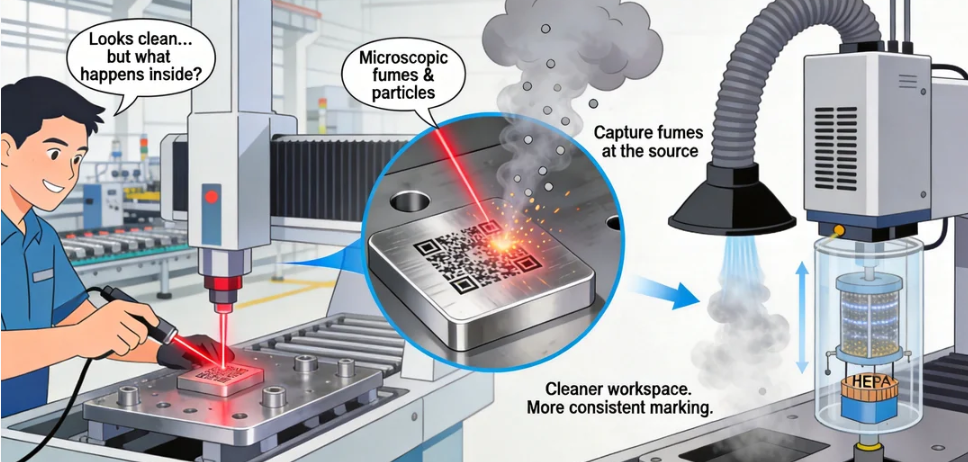
A laser marking process may look clean from the outside — no ink, no chemicals, and no visible cutting debris. But inside the machine, every mark tells a different story. As the laser beam removes material from metal, plastic, or coated surfaces, it releases microscopic particles, airborne contaminants, and chemical fumes that can accumulate over time.
This is where a laser marking fume extractor becomes essential. By capturing airborne contaminants directly at the marking area, it helps keep the workspace cleaner, protects sensitive machine components, and supports consistent marking quality during continuous production.
Used across industries such as automotive, electronics, medical devices, and metal manufacturing, fiber laser marking machines offer fast and permanent identification. But reliable marking performance depends not only on the laser source — it also depends on how effectively the generated fumes are managed.
Laser marking creates different types of emissions depending on the material and processing method.
Unlike traditional cutting processes that produce obvious smoke, laser marking often generates microscopic particles that are difficult to notice immediately. However, these particles can accumulate over time and affect both the machine and the surrounding environment.
The main sources of laser marking emissions include:
The amount of smoke depends on factors such as laser power, marking speed, material composition, and production frequency.
A laser marking machine works by focusing a high-energy beam onto a small area of the material surface.
When the energy density reaches a certain level, the material undergoes physical or chemical changes.
The basic process is:
Laser energy → Material reaction → Surface modification → Particles and gases released
For different materials, the emissions can vary significantly.
| Material | Possible Emissions | Recommended Filtration |
| Metal | Metal particles, oxides | HEPA |
| Plastic | VOCs, odors | HEPA + Activated Carbon |
This difference is important when selecting the right laser fume extraction system, because filtration requirements depend heavily on the processed material.
Laser marking fumes are usually a combination of solid particles and gaseous compounds.
The main components include:
During laser processing, small particles can be released from the material surface.
These particles may include:
Although individual particles may be invisible to the naked eye, they can remain airborne or settle on equipment surfaces.
Some materials release gases when exposed to laser energy.
This is especially common with:
These emissions may create noticeable odors and require additional filtration beyond standard particle removal.
For applications involving plastics or coatings, activated carbon filtration is often used together with particle filtration.
Many manufacturers initially focus on laser power, marking speed, and accuracy when selecting equipment. However, the surrounding production environment is equally important.
A suitable laser smoke extraction system supports three key areas:
Laser marking machines are often operated continuously in manufacturing environments.
During long production cycles, operators may spend hours near the marking area. Without proper extraction, smoke and airborne particles can gradually accumulate around the workstation.
A dedicated extraction system captures contaminants close to the source instead of allowing them to spread throughout the production area.
This creates a cleaner and more comfortable working environment.
Laser machines contain sensitive optical components that require a clean operating environment.
Smoke particles may settle on:
Over time, contamination may affect:
Using a laser smoke extractor helps reduce the amount of airborne residue entering the equipment area.
Clean processing conditions are especially important for industries producing precision components.
Smoke residue may affect the finished product by causing:
A stable extraction system helps maintain a cleaner marking process, especially for high-volume manufacturing.
Some small workshops rely on fans or general ventilation to remove smoke.
However, standard ventilation systems are not designed to capture laser-generated contaminants at the source.
A ventilation fan mainly moves air, while a dedicated laser marking fume extractor is designed to:
For industrial laser marking applications, source extraction provides a more controlled and effective solution.
A laser marking fume extractor is designed to capture and filter airborne contaminants generated during the marking process. Unlike a simple ventilation fan that only moves contaminated air, a professional extraction system collects smoke close to the laser source and processes it through multiple filtration stages.
During laser marking, the extraction nozzle creates localized suction around the processing area. This allows smoke and particles to be removed before they spread across the workstation or settle inside the laser machine.
For manufacturers operating fiber laser marking machines for long periods, source capture is especially important. Fine particles generated during metal marking can remain suspended in the air and gradually affect both the working environment and sensitive machine components.
A well-designed extraction system follows a simple process:
Capture → Filter → Clean air output
The contaminated air enters the extractor through the inlet pipe, passes through several filtration layers, and releases cleaner air after pollutants have been removed.
A high-quality laser fume extraction system usually combines different filter technologies because laser emissions contain both particles and gases.
Different filters handle different contaminants.
| Filtration Stage | Main Function | Typical Contaminants Removed |
| Pre-filter | Protects the main filter system | Larger dust and particles |
| HEPA filter | Removes fine airborne particles | Metal dust, smoke particles, fine residues |
| Activated carbon filter | Adsorbs chemical gases | Odors, VOCs, harmful vapors |
The HEPA filter is particularly important for metal marking applications. When a fiber laser marks stainless steel, aluminum, or other metals, the process can generate microscopic particles that are difficult to capture through normal ventilation.
For plastic and coated materials, activated carbon filtration becomes more important because these materials may release odors and chemical vapors during laser processing.
For this reason, many industrial users choose a multi-stage filtration system instead of a single filter solution.
Selecting the right extractor depends on more than the laser machine itself. The material being processed, production volume, and working environment all influence the required extraction performance.
A small workshop marking a few products per day may have different requirements from a factory running multiple marking stations continuously.
Before choosing an extractor, manufacturers should consider three key factors:
Different materials create different types of emissions.
Metal marking applications, including automotive parts, electronic components, and industrial hardware, mainly generate fine particles.
A suitable extraction system should focus on:
Plastic materials behave differently during laser processing.
Materials such as ABS, acrylic, and resin-based products may produce:
For these applications, a filtration system with activated carbon is often recommended.
Painted or coated surfaces usually create mixed emissions because both particles and gases may be released when the coating layer is removed.
A combined filtration approach provides better results for these applications.
Airflow is one of the most important specifications when selecting an industrial laser fume extractor.
However, maximum airflow is not always the best choice.
The extractor should match the actual working conditions.
Important factors include:
| Consideration | Impact on Extraction |
| Laser power | Higher power may generate more emissions |
| Marking speed | Faster processing increases smoke production |
| Material type | Different materials require different filtration |
| Working hours | Continuous operation requires stable performance |
| Number of machines | Multiple stations require higher capacity |
The goal is to remove smoke efficiently without creating unnecessary energy consumption or excessive noise.
A properly sized extractor provides a balance between extraction performance, operating cost, and maintenance requirements.
Regular maintenance helps maintain consistent extraction performance.
The most important part is monitoring filter condition.
Filter replacement frequency depends on:
Common signs that filters may need attention include:
Replacing filters at the appropriate time prevents reduced airflow and keeps the system working efficiently.
Fiber laser marking is widely used because it provides high processing speed and high marking precision, especially for metals.
However, precision does not mean the process creates no emissions.
During fiber laser marking, microscopic particles can be produced when the laser interacts with the material surface.
A suitable fiber laser marking fume extractor helps remove these particles before they affect:
For manufacturers using fiber laser marking machines in automotive, electronics, medical, and hardware industries, extraction is often an important part of the complete production setup.
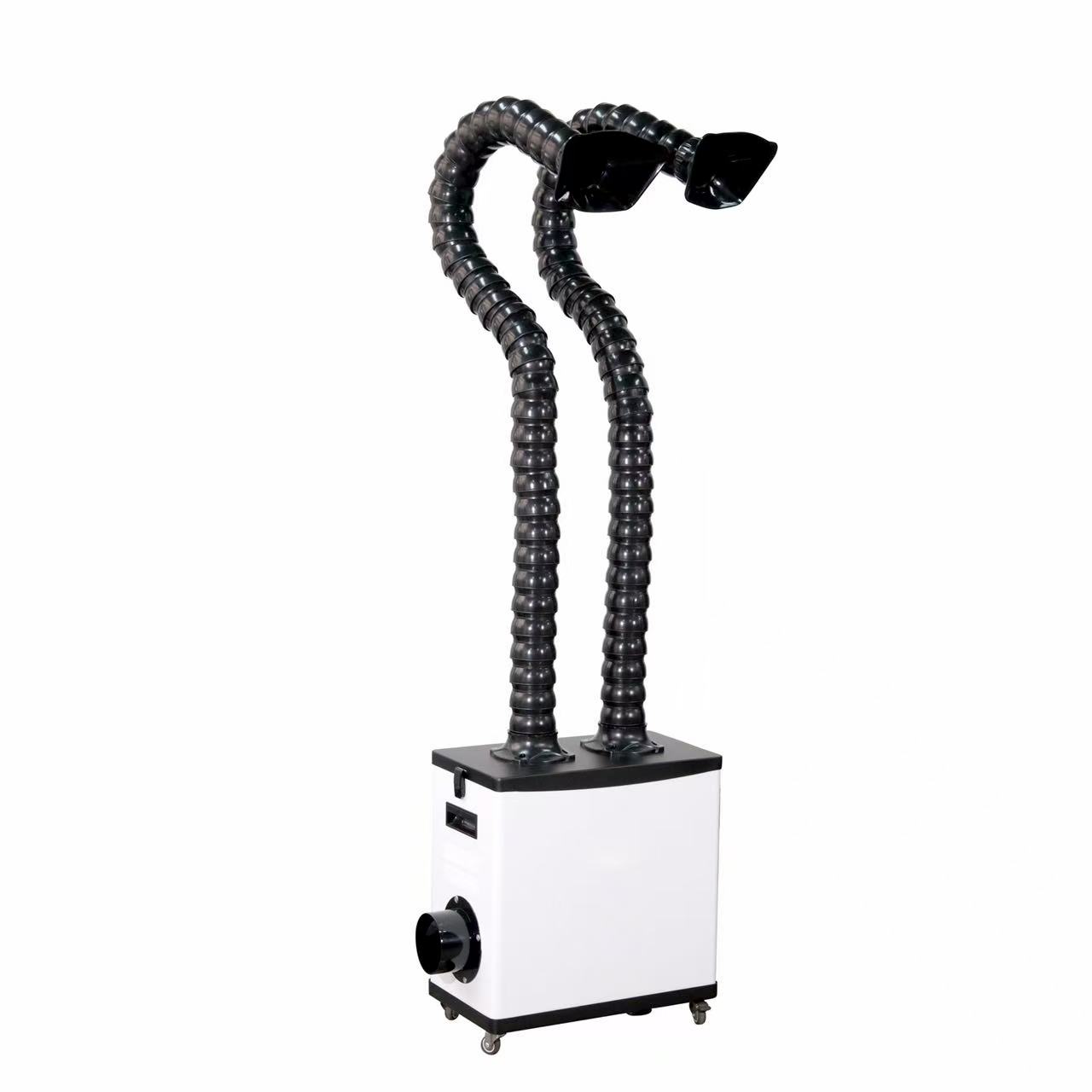
MimoWork develops laser processing solutions covering fiber laser marking, CO2laser cutting, engraving, welding, and fume extraction applications.For laser marking environments, MimoWork’s M-Series fume extractor is designed to provide efficient smoke removal in a compact industrial format.
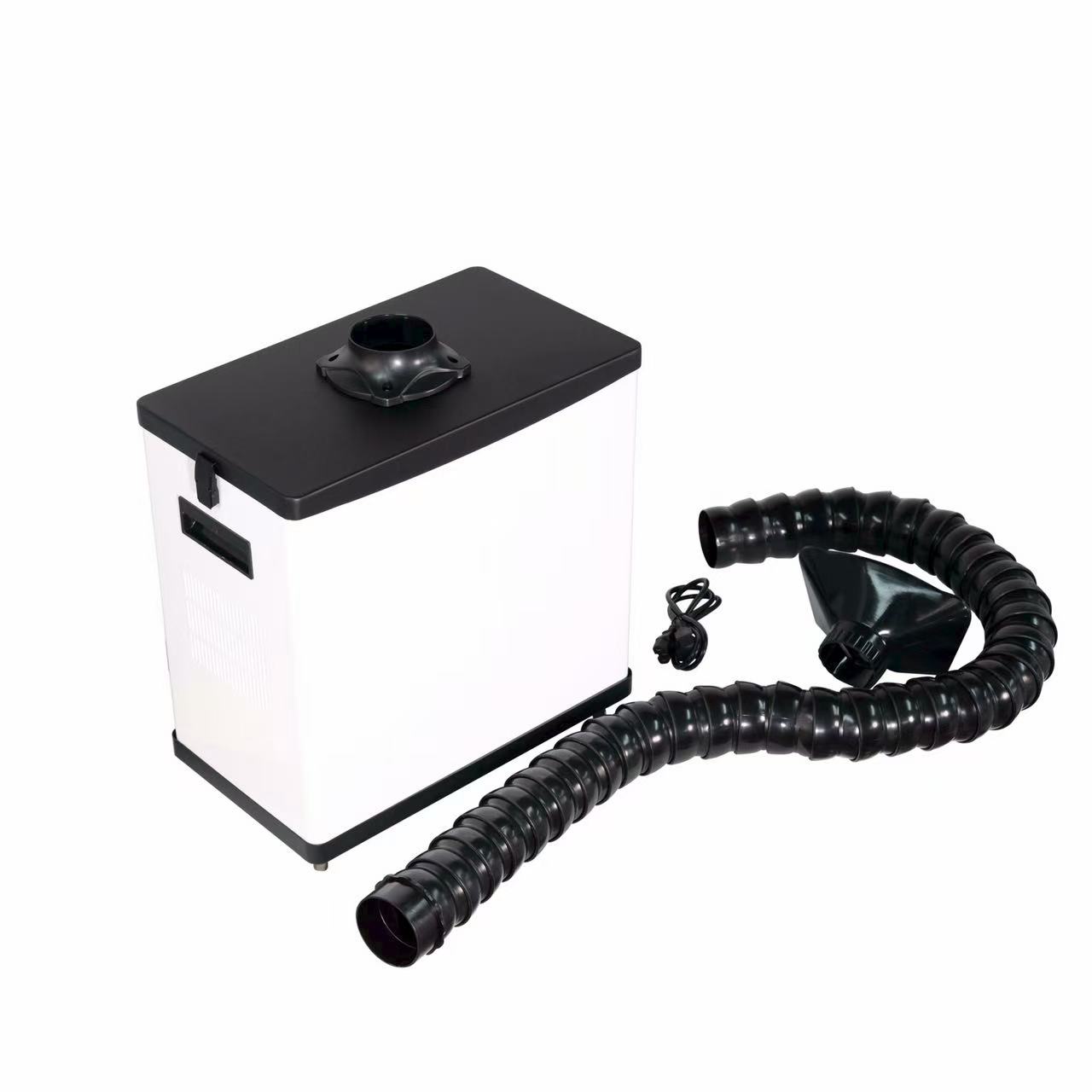
The system combines multi-stage filtration with stable airflow performance, making it suitable for laser marking workstations where space and cleanliness are important.
| Feature | M-Series Specification |
| Application | Laser marking |
| Power Rating | 230W |
| Airflow Capacity | 390 m³/h |
| Filtration Efficiency | 99.97% @ 0.3 μm |
| Inlet Diameter | Ø75 mm |
The compact design allows the extractor to be installed close to the laser marking area, improving smoke capture efficiency while reducing workspace occupation.
1. Capture Smoke Where It Is Generated
The M-Series captures laser-generated smoke and particles directly from the laser marking area before they spread into the workspace. This source extraction approach helps keep the workstation cleaner and prevents residue from building up on products, machines, and surrounding surfaces during daily production.
2. Compact Design That Fits Your Workspace
Not every production environment has space for a large extraction system. The M-Series features a compact design that can be installed close to laser marking machines, making it a practical choice for workshops, production lines, and integrated laser marking setups.
3. Efficient Filtration for Cleaner Processing
Laser marking can generate fine particles and airborne contaminants that are difficult to remove with standard ventilation. The M-Series uses a multi-stage filtration system with HEPA filtration efficiency of 99.97% at 0.3 μm, helping maintain cleaner air and a more controlled production environment.
4. Support Stable Marking Performance
Smoke and particles can gradually affect optical components and machine cleanliness. By reducing airborne contamination around the laser system, the M-Series helps minimize maintenance needs and supports consistent marking quality over long production cycles.
For different laser applications, MimoWork can provide extraction solutions based on material type, processing conditions, and production requirements.
Yes, especially for professional laser marking applications. A laser marking fume extractor captures fine particles, smoke, and chemical emissions generated during processing, helping maintain a cleaner workspace and protect laser equipment.
A dedicated laser fume extraction system removes smoke by capturing emissions near the marking area and filtering them through multiple stages, including particle filtration and activated carbon adsorption.
No. A ventilation fan only moves contaminated air, while a laser smoke extractor is designed to capture and filter fine particles, odors, and chemical vapors directly from the source.
Filter life depends on the material, production volume, and operating hours. Regular inspection is recommended to maintain stable airflow and filtration performance.
The right extractor depends on your material and production needs. A compact multi-stage filtration system is suitable for many fiber laser marking, engraving, and industrial applications.
MimoWork provides laser fume extraction solutions designed for fiber laser marking, engraving, cutting, welding, and other laser applications. The M-Series combines compact design, efficient filtration, and stable airflow performance for industrial laser workstations.
Whether you are upgrading an existing laser marking setup or planning a new production line, MimoWork can help you evaluate the right extraction approach based on your materials, laser system, and working conditions.
Explore how MimoWork can support your laser marking applications with reliable fume extraction and customized solutions.
News | Aug-6-2026
News | Jul-31-2026