Blog
In a field that evolves daily, staying ahead means staying informed.
Explore in-depth articles designed to help you solve complex challenges,
maximize your machine’s ROI.
Stay ahead in a competitive market.


In a field that evolves daily, staying ahead means staying informed.
Explore in-depth articles designed to help you solve complex challenges,
maximize your machine’s ROI.
Stay ahead in a competitive market.
News | Oct-27-2026 | Mimowork
Laser cutting cork fabric can produce precise shapes and detailed patterns without the mechanical pressure of a blade. However, cork’s porous structure, surface texture, fabric backing, and adhesive layers can all influence the finished edge. To reduce scorching, start with representative material samples, use the lowest effective heat input that achieves a complete cut, maintain suitable extraction, and inspect the reverse side as carefully as the front. The best settings depend on the complete cork-fabric construction, not just the cork surface.
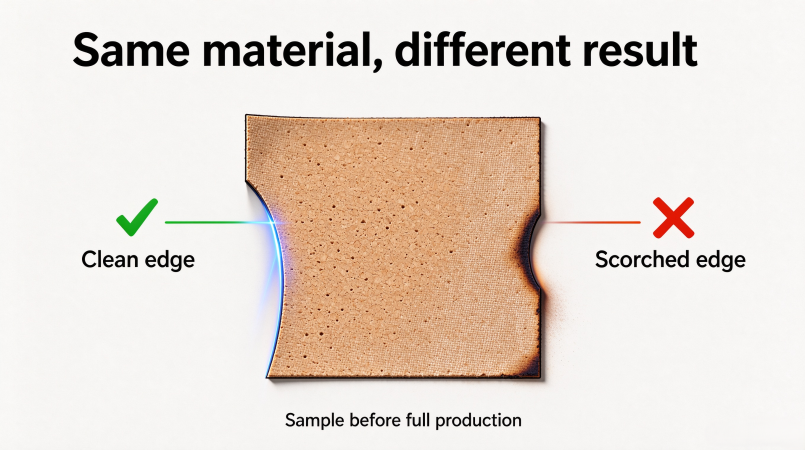
Cork fabric presents a different challenge from ordinary woven textiles.
Its natural surface contains pores and irregularities, and the material sold as cork fabric may combine a thin cork layer with a textile backing or adhesive. Two products that look similar on the roll can therefore respond differently to laser energy.
This is where production problems often begin. A small sample cuts cleanly, so the operator saves the settings and starts a larger batch. The next roll has a different backing, the edges darken, or the smallest cutouts become brittle and uneven.
The issue is not necessarily that laser cutting is unsuitable for cork fabric. It is that the surface appearance alone does not reveal how the entire material will respond to heat.
A reliable process starts by identifying the material construction and testing it under conditions that reflect the intended production job.
Cork is a natural material, and laser energy can cause localized heating, discoloration, or charring. If the process uses more energy than necessary, the edge may become darker or rougher than the surrounding surface.
Increasing power to ensure a complete cut can make the problem worse. A better starting point is to test the relationship between power, speed, and the number of passes, aiming for reliable separation with minimal unnecessary heat input.
Some cork fabrics have textile backings or adhesive layers. The backing may require different processing conditions from the cork surface, so a setting that cuts through one layer cleanly may overheat another.
Before processing a full sheet, confirm the material composition and whether the backing and adhesive are suitable for laser processing. Do not assume that every composite sold as cork fabric is safe to cut with a laser.
A broad outline may look acceptable even when narrow slots, tight curves, and small internal cutouts show excessive darkening or incomplete separation.
This is especially important for decorative panels, accessories, labels, and products with repeated patterns. Test the smallest and most detailed features in the design, not only the outer perimeter.
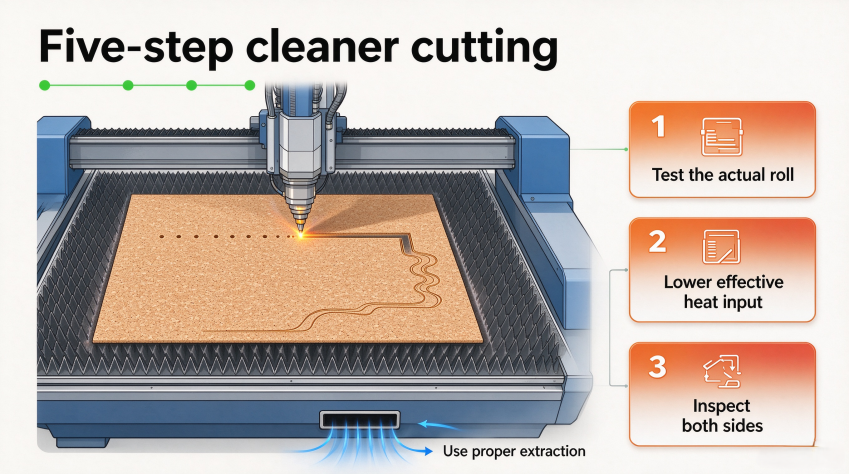
Record the cork layer, backing type, approximate thickness, adhesive construction if applicable, and any surface finish. When purchasing from a supplier, request material information rather than relying on appearance.
Use samples from the actual production roll whenever possible. If the backing or finish changes between batches, repeat the test before reusing the original settings.
Start with a controlled parameter test. Evaluate power and speed together, then check whether the material separates completely and whether the cut edge remains acceptable.
If the edge is excessively dark, test a faster cutting speed or lower power where complete separation can still be achieved. If the material remains attached, determine whether a different power-speed combination or another pass is appropriate.
Multiple passes are not automatically better: they can increase cumulative heat exposure and may worsen edge discoloration. Test the complete result before selecting a production setting.
A clean-looking top surface does not guarantee a clean reverse side. Examine both sides for darkening, residue, backing damage, and incomplete cuts.
Include small holes, tight curves, and narrow bridges in the test design. These features often reveal whether the process can maintain consistent quality across the full pattern.
Laser processing cork and composite textiles can produce smoke, odors, and airborne particles. An appropriate extraction system helps remove emissions from the processing area and reduces contaminant buildup around the machine.
The extraction arrangement should suit the laser machine, material, and production load. Material safety must also be confirmed before processing, especially when the cork product contains adhesives, coatings, or synthetic backing.
One clean cut is not enough to establish a production-ready process. Repeat the test across representative sections of the material and inspect the result for variations in edge color, separation, and dimensional accuracy.
For commercial production, record the material specification, tested parameters, and quality criteria. This makes it easier to identify why a later batch behaves differently and reduces the need to restart the entire process from scratch.
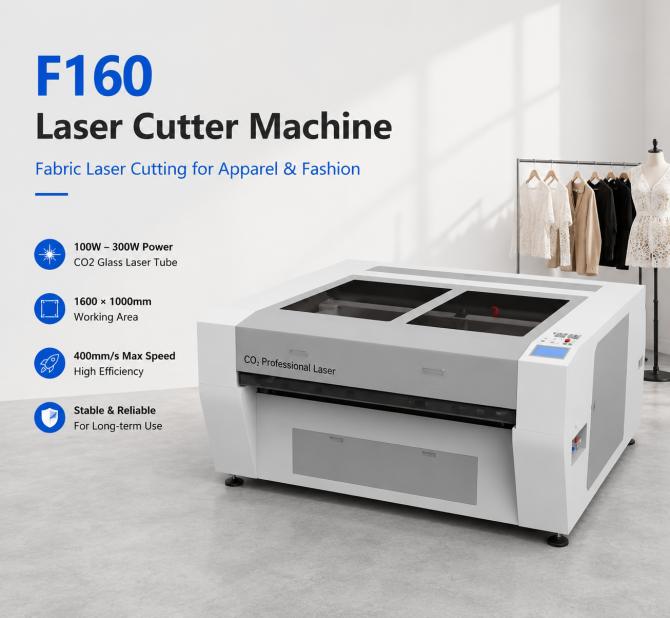
CO2 laser systems are commonly used to cut and engrave many non-metallic materials, including suitable fabrics and leather products. However, the correct machine and settings for cork fabric depend on its thickness, backing, required cut quality, working area, and production volume.
| Selection factor | Why it matters |
| Material construction | Cork, textile backing, adhesive, and surface finish may respond differently to heat |
| Laser power | Must provide sufficient cutting energy without unnecessary thermal damage |
| Cutting speed | Affects heat exposure and the ability to complete detailed cuts |
| Working area | Should accommodate the size and layout of the material sheets or rolls |
| Motion and positioning | Important for maintaining consistent dimensions across repeated patterns |
| Fume extraction | Helps control smoke and particles generated during processing |
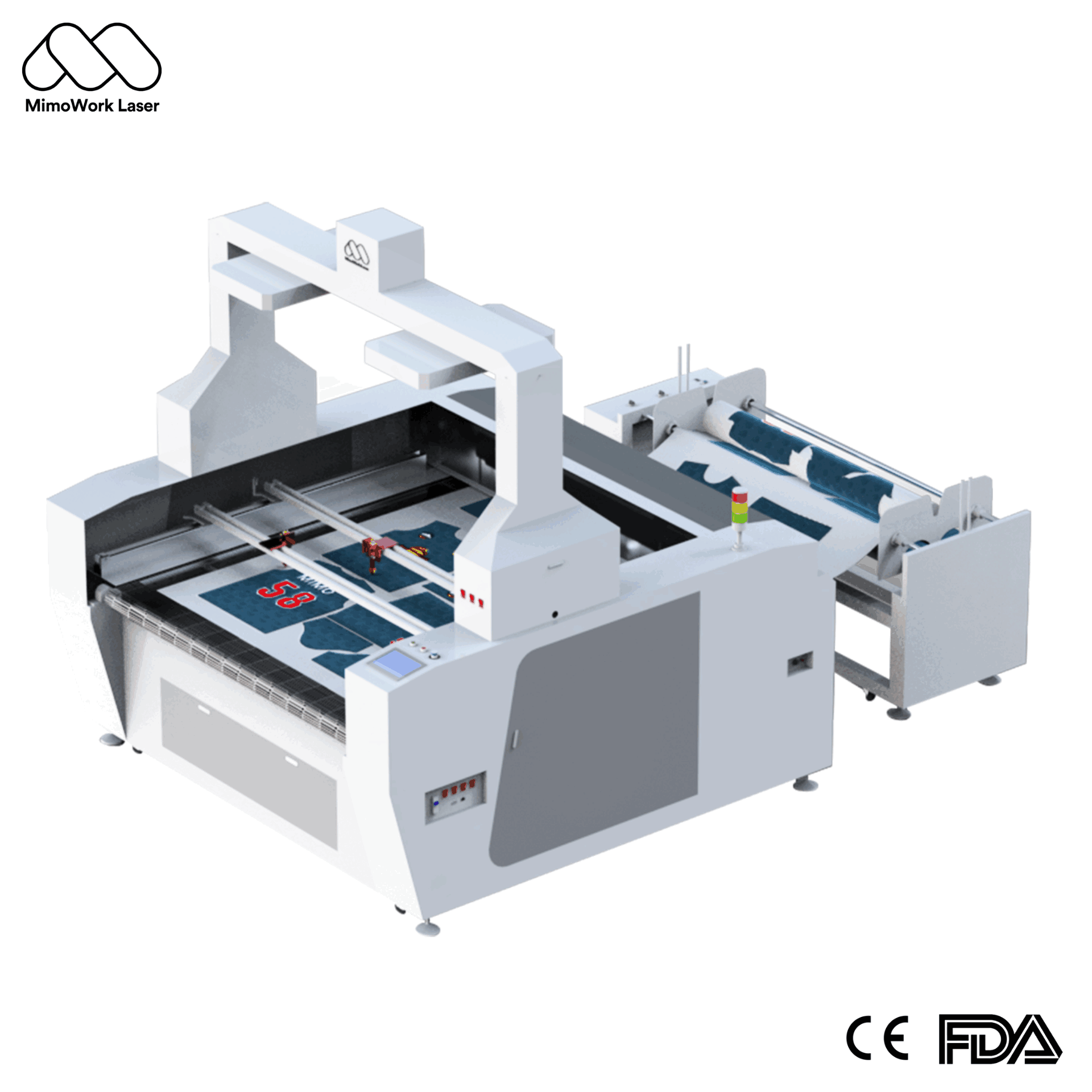
MimoWork offers CO2 laser cutting solutions for materials such as fabrics, leather, and other non-metallic substrates. A CO2 Laser Cutter can be a potential option for cork-fabric processing, depending on the material composition, thickness, and required cutting results. These solutions provide a starting point for evaluating a suitable system for specific cork-fabric applications.
Before choosing a CO2 Laser Cutter, test the actual cork-fabric sample. A material trial can help determine whether the required edge quality, cutting speed, and design detail are achievable with the proposed machine configuration.
Related Guide: What’s the Best Laser Cutter for Fabric That Can Handle Production Runs Every Day?
You can reduce scorching through careful material selection, controlled power and speed, appropriate extraction, and representative sample testing. However, the natural cork surface may still show some heat-related discoloration depending on the material construction and required cut quality.
A CO2 laser may be suitable for cork fabric that is compatible with laser processing. The complete construction matters, particularly if the material includes synthetic backing, adhesive, or surface coatings. Confirm material safety and test the required cut quality before production.
Dark edges generally indicate thermal discoloration or charring. Excessive heat input, slow cutting, material composition, and repeated passes can contribute to the result. Test alternative power-speed combinations while ensuring that the cut remains complete.
Laser cutting can produce intricate shapes without applying mechanical cutting pressure and may reduce the need for physical cutting dies. Blade cutting may be preferable for some thicker, highly compressible, or heat-sensitive constructions. The better option depends on edge requirements, design complexity, batch size, and material compatibility.
The challenge with laser cut cork fabric is not simply making the laser pass through the material. It is achieving a clean, repeatable edge across a composite surface without damaging the backing or sacrificing fine details. Testing the complete material and validating the smallest features before production can prevent avoidable waste and inconsistent results.
If you are developing a cork-fabric cutting workflow, explore MimoWork’s laser cutting solutions and discuss your material construction, cutting dimensions, and edge-quality requirements to identify a suitable machine configuration.
News | Sep-25-2026
News | Sep-1-2026
News | Aug-24-2026