Blog
In a field that evolves daily, staying ahead means staying informed.
Explore in-depth articles designed to help you solve complex challenges,
maximize your machine’s ROI.
Stay ahead in a competitive market.


In a field that evolves daily, staying ahead means staying informed.
Explore in-depth articles designed to help you solve complex challenges,
maximize your machine’s ROI.
Stay ahead in a competitive market.
News | Nov-6-2026 | Mimowork
A laser engraving machine does more than remove material or create surface patterns. The heat generated during processing can release airborne particles, volatile organic compounds (VOCs), and other chemical byproducts. Without effective extraction, these contaminants may accumulate around the machine and spread into the working environment.
A fume extractor for laser engraver helps capture contaminated air close to its source and pass it through suitable filtration stages. A typical industrial configuration combines a pre-filter for larger particles, a HEPA filter for fine particulate matter, and activated carbon media for selected gases and odors.
For workshops that regularly process wood, acrylic, textiles, or other approved materials, choosing the right extraction system is an important part of workplace safety, equipment maintenance, and production consistency.
Laser-generated air contaminants are not a single type of pollutant. Their composition depends on the material, laser power, processing conditions, and ventilation performance.
A 2024 study published in Aerosol and Air Quality Research examined emissions from desktop laser processing. It identified respirable particles, ultrafine particles, VOCs, and carbon monoxide among the potential emissions. The research also demonstrated that material selection and ventilation significantly influence exposure levels.
Different materials produce different emissions when exposed to concentrated laser energy.
Wood and plywood can release smoke, fine particles, VOCs, and carbon monoxide. The actual composition varies with wood species, adhesives, coatings, and processing conditions.
Acrylic processing may produce particulate matter and volatile organic compounds, including methyl methacrylate under certain processing conditions. Painted, coated, or adhesive-backed materials can introduce additional chemical contaminants.
Synthetic fabrics also require careful evaluation. Polyester, felt, and coated textiles may release complex mixtures of airborne chemicals depending on their composition and additives.
This creates an important material-selection issue: a filtration system should never be treated as permission to process an unsuitable material. PVC and vinyl, for example, must not be laser processed because they can release hazardous chlorine-containing compounds, including hydrogen chloride.
Visible smoke is only part of the problem. Laser processing can generate particles small enough to remain suspended in the air long after the visible smoke disappears.
PM10 refers to particles with aerodynamic diameters of 10 micrometers or less, while PM2.5 refers to particles of 2.5 micrometers or less. Laser processing can also generate ultrafine particles smaller than 0.1 micrometers.
These particles can enter the respiratory system when inhaled. Depending on their chemical composition, concentration, and exposure duration, they may contribute to respiratory irritation and other adverse health effects.
For operators who spend several hours near a laser engraving machine, controlling emissions at the source is more reliable than depending on room ventilation alone.
Airborne contaminants also affect the machine itself.
Smoke and processing residues can settle on optical components, protective windows, guide rails, ventilation ducts, and internal surfaces. Over time, accumulated deposits may reduce optical cleanliness, interfere with mechanical movement, and increase maintenance requirements.
Some materials produce acidic or corrosive byproducts that can accelerate equipment deterioration when they accumulate on vulnerable components.
The consequences are not limited to additional cleaning. Contaminated optical paths and restricted airflow can also affect processing consistency.
A properly designed extraction system therefore serves two purposes: controlling workplace emissions and reducing the amount of residue that reaches sensitive machine components.
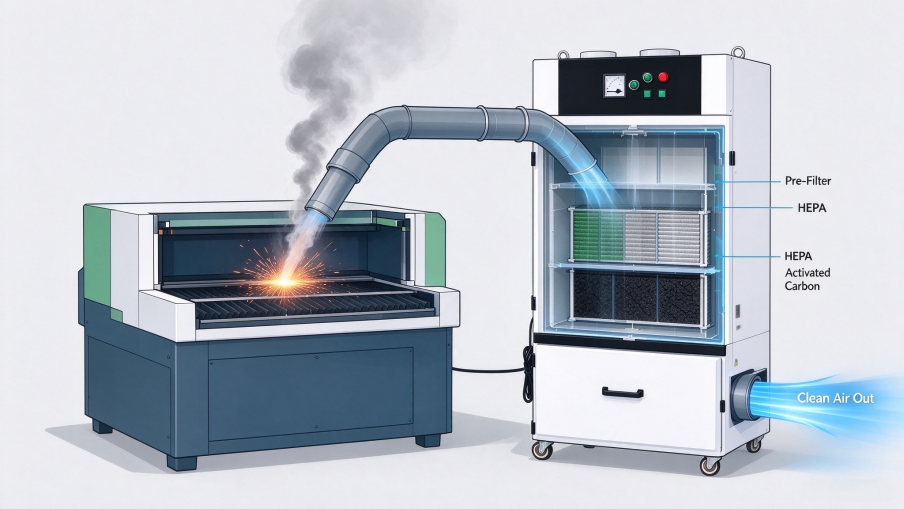
Not every filtration system provides the same level of protection. Before purchasing equipment, manufacturers and workshop operators should examine the filtration configuration, airflow performance, and compatibility with the materials being processed.
The pre-filter is the first stage of a multi-stage filtration system.
Its primary function is to capture larger dust particles, fibers, and processing debris before they reach the more expensive downstream filters.
Without adequate pre-filtration, the HEPA and activated carbon stages may become loaded more quickly, increasing maintenance costs and airflow resistance.
When evaluating a pre-filter, consider its dust-holding capacity, replacement cost, and suitability for the type of residue generated by your machine.
For workshops processing wood or textiles, a pre-filter designed for relatively high particulate loading can help extend the service life of subsequent filtration stages.
A high-efficiency particulate air (HEPA) filter is designed to capture fine airborne particles that ordinary dust filters may not effectively retain.
A commonly referenced benchmark for a true HEPA filter is at least 99.97% efficiency at 0.3 microns under the applicable test method.
This specification should be interpreted carefully. It describes particulate filtration performance, not the removal of every airborne chemical or gas.
For laser engraving applications, HEPA filtration is particularly relevant when processing materials that generate fine smoke particles and dust.
However, actual system performance also depends on filter sealing, housing design, airflow distribution, and the prevention of air bypass around the filter.
Particulate filtration alone cannot adequately address many gaseous contaminants.
Activated carbon works through adsorption. Its porous structure provides a large internal surface area where certain gas molecules and organic compounds can be retained.
In a laser fume extraction system, activated carbon can help reduce selected VOCs and unpleasant odors that pass through the particulate filtration stages.
However, activated carbon is not universally effective against every gas. Its performance depends on the carbon type, contaminant chemistry, humidity, contact time, and filter capacity.
A thicker carbon bed does not automatically guarantee better protection. Buyers should ask for information about the media composition, intended contaminants, replacement intervals, and any available performance testing.
Airflow and static pressure are two important but frequently misunderstood specifications.
CFM (cubic feet per minute) measures the volume of air moved by a system. Static pressure describes its ability to overcome resistance from filters, hoses, ducts, and other components.
A fan with a high free-air CFM rating may deliver considerably less airflow after the complete filtration system is installed.
Consider a practical example: a laser engraving machine with a long extraction hose, several bends, and multiple filtration stages creates more resistance than a machine connected through a short, straight duct.
Therefore, buyers should evaluate the fan’s performance curve rather than relying on its maximum airflow specification alone.
The most useful measurement is the airflow delivered under the actual operating resistance of the extraction system.
The right extraction configuration depends on more than machine size. Material type, processing frequency, enclosure design, and available ventilation infrastructure all influence the selection.
Small desktop machines generally produce lower total emissions than large industrial systems, but this does not mean their fumes are harmless.
For a personal workshop or small engraving studio, the extraction system should provide:
A compact filtration unit may be appropriate when external duct installation is difficult. However, its actual airflow and filtration performance must match the machine’s requirements.
If the workshop frequently processes different materials, it is also important to check whether the selected filter configuration can handle the expected range of emissions.
Industrial laser cutting and engraving machines often operate for extended periods and process larger material areas.
These conditions can generate substantial quantities of smoke and dust, making extraction capacity and filter loading particularly important.
For industrial applications, selection should focus on:
Continuous airflow performance: The extraction unit must maintain the required airflow as filters accumulate dust and resistance increases.
Multi-stage filtration: Pre-filtration, fine-particle filtration, and suitable gas adsorption media should work together to address different contaminant types.
Maintenance accessibility: Large workshops need practical filter replacement procedures and clear maintenance indicators to avoid unexpected interruptions.
Machine integration: Extraction connections should match the machine enclosure, exhaust outlets, and production layout.
For example, a workshop processing plywood panels throughout the day may prioritize particulate-loading capacity and filter replacement convenience. A facility engraving coated materials must pay closer attention to the chemical compatibility of its gas filtration media.
The objective is not simply to install the largest fan available. It is to maintain effective contaminant capture throughout actual production conditions.
Both configurations have advantages, but they solve different installation problems.
| Comparison | External Exhaust | Recirculating Filtration |
| Air discharge | Exhausts air outside the building | Returns filtered air to the workspace |
| Installation | Requires suitable ducting and an outdoor discharge point | Can reduce the need for long external ductwork |
| Filter requirements | Depends on local regulations and exhaust conditions | Requires suitable filters for both particles and relevant gases |
| Maintenance | Duct inspection and exhaust-system maintenance | Regular inspection and replacement of multiple filter stages |
| Main consideration | Outdoor discharge location and environmental requirements | Verified filtration performance and prevention of filter bypass |
External exhaust can be effective when properly designed and discharged in accordance with applicable environmental and workplace requirements.
Recirculating systems can offer greater installation flexibility, particularly in facilities where outdoor ducting is impractical. However, they must have filtration stages appropriate for the actual contaminants.
Neither option should be selected based on installation convenience alone. The decision should consider material safety, emission composition, local regulations, and the filtration system’s verified performance.
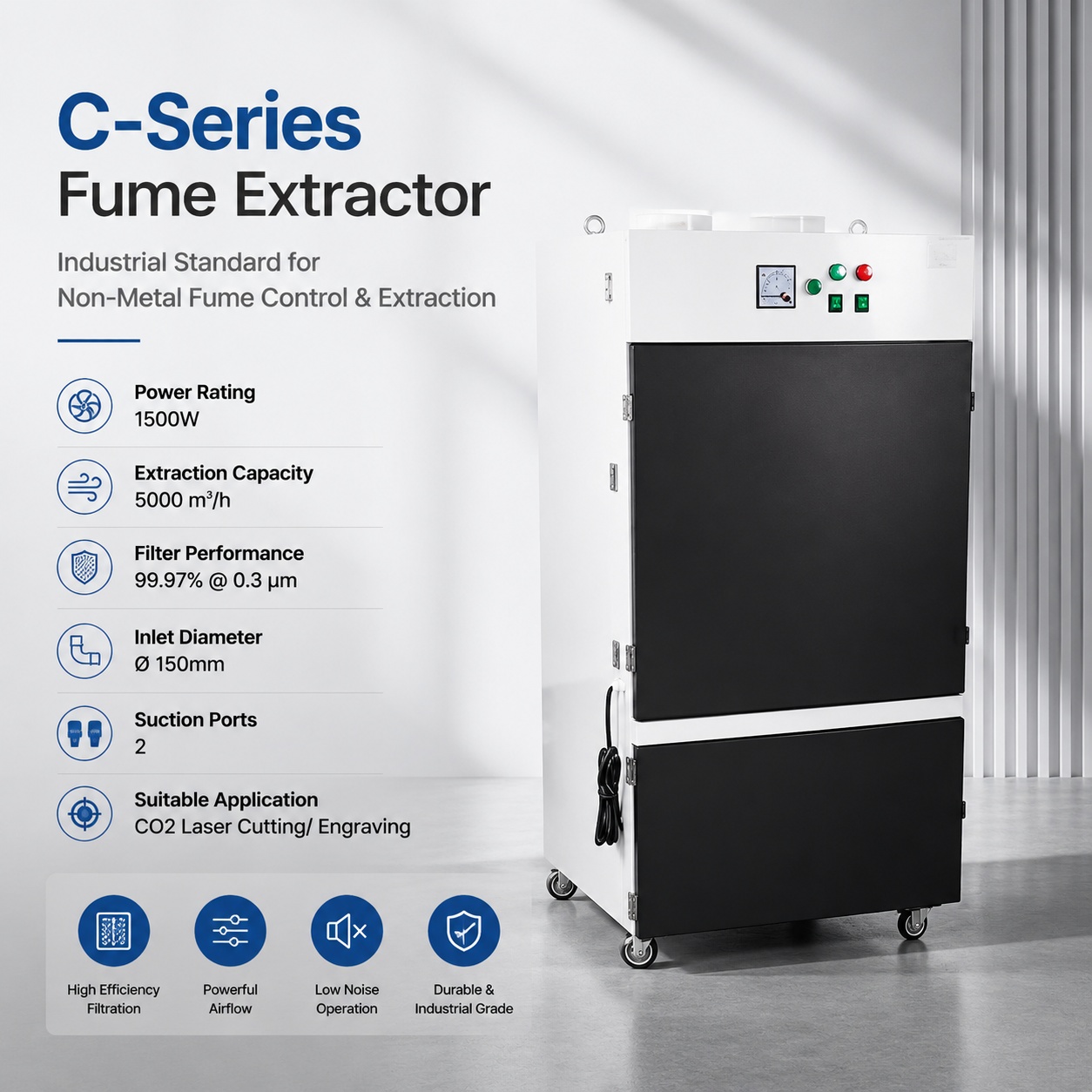
For laser processing facilities, extraction equipment should be considered part of the overall machine configuration rather than an optional accessory.
MimoWork provides industrial fume extraction solutions, including its C-Series fume extractor, designed for CO₂ laser cutting and engraving applications.
When evaluating an extraction configuration, workshops should consider the relationship between the laser machine, extraction connection, airflow requirements, and filtration stages.
For example, workshops processing wood, acrylic, leather, and other non-metal materials need an extraction system capable of handling the smoke and particulate generated during laser cutting and engraving.
The C-Series provides an option for businesses looking to integrate dedicated fume extraction into their CO₂ laser processing setup.
Rather than choosing equipment based on a single advertised airflow figure, buyers should confirm the required airflow at the operating static pressure, the available filter configuration, and the compatibility of the filtration media with their processing materials.
Explore MimoWork’s C-Series Fume Extractor to learn more about its solutions for CO₂ laser cutting and engraving.
An ordinary exhaust fan can move air, but it does not necessarily filter the contaminants contained in that air.
If the exhaust is discharged outdoors, its location, discharge conditions, and compliance with local environmental requirements must be considered. If contaminated air is simply circulated inside the workshop, fine particles and gaseous pollutants may remain in the occupied environment.
A dedicated extraction and filtration system combines contaminant capture with appropriate filtration, providing a more controlled approach to managing laser-generated emissions.
There is no universal replacement interval for every filter.
Service life depends on the material being processed, operating hours, contaminant concentration, airflow, and filter capacity.
A workshop processing plywood every day may load its pre-filter considerably faster than a facility performing occasional engraving on clean materials.
Operators should monitor pressure differences across filters, airflow reduction, filter condition, and manufacturer maintenance recommendations. Activated carbon also requires attention because its adsorption capacity can become exhausted even when the filter still looks clean.
Replacing filters based only on appearance is therefore not a reliable maintenance strategy.
No. Ordinary activated carbon filters should not be considered a solution for making PVC laser processing safe.
PVC and vinyl can release hydrogen chloride and other hazardous decomposition products when exposed to laser energy. These emissions may also damage machine components.
Other plastics may generate different toxic gases or VOCs depending on their chemical composition.
Before processing any material, verify its composition and suitability through reliable material safety information and the laser machine manufacturer’s approved-material guidance.
If a material is unsuitable for laser processing, upgrading the filtration system does not make it safe.
The working area is only one factor in determining extraction requirements.
A larger machine may need more airflow because of its enclosure volume, exhaust opening configuration, and emission generation rate. However, two machines with identical working areas can still have different extraction requirements.
Start by checking the machine manufacturer’s recommended exhaust airflow and static pressure.
Then consider the extraction duct diameter, duct length, number of bends, filter resistance, and enclosure leakage.
Finally, verify the airflow delivered by the complete system under operating conditions. This is more meaningful than comparing the fan’s maximum free-air CFM rating with the machine’s working dimensions.
Laser-generated fumes are a combination of particles, vapors, and potentially hazardous gases. Their composition changes with the material and processing conditions, which makes a one-size-fits-all filtration solution unreliable.
A suitable extraction system should combine effective source capture, appropriate particulate filtration, compatible gas adsorption media, and sufficient airflow under actual operating resistance.
For workshop operators, the most important decision is not simply how powerful the fan is, but whether the complete system can control the contaminants generated by their specific laser applications.
Choosing the right equipment, processing only approved materials, and maintaining filters according to operating conditions can help create a cleaner, safer, and more reliable laser processing environment.
Related guide:High-Performance Fume Extractors for Laser Engravers: Protect Your Health & Machine
1. O’Neill, K., Niu, X., Wang, J., & Fang, R. (2024). Respirable Particles and Gas Contaminants Emissions from a Desktop Laser Cutter and Engraver. Aerosol and Air Quality Research, 24, 240032.
2. U.S. Environmental Protection Agency (EPA). What Is a HEPA Filter?
News | Nov-2-2026
News | Oct-14-2026
News | Oct-8-2026