Blog
In a field that evolves daily, staying ahead means staying informed.
Explore in-depth articles designed to help you solve complex challenges,
maximize your machine’s ROI.
Stay ahead in a competitive market.


In a field that evolves daily, staying ahead means staying informed.
Explore in-depth articles designed to help you solve complex challenges,
maximize your machine’s ROI.
Stay ahead in a competitive market.
News | Nov-2-2026 | Mimowork
Laser cutting produces smoke, fine particles, and material-dependent airborne contaminants. Without effective extraction, these emissions can contaminate optical components, affect production consistency, and create workplace hazards.
Choosing the right industrial dust collectors laser cutting setup requires more than comparing motor power. Airflow, filter performance, material compatibility, duct resistance, and maintenance all influence extraction effectiveness.
This guide explains how to evaluate a laser fume extraction system, compare filtration technologies, and select a suitable configuration for your production needs.
Industrial dust collection helps control airborne emissions, protect machine cleanliness, and support safer working conditions. The system must match the materials being processed, the laser enclosure, and applicable safety requirements.
Laser cutting generates smoke and particles that can settle on optical components, machine surfaces, and extraction ducts. Contaminated lenses and mirrors may reduce laser transmission and processing consistency, increasing cleaning requirements and downtime.
Effective source capture removes smoke before it spreads through the cutting enclosure. However, extraction does not replace routine maintenance. Operators should inspect optics, clean cutting beds, and check filters and ductwork according to the equipment manufacturer’s instructions.
Laser-generated emissions vary with the material, coatings, adhesives, and processing conditions. Fine particles may pose inhalation risks, while combustible dust and hot debris can increase fire hazards.
A properly selected industrial dust collector for laser cutting helps capture contaminants at the source. However, particle filters do not necessarily remove hazardous gases, and activated carbon cannot capture every chemical.
Always check material safety data, confirm extraction compatibility, and follow applicable ventilation and occupational safety requirements.
Related guide: https://www.mimowork-laser.com/blog/laser-cutting-fumes-extractor-guide
A laser cutter fume extractor draws contaminated air from the cutting enclosure or extraction port, passes it through suitable filters, and returns or exhausts the treated air according to the system design.
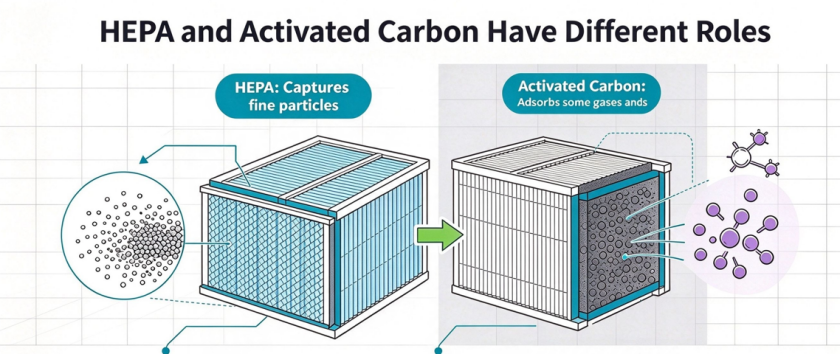
Different filters target different contaminants. A multi-stage system may combine pre-filtration, high-efficiency particle filtration, and activated carbon.
| Filter Type | Primary Function | Key Consideration |
| Pre-filter | Captures larger particles and debris | Protects downstream filters from premature loading |
| HEPA or other high-efficiency particle filter | Captures fine airborne particles | Verify rated efficiency and test standards |
| Activated carbon | Adsorbs certain gases and VOCs | Performance depends on contaminant type and carbon capacity |
HEPA and activated carbon filters for laser cutting serve different purposes. Particle filtration captures airborne particles, while activated carbon adsorbs certain gaseous contaminants.
Select filter media according to the actual material emissions. Some applications require specialized filtration or outdoor exhaust rather than recirculation.
Airflow measures the volume of air moved by an extraction system. Negative pressure helps draw contaminated air into an enclosure or extraction hood, reducing the chance of smoke escaping.
A high advertised airflow rating does not guarantee effective capture. Confirm the airflow available at the required operating pressure under actual installation conditions.
Extraction requirements depend on material composition and processing conditions, not simply the laser type.
Wood and medium-density fiberboard (MDF) generate smoke, fine particles, and combustion by-products. MDF binders and plywood adhesives can influence emissions, while accumulated residues may restrict airflow and increase maintenance needs.
Maintain effective source capture, inspect ducts and filters, and remove combustible debris regularly. Only process materials approved for laser cutting, especially when coatings or adhesives are present.
Acrylic (PMMA) produces fumes and airborne emissions during laser cutting. Other plastics can release different contaminants, including hazardous gases, depending on their chemical composition.
Particle filtration alone may be insufficient when gaseous contaminants are present. Before processing a plastic, verify its composition, consult supplier safety documentation, and confirm that the extraction system is suitable for the expected emissions.
Never laser-process unidentified plastics or materials that the machine manufacturer has not approved.
Choose a collector based on capture performance, filtration requirements, machine configuration, and maintenance needs—not motor wattage alone.
The collector must provide sufficient airflow at the extraction ports to capture smoke before it escapes into the workspace. Larger enclosures, multiple ports, and restrictive ductwork may require different configurations.
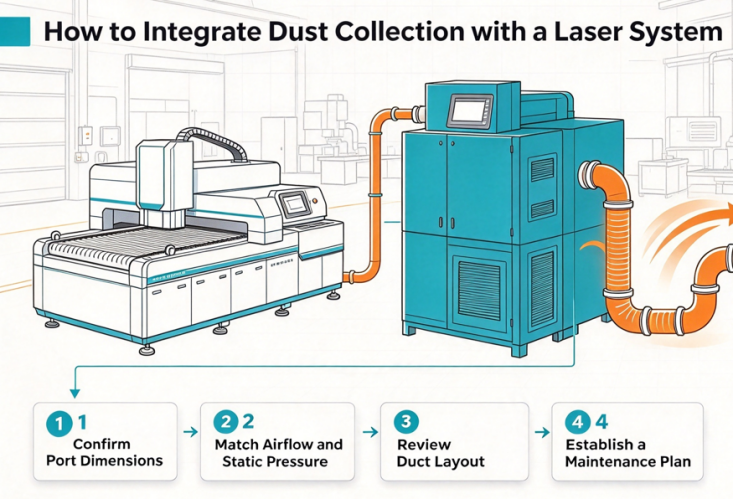
Before selecting a unit, confirm the required operating airflow, static pressure, duct diameter, port arrangement, and whether multiple machines will share the system.
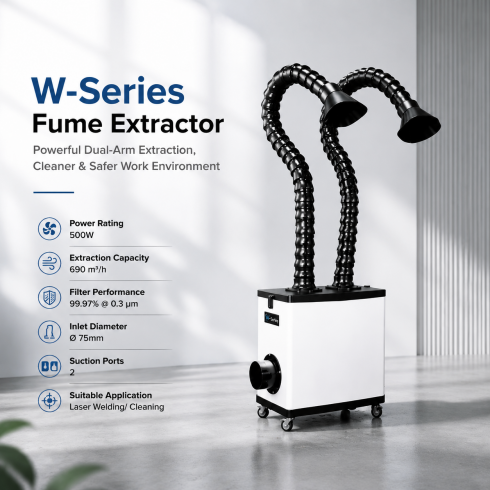
MimoWork offers extraction units with different airflow capacities for comparison:
| Specification | M Unit | W Unit |
| Motor power | 230 W | 500 W |
| Rated airflow | 390 m³/h | 690 m³/h |
| Extraction ports | 1 × Ø75 mm | 2 × Ø75 mm |
These specifications are starting points, not guarantees of suitability. Actual performance depends on duct resistance, filter configuration, material emissions, and required capture airflow. Confirm the complete system specifications before choosing a unit.
Filter life depends on operating hours, contaminant loading, material type, airflow, and filter capacity. Frequent MDF cutting, for example, may create a different maintenance demand from occasional cutting of thin acrylic sheets.
Follow manufacturer guidance and actual operating conditions rather than relying on a universal filter replacement interval. Activated carbon can become saturated even when it looks clean.
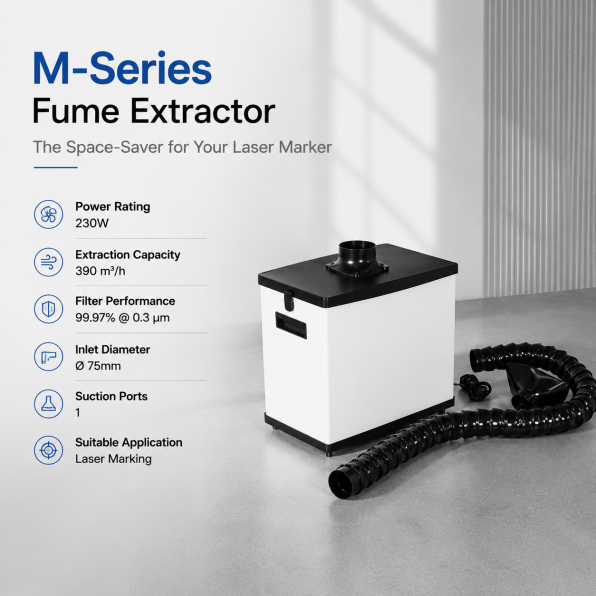
MimoWork offers extraction configurations for different laser processing environments. Selecting a suitable unit requires matching its airflow and filtration capabilities to the machine, material, and production workload.
For sustained production, prioritize stable airflow, appropriate filter media, accessible maintenance points, and compatibility with the expected contaminant load.
MimoWork’s M and W units offer rated airflow capacities of 390 m³/h and 690 m³/h, respectively. Compare these ratings with your installation’s required airflow and static pressure, and confirm the complete filtration specifications before making a decision.
Successful integration requires checking the laser cutter’s extraction ports, enclosure design, duct routing, and operating airflow. Poorly matched connections or restrictive duct layouts can reduce extraction performance.
Before installation, verify connection dimensions, filtration requirements, electrical arrangements, maintenance access, and applicable fire-safety measures.
Ready to configure extraction for your laser cutting operation? Send MimoWork your laser model, working area, material specifications, extraction-port dimensions, and production requirements. Get support evaluating a compatible extraction setup before investing, so you can address airflow, filtration, and maintenance needs with greater confidence.
There is no universal replacement interval. Filter life depends on operating hours, contaminant loading, material type, and filter design. Follow supplier recommendations and monitor available pressure or airflow indicators. Activated carbon may become saturated before visible signs appear.
Required airflow depends on enclosure size, extraction ports, duct resistance, material emissions, and capture requirements. Obtain the laser manufacturer’s airflow and static-pressure specifications, then confirm the collector can deliver the required performance under installed conditions.
Generally, no. A standard workshop vacuum may lack suitable smoke capture, filtration for fine particles and gaseous emissions, or controls for combustible debris. Use extraction equipment specifically designed and approved for your laser application and materials.
Effective industrial dust collectors for laser cutting combine sufficient capture airflow, suitable filtration, compatible ductwork, and a practical maintenance plan.
Before choosing a unit, identify your materials, confirm the laser’s extraction requirements, and determine whether particle filtration, gas adsorption, or additional emission controls are necessary.
Contact MimoWork with your laser model, material types, working area, and extraction-port specifications to assess a suitable configuration for your production environment.
News | Oct-16-2026
News | Oct-7-2026
News | Sep-25-2026