Blog
In a field that evolves daily, staying ahead means staying informed.
Explore in-depth articles designed to help you solve complex challenges,
maximize your machine’s ROI.
Stay ahead in a competitive market.


In a field that evolves daily, staying ahead means staying informed.
Explore in-depth articles designed to help you solve complex challenges,
maximize your machine’s ROI.
Stay ahead in a competitive market.
News | Oct-16-2026 | Mimowork
Quick Answer
A laser fume extractor is essential for controlling the smoke, airborne particles, and potentially hazardous gases generated during laser cutting and engraving. Wood can produce fine particles and combustion products, acrylic releases processing fumes, and leather may contain emissions from tanning agents, dyes, or surface finishes. A suitable extraction system captures contaminants close to the processing area and uses filtration appropriate to the material. The most important buying factors are effective source capture, filter compatibility, airflow under real operating conditions, and manageable maintenance costs.
Laser cutting heats and removes material, generating a mixture of smoke, fine particles, vapors, and other airborne contaminants. Without effective extraction, these emissions can spread beyond the machine and accumulate in the surrounding workspace.
The absence of visible smoke does not prove that the air is safe. Some contaminants are difficult to see, and their composition depends on the material, coating, processing conditions, and temperature.
The Occupational Safety and Health Administration (OSHA) identifies adequate ventilation as an important control for potentially hazardous fumes and vapors produced during laser cutting, welding, and other laser-material interactions. Local exhaust ventilation is also a recognized method of capturing airborne contaminants near their source. For businesses operating a laser cutter every day, extraction should be considered part of the production system rather than an optional accessory.
The materials do not generate identical emissions. Their composition determines what may enter the airstream, while the laser settings and cutting conditions affect how much is produced.
| Material | Main extraction concerns | What buyers should verify |
| Wood and plywood | Smoke, fine particles, and material-dependent combustion products | Particle filtration, airflow, and compatibility with adhesives or finishes |
| Acrylic (PMMA) | Smoke and processing vapors | Whether the filtration system is suitable for the emissions generated |
| Genuine leather | Smoke, particles, and potential emissions from tanning chemicals or finishes | Material composition and filter compatibility |
| Synthetic leather | Potentially hazardous emissions from polymers and additives | Exact polymer composition and manufacturer guidance |
| Painted or coated materials | Emissions from both the base material and its surface treatment | Coating chemistry and whether laser processing is appropriate |
Wood processing may require effective particle capture, while applications that release gaseous contaminants may also need suitable gas-phase filtration. One filter specification cannot establish that a system is suitable for every material.
Material identification is particularly important when processing synthetic leather or coated products. Never assume a material is safe to laser cut simply because it is sold as leather, plastic, or wood. PVC and vinyl, for example, can release corrosive and hazardous gases during laser processing and should not be processed unless the specific equipment and process are explicitly designed and approved for the application under appropriate controls.
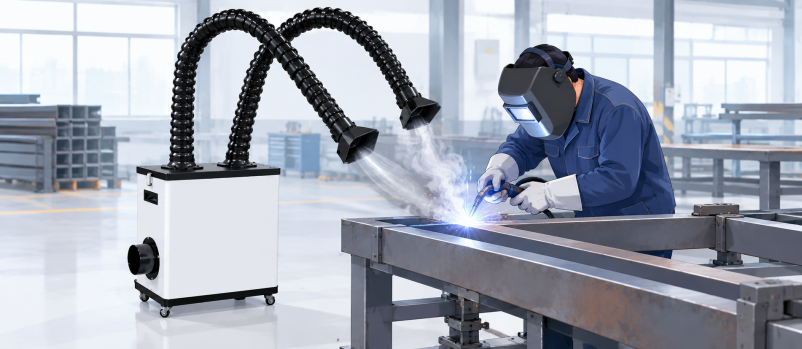
An effective extractor draws contaminated air away from the cutting area before it spreads into the workspace. The air then passes through filtration stages selected for the contaminants generated by the process.
A typical configuration may include a pre-filter for larger particles, a fine-particle filter, and gas-phase filtration using activated carbon or other suitable media. The exact arrangement depends on the application and the extractor design.
Fine-particle filtration and gas-phase filtration perform different functions. A filter that captures particles efficiently cannot automatically be assumed to remove every vapor or gas. Likewise, activated carbon performance depends on the contaminant, media quantity, contact time, and operating conditions.
Extraction also depends on how the system is installed. An undersized duct, excessive bends, clogged filters, or a poorly positioned capture point can reduce effective airflow. A technically capable extractor may therefore perform poorly when connected to an unsuitable setup.
Choose the system according to the machine’s airflow requirements, the contaminants produced, and the intended production schedule. A high advertised airflow figure alone is not enough to establish suitability.
| Buying factor | Why it matters | What to check |
| Airflow and static pressure | Determine how much air the system can move through the installed setup | Performance data at the expected operating resistance |
| Filter configuration | Determines which particles and gases can be controlled | Filter media, ratings, and documented contaminant compatibility |
| Capture design | Affects how much smoke escapes before reaching the extractor | Enclosure, hood position, and connection points |
| Filter service life | Influences recurring operating costs | Replacement intervals, availability, and cost |
| Duty cycle | Determines whether the unit can support the production schedule | Continuous-operation capability and maintenance requirements |
| Monitoring | Helps identify reduced performance or the need for servicing | Filter-status indicators and airflow monitoring, where available |
| Installation | Affects extraction performance and workplace requirements | Duct length, bends, exhaust arrangements, and ventilation needs |
For example, a small workshop processing occasional wood projects has different operating requirements from a production facility cutting acrylic throughout a shift. The latter may need a more robust system with suitable gas-phase filtration, greater sustained airflow, and a clear filter-maintenance plan.
Ask the supplier to explain how the proposed configuration addresses your actual materials. If the answer focuses only on motor power or maximum airflow, request additional performance and filtration documentation.Related guide: High-Performance Fume Extractors for Laser Engravers: Protect Your Health & Machine
No. The goal is effective contaminant capture at the processing point, not simply the highest possible airflow.
Insufficient airflow can allow smoke to escape. However, the system must also be compatible with the laser machine’s exhaust design, ducting, enclosure, and intended operating conditions. Excessive or poorly balanced airflow can create other process problems and unnecessary energy costs.
The most useful performance evidence comes from the installed configuration. Confirm that the system maintains the required capture under normal operating conditions, including when filters begin to accumulate contaminants.
Also consider the placement of the capture point. Collecting smoke near where it is generated generally provides better control than relying on general room ventilation to dilute contaminants after they have spread.
Yes, if the system is properly engineered for the combined workload and the different contaminants involved. Sharing an extractor can reduce equipment duplication, but it is not automatically the most practical solution.
The design must account for the number of machines operating simultaneously, duct resistance, airflow requirements, and the filtration needed for each process. If one machine cuts wood while another processes coated materials, the contaminant mix may complicate filter selection and maintenance.
A centralized system may suit a larger production facility with predictable operating schedules. Separate extractors can be easier to manage when machines process different materials or run independently.
Before selecting a shared system, ask an extraction specialist to evaluate the complete installation rather than simply adding the machines’ advertised airflow figures together.
Replace filters according to the manufacturer’s instructions and the system’s monitoring or measured performance. Reduced extraction, increased pressure drop, maintenance alerts, or abnormal odors may indicate that the system needs attention.
Do not rely on visual inspection alone. Some filters can accumulate contaminants without appearing heavily loaded, while a dirty pre-filter does not necessarily mean every downstream filter needs immediate replacement.
Keep records of operating hours, materials processed, filter changes, and any changes in performance. This helps establish realistic maintenance intervals and identify recurring problems.
If the system cannot maintain effective extraction, stop the affected process until the problem has been addressed. A filter replacement schedule is only useful when combined with appropriate monitoring and maintenance.
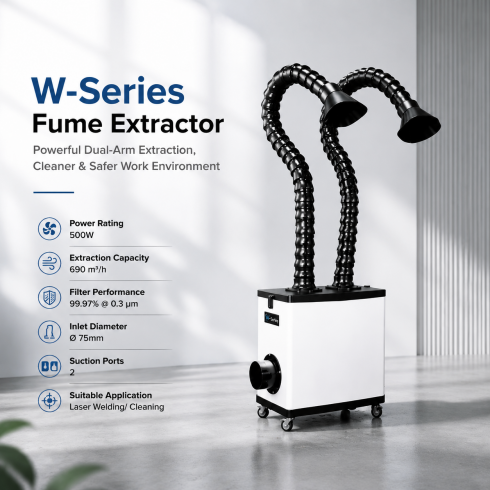
MimoWork offers several fume extraction solutions for different laser-processing applications. The W-Series Fume Extractor is specifically positioned for laser welding and laser cleaning, where localized smoke, fine particles, and process debris need to be captured near the source.
Its published specifications include a listed extraction capacity of 690 m³/h and filter performance of 99.97% at 0.3 μm. The unit also features an articulated extraction arm intended for targeted capture around the working area. These specifications are relevant to evaluating its stated applications, but they do not establish that the W-Series is automatically suitable for every wood, acrylic, or leather cutting setup.
For laser cutting applications, ask MimoWork which extractor model is intended for your particular machine and material. Confirm the airflow requirements, filter media, gas-phase filtration needs, and compatibility with the cutting enclosure before purchasing.
Explore MimoWork’s fume extraction solutions and request a configuration recommendation based on your actual cutting materials and daily workload.
Laser cutting wood generates smoke and airborne contaminants that need appropriate control. Use a suitable extraction and ventilation arrangement rather than relying on room ventilation alone.
Not necessarily. Particle filtration does not guarantee the removal of gaseous contaminants. Confirm that the filtration media and ventilation arrangement are suitable for the specific acrylic and processing conditions.
Potentially, provided that the system and filter media are compatible with the emissions from both materials. Because leather finishes and synthetic alternatives vary, verify the material composition before processing.
Check the laser machine’s requirements, the installed duct resistance, the capture arrangement, and the extractor’s performance under operating conditions. A maximum airflow figure alone does not prove effective capture.
No. Extraction controls airborne contaminants but does not eliminate laser radiation, fire, electrical, or other machine hazards. Appropriate enclosure design, interlocks, fire precautions, training, and other safety controls are still necessary.
OSHA, Technical Manual: Nonbeam Laser Hazards — explains the need for adequate ventilation to control potentially hazardous fumes and vapors generated by laser-material interactions.
News | Oct-8-2026
News | Sep-25-2026