Blog
In a field that evolves daily, staying ahead means staying informed.
Explore in-depth articles designed to help you solve complex challenges,
maximize your machine’s ROI.
Stay ahead in a competitive market.


In a field that evolves daily, staying ahead means staying informed.
Explore in-depth articles designed to help you solve complex challenges,
maximize your machine’s ROI.
Stay ahead in a competitive market.
News | Nov-9-2026 | Mimowork
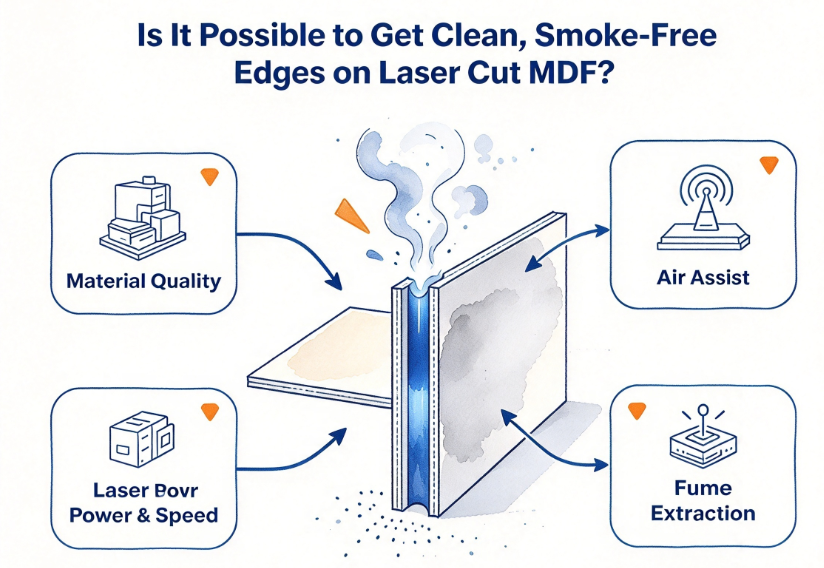
A laser cutting machine for MDF can produce precise cuts and reduce surface smoke stains with the right material, laser settings, and fume extraction. However, MDF contains wood fibers and synthetic binders that generate smoke and carbonized residue during laser processing. Completely smoke-free cutting is not a realistic expectation.
To reduce black residue on MDF, choose suitable laser-compatible boards, balance laser power and cutting speed, set the focus accurately, and combine appropriate air assist with effective fume extraction.
Some edge darkening is normal; the goal is to reduce excessive burning and surface contamination, not promise black-free edges.
MDF produces considerable smoke during laser cutting because its wood fibers and binding agents undergo thermal decomposition. Smoke and residue levels vary with board composition, thickness, laser parameters, and extraction conditions.
Medium-density fiberboard is made from wood fibers bonded with adhesives and resin systems under heat and pressure. When a CO2 laser beam processes the board, heat affects both the fibers and binding materials, producing smoke, fine particles, and other byproducts.
Binder formulations, density, moisture, and coatings vary, so boards of the same nominal thickness may produce different edge finishes and smoke levels.
Air assist clears smoke and debris around the beam; fume extraction removes contaminated air through a filtration or exhaust system.
Poor airflow or extraction allows smoke to settle on the MDF, causing dark stains and uneven residue.
Laser power that is too high or cutting speed that is too slow can expose MDF to unnecessary heat, increasing carbonization and producing wider, darker edges. Conversely, insufficient power or excessive speed can leave cuts incomplete.
Balance power, speed, and focus instead of simply maximizing laser output.
Density, fiber distribution, binder content, moisture, and coatings all affect processing.
For production, test samples from the actual MDF batch rather than applying one fixed setting to every board.
Cleaner MDF cutting requires coordinated adjustments to material quality, laser parameters, airflow, and surface protection.
Check the MDF manufacturer’s technical documentation and safety data sheet before processing. Low-formaldehyde or low-emission MDF may reduce certain emissions under specified test conditions, but this does not automatically make a board safe for laser processing.
Consider the complete binder composition, coatings, and additives. Confirm material suitability with the supplier and assess potential emissions under laser conditions. Avoid MDF containing PVC or other unsuitable halogenated materials.
Air assist clears the cutting path, while extraction removes smoke from the enclosure. A practical system needs sufficient airflow, correctly positioned nozzles, appropriately sized ducts, regular filter maintenance, and ventilation that prevents contaminated air escaping into the workspace.
Higher pressure does not guarantee cleaner edges: excessive airflow may spread debris, while insufficient airflow leaves smoke around the cut. Adjust it to the material and machine.
Effective MDF laser cutting settings balance cutting penetration with heat accumulation.
| Parameter | Potential problem | Adjustment objective |
| Laser power | Too much increases burning; too little leaves incomplete cuts | Match output to MDF thickness |
| Cutting speed | Too slow increases heat; too fast reduces penetration | Complete the cut while controlling heat |
| Focus position | Incorrect focus creates uneven energy distribution | Calibrate for material thickness |
| Cutting passes | Repeated passes add cumulative heat | Use an effective single pass where possible |
Higher power may help maintain cutting speed on thicker MDF, but test settings against board density, edge requirements, and laser source.
Laser-compatible paper masking tape can create a protective layer between the MDF surface and smoke residue. It may reduce discoloration around the cutting path and make cleaning easier.
Masking can also generate smoke or flame. Check the adhesive and paper composition, then test the complete tape under appropriate extraction. Not every paper tape is laser compatible.
Related guide: Green Laser Marking Machine
An industrial CO2 laser cutting machine for MDF should provide suitable cutting power, a working area that fits the material, stable support, and effective smoke extraction.
MDF cutting produces smoke and airborne particles that must be removed from the enclosure. Evaluate extraction capacity based on airflow, duct resistance, filtration requirements, and the number of extraction ports. Select filtration according to actual emissions and local environmental requirements.
Blocked filters, dust, and poor ductwork can reduce performance even with a high-rated fan.
CO2 lasers are widely used for MDF because wood-based materials absorb their energy effectively. Required power depends on thickness, density, cutting speed, and edge-quality requirements.
Thinner components may be processed with lower-power configurations. Thicker boards or higher production volumes may need greater output to maintain practical cutting speeds. Higher power alone, however, does not eliminate burn marks; parameter optimization and extraction remain important.
The working table affects material support and smoke flow beneath the cut.
| Table type | Main advantage | Suitable applications |
| Honeycomb | Distributed support for small components | Decorative patterns and small MDF parts |
| Knife-strip | More open space beneath the cutting path | Larger sheets and structural components |
Choose between them according to board size, part geometry, and under-table smoke clearance.
Match the bed to sheet and part dimensions. A larger area can reduce repositioning and improve nesting flexibility.
A conveyor may suit compatible continuous workflows, but rigid MDF still needs suitable loading and support. Consider sheet size, handling, cutting layout, and factory space.
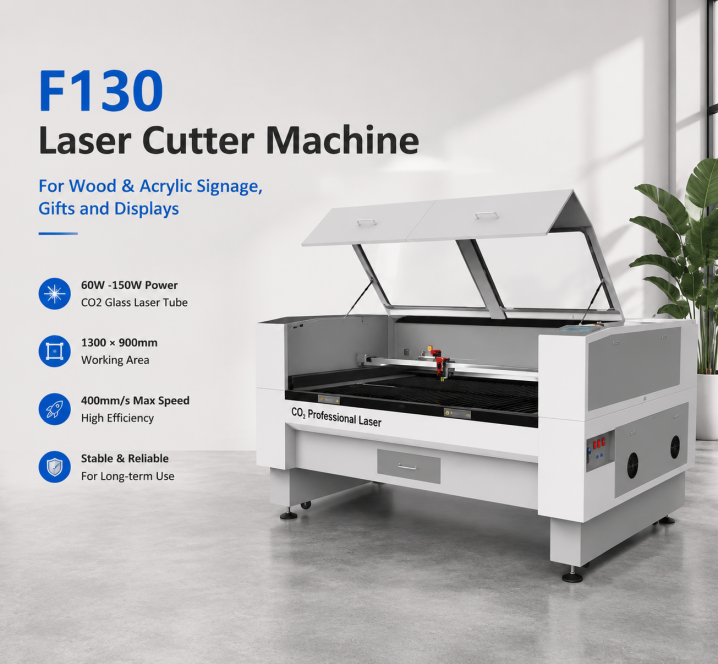
MimoWork offers CO2 laser configurations that can be evaluated according to MDF sheet dimensions, cutting requirements, and production volume.
For decorative components, customized signage, and smaller panels, medium-format equipment can provide a practical working area. MimoWork configurations include:
They suit customized MDF products, decorative panels, and smaller batches.
For larger MDF sheets and production layouts, a wider working area can reduce material repositioning and support more efficient nesting.
The MimoWork F130-L provides a 1300 × 2500 mm working area, with available laser power configurations from 100W to 600W. It suits evaluation for large decorative panels, furniture components, and other sheet-based applications.
Actual cutting thickness, speed, and edge quality must be verified through material testing.
Identify the defect before changing multiple settings.
| Defect | Possible cause | Recommended adjustment |
| Excessively dark edges | Excessive heat or slow cutting speed | Rebalance power and speed |
| Smoke stains on the surface | Smoke accumulation or weak extraction | Check airflow and exhaust performance |
| Incomplete cutting | Insufficient power, excessive speed, or incorrect focus | Recalibrate cutting parameters |
| Rough edges | Uneven board density or unstable processing | Test material consistency and adjust settings |
| Excessive smoke in enclosure | Insufficient extraction or restricted ductwork | Inspect fans, filters, and ducts |
If defects occur across batches, inspect the machine, optics, and extraction. If they affect one board only, check its density, binder, and surface treatment.
Laser cutting thermally decomposes wood fibers and binders, so completely residue-free edges are difficult. Suitable MDF, balanced settings, airflow, and extraction can reduce stains; results depend on the material and application.
Choose MDF with consistent density and documented binder composition. Low-emission MDF is worth evaluating, but low formaldehyde emissions do not guarantee safe laser processing. Review its safety data and assess emissions under actual conditions.
Air assist clears smoke and debris. Too little airflow allows residue to accumulate; too much may spread contamination. Set it according to the nozzle, speed, thickness, and extraction system, and use it alongside effective fume extraction.
The required power for 6mm MDF depends on density, binder, speed, and edge-quality requirements. MimoWork’s 60W, 80W, and 100W configurations may be starting points for testing, not guaranteed specifications. Test the actual board to confirm complete cutting at the required speed and finish.
Cleaner MDF edges depend on more than laser power or air pressure. Material composition, board density, cutting speed, focus position, air assist, and fume extraction all influence the result.
Test actual MDF samples and choose a CO2 system matched to sheet size, thickness, and production volume. MimoWork offers different working areas and power configurations for MDF processing, from medium-format applications to large-format sheet cutting.
Planning to improve your MDF cutting process? Share your MDF thickness, board specifications, cutting files, and production requirements with the MimoWork team. A material test can help evaluate suitable laser power, working area, and extraction configurations for your application.
News | Oct-31-2026