Blog
In a field that evolves daily, staying ahead means staying informed.
Explore in-depth articles designed to help you solve complex challenges,
maximize your machine’s ROI.
Stay ahead in a competitive market.


In a field that evolves daily, staying ahead means staying informed.
Explore in-depth articles designed to help you solve complex challenges,
maximize your machine’s ROI.
Stay ahead in a competitive market.
News | Jul-30-2026
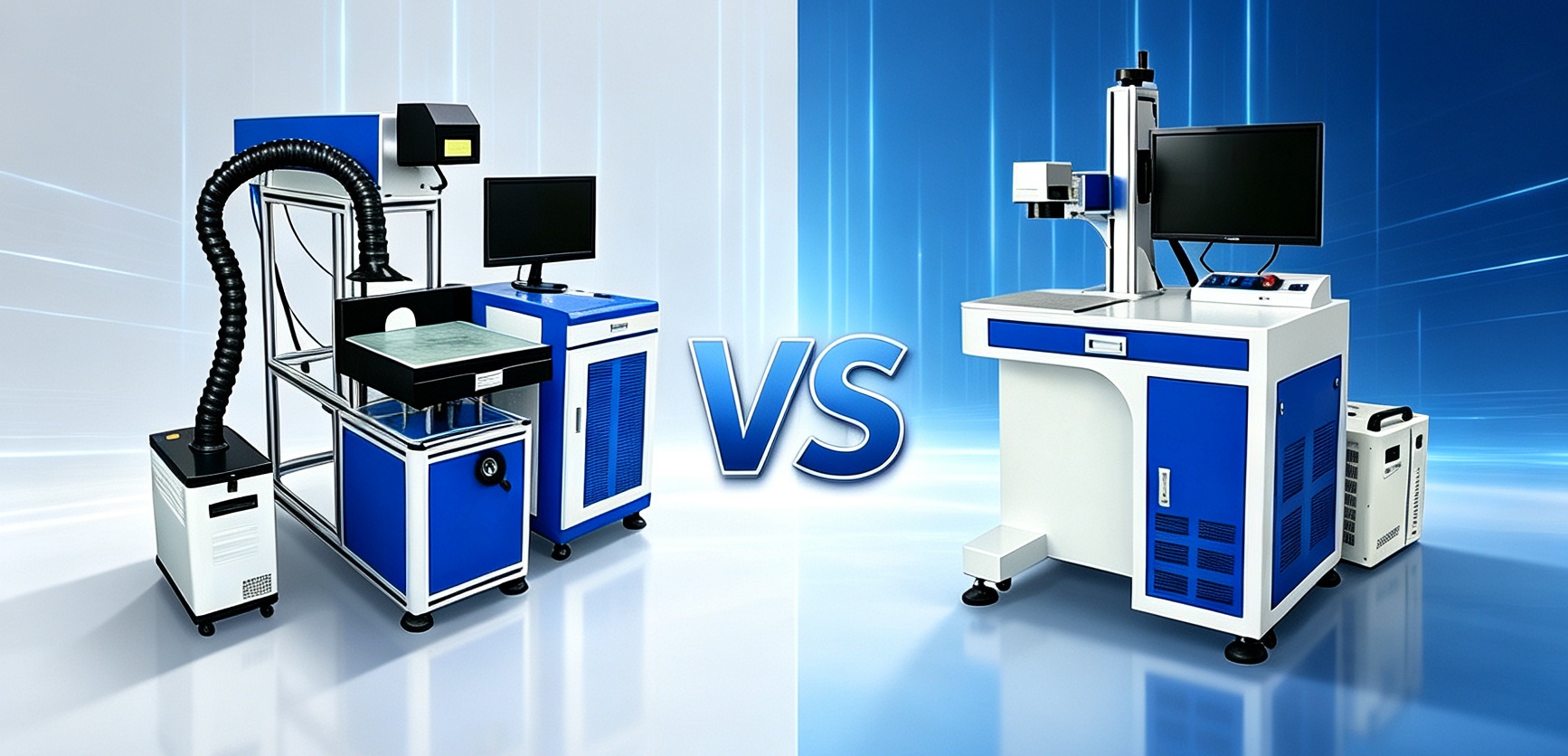
Quick Answer: CO2 laser marking machines are designed for marking non-metal materials, while fiber laser marking machines are optimized for permanent marking on metals.
But material alone doesn’t decide the purchase. Production volume, required marking depth, and total cost of ownership all factor into the decision.
This guide breaks down how CO2 and fiber lasers differ in technology, output quality, upkeep, and real-world use, so you can match the machine to your production line.
The biggest difference between CO2 and fiber laser marking machines comes from their laser wavelength and material absorption characteristics.
CO2 laser machines use a gas laser source with a wavelength of around 10.6μm. This wavelength is highly absorbed by organic materials, allowing the laser to mark surfaces with clean and precise results.
One of the biggest advantages of CO2 laser technology is its versatility.
CO2 lasers are also widely used in packaging applications, where manufacturers need clear and permanent marking for product information, logos, and decorative designs.
For companies involved in customization, advertising products, packaging, or non-metal manufacturing, CO2 lasers provide the material flexibility needed for daily production.
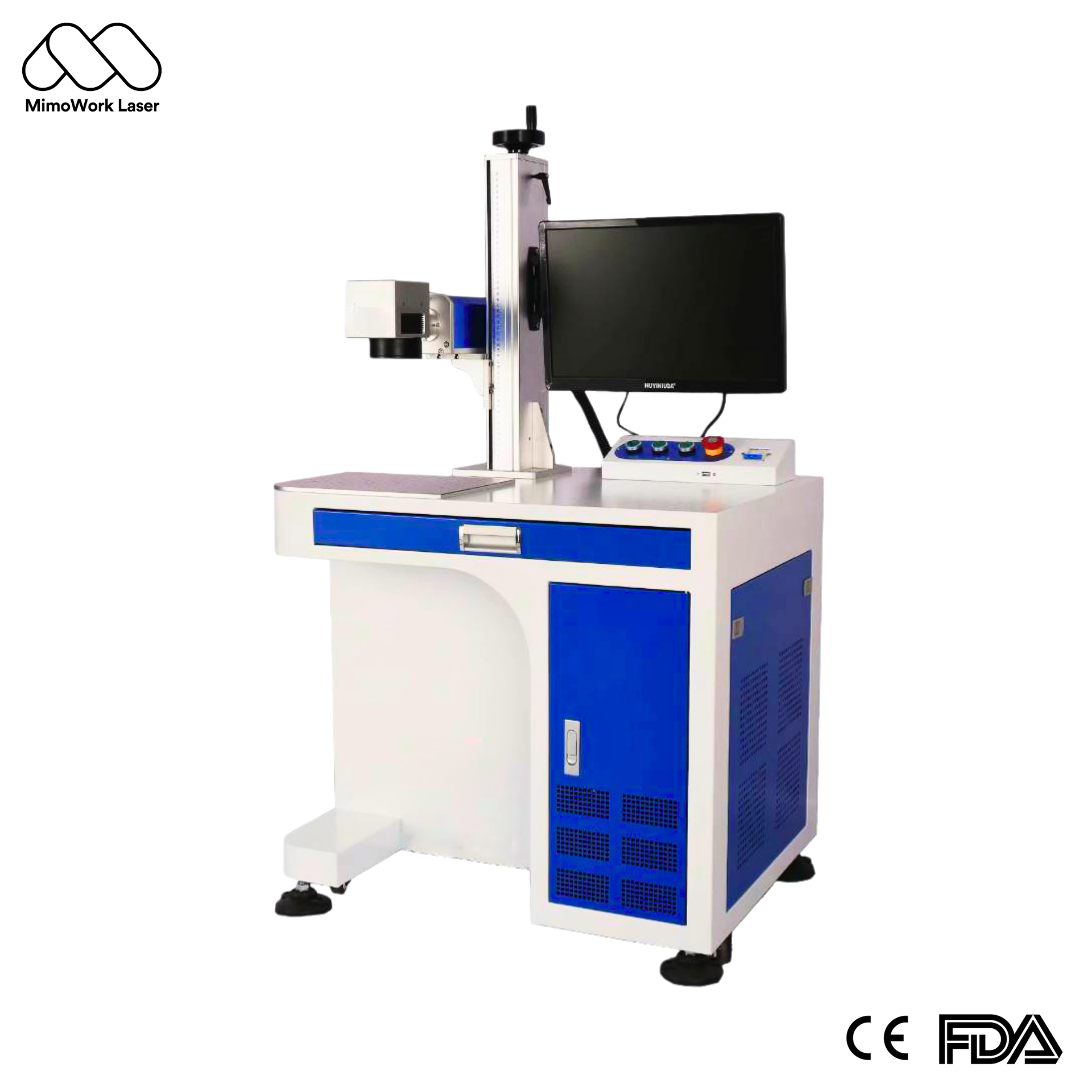
Fiber laser systems use a solid-state laser source with a wavelength of approximately 1064nm. This wavelength is efficiently absorbed by metals, allowing fiber lasers to create precise and permanent marks.
A fiber laser can mark serial numbers, QR codes, barcodes, and logos directly onto metal surfaces. These marks can withstand wear, heat, and harsh working environments, making them suitable for long-term identification.
For manufacturers that need reliable marking on thousands of parts, fiber lasers provide the speed and consistency required for industrial production.
Material compatibility determines which laser you should choose, but processing quality and production efficiency determine whether the machine can meet your business requirements.
On metal, fiber lasers hit their stride. Their tightly focused beam holds fine detail even at small scale, which matters for compliance marking, serialized parts, and dense QR codes.
Typical fiber laser applications include:
Fiber lasers generally deliver faster marking speeds on metal, sharper micro-detail, higher contrast, and deeper engraving where it’s needed.
While CO2 laser marking is a popular choice in packaging, crafts, promotional products, and custom personalization work—anywhere fine surface detail on non-metal materials matters.
CO2 marking systems typically use a metal (RF) tube, which delivers strong stability, beam quality, service life, and response speed. Routine care mainly involves cleaning optical components, checking focusing lenses, maintaining cooling performance, and inspecting the beam path.
Fiber marking systems use a solid-state laser source with fewer consumable parts, but still need regular attention—mainly cleaning the marking lens, protecting the scanning system, and keeping the work area clean. In practice, the overall maintenance workload for CO2 marking and fiber marking end up in a similar range.
When comparing marking machines specifically, cost is one of the clearer differences between the two technologies.
CO2 marking machines are typically equipped with metal (RF) tubes—precision components built for industrial-grade stability and beam quality. As a result, CO2 marking machines are generally more expensive than fiber marking machines of comparable power and configuration. They’re worth the investment for businesses that need high-quality non-metal engraving, fine surface detail, and stable production performance.
Fiber marking machines tend to have a more compact, cost-efficient structure, with pricing driven mainly by laser power, marking area, laser source brand, and any automation add-ons. For metal processing, fiber lasers tend to offer strong long-term value thanks to their speed and durability.
| Business Needs | Recommended Laser | Applications |
| Non-Metal Products | CO2 Laser Marking | Acrylic, wood, signage, packaging, crafts, gifts |
| Metal Products | Fiber Laser Marking | Jewelry, stainless steel, industrial parts, electronics |
| Mixed Materials | CO2 + Fiber Laser | CO2 for non-metals, Fiber for metals |
Match the machine to what you actually produce day to day—not to whichever spec sheet looks more impressive. This isn’t about finding the “best” laser overall; it’s about finding the best fit for your materials.
Non-Metal Products and Signage → CO2
CO2 is usually the stronger investment if your output is mostly:
Metal Parts and Jewelry → Fiber
Fiber is the better fit if your business centers on:
Both Metal and Non-Metal Work → Run Both
Plenty of manufacturers process both material types—acrylic packaging alongside metal components, for instance. In that case, running a CO2 machine for non-metals and a fiber machine for metal parts is usually more efficient than forcing one system to handle jobs it wasn’t built for.MimoWork supplies both CO2 and fiber laser systems, and helps customers pair the right combination of equipment to their materials and production volume—so you’re never stuck choosing one technology at the expense of the other.
The laser technology is only half the decision. Machine configuration, supplier experience, and after-sales support determine whether the equipment keeps performing once it’s on your floor.
MimoWork builds CO2 and MOPA fiber laser systems for:
Rather than defaulting customers to the highest-spec unit, MimoWork sizes the machine to material type, part size, required finish, output volume, and where the business expects to grow — so buyers aren’t paying for capability they won’t use.
Laser results shift with material grade, surface finish, and coating, so testing your actual material before purchase is the most reliable way to confirm output quality.
MimoWork runs sample testing on:
Post-installation, customers get support on machine setup, parameter tuning, and production troubleshooting—the kind of ongoing support that keeps output consistent well after the initial purchase.
Not directly, in most cases. Bare metal reflects most of the CO2 wavelength, so marking results are weak or inconsistent. CO2 lasers can process some coated or anodized metals, but for direct, permanent marking on bare metal, a fiber laser is the better choice.
Fiber laser marking machines are mainly designed for metal marking. They are not suitable for most non-metal marking applications because many non-metal materials do not absorb the 1064nm wavelength efficiently.
Neither one is “better” outright — they’re built for different materials and excel in different lanes.CO2 laser marking machines provide excellent contrast, fine details, and permanent marking results on non-metal materials such as acrylic, wood, leather, and packaging products.; fiber gives you speed, permanence, and precision on metal. The right pick depends on what you’re producing, not which technology sounds more advanced. MimoWork offers both, so you don’t have to compromise if your work spans both categories.
Fiber, typically. Fiber laser sources are commonly rated for 50,000+ hours, while CO2 tubes usually need replacing after a few thousand hours of use, depending on power and duty cycle. That said, lifespan alone shouldn’t drive the decision—a CO2 laser matched to the right materials can deliver strong long-term value, the same way a fiber laser does in metal processing.
CO2 and fiber lasers solve different problems, and both do their job extremely well. CO2 is built for non-metal materials—acrylic, wood, leather, and packaging—with strong marking quality and engraving detail. Fiber is built for metal—fast, permanent marking and deep engraving for parts, jewelry, electronics, and industrial components.
The real question in a CO2 vs. fiber comparison isn’t which technology is more advanced. It’s which one matches what you actually produce.
Choose CO2 if you need:
Choose fiber if you need:
And if your work spans both—MimoWork carries both platforms, so you can get the right machine for each job instead of forcing one system to do two jobs at once.
News | Jul-3-2026
News | Jun-29-2026
News | Jun-15-2026