Blog
In a field that evolves daily, staying ahead means staying informed.
Explore in-depth articles designed to help you solve complex challenges,
maximize your machine’s ROI.
Stay ahead in a competitive market.


In a field that evolves daily, staying ahead means staying informed.
Explore in-depth articles designed to help you solve complex challenges,
maximize your machine’s ROI.
Stay ahead in a competitive market.
News | Apr-7-2026
Industrial marking plays an important role in product identification, traceability, and brand recognition. From automotive components and machinery parts to metal tools and electronic products, manufacturers require permanent and reliable marking solutions that can withstand harsh working environments.
Traditional laser marking systems are highly effective for standardized production lines, but they often require the workpiece to be transported to a fixed marking station. This becomes challenging when processing large, heavy, installed, or irregularly shaped components.
A handheld laser marking machine provides a flexible solution by bringing laser marking capability directly to the workpiece. Unlike conventional stationary systems, handheld laser markers allow operators to perform precision marking on-site without moving large components.
Powered mainly by fiber laser technology, handheld laser marking machines deliver high-speed, permanent marking on metals while improving production flexibility and reducing handling time.
This article explains how handheld laser marking machines work, their advantages, applications, compatible materials, and key factors to consider when selecting an industrial marking solution.
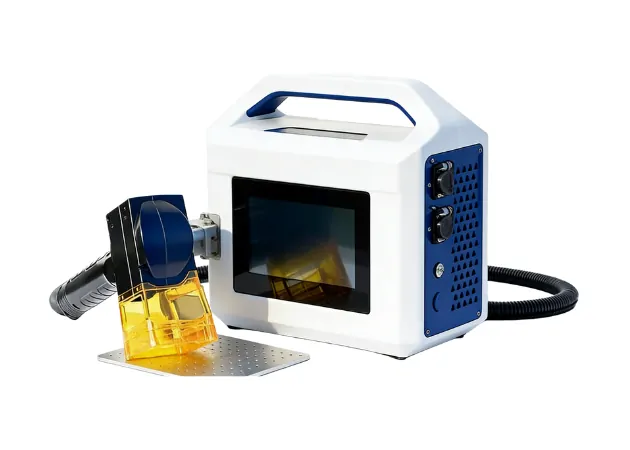
A handheld laser marking machine is a portable laser marking system designed to create permanent marks directly on large, heavy, or difficult-to-move objects.
Unlike desktop laser markers where the material is placed inside a fixed working area, handheld systems allow operators to move the marking head around the workpiece.
A typical handheld laser marking machine consists of:
| Component | Function |
| Fiber laser source | Generates a high-energy laser beam for permanent marking |
| Handheld marking head | Allows flexible positioning on different surfaces |
| Fiber optic cable | Transfers laser energy between source and marking head |
| Control system | Adjusts marking parameters and manages operation |
The portable design makes handheld laser marking machines particularly useful in industrial environments where component mobility is limited.
A handheld laser marking machine uses a focused laser beam to modify the surface of a material and create permanent marks.
The basic working process includes:
The fiber laser source generates a concentrated laser beam with high stability and efficiency.
Fiber lasers are commonly used because they provide:
The laser beam travels through a flexible fiber optic cable from the laser source to the handheld marking head.
This design separates the heavy laser source from the lightweight marking unit, allowing easier operation.
Inside the handheld marking head, a galvanometer scanning system controls the laser movement and directs the beam according to the digital design.
The laser can create:
Decorative patterns
Text
Serial numbers
Barcodes
QR codes
Logos
The biggest advantage of a handheld laser marking machine is its mobility.
Manufacturers no longer need to move large parts to a fixed workstation. Instead, operators can bring the marking system directly to the component.
This is especially useful for:
Moving large components between workstations can increase labor requirements and production downtime.
A handheld laser marker simplifies the workflow by allowing marking at the point of production, assembly, or maintenance.
Benefits include:
Many industrial parts have irregular shapes, curved surfaces, or large dimensions that are difficult to process with fixed laser systems.
The handheld design allows operators to position the marking head according to the surface condition, providing greater application flexibility.
Fiber laser marking creates durable marks without ink, labels, or additional consumables.
The markings are resistant to:
This makes handheld laser marking suitable for industrial traceability applications.
Handheld laser marking technology is widely used in industries that require flexible identification and traceability solutions.
Applications include:
Aerospace components often require permanent identification throughout their service life.
Handheld laser markers can process:
Large industrial equipment is one of the most suitable applications for handheld laser marking.
Examples include:
Manufacturers use handheld laser marking machines for:
Quality inspection marks
Product logos
Serial numbers
Batch codes
Most handheld laser marking machines use fiber laser sources, making them particularly suitable for metal processing.
| Material | Common Applications |
| Stainless steel | Industrial parts, tools, equipment |
| Aluminum | Electronics, automotive components |
| Carbon steel | Machinery and structural parts |
| Brass | Hardware and decorative components |
| Copper | Electrical components |
Some engineered plastics can also be marked depending on the material composition and laser parameters.
Both handheld and fixed laser marking systems have advantages depending on production requirements.
| Feature | Handheld Laser Marking Machine | Fixed Laser Marking Machine |
| Mobility | Excellent | Limited |
| Large workpieces | Ideal | Requires suitable working area |
| Production type | Low to medium volume, flexible production | High-volume automated production |
| Installation requirements | Simple | More structured setup |
| Best applications | Field marking, maintenance, large parts | Assembly lines and standardized production |
A handheld laser marking machine is ideal when flexibility and accessibility are more important than fully automated production.
Before purchasing a handheld laser marking machine, manufacturers should consider several factors.
Determine the main materials you need to process.
For metal marking applications, fiber laser systems are usually the preferred choice because of their speed and durability.
Consider the size of the components you need to mark.
Large industrial parts may require a portable system that can cover different areas without repositioning the workpiece.
Different power levels affect marking speed and processing capability.
Common considerations include:
| Power Range | Suitable Applications |
| 20W | Fine marking and detailed designs |
| 30W | General industrial marking |
| 50W | Faster marking and deeper engraving |
Because laser marking involves high-energy laser beams, safety systems are essential.
Important features include:
Proper operation ensures safe and reliable performance.
As manufacturing becomes more flexible and decentralized, portable laser marking solutions are becoming increasingly valuable.
Future trends include:
Handheld laser marking machines help manufacturers improve efficiency while adapting to changing production requirements.
A handheld laser marking machine is a portable laser system that allows operators to mark large or difficult-to-move components directly at the working location.
Most handheld laser marking machines use fiber laser sources because they provide high efficiency, long lifespan, and excellent performance on metals.
They are mainly used for metals such as stainless steel, aluminum, steel, brass, and copper. Some plastics may also be suitable depending on the material.
It depends on the application. Handheld systems are better for large parts, field service, and flexible production, while fixed systems are usually better for automated high-volume manufacturing.
A handheld laser marking machine provides manufacturers with a flexible and efficient solution for industrial identification and traceability.
By combining fiber laser technology with portable operation, it enables precise marking on large, heavy, and irregular components without complex material handling.
For industries such as automotive, aerospace, machinery, and metal fabrication, handheld laser marking systems offer an effective way to improve workflow efficiency, reduce downtime, and achieve permanent high-quality marks.
News | Jul-24-2026
News | Jul-3-2026
News | Jun-15-2026