Blog
In a field that evolves daily, staying ahead means staying informed.
Explore in-depth articles designed to help you solve complex challenges,
maximize your machine’s ROI.
Stay ahead in a competitive market.


In a field that evolves daily, staying ahead means staying informed.
Explore in-depth articles designed to help you solve complex challenges,
maximize your machine’s ROI.
Stay ahead in a competitive market.
News | Jul-24-2026
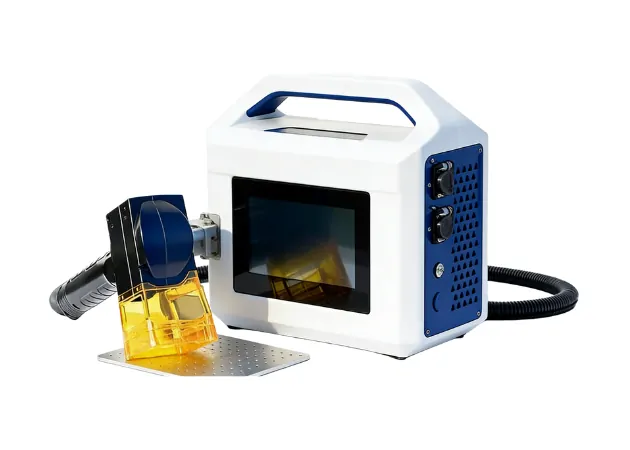
In many factories, the biggest challenge is not creating a mark—it is reaching the part that needs to be marked. Large molds, assembled machines, and oversized metal components often cannot be moved to a traditional marking station. Traditional laser marking systems offer high accuracy, but their fixed work areas can limit flexibility for oversized parts or assembled equipment.
A handheld laser marking machine offers a more flexible approach. Instead of moving the workpiece, operators can bring the marking head directly to the part. This makes it easier to mark large metal components, customized products, and industrial equipment while maintaining clear and durable results.
In this guide, we will explain how handheld laser marking machines work, their main advantages, industrial applications, and key factors to consider when selecting a system.
A handheld fiber laser marking machine is a laser marking system designed for direct marking on large, heavy, or complex workpieces.
Unlike fixed laser marking equipment, which requires the part to be placed inside a defined marking area, handheld systems allow the operator to position the marking head where the mark is needed.
This design is especially useful when:
Most handheld systems use fiber laser technology because it delivers excellent beam quality, stable performance, and long service life for metal marking applications.
Common materials include:
Typical marking tasks include:
Laser marking creates a permanent mark directly on the material surface without consumables.
A handheld laser marking machine uses a focused laser beam to modify the surface of a material and create a permanent mark.
Most industrial systems use a fiber laser source because it provides stable performance and is well suited for metal marking applications.
A typical system includes three main components:
The fiber laser source is the core component responsible for generating the marking beam.
Industrial fiber lasers are widely preferred because they provide:
For metal applications, fiber lasers offer excellent performance on materials such as stainless steel, aluminum, and steel alloys.
The laser power selection affects:
Lower-power systems are commonly used for detailed identification marks, while higher-power models are preferred for faster production or deeper engraving.
The handheld marking head allows operators to directly access different areas of a component.
It typically includes:
The operator can adjust the marking position according to the shape, size, and location of the workpiece.
This flexibility is one of the biggest differences between handheld systems and fixed laser markers.
For example, a manufacturer may need to mark:
Instead of moving these parts, the marking head can be brought directly to the surface.
Modern handheld laser marking machines use dedicated software to create and manage marking files.
Common functions include:
Operators can modify settings such as:
These adjustments allow the system to achieve different results depending on the material and marking requirement.
One of the main benefits of a handheld laser marking machine is the ability to mark large components directly.
In many industries, transporting heavy parts to a fixed marking station can increase handling time and production costs.
Handheld systems are often used for:
By moving the marking head instead of the workpiece, manufacturers can simplify the marking process.
Handheld laser marking machines are mainly used for metal identification applications.
Common materials include:
Typical applications include:
Laser marking creates durable identification without inks, labels, or additional consumables.
A handheld laser marking machine can be integrated into various manufacturing workflows.
Typical applications include:
The operator can adjust the marking position based on the component shape and production requirements.
Automotive manufacturers use handheld laser marking machines for part identification and traceability.
Common applications include:
Permanent marks help manufacturers track parts throughout production and service processes.
Aerospace manufacturing requires reliable identification for safety and maintenance purposes.
Handheld laser marking machines are used for:
The ability to mark complex components directly can simplify production workflows.
Large machinery parts often cannot be processed efficiently with standard marking systems.
Handheld laser marking machines are suitable for:
They allow manufacturers to complete marking tasks without moving oversized equipment.
In mold and metal fabrication, clear identification helps improve production management.
Applications include:
Handheld systems are suitable for customized components with different shapes and sizes.
Laser power affects marking speed, depth, and application range.
Suitable for:
A 20W system is often selected when marking quality and detail are more important than processing speed.
A 30W system provides a balance between speed and marking performance.
Common applications include:
Higher-power systems are suitable for applications requiring increased productivity.
Typical uses include:
Choosing the right power for your handheld laser marking machine depends on your marking priorities—precision, speed, or depth. Compare MimoWork 20W, 30W, and 50W fiber laser markers to find the best match for your application, from fine detailed marks to deep engraving on large components.
| Feature | 20W Handheld Laser Marking Machine | 30W Handheld Laser Marking Machine | 50W Handheld Laser Marking Machine |
| Best For | Fine marking applications | General industrial marking | High-productivity requirements |
| Ideal Workpieces | Small metal components | Standard components, factory parts | Large marking areas, deeper engraving |
| Typical Marks | Detailed identification marks | Component identification, factory traceability | Deep engraving, fast processing |
| Key Strength | Marking quality and detail | Balanced speed and performance | Increased throughput and efficiency |
| Speed | Moderate | Fast | High-speed |
| Marking Depth | Surface-level, fine detail | Moderate depth | Deep engraving capable |
For industrial applications, equipment stability is an important factor.
When selecting a system, consider:
A reliable system helps maintain consistent marking quality during daily operation.
A practical handheld laser marking machine should offer:
Simple operation reduces training requirements and improves production efficiency.
Yes. Handheld laser marking machines can mark many curved and irregular surfaces because the operator can adjust the marking head position manually.
For applications requiring extremely consistent positioning, fixtures may be added.
Not necessarily.
Handheld systems use the same fiber laser technology and scanning principles as many fixed laser markers.
The main difference is the operation method. Fixed systems provide automated positioning, while handheld systems offer more flexibility for large or complex parts.
Most modern systems are designed for straightforward operation.
Operators typically learn:
Laser safety procedures should always be followed when operating handheld laser marking equipment.
Recommended practices include:
A handheld laser marking machine provides an effective solution for manufacturers that need to mark large, heavy, or complex components.
By allowing operators to position the marking head directly on the workpiece, handheld systems simplify marking operations while maintaining the quality expected from fiber laser technology.
From automotive and aerospace components to machinery and metal fabrication, handheld laser marking machines help manufacturers improve traceability and product identification.
For manufacturers comparing different fiber laser markers, MimoWork offers 20W, 30W, and 50W handheld laser marking solutions designed for different production requirements.
News | Jul-3-2026
News | Jun-29-2026