Blog
In a field that evolves daily, staying ahead means staying informed.
Explore in-depth articles designed to help you solve complex challenges,
maximize your machine’s ROI.
Stay ahead in a competitive market.


In a field that evolves daily, staying ahead means staying informed.
Explore in-depth articles designed to help you solve complex challenges,
maximize your machine’s ROI.
Stay ahead in a competitive market.
News | Nov-18-2026 | Mimowork

Superior laser marking helps manufacturers create permanent, precise identification on components while improving production consistency and traceability. As manufacturing lines handle smaller components, more complex materials, and higher output requirements, traditional ink printing and labeling methods may struggle to keep up.
Upgrading to modern laser technology offers a different approach. Manufacturers can mark serial numbers, QR codes, barcodes, logos, and product information directly onto material surfaces without relying on inks or labels.
However, a more advanced laser does not automatically mean better production results. The laser source, marking area, material compatibility, optical configuration, and automation options must all match the application. Understanding these factors helps manufacturers select equipment that addresses actual production challenges.
A laser marking system uses a focused beam to modify a material surface, producing text, codes, graphics, or decorative patterns. Depending on the laser source and material response, the process can create surface discoloration, oxidation, engraving, or controlled material removal.
Compared with conventional printing, laser marking does not require ink, ribbons, or adhesive labels. It also allows manufacturers to change marking content digitally, making it suitable for product customization and variable-data identification.
For modern production, industrial laser marking systems should provide consistent marking quality, sufficient resolution for small codes, a suitable working area, and processing speeds that meet production targets.
Another important consideration is repeatability. A code that looks clear on one component but becomes distorted on the next is not suitable for a traceability process. Manufacturers should evaluate marking consistency across multiple production batches, not simply the appearance of a single sample.
Different laser sources interact with materials in different ways. The most suitable option depends on the substrate, required marking effect, and production conditions.
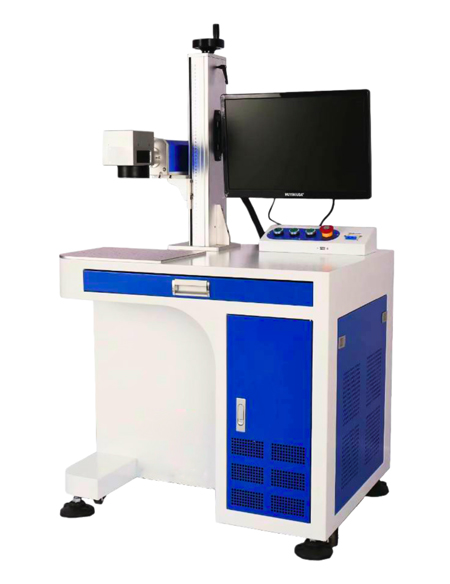
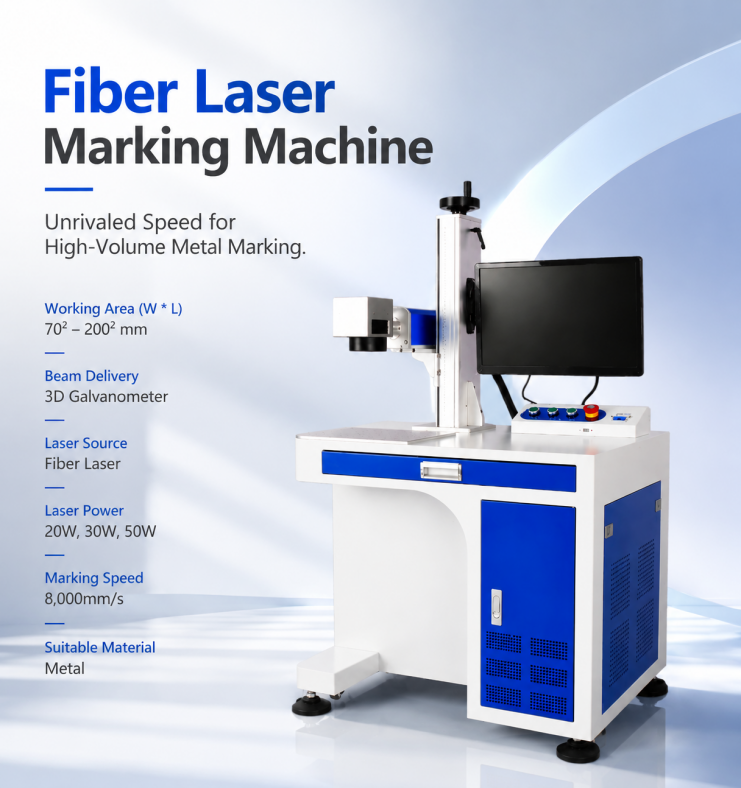
A fiber laser marking machine is a common choice for permanent identification on stainless steel, aluminum, titanium, copper, and selected engineered plastics.
It is particularly suitable for serial numbers, QR codes, data matrix codes, logos, and other industrial identification marks. Depending on the material and parameters, fiber lasers can produce surface contrast, annealed marks, or deeper engraving.
A CO2 laser marking system is designed for many non-metal applications, including wood, acrylic, leather, paper, glass, ceramics, and selected plastics.
Its longer wavelength is well suited to organic materials and various non-metallic surfaces. Manufacturers can use it for packaging information, decorative patterns, product logos, and detailed graphics.
Some materials can melt, discolor, or deform when exposed to excessive laser heat. This is particularly important when marking compact electronic components, transparent plastics, and precision parts.
UV laser marking for electronics is often selected for these applications because its 355 nm wavelength supports photochemical processing with reduced thermal impact compared with many conventional laser marking processes.
When standard metal marking cannot achieve the required appearance, MOPA technology offers additional parameter control.
Unlike a conventional fiber laser, a MOPA source allows operators to adjust pulse width and frequency. This makes it possible to produce specialized surface effects, including color marking on stainless steel and anodized aluminum.
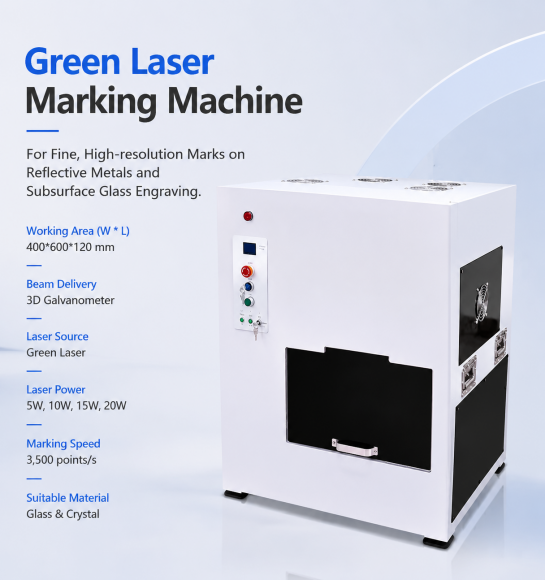
For applications involving highly reflective metals or internal glass engraving, a green laser offers another specialized option.
| Laser source | Recommended applications | MimoWork system specifications |
| Fiber | Stainless steel, aluminum, metal components | 20W–50W; 70²–200² mm |
| CO2 | Wood, acrylic, leather, paper, selected plastics | 180W–500W; 400² mm |
| UV | Electronics, selected plastics, glass, ceramics | 3W–10W; 100²–180² mm |
| MOPA | Color marking on stainless steel and anodized aluminum | 60W; 175² mm |
| Green | Reflective metals, glass and crystal engraving | 5W–20W; 400 × 600 × 120 mm |
All listed systems use galvanometer beam delivery. Their marking speeds and achievable results vary with the material, artwork, processing parameters, and required finish.
Related guide:https://www.mimowork-laser.com/solutions/laser-marking/green-laser-marking-machine

Selecting a laser source is only the beginning. Several equipment factors determine whether the system can integrate smoothly into an existing production process.
Start with actual production samples rather than ideal demonstration materials.
Check code readability, edge definition, contrast, engraving depth, and consistency across repeated parts. For traceability applications, test the finished marks using the barcode or QR code scanners installed on the production line.
The marking field should match component dimensions and production requirements.
A smaller field can be suitable for compact components requiring detailed marks, while a larger field may accommodate bigger parts or multiple marking positions. However, working area and marking resolution should be evaluated together.
For uneven surfaces or components with different heights, a dynamic-focus configuration may help maintain marking consistency. Rotary devices can also be considered when marking cylindrical products such as bottles, tumblers, and other round objects.
Laser marking can generate smoke, fumes, and fine particles depending on the processed material.
Manufacturers should select extraction equipment according to the material, processing volume, and workstation configuration. Materials such as PVC and PTFE require particular attention because laser processing can generate hazardous fumes.
A complete safety assessment should also cover machine enclosures, interlocks, viewing windows, and other protective measures. The safety classification of the integrated machine should not be determined by the laser source alone.
Manual loading and positioning may be sufficient for small batches or frequently changing products. As production volume increases, however, repetitive handling can become a bottleneck.
Automated laser marking solutions help reduce manual positioning, improve repeatability, and support more continuous production.
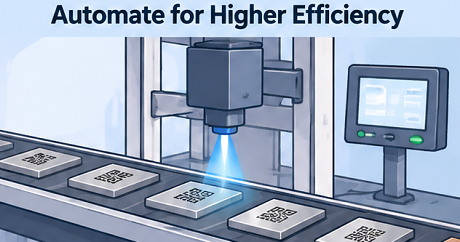
MimoWork offers several configurations that manufacturers can evaluate:
| Automation option | Production application | Main advantage |
| Rotary device | Cylindrical products | Supports 360° marking |
| Shuttle table | Batch processing | Allows loading during processing |
| Conveyor integration | Continuous production | Reduces manual material handling |
| Dynamic-focus head | Uneven or larger surfaces | Supports marking across varying heights |
| Automated vision integration | High-volume production | Helps align and position components |
The appropriate configuration depends on component geometry, loading methods, cycle time, and production-line requirements.
For example, a manufacturer marking metal fittings may benefit from a rotary fixture, while a packaging producer processing non-metal materials may prioritize a shuttle table or continuous feeding arrangement.
Automation should be planned around the entire workflow rather than added simply to increase the machine’s feature count.
No. Marking speed depends on material response, marking depth, graphic complexity, focal conditions, and required contrast. Higher power can improve processing efficiency in certain applications, but it does not guarantee better results for every material.
Some laser sources can process selected metals and engineered plastics, but compatibility varies considerably. Fiber lasers, for example, are commonly used for metal marking and certain laser-sensitive plastics. UV systems are often considered when more delicate surface processing is required.
Manufacturers should test the exact material formulation and desired marking effect before selecting a machine.
The finished mark should be tested under the conditions it will experience during actual use. Depending on the application, this may include abrasion, cleaning, chemical exposure, and environmental testing.
The required durability and readability standards should be established before equipment selection.
Yes, depending on the machine configuration and production environment. Conveyor systems, rotary fixtures, vision integration, and other customized components can help connect laser marking with existing manufacturing workflows.
Manufacturers should confirm positioning requirements, cycle time, data communication, and safety integration before installation.
Choosing a superior laser marking system starts with understanding the material, required marking effect, and production workflow.
Whether your application involves permanent metal identification, fine electronic component marking, non-metal product customization, or advanced color marking, MimoWork offers Fiber, CO2, UV, MOPA, and Green laser marking solutions for different manufacturing requirements.
Rather than selecting equipment based on laser power alone, manufacturers can evaluate actual material samples, marking quality, working area, and automation requirements before finalizing a configuration.
Contact the MimoWork team to discuss your marking application and arrange a material test. With the appropriate laser source and system configuration, you can develop a marking workflow that meets your production requirements today and supports future manufacturing upgrades.
News | Nov-18-2026
News | Nov-14-2026