Blog
In a field that evolves daily, staying ahead means staying informed.
Explore in-depth articles designed to help you solve complex challenges,
maximize your machine’s ROI.
Stay ahead in a competitive market.


In a field that evolves daily, staying ahead means staying informed.
Explore in-depth articles designed to help you solve complex challenges,
maximize your machine’s ROI.
Stay ahead in a competitive market.
News | Jun-30-2026
Featured Snippet
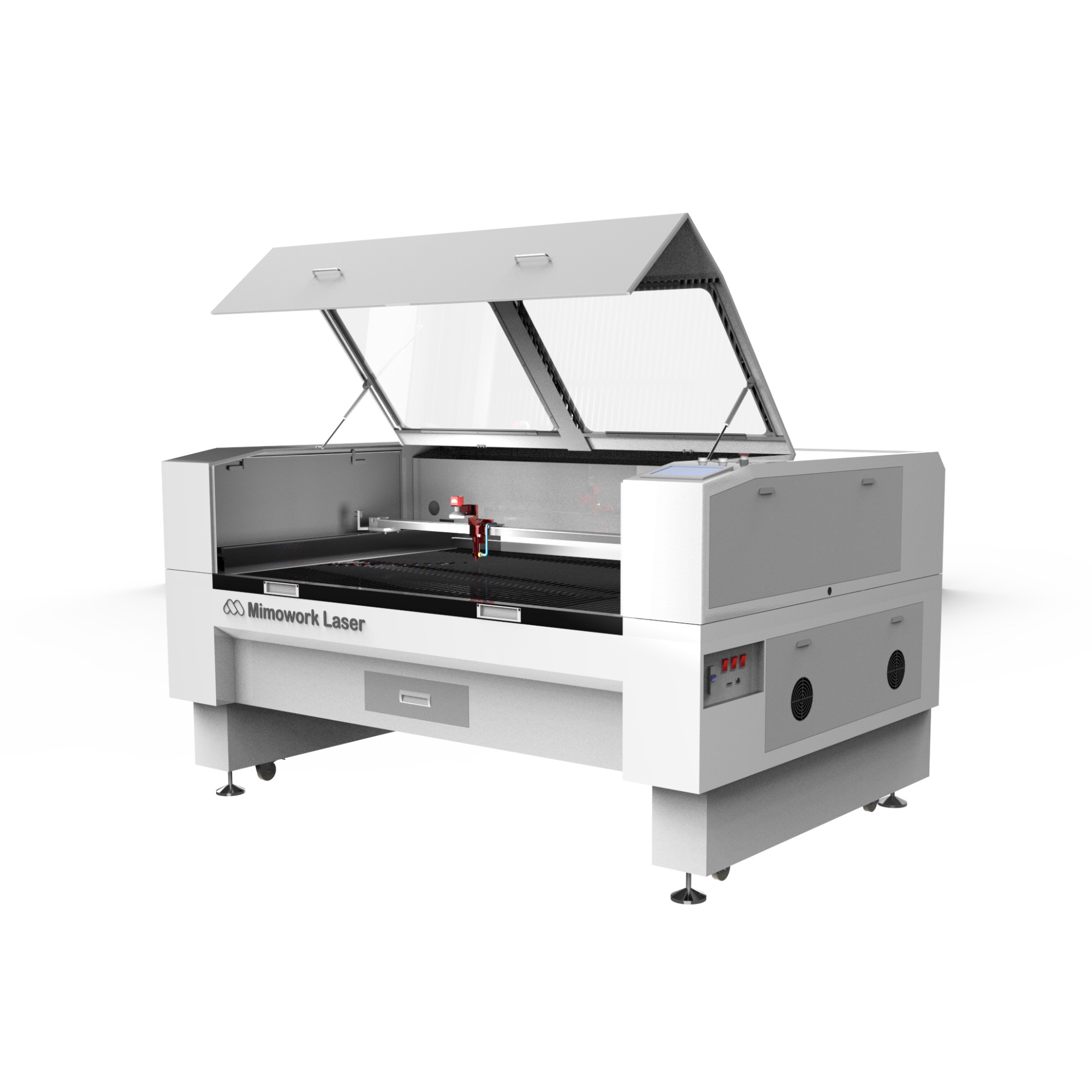
A woodworking laser cutter is a precision manufacturing tool that uses a focused laser beam to cut, engrave, and mark wood materials without physical contact. CO2 laser cutters are the preferred choice for woodworking because they provide clean cuts, detailed engraving, minimal material waste, and excellent compatibility with plywood, MDF, hardwood, softwood, veneer, and engineered wood products. For furniture makers, sign manufacturers, craft businesses, and industrial wood processors, laser cutting offers greater design flexibility than traditional woodworking methods.
A woodworking laser cutter is a computer-controlled machine that uses laser energy to cut or engrave wood materials with exceptional precision. Unlike traditional woodworking equipment that relies on blades, bits, or mechanical tools, a laser cutter directs a concentrated beam of light onto the material surface, vaporizing or burning away material along a programmed path.
The technology has transformed modern woodworking by enabling manufacturers to create intricate patterns, precise components, custom engravings, and complex geometries that would be difficult or impossible to achieve using conventional cutting tools. Because the process is controlled digitally, design files can be converted directly into finished products without the need for custom tooling or manual adjustments.
Today, woodworking laser cutters are widely used in furniture manufacturing, architectural modeling, signage production, decorative woodworking, packaging design, educational projects, and custom product manufacturing. Their ability to combine cutting and engraving within a single machine makes them one of the most versatile tools available to modern woodworkers.
Laser cutting works by concentrating a high-energy laser beam onto a small area of the wood surface. As the laser interacts with the material, the wood rapidly heats and vaporizes, creating a narrow and highly controlled cutting path. The process is guided by computer software, which determines the exact movement of the laser head according to the design file.
One of the primary advantages of laser cutting is its non-contact nature. Since there is no physical blade touching the wood, there is no tool wear, vibration, or mechanical stress applied to the material. This results in smoother edges, improved dimensional accuracy, and greater consistency across production runs.
The focused laser beam also enables extremely fine detail. Decorative patterns, complex curves, internal cutouts, and intricate artistic designs can be produced with precision that is often difficult to replicate using traditional woodworking equipment. Depending on laser power, material type, and processing parameters, a woodworking laser cutter can both engrave surface details and cut completely through wood panels of varying thicknesses.
When evaluating laser technologies for woodworking, the comparison almost always comes down to CO2 lasers versus fiber lasers. While both technologies use laser energy, their wavelengths interact with materials in fundamentally different ways.
| Feature | CO2 Laser | Fiber Laser |
| Wavelength | 10.6 μm | 1064 nm |
| Wood Absorption | Excellent | Poor |
| Cutting Performance | Excellent | Limited |
| Engraving Quality | Excellent | Moderate |
| Acrylic Processing | Excellent | Poor |
| Metal Marking | Limited | Excellent |
| Woodworking Applications | Ideal | Not Recommended |
Wood naturally absorbs the 10.6-micron wavelength produced by CO2 lasers, making them highly efficient for cutting and engraving wood products. Fiber lasers, by contrast, are optimized for metals and typically perform poorly when processing wood materials.
For furniture manufacturers, woodcraft businesses, sign makers, and woodworking workshops, CO2 laser systems remain the industry standard. They provide superior edge quality, greater processing efficiency, and broader compatibility with wood-based materials. Unless metal processing is a primary requirement, CO2 technology is generally the best investment for woodworking applications.
Laser cutting works by concentrating a high-energy laser beam onto a small area of the wood surface. As the laser interacts with the material, the wood rapidly heats and vaporizes, creating a narrow and highly controlled cutting path. The process is guided by computer software, which determines the exact movement of the laser head according to the design file.
One of the primary advantages of laser cutting is its non-contact nature. Since there is no physical blade touching the wood, there is no tool wear, vibration, or mechanical stress applied to the material. This results in smoother edges, improved dimensional accuracy, and greater consistency across production runs.
The focused laser beam also enables extremely fine detail. Decorative patterns, complex curves, internal cutouts, and intricate artistic designs can be produced with precision that is often difficult to replicate using traditional woodworking equipment. Depending on laser power, material type, and processing parameters, a woodworking laser cutter can both engrave surface details and cut completely through wood panels of varying thicknesses.
When evaluating laser technologies for woodworking, the comparison almost always comes down to CO2 lasers versus fiber lasers. While both technologies use laser energy, their wavelengths interact with materials in fundamentally different ways.
| Feature | CO2 Laser | Fiber Laser |
| Wavelength | 10.6 μm | 1064 nm |
| Wood Absorption | Excellent | Poor |
| Cutting Performance | Excellent | Limited |
| Engraving Quality | Excellent | Moderate |
| Acrylic Processing | Excellent | Poor |
| Metal Marking | Limited | Excellent |
| Woodworking Applications | Ideal | Not Recommended |
Wood naturally absorbs the 10.6-micron wavelength produced by CO2 lasers, making them highly efficient for cutting and engraving wood products. Fiber lasers, by contrast, are optimized for metals and typically perform poorly when processing wood materials.
For furniture manufacturers, woodcraft businesses, sign makers, and woodworking workshops, CO2 laser systems remain the industry standard. They provide superior edge quality, greater processing efficiency, and broader compatibility with wood-based materials. Unless metal processing is a primary requirement, CO2 technology is generally the best investment for woodworking applications.
One of the key advantages of laser technology is its ability to process a wide variety of wood materials. However, different wood types respond differently to laser energy due to variations in density, resin content, moisture levels, and surface coatings.
Plywood is one of the most popular materials for laser cutting because of its dimensional stability and consistent structure. It is widely used in furniture components, architectural models, decorative products, and educational projects. MDF is another common material due to its smooth surface and uniform density, which allow highly detailed engraving and clean cutting performance.
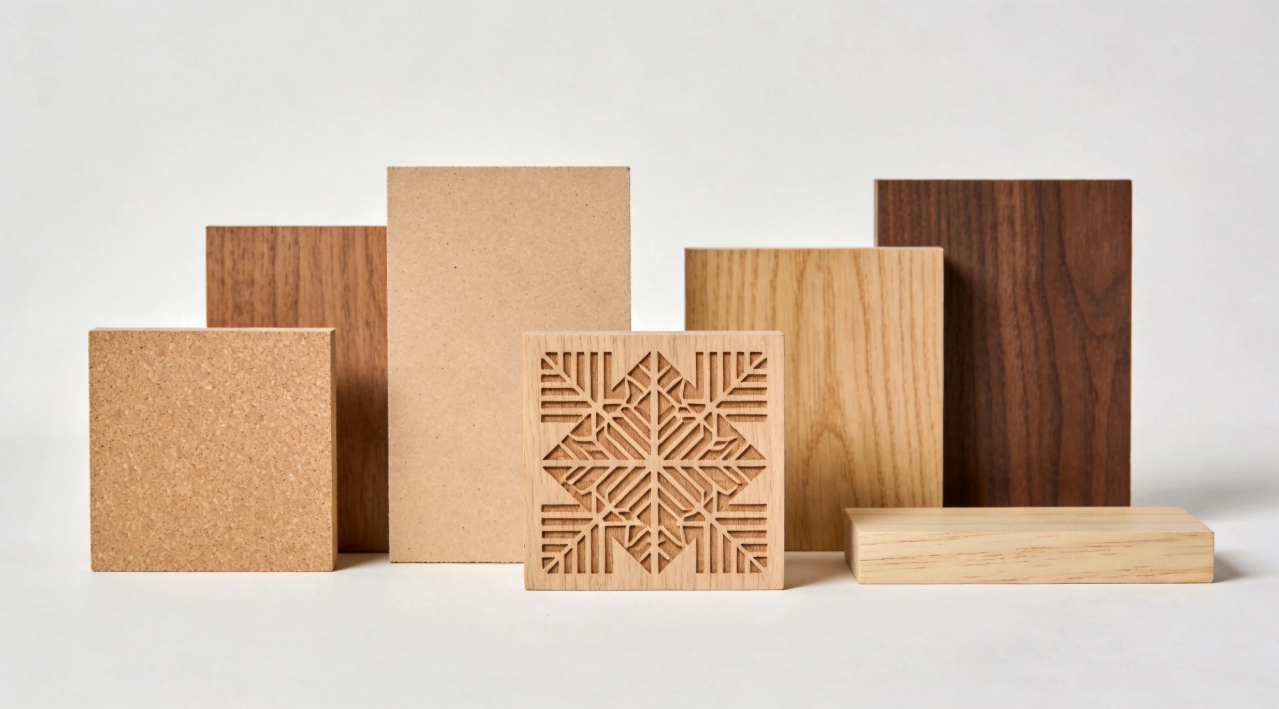
Hardwoods such as oak, walnut, cherry, and maple can also be processed successfully. These materials are often chosen for premium products because laser engraving creates rich contrast and visually appealing surface textures. Softwoods such as pine and cedar are suitable as well, although their resin content may influence engraving appearance and cutting consistency.
Thin veneers and engineered wood products are particularly well suited to laser cutting because the narrow kerf width minimizes material waste while allowing highly detailed patterns and decorative elements.
| Wood Type | Cutting Performance | Engraving Quality | Typical Applications |
| Plywood | Excellent | Excellent | Furniture, Models |
| MDF | Excellent | Excellent | Signage, Crafts |
| Oak | Good | Excellent | Premium Furniture |
| Walnut | Good | Excellent | Luxury Products |
| Maple | Good | Excellent | Decorative Panels |
| Veneer | Excellent | Good | Decorative Applications |
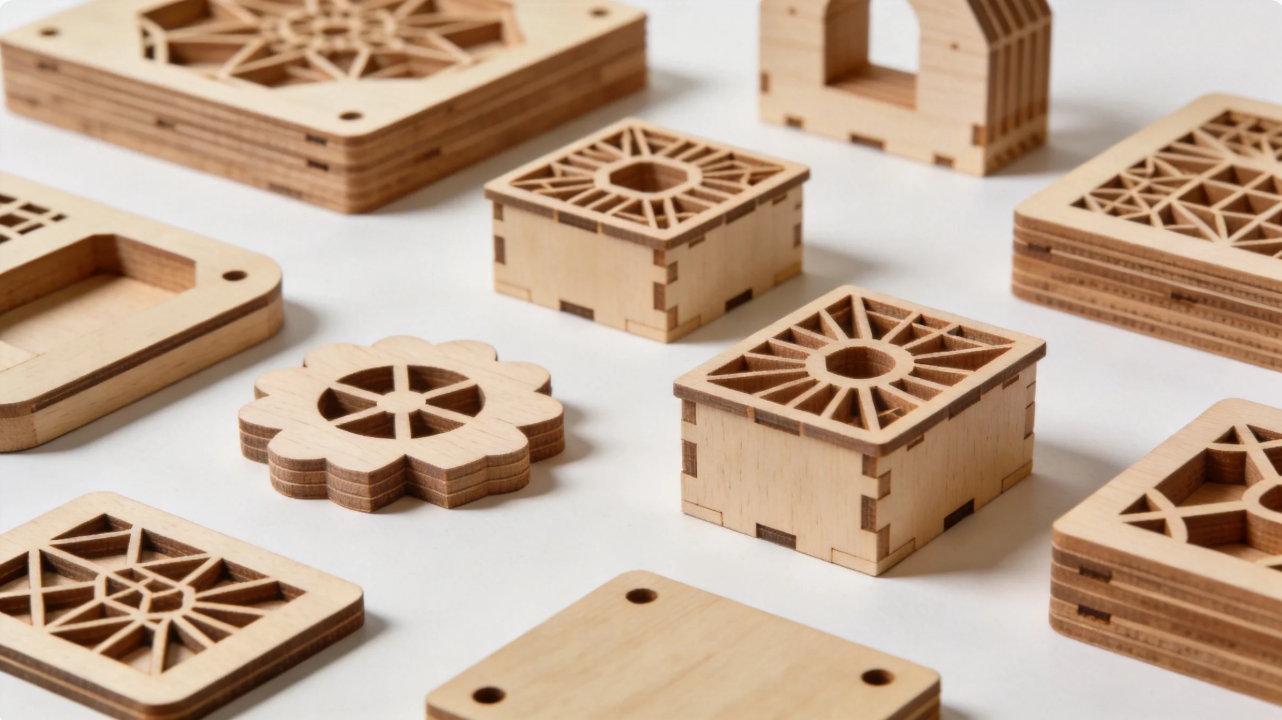
The versatility of laser technology allows a single machine to support multiple business models and production requirements. In furniture manufacturing, laser cutters are used to create decorative panels, cabinet components, inlays, and customized design features. The ability to produce intricate geometric patterns has become increasingly valuable in contemporary furniture design.
Sign-making companies frequently use laser cutters to create wooden signs, branded displays, retail fixtures, and decorative wall art. Laser engraving enables the production of highly detailed logos and graphics while maintaining a professional finish.
Architectural model makers rely on laser systems because they can quickly produce highly accurate scale models directly from CAD files. Educational institutions and design studios use laser cutters for prototyping, product development, and creative projects. Small businesses and online sellers often leverage laser technology to create personalized gifts, home décor products, wedding accessories, and customized craft items.
The ability to switch rapidly between designs without changing tooling makes woodworking laser cutters particularly attractive for businesses focused on customization and short-run production.
Woodworking laser cutters have gained widespread adoption because they offer a unique combination of precision, flexibility, efficiency, and creative freedom.
Both laser cutters and CNC routers are widely used in woodworking, but they excel in different applications. CNC routers remove material using rotating cutting tools, making them highly effective for deep machining, shaping, and heavy-duty woodworking operations. Laser cutters, on the other hand, use focused light energy to create highly detailed cuts and engravings without physical contact.
| Factor | Laser Cutter | CNC Router |
| Contact with Material | No | Yes |
| Tool Wear | None | Continuous |
| Fine Detail Capability | Excellent | Good |
| Internal Sharp Corners | Excellent | Limited |
| Material Waste | Low | Moderate |
| Setup Complexity | Low | Moderate |
| Engraving Capability | Excellent | Good |
Laser cutting is particularly advantageous for decorative applications, detailed patterns, signage, and products requiring high precision. CNC routers remain valuable for thick materials and three-dimensional machining operations. Many advanced woodworking businesses use both technologies because they complement each other rather than compete directly.
Laser engraving allows woodworkers to create highly detailed graphics, logos, photographs, text, and decorative patterns directly on wood surfaces. Unlike printing methods, the engraving becomes part of the material itself and cannot peel, fade, or wear away easily.
The visual appearance of laser engraving is often considered one of its greatest strengths. Different wood species produce unique contrasts and textures, allowing designers to create products with a distinctive handcrafted appearance while maintaining digital precision.
Personalization has become a major growth area for woodworking businesses. Laser engraving makes it possible to add customer names, branding elements, artwork, serial numbers, or custom messages without additional tooling or setup costs. This capability enables profitable production of customized products while maintaining efficient workflows.
Selecting the right machine requires balancing production goals, material requirements, workspace constraints, and future business growth plans.
Laser power directly influences cutting speed and maximum material thickness. Lower-power machines are often sufficient for engraving and thin materials, while higher-power systems provide greater productivity and expanded cutting capability.
| Laser Power | Typical Wood Cutting Thickness |
| 40W | Up to 3-5 mm |
| 60W | Up to 6-8 mm |
| 100W | Up to 10-15 mm |
| 150W | Up to 18-20 mm |
| 200W+ | 20 mm and Above |
For businesses focused primarily on engraving and craft production, a 60W to 100W CO2 laser often provides an excellent balance of capability and cost. Furniture manufacturers and industrial processors may benefit from higher-power systems that support thicker materials and faster production speeds.
Working area dimensions determine the maximum size of material that can be processed without repositioning. Small desktop systems may be suitable for gifts and crafts, while commercial production environments often require larger platforms capable of handling full sheets of plywood or MDF.
Businesses should evaluate not only their current projects but also future growth opportunities. Choosing a machine with sufficient workspace can reduce workflow limitations and improve production efficiency over time.
Software serves as the bridge between design concepts and finished products. A woodworking laser cutter should support common design formats and integrate smoothly with popular design software such as Adobe Illustrator, CorelDRAW, AutoCAD, SolidWorks, and various CAD/CAM platforms.
Advanced software features can significantly improve productivity by optimizing cutting paths, reducing material waste, automating nesting, and managing production workflows. Businesses handling customized orders often benefit from software capable of variable data processing and batch job management.
A machine’s long-term value is often influenced as much by software capabilities as by hardware specifications. Choosing a system with flexible and scalable software can simplify future upgrades and improve operational efficiency.
Successful laser processing depends on proper preparation, accurate parameter selection, and systematic workflow management.
The process begins with creating or importing a design file. Vector graphics are typically used for cutting operations, while raster images are used for engraving. Proper layer organization helps distinguish between cutting, engraving, and marking operations within the software environment.
Before starting production, operators should verify material dimensions, optimize nesting layouts, and confirm that all design elements are correctly configured. Careful preparation helps reduce material waste and minimizes the likelihood of production errors.
Machine calibration, focus adjustment, and material positioning should also be completed before processing begins. These steps ensure consistent results and maximize overall efficiency.
Achieving high-quality results requires balancing laser power, cutting speed, frequency, air assist, and focus settings. Excessive power may cause charring or wider kerf widths, while insufficient power can lead to incomplete cuts.
Air assist plays an important role by removing smoke and debris from the cutting area, reducing scorching and improving edge quality. Focus position also influences kerf width and cut consistency, particularly when processing thicker materials.
Because wood species vary significantly in density and moisture content, operators should perform test cuts whenever processing unfamiliar materials. Developing material-specific parameter libraries can dramatically improve consistency and reduce setup time in future projects.
Yes, but cutting capacity depends on laser power, wood density, and material quality. Industrial CO2 laser systems can cut wood panels exceeding 20 mm in thickness, although multiple passes or higher-power configurations may be required.
Laser cutting removes material completely to create shapes and components, while laser engraving modifies the surface to create graphics, text, patterns, or decorative effects without cutting through the material.
A certain degree of thermal interaction is inherent to the process. However, proper parameter optimization, air assist systems, and high-quality optics can minimize charring while maintaining clean edges and excellent engraving quality.
Most woodworking laser cutters support software such as Adobe Illustrator, CorelDRAW, AutoCAD, LightBurn, RDWorks, and various CAD/CAM platforms. Compatibility depends on the machine controller and software ecosystem.
Yes. Woodworking laser cutters are widely used in commercial manufacturing environments for furniture production, signage, architectural models, packaging prototypes, custom products, and personalized goods. Their flexibility and efficiency make them suitable for both small businesses and industrial operations.
A woodworking laser cutter is one of the most versatile and efficient tools available for modern wood processing. By combining precision cutting, detailed engraving, digital workflow integration, and broad material compatibility, CO2 laser technology enables manufacturers, designers, and craftspeople to create products that would be difficult to achieve using traditional woodworking methods.
Whether producing furniture components, decorative panels, custom signage, architectural models, personalized gifts, or industrial products, a properly selected CO2 laser cutter can improve productivity, reduce material waste, and expand creative possibilities. As demand for customization and flexible manufacturing continues to grow, woodworking laser cutters will remain an essential technology for businesses seeking precision, efficiency, and innovation.
News | Jun-22-2026
News | Jun-15-2026