Blog
In a field that evolves daily, staying ahead means staying informed.
Explore in-depth articles designed to help you solve complex challenges,
maximize your machine’s ROI.
Stay ahead in a competitive market.


In a field that evolves daily, staying ahead means staying informed.
Explore in-depth articles designed to help you solve complex challenges,
maximize your machine’s ROI.
Stay ahead in a competitive market.
News | Oct-7-2026
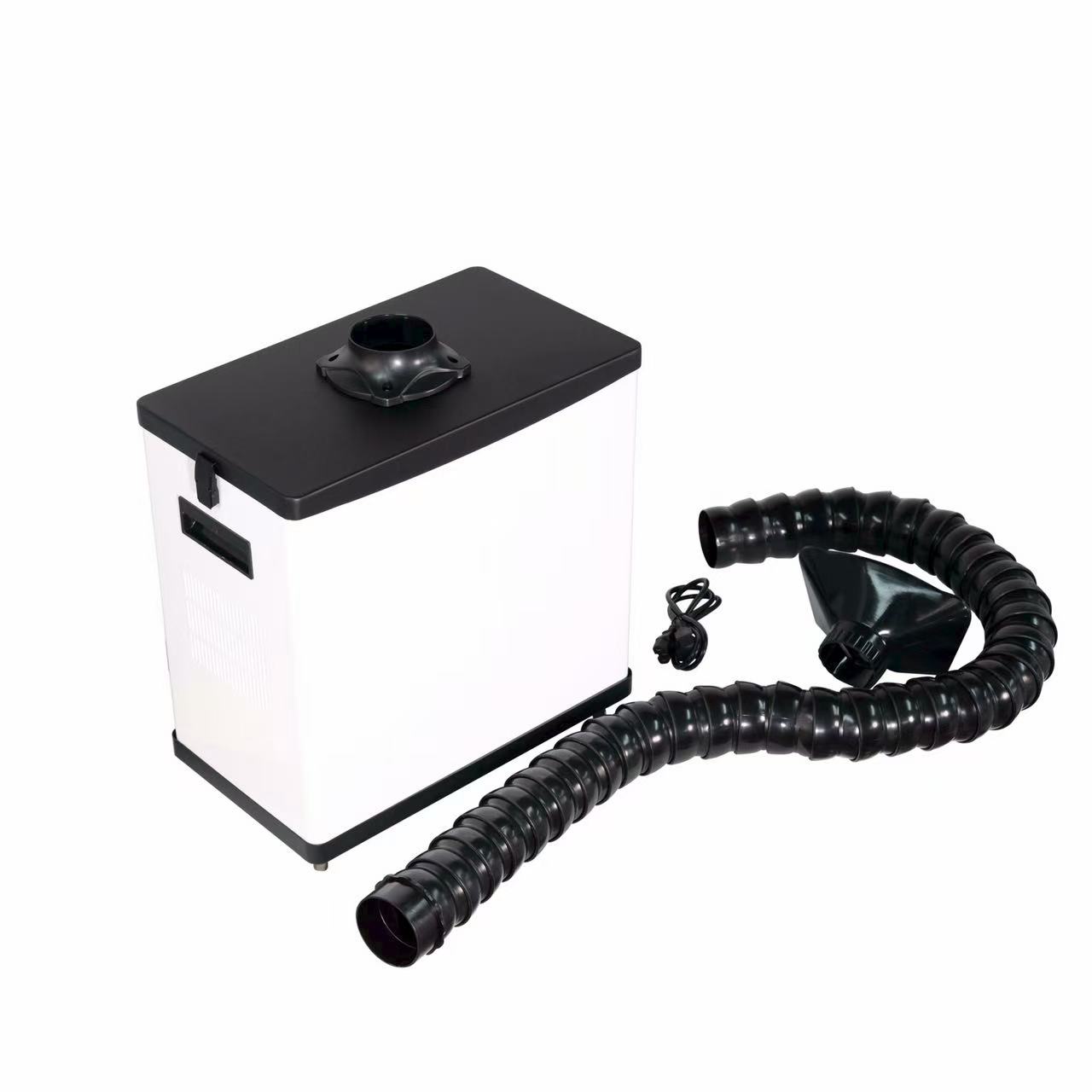
A fume extractor becomes an important part of a laser processing setup when cutting, engraving, welding, or cleaning generates smoke, dust, fine particles, or odors.
The extraction requirement can change significantly from one application to another. Cutting acrylic is different from cutting metal, while laser welding creates a concentrated fume source close to the operator.
For this reason, selecting a dust and fume extractor starts with the actual production process. Material, contaminant type, airflow, capture point, filtration, and maintenance all need to be considered before choosing an extraction unit.
A dust and fume extractor removes airborne contaminants generated during processing and passes them through a filtration system before the air is discharged.
In a laser workshop, the contaminants may include:
These emissions are not the same across all laser applications. A process that mainly produces dry particles places different demands on filtration from one that produces smoke, fine particles, and odors at the same time.
Laser cutting and engraving can release airborne particles as material is heated, melted, or vaporized. The amount of contamination varies with the material, thickness, laser power, cutting speed, and production volume.
A laser dust and fume extractor therefore needs to be evaluated against the actual process rather than the laser power alone.
Different materials create different emissions during laser processing.
Wood, acrylic, leather, plastics, and coated materials can produce smoke and odors in addition to particulate matter. Particle filtration can remove airborne solids, while gas-phase filtration such as activated carbon may be used where certain gaseous contaminants or odors are present.
When a process produces several types of emissions, a multi-stage dust fume extraction system can provide a more suitable approach than a system designed only for dry dust.
The main difference is the type of contamination generated by the process.
| Processing condition | Equipment to consider |
| Mainly dry dust and larger particles | Dust collector |
| Smoke and fine particles | Dust and fume extractor |
| Particles plus odors | Multi-stage extraction system |
| Fine metal particles | Industrial dust and fume extractor |
| Concentrated welding fumes | Welding fume extractor |
| Dust and residue from laser cleaning | Application-specific extraction |
A dust collector can be suitable when the process is dominated by particulate matter. Laser cutting and engraving, however, can also produce smoke, very fine particles, and material-specific emissions.
This is why dust collector and fume extractor should not be treated as interchangeable terms. Filtration stages, airflow, pressure capability, capture method, and the intended application all affect how an extraction system performs.
The material is one of the first things to check when specifying an extraction system.
Wood, acrylic, leather, plastics, and metals can generate different types and amounts of airborne contamination. If several materials are processed on the same laser, the extraction system should be evaluated against the material that creates the highest expected contaminant load.
For metal applications, pay particular attention to the filtration requirements for fine metal particles. For non-metallic materials, consider the combination of dust, smoke, and odors produced during cutting or engraving.
When choosing a dust and fume extractor for laser cutting, check the machine’s exhaust requirements and the complete extraction route. A system with an appropriate working airflow is more useful than simply selecting the unit with the highest advertised fan capacity.
Filters gradually collect the material removed from the air. As the filter loads, airflow and extraction performance can be affected.
Before purchasing an extractor, consider:
There is no universal filter replacement interval. Actual filter life depends on the material, operating hours, contaminant concentration, airflow, and filter design.
A system that is easy to inspect and maintain can also reduce unnecessary production interruptions.
For enclosed laser cutting machines, the extraction connection needs to work with the machine’s enclosure and exhaust design. For source-capture applications such as welding, the position of the hood or extraction nozzle becomes even more important because fumes can disperse quickly after leaving the emission point.
A practical extraction layout should therefore be considered before selecting the extractor itself.
Laser applications create different housekeeping and extraction challenges. The system should be matched to the material, contaminant, and production setup rather than using the same configuration for every process.
CO2 lasers are commonly used to process wood, acrylic, leather, textiles, plastics, and other non-metallic materials.
Depending on the material and production volume, cutting and engraving can generate smoke, fine particles, residue, and odors. Continuous production can also create a much higher contaminant load than occasional prototyping.
A dust and fume extractor for laser cutting should therefore be selected around the material being processed, machine exhaust configuration, and expected production load.
Fiber laser cutting and marking of metals can generate fine metal particles and smoke. These contaminants differ from the dust and smoke produced when processing wood or acrylic with a CO2 laser.
An industrial dust and fume extractor for fiber laser applications should therefore be evaluated for fine metal particle filtration, extraction capacity, and the expected operating conditions.
The material being processed also matters. Steel, stainless steel, aluminum, and coated metals can produce different processing emissions, so the filtration setup should be considered alongside the application.
Laser welding produces a concentrated fume source around the welding area. Unlike an enclosed cutting machine, the emission point can move with the operator and workpiece.
A dedicated welding exhaust fume extractor can capture fumes closer to the source and help prevent them from spreading through the wider workspace.
The extraction position, number of welding stations, working distance, and required airflow should all be considered when planning the system.
Laser cleaning removes rust, paint, coatings, oxides, and other surface contaminants from a substrate. The resulting particles depend on both the base material and the material being removed.
For this reason, extraction requirements can vary considerably between cleaning applications. The extraction system should be selected according to the type and volume of particles generated, as well as the distance between the processing point and capture system.
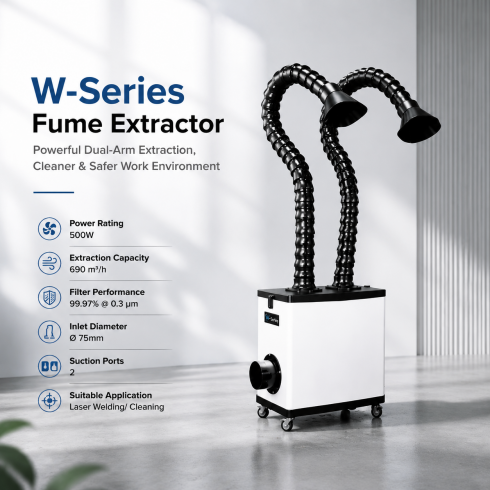
Different laser processes place different demands on an extraction system. MimoWork provides several extraction configurations for laser marking, CO2 laser cutting and engraving, fiber laser processing, and laser welding or cleaning.
For CO2 laser cutting and engraving, the C-Series is designed for applications that generate smoke, dust, and fine particles from materials such as wood, acrylic, leather, and plastics.
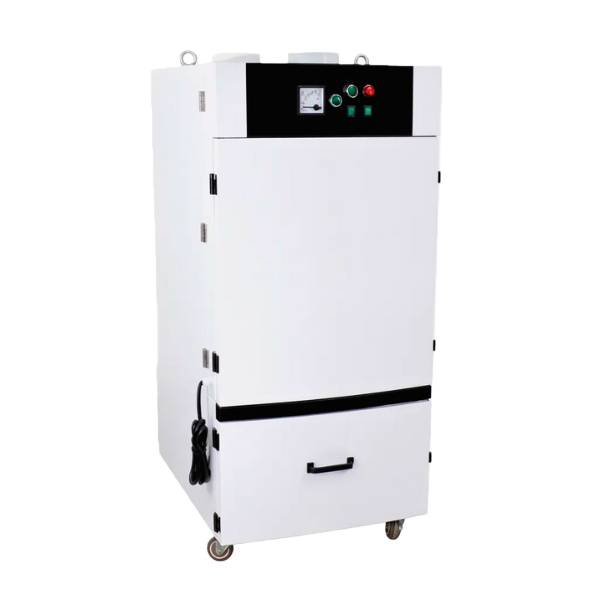
For fiber laser processing, the F-Series is designed around the fine metal dust and fumes generated during fiber laser cutting.
For laser marking, the M-Series provides a more compact extraction configuration with 230W power, 390 m³/h airflow, 99.97% filtration efficiency at 0.3 μm, and one Ø75 mm port.
Each configuration is intended for a different laser application. Rather than selecting an extractor by capacity alone, the material, process, emission type, extraction distance, and number of capture points should be considered together.
Related Guide: https://www.mimowork-laser.com/blog/fume-extractor-for-laser-engraver-guide
A dust and fume extractor captures and filters airborne contaminants generated during industrial processing. In laser applications, this can include dust, smoke, fine particles, and certain odors or gaseous contaminants, depending on the filtration configuration.
Yes, provided that the filtration system and working airflow are suitable for the material and laser process. The machine’s exhaust configuration and extraction path should also be considered when determining the required capacity.
Not necessarily. A dust collector is generally designed around particulate collection, while a fume extraction system can be configured for finer particles and smoke. Additional filtration stages may also be used for certain gaseous contaminants or odors.
There is no fixed replacement interval for every application. Filter life depends on the material being processed, contaminant loading, operating hours, airflow, and filter capacity.
Monitoring filter condition and maintaining the system according to its operating requirements provides a more useful basis for replacement than following a universal schedule.
Choosing a dust and fume extractor starts with the production process.
The material being processed determines what contaminants are generated, while the machine design, extraction layout, airflow, and filtration determine how effectively those contaminants can be captured.
For dry particulate, a dust collector may be sufficient. When laser cutting or engraving produces smoke, fine particles, and odors, a broader laser fume extraction system may be required. Fiber laser processing, welding, and cleaning bring their own filtration and capture considerations.
For welding applications, see the dedicated welding exhaust fume extractor guide for a closer look at source capture, airflow, filtration, and maintenance.
News | Sep-30-2026
News | Sep-25-2026