Blog
In a field that evolves daily, staying ahead means staying informed.
Explore in-depth articles designed to help you solve complex challenges,
maximize your machine’s ROI.
Stay ahead in a competitive market.


In a field that evolves daily, staying ahead means staying informed.
Explore in-depth articles designed to help you solve complex challenges,
maximize your machine’s ROI.
Stay ahead in a competitive market.
News | Oct-6-2026
Quick Answer: Choosing the right laser printer fume extractor requires more than matching a fan to a machine. Businesses should consider the materials being processed, contaminant type, enclosure design, airflow, filtration stages, filter capacity, noise, maintenance, and whether the system is suitable for continuous commercial operation. A correctly designed extraction system captures contaminants near their source instead of allowing smoke, particles, and odors to spread throughout the workplace.
Laser processing is often discussed in terms of power, speed, accuracy, and productivity.
Fume extraction receives less attention until a workshop starts dealing with smoke, odors, residue, dirty optics, or poor indoor air quality.
That makes extraction a classic example of an accessory that can become a production issue.
For businesses operating laser equipment regularly, choosing a laser printer fume extractor should therefore be treated as part of machine planning rather than as an afterthought.
Laser processing can generate smoke, vapors, particles, and odors depending on the material and process.
The composition of those emissions can vary significantly.
Wood, acrylic, plastics, coated materials, paper, rubber, and other substrates do not produce identical contaminants.
This means there is no universal filter specification that works equally well for every laser application.
The extraction system needs to match the process.
OSHA’s ventilation guidance emphasizes source capture as an important engineering-control principle: contaminants should be captured as close as practical to where they are generated rather than being allowed to disperse into the workplace.
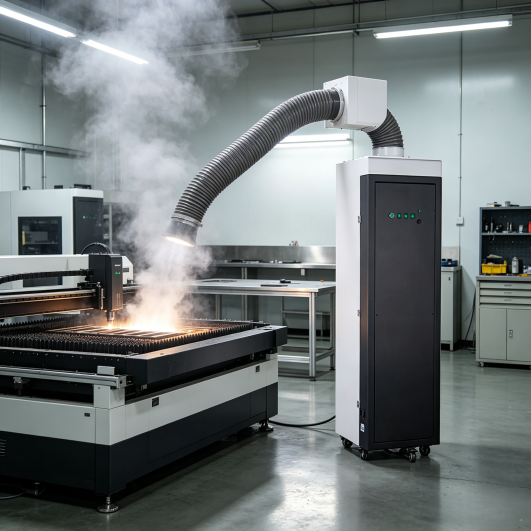
A typical extraction system combines airflow with one or more filtration stages.
The airflow draws contaminated air from the laser enclosure toward the extraction unit.
Filters then remove different types of contaminants.
A system may include stages for larger particles, finer particles, and gaseous or odor-related contaminants depending on its design.
The exact filter architecture should be selected based on the material and emissions.
A machine processing wood may require a different filtration strategy from one processing plastics or coated materials.
This is the most important purchasing question.
Do not begin by asking how powerful the extractor is.
Begin with the materials.
| Material/process | Potential concern |
| Wood | Smoke, fine particles, odor |
| MDF | Smoke, fine particulate, resin-related emissions |
| Acrylic | Vapors, particles, odor |
| Paper/cardboard | Smoke and fine particles |
| Rubber | Odor and process-specific emissions |
| Coated materials | Coating-related contaminants |
| Plastics | Material-dependent vapors and particles |
| Mixed production | Requires broader assessment |
The table is intentionally general because the actual emissions depend on the specific material composition, coatings, additives, laser settings, and processing conditions.
Material safety documentation should be checked before processing unfamiliar substrates.
A common buying mistake is to compare extractor units using airflow alone.
High airflow does not automatically mean good contaminant control.
The extraction system must maintain effective capture at the source.
If the machine enclosure leaks excessively, ducts are restrictive, filters become loaded, or the airflow is poorly matched to the enclosure, a powerful fan may still produce disappointing results.
The entire airflow path matters.
A commercial extractor may use multiple filtration stages.
A pre-filter can capture larger particles and protect downstream filters.
A fine-particle filter can capture smaller particulate matter.
Activated carbon or another gas-phase filtration medium may be used for certain gaseous contaminants and odors, depending on the system.
The key question is not simply whether a unit has “three-stage filtration.”
Ask what each stage is designed to remove and whether the filtration media are appropriate for the actual materials being processed.
Filters are consumable.
A machine may have an attractive purchase price but become expensive if filters need frequent replacement.
Filter life depends on material, processing volume, extraction efficiency, and contaminant loading.
A commercial buyer should therefore ask:
How frequently are filters expected to be replaced?
How is filter loading monitored?
What does replacement cost?
Can individual filter stages be replaced independently?
Is the maintenance procedure accessible?
These questions can be more important than a small difference in initial purchase price.
An extractor is often running whenever the laser is running.
If the machine operates for several hours per day, fan noise becomes part of the working environment.
For businesses with multiple machines, noise can become even more noticeable.
This does not mean the quietest extractor is automatically the best choice. Airflow, filtration, enclosure capture, and system compatibility remain more important.
But noise should be included in the overall workplace evaluation.
It depends.
A centralized system can make sense in a larger workshop with several machines and carefully designed ducting.
However, shared extraction introduces additional engineering considerations.
The system must maintain adequate airflow across the operating machines. Duct design, pressure losses, dampers, machine enclosure configuration, and simultaneous usage all become important.
A dedicated extractor can be simpler for a single-machine workstation.
For a multi-machine factory, a centralized solution may provide operational advantages if properly engineered.
| Selection factor | Questions to ask |
| Airflow | Is capture adequate for the machine enclosure? |
| Filtration | What contaminants does each stage target? |
| Filter life | How long do filters typically last under similar workloads? |
| Maintenance | Can operators replace filters easily? |
| Materials | Is the system suitable for the actual substrates? |
| Ducting | Will the duct length and configuration reduce performance? |
| Noise | Is the operating noise acceptable for the workplace? |
| Continuous operation | Is it designed for the intended duty cycle? |
| Monitoring | Can airflow or filter loading be monitored? |
| Disposal | How are used filters and captured contaminants handled? |
Opening a door or relying on a building’s general HVAC system does not necessarily provide source control.
The objective of local exhaust is to capture contaminants before they spread.
OSHA describes local exhaust ventilation as a method designed to prevent fumes, vapor, dust, and gases from dispersing into the work area.
For laser processing, this principle is particularly important because the emission point is concentrated inside the machine.
The enclosure and extraction system should therefore be considered together.
Even a well-designed extractor can perform poorly if it is neglected.
Filters become loaded.
Ducts accumulate debris.
Connections can loosen.
Fans can lose performance.
Operators may also continue using a machine after the filter has reached its practical capacity.
A maintenance schedule should therefore include filter inspection, duct inspection, airflow checks, and cleaning according to the equipment manufacturer’s instructions.
For commercial users, maintenance records can also help identify changes in production conditions.
A single airflow rating does not tell the complete story.
A better evaluation considers:
Capture → airflow → filtration → pressure loss → filter loading → maintenance.
Suppose Extractor A has a higher advertised airflow but experiences significant pressure loss through its filters and ducting.
Extractor B may have a lower nominal airflow but maintain more effective capture under the actual system configuration.
The second system could therefore perform better in the real workplace.
This is why the extractor should be evaluated as part of the entire laser installation.
An upgrade may be worth considering when production volume increases, new materials are introduced, existing filters load too quickly, smoke escapes the enclosure, odors become noticeable, or the current extraction system cannot maintain adequate capture.
The first step should be to identify why the current system is failing.
The problem may be the extractor itself.
But it could also be the enclosure, ducting, filter loading, machine seals, or airflow configuration.
Replacing the extractor without identifying the actual bottleneck can lead to another disappointing investment.
Choosing a laser fume extractor should start with the type of laser process and material being processed rather than simply selecting the extractor with the highest airflow. CO₂ cutting and engraving, laser marking, metal cutting, and welding can produce very different combinations of smoke, particulate, and gases, so filtration requirements need to match the application.
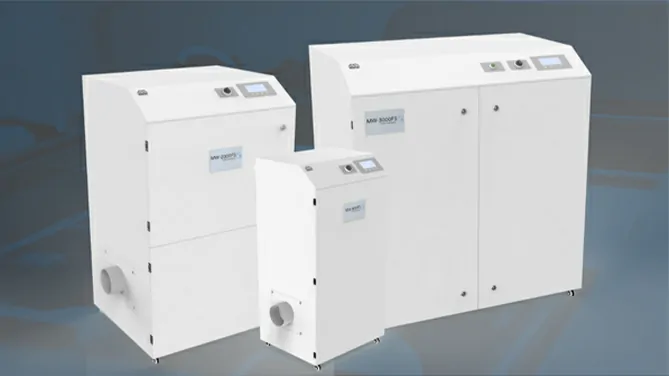
For businesses using CO₂ lasers to cut or engrave materials such as wood, acrylic, leather, and plastics, MimoWork’s C-Series Fume Extractor is a relevant option to consider. It is specifically designed for non-metal laser fumes and is positioned for high-volume smoke and particulate generated during laser cutting and engraving. The C-Series provides a 5000 m³/h extraction capacity and multi-stage filtration, making it more appropriate for production environments than treating a general shop vacuum as a substitute for dedicated extraction.
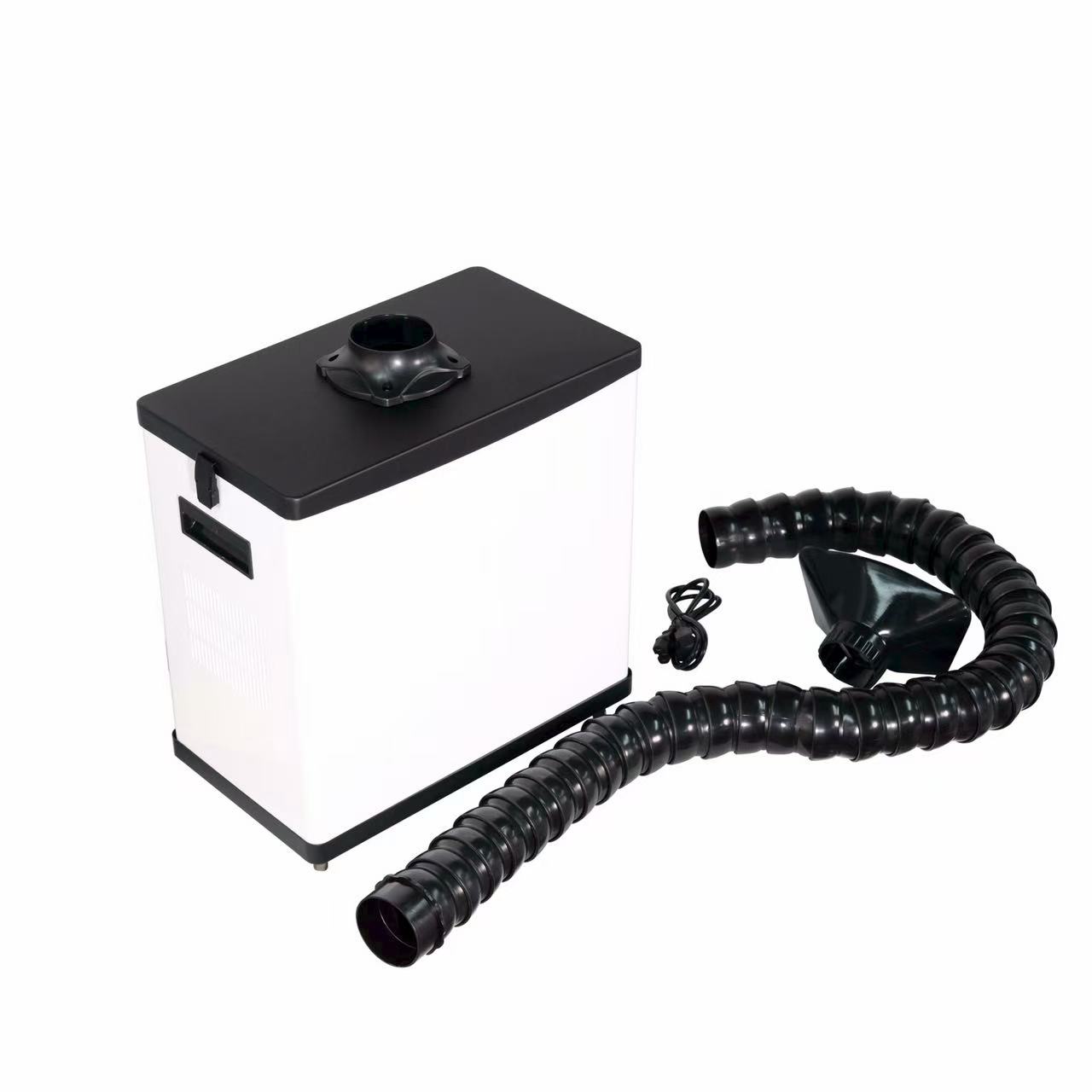
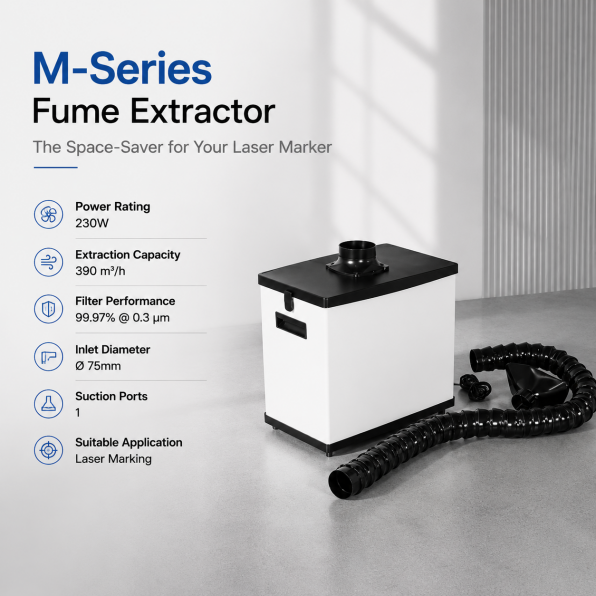
For laser marking applications, the MimoWork M-Series Fume Extractor takes a different approach. Its compact design is intended for laser marking workstations, with a 390 m³/h extraction capacity and a HEPA filtration stage rated at 99.97% at 0.3 µm. This makes it more relevant to smaller, localized marking operations rather than large-format CO₂ cutting.
For welding applications, the MimoWork W-Series Fume Extractor is designed for targeted extraction around the welding or cleaning point. It uses an articulated extraction arm to capture localized fumes and is rated at 690 m³/h, making it a more application-specific option when the primary concern is welding-related fume capture rather than CO₂ cutting smoke.
The right choice therefore depends on the process being performed. A CO₂ cutting workshop may need the higher-capacity filtration approach of the C-Series, while a compact laser marking station may be better matched to the M-Series. Welding operations have different extraction requirements again, which is where a dedicated system such as the W-Series becomes relevant. The extractor should ultimately be sized around the laser, enclosure, material, airflow requirements, and production workload rather than chosen from airflow capacity alone.
Depending on the design and filtration media, a system can capture particulate matter and certain gaseous contaminants generated during laser processing. The exact performance depends on the material and filter configuration.
Laser processing can generate airborne contaminants, smoke, vapors, and odors. Appropriate extraction and ventilation are important engineering controls, particularly in commercial environments. OSHA specifically identifies ventilation as a method for controlling laser-generated airborne contaminants.
No. Effective source capture depends on the complete airflow system, including enclosure design, ducting, pressure losses, and filtration.
There is no universal interval. Replacement frequency depends on material, production volume, filter type, and contaminant loading. A filter-monitoring or inspection procedure is more reliable than using a fixed calendar interval for every application.
It can, but the ducting and airflow system must be designed for the expected simultaneous load. Multi-machine systems require more careful airflow management than a simple single-machine setup.
Some filtration systems include media designed to capture certain gaseous contaminants and odors. However, performance depends on the specific material emissions and filtration media, so buyers should not assume that every extractor removes every odor.
A laser printer fume extractor should be selected as part of the laser processing system, not as a generic fan.
The most important factors are the materials being processed, contaminant characteristics, source capture, airflow, filtration stages, filter capacity, maintenance requirements, and expected production volume.
For a commercial workshop, the right system should provide reliable contaminant capture without creating excessive maintenance or workflow problems.
The goal is not simply to move air.
The goal is to control the contaminants generated by the actual laser process in a predictable and maintainable way.
Related Guide:High-Performance Fume Extractors for Laser Engravers: Protect Your Health & Machine
News | Sep-30-2026