Blog
In a field that evolves daily, staying ahead means staying informed.
Explore in-depth articles designed to help you solve complex challenges,
maximize your machine’s ROI.
Stay ahead in a competitive market.


In a field that evolves daily, staying ahead means staying informed.
Explore in-depth articles designed to help you solve complex challenges,
maximize your machine’s ROI.
Stay ahead in a competitive market.
News | Nov-10-2026 | Mimowork
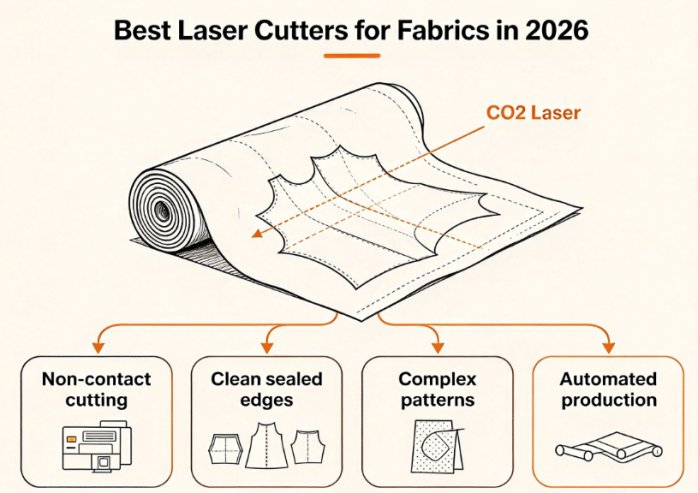
The textile industry faces growing pressure to improve production efficiency, reduce material waste, and meet customization demands. Traditional cutting methods, such as scissors and mechanical knives, can struggle with intricate patterns, stretchy fabrics, and large-volume orders.
A laser cutter for fabrics provides a flexible alternative. Using a focused CO2 laser beam and a CNC-controlled motion system, it cuts materials without direct mechanical contact. This reduces material displacement, eliminates blade wear, and produces consistent cutting paths.
From apparel and sportswear to automotive upholstery and industrial textiles, laser technology supports modern textile manufacturing.
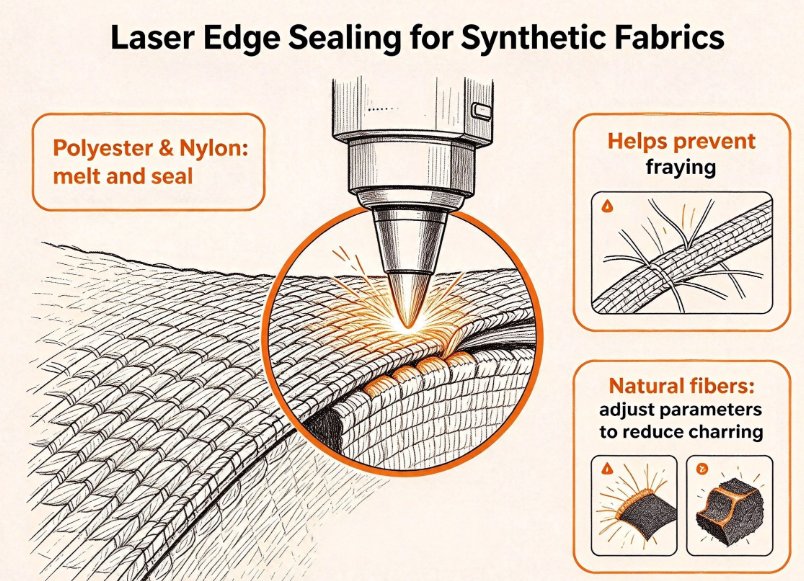
One major advantage of laser cutting is its ability to seal the edges of suitable synthetic fabrics during processing.
When a CO2 laser cuts polyester or nylon, localized heat melts and fuses the fibers along the cutting line, helping prevent fraying and unraveling.
This is particularly useful for sportswear, flags, outdoor equipment, and technical textiles. However, natural fibers such as cotton do not melt and seal in the same way, so processing parameters must be adjusted to minimize charring.
Stretch fabrics and delicate knitted textiles can easily deform under mechanical cutting pressure.
Laser cutting uses a non-contact process, reducing physical interference with the material. It can produce intricate shapes, narrow curves, and detailed garment components without the pressure associated with conventional blades.
Combined with a conveyor system and vacuum hold-down platform, a laser cutting machine for sportswear can process polyester, spandex blends, and knitted fabrics while maintaining material stability.
Automated laser cutting combines digital pattern input, material positioning, and programmed cutting into one workflow.
With continuous feeding, automatic pattern recognition, and optional multi-laser head configurations, manufacturers can reduce repetitive manual operations and improve production efficiency.
Laser cutting also eliminates physical cutting dies, making design changes easier and more cost-effective.
Choosing an industrial fabric laser cutter involves more than comparing laser power and working area. Material handling, cutting accuracy, automation, and exhaust performance also influence production results.
For manufacturers processing fabric rolls, automatic feeding is essential.
A conveyor-based system transports fabric continuously through the cutting area, reducing manual loading and repositioning. Combined with an automatic unwinder, an automatic roll-to-roll fabric laser cutter supports continuous processing of long textile rolls.
When evaluating a machine, consider fabric width, roll weight, feeding accuracy, and compatibility with your production workflow.
Flexible fabrics can wrinkle or shift during cutting, particularly lightweight and stretch materials.
A vacuum hold-down system uses controlled suction to keep fabric flat against the conveyor, reducing movement and improving dimensional accuracy.
The vacuum system should provide consistent suction without unnecessarily stretching or deforming delicate materials.
Printed textiles require accurate alignment between graphic patterns and cutting paths.
A vision laser cutter for printed fabric uses an industrial camera to identify printed contours or registration marks. The control system then adjusts the cutting path according to the detected graphics.
This technology is particularly useful for sublimated sportswear, jerseys, leggings, flags, and customized apparel.
MimoWork’s C160-L Vision Laser Cutter integrates camera recognition and automatic contour extraction to support accurate cutting of pre-printed materials.
Related guide: https://www.mimowork-laser.com/blog/fabric-laser-cutting-revolutionizing-textile-and-apparel-manufacturing
Different textile applications require different levels of automation, cutting power, and material handling. MimoWork provides CO2 laser cutting systems and customizable configurations for various production requirements.
An industrial fabric laser cutting machine with automatic feeding is suitable for manufacturers processing long fabric rolls.
The configuration typically includes an automatic unwinder, conveyor table, material guiding components, and a laser cutting head.
MimoWork’s F180-L Laser Cutter is designed for industrial textile applications. It offers CO2 laser power options from 150W to 600W, an industrial servo motor drive, and a gear rack system.
Its air-shaft unwinder with automatic edge guidance helps manage large fabric rolls, while the pneumatic material clamping bar helps reduce wrinkles and material shifting.
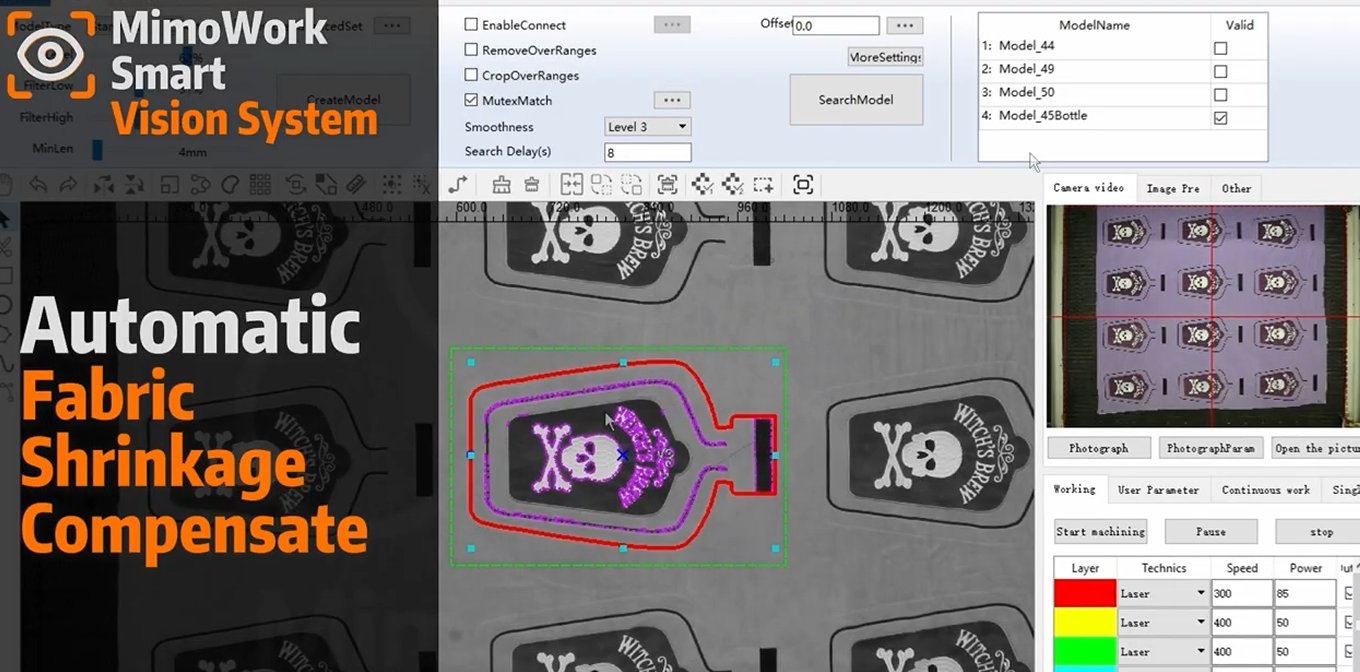
For printed and sublimated fabrics, cutting accuracy depends on the alignment between graphics and cutting paths.
MimoWork’s C160-L Vision Laser Cutter uses an integrated camera system to identify printed contours and registration marks, allowing the machine to align cutting paths with actual patterns.
The conveyor and vacuum hold-down system also help maintain stable material positioning during processing.
For large production orders, multi-laser head configurations can increase output by processing multiple components simultaneously.
MimoWork’s C160-L Vision and F180-L platforms offer multi-laser head options. The appropriate configuration depends on pattern layout, material characteristics, cutting accuracy, and production targets.
Manufacturers producing repeated garment panels can benefit from synchronized cutting heads, reducing the time required for repetitive processing.
Fabric composition, thickness, density, and surface treatment all influence laser cutting performance. There is no universal parameter setting for every textile.
Synthetic fabrics such as polyester and nylon are thermoplastic materials. Laser heat melts and separates the fibers, helping create sealed edges.
However, excessive heat may cause discoloration, overly melted edges, or material deformation.
The objective is to balance laser power, cutting speed, and frequency. Test samples should be used to identify suitable parameters for each fabric type and thickness.
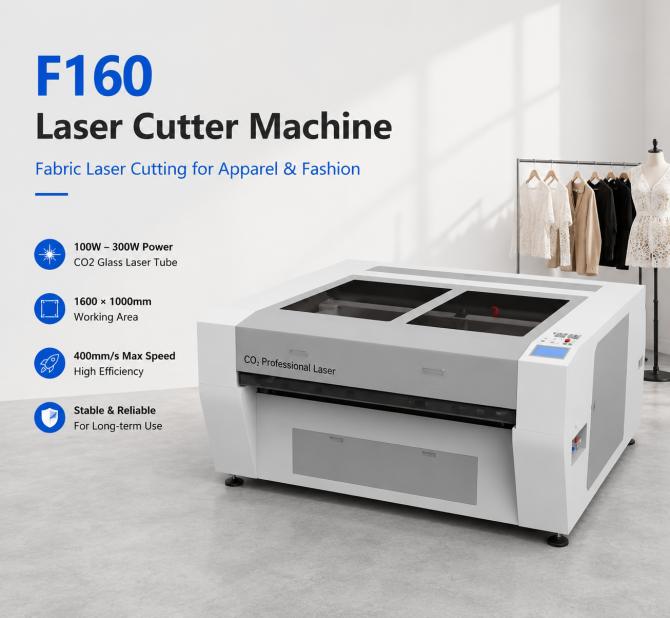
A suitable CO2 laser cutter for fabric should provide stable power output and adjustable processing parameters for different textile applications.
Excessive tension during unwinding can stretch flexible fabrics, especially knitted and elastic materials. When released, the fabric may return toward its original dimensions and affect cutting accuracy.
Maintain consistent feeding tension and use appropriate guiding and clamping components. Automatic edge guidance can help correct sideways material drift, while suitable material handling reduces wrinkles and displacement.
Controlled air assist helps remove debris and manage unwanted flame formation during processing. However, excessive airflow may disturb lightweight fabrics.
An effective exhaust system removes smoke, fumes, and processing byproducts. This is particularly important when cutting synthetic or coated textiles.
Always verify material compatibility and consult safety documentation before processing unfamiliar fabrics.
Yes. CO2 laser systems can process many knitted and woven textiles, including polyester, nylon, spandex blends, cotton, and denim.
However, different materials require different parameters. Stretch fabrics need careful handling, while natural fibers may require adjustments to minimize charring.
For suitable synthetic fabrics such as polyester and nylon, laser cutting can seal the fibers and help prevent fraying, reducing the need for additional edge finishing.
However, natural fabrics and products with specific assembly requirements may still require sewing, hemming, or other finishing operations.
Use suitable laser power and cutting speed to avoid excessive heat input. Test different parameter combinations and ensure the fabric remains flat through proper vacuum hold-down and consistent feeding.
Appropriate air assist and exhaust extraction also help maintain stable processing conditions.
The C160-L Vision is suitable for printed and sublimated fabric rolls requiring camera recognition and accurate pattern alignment.
For heavier industrial textiles and continuous production, the F180-L offers high-power CO2 options, automatic edge guidance, and material clamping components.
The final selection depends on fabric width, roll weight, material composition, and production volume.
Choosing the right laser cutter for fabrics requires evaluating material compatibility, cutting quality, automation, and production efficiency.
For apparel and sublimated sportswear, vision-assisted cutting improves pattern alignment. For industrial textiles, automatic feeding, stable material handling, and suitable laser power become more important.
Before investing, test your actual fabric samples and cutting files. Evaluate edge quality, dimensional accuracy, feeding stability, cutting speed, and material utilization.
MimoWork provides fabric laser cutting solutions ranging from vision-assisted conveyor systems to high-power industrial textile cutters and customized configurations.
Share your fabric type, thickness, roll dimensions, cutting patterns, and production targets with the MimoWork team to identify a suitable laser cutting solution.