Blog
In a field that evolves daily, staying ahead means staying informed.
Explore in-depth articles designed to help you solve complex challenges,
maximize your machine’s ROI.
Stay ahead in a competitive market.


In a field that evolves daily, staying ahead means staying informed.
Explore in-depth articles designed to help you solve complex challenges,
maximize your machine’s ROI.
Stay ahead in a competitive market.
News | Nov-13-2026 | Mimowork
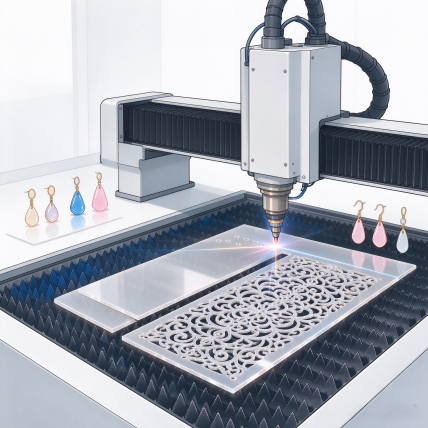
CO2 lasers are widely used for laser cut acrylic jewellery because acrylic absorbs CO2 laser energy efficiently, allowing manufacturers to produce intricate shapes, small holes, and smooth, polished cutting edges. This makes the technology particularly suitable for earrings, pendants, and decorative components that require detailed contours without mechanical pressure on the material.
The same machine can also engrave names, logos, and decorative patterns, giving manufacturers more flexibility when producing personalized jewellery and customized collections.
However, choosing the right machine involves more than selecting laser power. Working area, cutting accuracy, production volume, motion control, and fume extraction all influence whether a CO2 laser can meet your manufacturing requirements.
CO2 lasers are well suited to acrylic jewellery manufacturing. They support detailed cutting and engraving on acrylic (PMMA).
Edge quality matters more than maximum cutting speed. Smooth edges, accurate contours, and clean holes are essential for finished jewellery components.
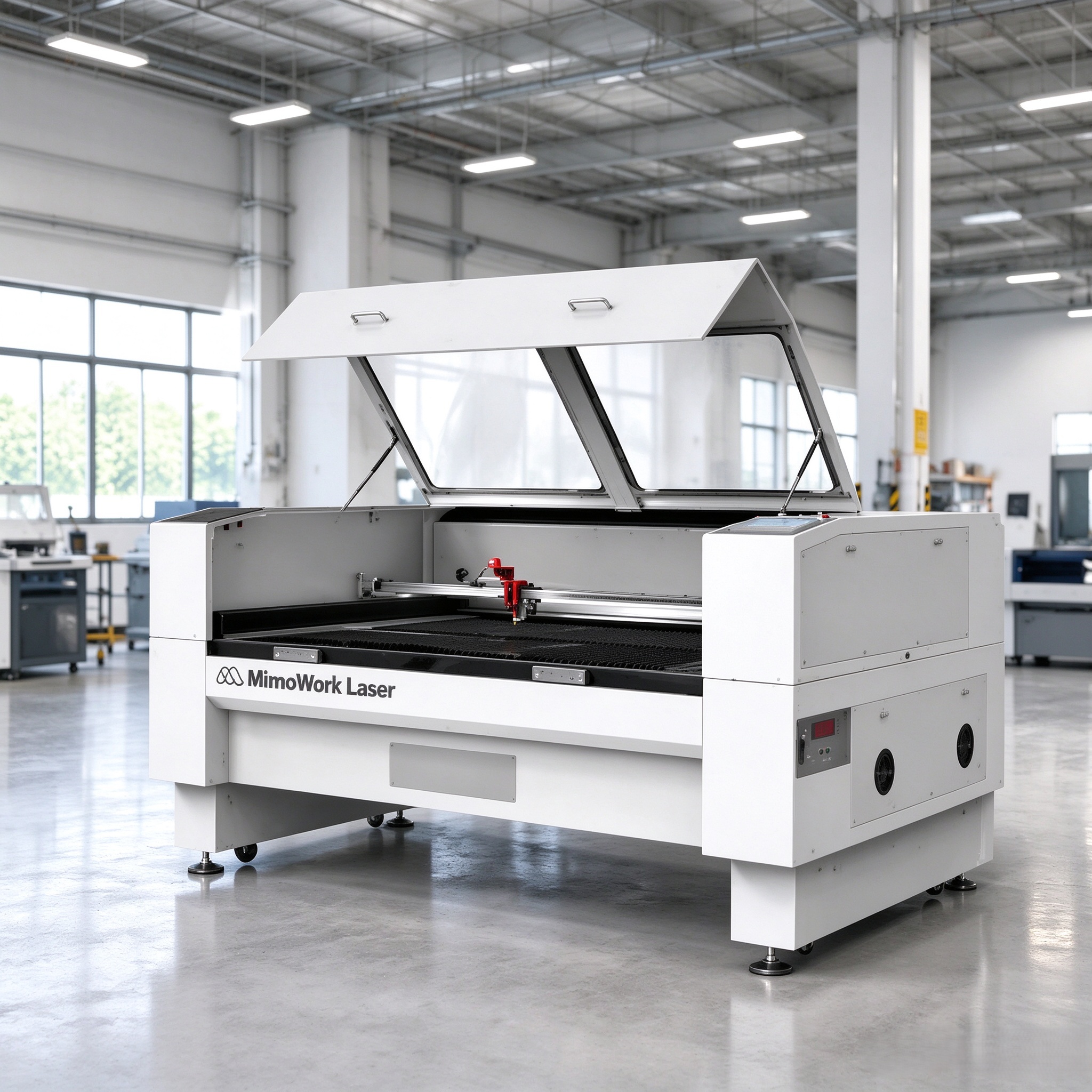
Machine size should match your production layout. MimoWork offers contour platforms with working areas of 600 × 400 mm, 900 × 500 mm, and 1300 × 900 mm, alongside larger configurations.
Marking speed is not cutting speed. The MimoWork Galvo Laser Marker 40 reaches a maximum marking speed of 10,000 mm/s, but this is not its acrylic cutting speed.
Fume extraction is part of the complete setup. The C-Series Fume Extractor has a rated extraction capacity of 5000 m³/h and filtration efficiency of 99.97% at 0.3 μm.
The main advantages of CO2 laser cutting come from material compatibility, edge quality, and processing flexibility rather than laser power alone.
Acrylic, also known as PMMA, absorbs CO2 laser energy efficiently. This allows manufacturers to cut intricate outlines and small decorative components with minimal mechanical interference.
Depending on material compatibility and machine configuration, CO2 laser systems can also process other non-metallic materials, including wood, leather, and paper.
For jewellery businesses producing customized collections, this flexibility makes it easier to work with different designs and compatible materials without relying entirely on separate cutting equipment.
In jewellery manufacturing, the cut edge is part of the finished product. Rough edges, irregular contours, and poorly formed holes can affect both appearance and assembly.
CO2 laser cutting can produce smooth, polished edges on suitable acrylic materials without direct mechanical contact. This is particularly useful for earrings, pendants, and decorative components featuring narrow connections, small holes, and intricate patterns.
For manufacturers focused on detailed acrylic jewellery, producing accurate contours and polished edges in one process can reduce additional mechanical finishing.
CO2 laser systems are available in different configurations for marking, engraving, and contour cutting.
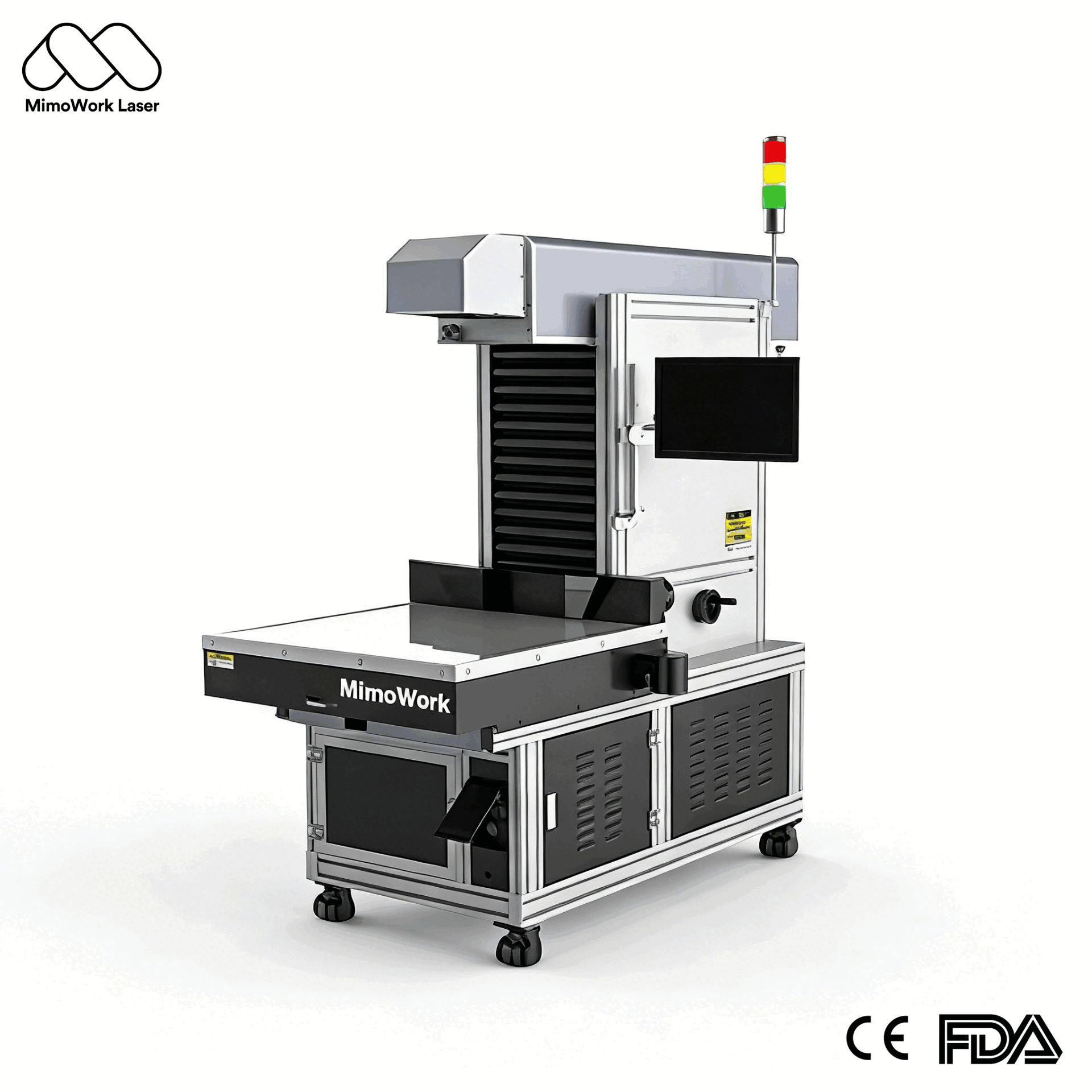
For example, MimoWork’s Galvo Laser Marker 40 uses a 3D galvanometer and CO2 RF metal laser tube, with available laser power configurations of 180 W, 250 W, and 500 W. Its published maximum marking speed reaches 10,000 mm/s.
An RF CO2 laser source is also an option when longer service life, reduced maintenance requirements, and consistent power output are important considerations.
However, marking speed and cutting performance are different specifications. The 10,000 mm/s figure refers to maximum marking speed, not the speed at which the machine cuts acrylic jewellery contours.
The appropriate configuration depends on material thickness, design complexity, and production volume.
Choose the working area according to your acrylic sheet dimensions, nesting layout, and production volume rather than simply the type of jewellery you manufacture.
A bed that is too small may restrict nesting layouts and require additional material handling. An unnecessarily large bed, meanwhile, increases equipment footprint without necessarily improving production efficiency.
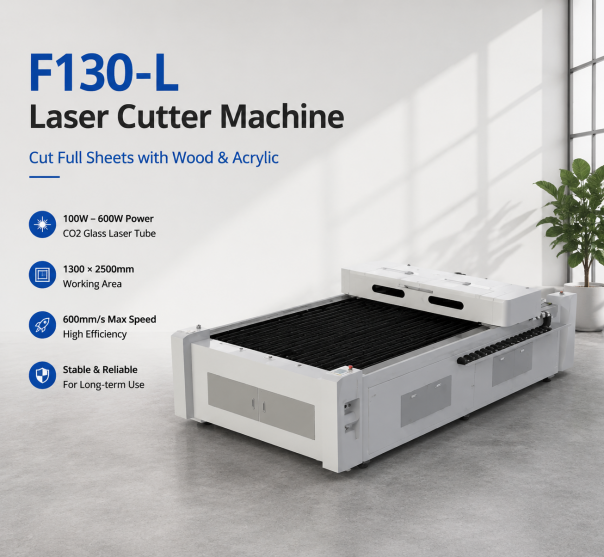
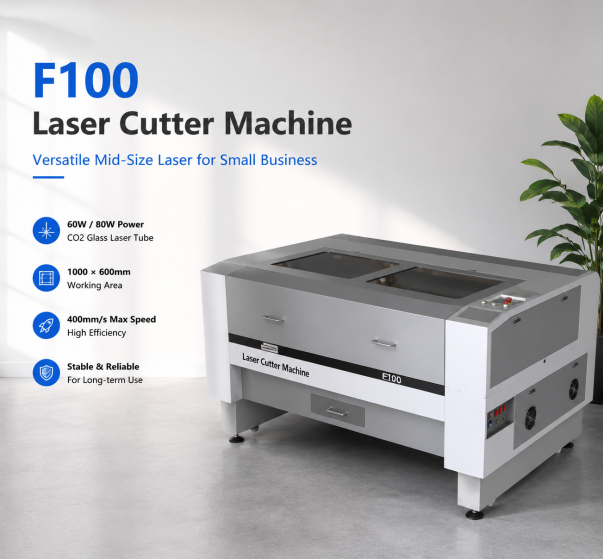
MimoWork offers several contour laser cutting platforms for different acrylic processing requirements, including 600 × 400 mm, 1000 × 600 mm, and 1300 × 900 mm working areas. Larger acrylic cutting platforms are also available, including a 1300 × 2500 mm configuration.
| Platform Format | Working Area | Suitable Applications | Main Consideration |
| Compact contour | 600 × 400 mm | Samples, small earring sheets, and small-batch production | Compact footprint but less nesting space |
| Mid-size contour | 1000 × 600 mm | Small-batch pendants, earrings, and mixed acrylic sets | Balances working area and material handling |
| Larger contour | 1300 × 900 mm | Larger acrylic jewellery panels and denser nesting layouts | Requires more floor space |
| Large-format flatbed | 1300 × 2500 mm | Larger acrylic sheets and higher-volume sheet processing | Suitable for larger material formats |
| Customized platform | Application-dependent | Specialized production layouts and automation requirements | Requires application-specific configuration |
Final machine specifications depend on the selected platform and configuration.
Before selecting a machine, prepare a sample production layout containing three elements:
Your largest acrylic sheet or material format.
Your most densely nested jewellery design.
Your smallest component, including holes, narrow connections, and detailed contours.
Check whether all three fit comfortably within the working area while leaving sufficient room for material positioning and handling.
For cutting accuracy, pay particular attention to small holes, narrow connections, repeated patterns, and the alignment between engraved and cut features.
Positioning precision and minimum line width are different technical measurements. They should not be treated as interchangeable or used as a universal cutting-accuracy specification.
Testing your own jewellery designs is a more reliable way to evaluate whether a machine meets your requirements.
CO2 lasers are particularly suitable for small-to-medium batch acrylic jewellery production involving intricate contours, personalized engraving, and customized designs.
These capabilities make CO2 laser systems suitable for manufacturers producing customized jewellery, seasonal collections, personalized gifts, and small-batch accessories.
Not every plastic is suitable for CO2 laser processing.
PVC and PTFE-based materials should not be processed using ordinary CO2 laser cutting configurations because they can release hazardous and corrosive fumes.
ABS and polycarbonate also require particular caution because of potential hazardous byproducts, melting, discoloration, and fire risks.
Before processing an unfamiliar material, confirm its composition with the supplier, review its safety data sheet (SDS), and check the machine manufacturer’s material compatibility guidance.
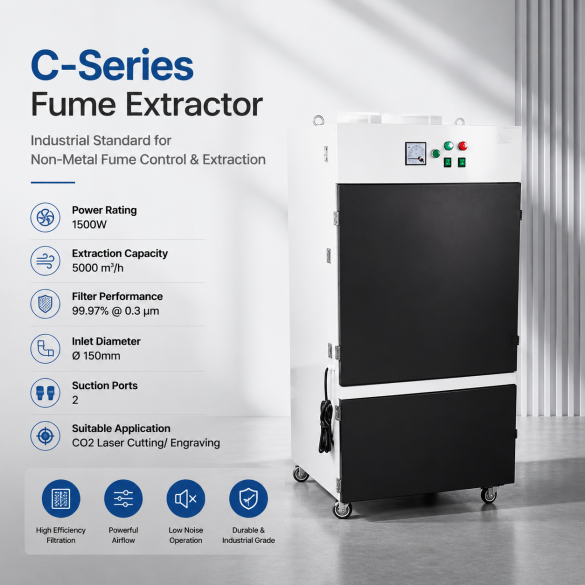
Fume extraction is essential when acrylic is processed regularly. Smoke, airborne particles, and processing residue can accumulate around the working area or redeposit onto workpieces, potentially causing surface contamination and additional cleaning requirements.
MimoWork’s C-Series Fume Extractor is designed for CO2 laser cutting and engraving applications.
| Specification | C-Series |
| Rated Power | 1500 W |
| Extraction Capacity | 5000 m³/h |
| Filtration Efficiency | 99.97% at 0.3 μm |
| Suction Ports | 2 |
| Inlet Diameter | Ø150 mm |
| Suitable Application | CO2 Laser Cutting and Engraving |
These are the published specifications of the C-Series Fume Extractor.
Actual extraction performance also depends on the machine enclosure, duct layout, extraction distance, material characteristics, and operating conditions. The extraction configuration should therefore be matched to the complete laser processing setup rather than selected by airflow capacity alone.
The right machine should match your actual production workflow rather than simply offer the highest specifications.
| Evaluation Factor | What to Consider |
| Product design complexity | Small holes, narrow connections, intricate contours, and engraving details |
| Production volume | Small customized batches versus repeated sheet processing |
| Working area | Current acrylic sheet dimensions, nesting layouts, and future production requirements |
| Fume extraction | Extraction capacity, filter configuration, installation space, and maintenance requirements |
For small workshops producing customized earrings and pendants, compact or mid-size contour platforms may be sufficient. Manufacturers processing larger acrylic sheets or repeated batches should evaluate larger working areas and material-handling requirements.
Ultimately, the best CO2 laser for acrylic jewellery is not necessarily the largest or most powerful model. It is the machine that matches your material dimensions, design complexity, batch requirements, and workshop conditions.
Acrylic (PMMA) absorbs CO2 laser energy efficiently, making it suitable for detailed contour cutting and engraving. The non-contact processing method also helps prevent mechanical deformation of delicate earrings, pendants, and other small components.
The appropriate working area depends on acrylic sheet dimensions, nesting layouts, and production volume. A 600 × 400 mm platform can suit samples and small batches, while 900 × 500 mm and 1300 × 900 mm platforms provide more room for larger layouts. For larger sheet formats, a 1300 × 2500 mm platform may be more appropriate.
Yes. Acrylic laser cutting generates airborne contaminants and processing residue that should be captured through an appropriate extraction system. The MimoWork C-Series Fume Extractor has a published extraction capacity of 5000 m³/h and filtration efficiency of 99.97% at 0.3 μm. The final configuration should match the machine enclosure, duct layout, and operating conditions.
CO2 laser technology offers a practical solution for acrylic jewellery manufacturers who need detailed cutting, smooth edges, and flexible production capabilities.
However, the right machine depends on more than the laser source. Working area, motion control, material thickness, cutting requirements, and fume extraction all influence the final production result.
MimoWork provides different CO2 laser cutter configurations, from compact contour systems to larger acrylic cutting platforms and customized solutions.
Before selecting a machine, prepare your actual acrylic material, jewellery design files, and expected batch quantities. Testing these requirements together provides a more reliable basis for choosing the right working area and machine configuration.
Contact MimoWork to discuss your acrylic jewellery processing requirements and arrange a sample evaluation using your own designs and materials.
News | Oct-27-2026