Blog
In a field that evolves daily, staying ahead means staying informed.
Explore in-depth articles designed to help you solve complex challenges,
maximize your machine’s ROI.
Stay ahead in a competitive market.


In a field that evolves daily, staying ahead means staying informed.
Explore in-depth articles designed to help you solve complex challenges,
maximize your machine’s ROI.
Stay ahead in a competitive market.
News | Sep-15-2026
Short answer: 150W is usually worth considering for thicker materials, higher workloads, or future production expansion. For lighter production, 100W may offer better value.
Choosing between a 100W and 150W CO2 laser is not simply a matter of choosing the larger number.
The extra 50W can provide more cutting capacity and greater flexibility with thicker materials. It may also help increase throughput when the machine is used heavily. But if most of your work involves thinner materials and moderate production volumes, a 100W co2 laser cutter may already provide enough capacity.
The key is to match the laser power with the work you actually need to process.
The main difference is laser output.
A 150w CO2 laser can deliver more energy to the material than a 100W source. This can improve cutting capacity, particularly when processing thicker or more demanding materials.
Cutting performance also depends on material type, thickness, focus, lens selection, air assistance, cutting parameters, and the machine’s motion system.
| Factor | 100W CO2 Laser | 150W CO2 Laser |
| Laser output | 100W | 150W |
| Cutting capacity | Suitable for many standard jobs | Greater capacity for demanding jobs |
| Thicker materials | More limited | Better suited |
| Production flexibility | Good | Higher |
| Initial investment | Generally lower | Generally higher |
| Typical use | Light to medium production | Medium to heavy production |
So when comparing a 100w vs 150w CO2 laser, the better question is not which one is more powerful, but whether your production can use that additional capacity.
This is one of the strongest reasons to choose 150W.
As material thickness increases, the laser needs to deliver enough energy through the material to maintain a stable cut. Additional power can therefore provide more headroom when processing thicker acrylic, plywood, MDF, wood, and other CO2-compatible materials.
For buyers looking for a 150w CO2 laser cutting machine for thick materials, that extra capacity can be useful both for current production and future expansion.
There is no universal thickness limit for a 100W or 150W laser. Actual results depend on the material, density, thickness, focus, optics, cutting speed, and machine configuration.
For a specific material, manufacturer test results are more useful than a general wattage-to-thickness chart.
It can be, but laser power is only part of the equation.
A 150W source may allow higher cutting speeds on certain materials while maintaining the required result. But the machine also needs a motion system capable of handling those speeds accurately.
A high-power laser installed on a machine with limited motion performance will not automatically deliver high productivity.
When comparing a co2 laser cutter, consider the laser source, motion system, working area, cooling, optics, and workflow as one system.
A 100W CO2 laser is often the more practical choice when additional cutting capacity will not significantly improve your production.
Consider 100W when:
The additional investment becomes easier to justify when the machine is expected to handle demanding production.
If thicker acrylic, plywood, MDF, or wood is already part of your product range, additional power can provide useful cutting headroom.
If the machine runs for several hours every day, reducing processing time can have a meaningful effect on total output.
The important metric is not simply maximum cutting speed, but how many finished parts the machine can produce during an actual production shift.
If you expect larger orders or a wider range of material thicknesses, 150W can reduce the risk of reaching the limits of a 100W machine too quickly.
Different materials and thicknesses require different cutting parameters. Additional power can give operators more room when adjusting the process for demanding jobs.
If you mainly cut thinner acrylic sheets and your production volume is moderate, 100W may be sufficient.
For thicker acrylic or higher-volume production, 150W can be more attractive.
When comparing a 100w vs 150w CO2 laser for acrylic, do not assume that higher power automatically produces a better edge.
Acrylic cutting quality also depends on focus, lens selection, optical configuration, speed, air assistance, material quality, and cutting parameters.
The extra power is most valuable when it helps you achieve the required cut more efficiently.
Wood shows a similar pattern.
Thin plywood, MDF, veneer, and other relatively thin materials can often be processed with moderate power. As thickness increases, cutting becomes more demanding.
A 150W configuration can therefore be useful for thicker wood or higher-volume production.
If your business uses a CO2 laser for both cutting and engraving, the required machine configuration may be different from a system used primarily for industrial cutting. For a related buying guide, see [Best CO2 Laser Engraver for Small Business].
The right power should be based on the materials, thicknesses, part sizes, and production volume you actually expect to handle.
Not necessarily in terms of cost per part.
A higher-power machine may use more electricity, but operating cost also includes:
If a 150W machine cuts faster or allows more material to be processed per shift, the additional energy consumption may be offset by higher output.
For production buyers, cost per finished part is more useful than electricity consumption alone.
A simple comparison is:
Total operating cost ÷ finished output = cost per part
This helps determine whether the additional investment in a 150W CO2 laser cutter actually improves production economics.
The lower purchase price of 100W does not automatically make it the cheaper option over the machine’s entire working life.
A 150W system costs more initially, but it may provide additional capacity for thicker materials, higher workloads, and future expansion.
| Buying Situation | Better Choice | Main Reason |
| Thin materials | 100W | Extra power may provide limited benefit |
| Moderate production | 100W | Lower investment may be sufficient |
| Thick acrylic | 150W | Greater cutting capacity |
| Thicker wood | 150W | More suitable for demanding cutting |
| High daily workload | 150W | More production headroom |
| Lowest initial investment | 100W | Lower equipment cost |
| Future expansion | 150W | More room for growth |
If your current 100W machine would already handle your expected workload comfortably, there may be little reason to pay more for 150W.
If your production is likely to become thicker, faster, or more demanding, the additional capacity can be easier to justify.
Laser power should never be the only specification you compare when buying a co2 laser cutter.
Make sure the cutting bed fits your typical material size. More laser power does not help if the machine cannot accommodate your workpieces efficiently.
Speed, acceleration, positioning, and repeatability affect how effectively the available laser power can be used.
Higher-power CO2 systems require appropriate cooling for stable operation. MimoWork’s higher-power F-Series machines use water-chilling systems designed for continuous operation.
Lens selection and optical configuration affect how laser energy is focused and delivered to the material.
For large sheets or high-volume production, loading and unloading can become a bigger bottleneck than cutting itself.
Nesting and workflow software can reduce material waste and make repeated production easier to manage.
The result is simple: a high-power CO2 laser is not automatically a high-productivity machine.
The complete machine configuration determines how effectively that power can be converted into production output.
Choose 100W when your materials are mostly thin to medium thickness, production volume is moderate, and keeping the initial investment controlled is important.
Choose 150W when you regularly cut thicker materials, need higher daily throughput, or expect your production requirements to grow.
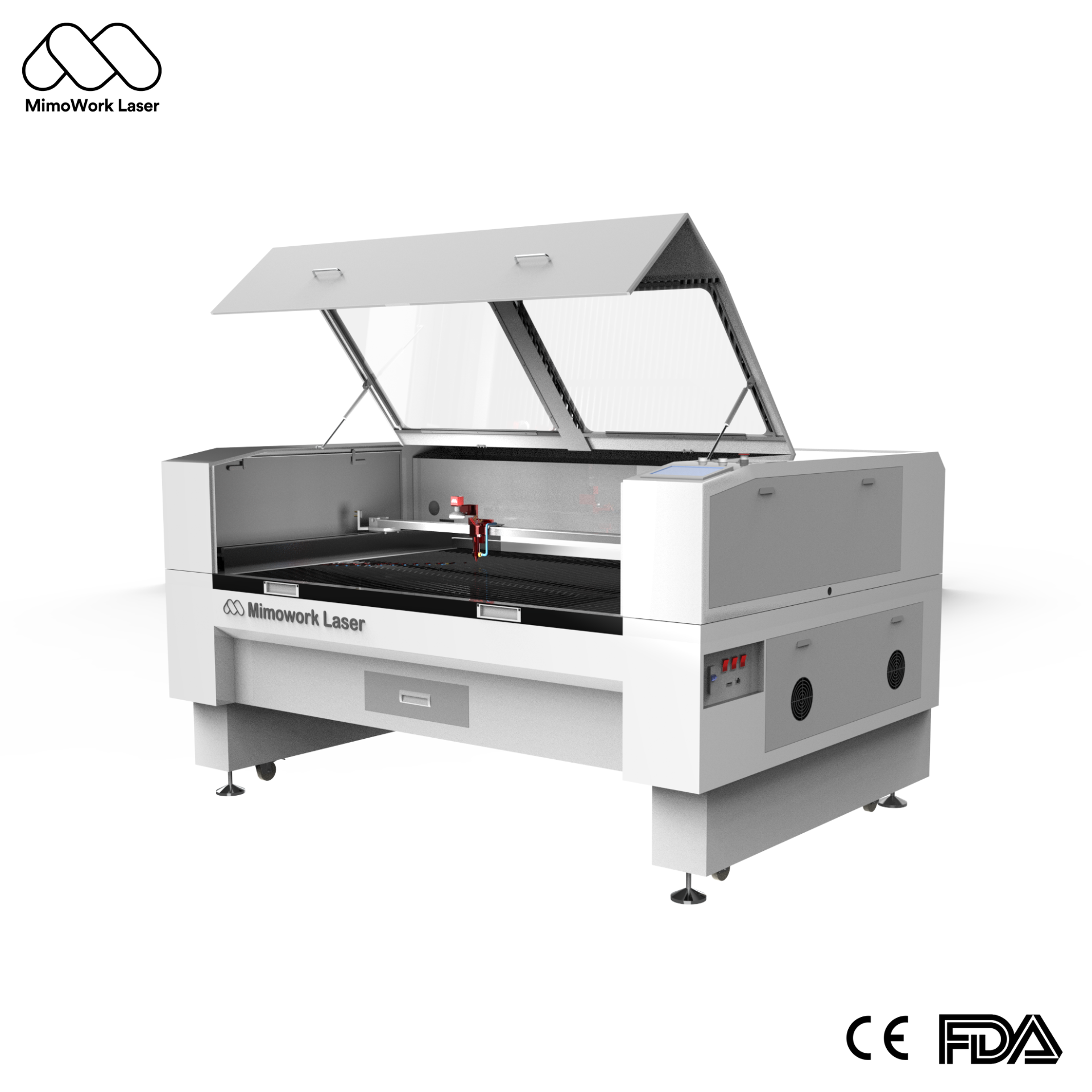
For businesses considering a 150w CO2 laser for industrial production, the MimoWork F130 is available with 60W–150W CO2 laser power and a 1300 × 900 mm working area. The 150W configuration can be considered when the application requires more cutting capacity while the 1300 × 900 mm working area is sufficient for the material size and production workflow.
Not always. 150W provides greater cutting capacity, while 100W can offer better value for thinner materials and moderate production.
There is no universal thickness limit. Results depend on the material, thickness, focus, optics, speed, and machine configuration.
It can be if the additional power improves throughput, enables thicker-material processing, or provides useful capacity for future production.
It can be advantageous for thicker acrylic and higher-volume production. For thinner acrylic, 100W may already be sufficient.
A 150W CO2 laser describes the laser source and output power. A 150W laser cutter refers to the complete machine, including its working area, motion system, optics, cooling, and software.
If you mainly process thinner materials and have moderate production requirements, 100W is likely enough.
If you regularly cut thicker materials, need higher throughput, or expect production to expand, 150W can be worth the additional investment.
Do not choose 150W simply because the number is higher.
Choose it when the extra power solves a real production requirement.
For a CO2 laser cutter, the best configuration is the one that provides enough cutting capacity without paying for performance you will rarely use.
If you are comparing 100W and 150W CO2 lasers, send MimoWork your material type, thickness, and cutting file. We can help you test the application and determine which power and machine configuration fits your production needs.
Related Guide:https://www.mimowork-laser.com/blog/laser-wood-cutter-and-engraver-complete-guide
News | Aug-24-2026
News | Sep-14-2026