Blog
In a field that evolves daily, staying ahead means staying informed.
Explore in-depth articles designed to help you solve complex challenges,
maximize your machine’s ROI.
Stay ahead in a competitive market.


In a field that evolves daily, staying ahead means staying informed.
Explore in-depth articles designed to help you solve complex challenges,
maximize your machine’s ROI.
Stay ahead in a competitive market.
News | Oct-30-2026 | Mimowork
A 300W pulse laser cleaning machine can remove selected rust, paint, and oxide layers while limiting heat transfer to the underlying material under suitable conditions. However, zero substrate damage cannot be guaranteed. Cleaning results depend on the substrate, contaminant, pulse parameters, scanning speed, and number of passes.
Removing a coating is relatively straightforward when the underlying material does not matter. The challenge changes when the component must retain its dimensions, surface finish, or functional properties.
A mold may contain fine details that must remain intact. An aluminum part may have a surface layer that should not be disturbed. A welded component may need oxide and residue removed without introducing unnecessary surface changes.
These requirements make a 300W pulse laser cleaning machine worth evaluating for precision cleaning applications. But the rated power is only a starting point. A successful process must remove the unwanted material while preserving the surface characteristics required by the next manufacturing step.
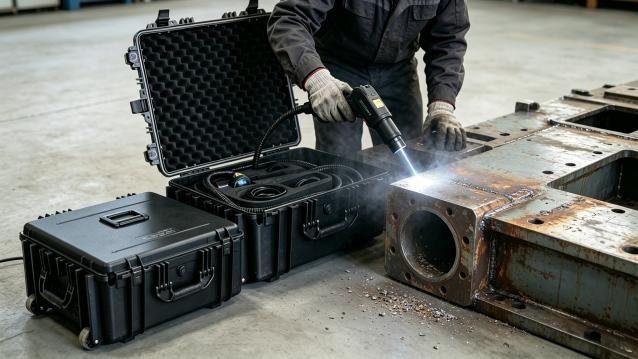
A pulsed laser delivers energy in short bursts rather than as a continuous beam. When the contaminant absorbs sufficient energy, it can be detached, ablated, or otherwise removed from the surface. The interaction depends on the optical and thermal properties of both the contaminant and the substrate.
Under suitable conditions, the difference in how the two materials respond to the laser allows the contaminant to be removed while limiting changes to the underlying surface.
This is particularly relevant when cleaning precision metal components, removing selected paint layers, or treating localized areas around welds.
MimoWork lists pulsed fiber laser cleaning systems with power options from 100W to 500W and a wavelength of 1064nm. Air- or water-cooled configurations are available depending on the system. A 300W model falls within this published power range.
However, pulsed operation does not automatically mean damage-free cleaning. If the energy density exceeds the substrate’s damage threshold, the process can alter the surface even when the average power appears appropriate.
Higher power may help improve throughput in some applications, but it does not automatically produce a better cleaning result.
A 300W pulsed system may be appropriate when the job requires controlled removal from precision components or localized surfaces. Examples include selected mold-cleaning tasks, oxide removal, and paint stripping where substrate integrity is important.
For heavy rust or thick coatings across large steel surfaces, a higher-throughput system may be more practical. The decision should be based on actual cleaning performance, not the assumption that a lower-power machine is always gentler or that a higher-power machine is always faster.
| Cleaning Application | Key Requirement | What to Validate |
| Light rust removal | Clean metal surface without unnecessary material alteration | Residual rust and surface condition |
| Paint removal from aluminum | Remove coating while preserving the alloy surface | Coating removal and substrate damage threshold |
| Mold cleaning | Preserve fine details and functional geometry | Surface roughness and dimensional integrity |
| Oxide removal | Remove unwanted surface layers consistently | Residual oxides and required surface finish |
| Weld-seam cleaning | Remove selected residue and discoloration | Base-metal condition and readiness for the next process |
| Heavy rust on large steel parts | High area coverage and productive removal | Cleaning rate, number of passes, and operating cost |
These applications are starting points for evaluation, not guarantees of compatibility. Coating thickness, adhesion, surface treatment, and the required acceptance criteria can change the suitability of the process.
Average power describes the laser’s overall output, but it does not tell the whole story. Pulse energy and energy density help determine how much energy reaches a specific area during each pulse.
If the energy is too low, the contaminant may remain. If it is too high, the substrate may be altered. The ideal operating window lies between insufficient removal and unacceptable surface damage.
This is why a supplier should test the actual coating and base material rather than recommending a setting from the 300W rating alone.
Pulse duration affects how energy interacts with the surface over time. Repetition frequency influences how frequently energy is delivered.
Together with pulse energy, these parameters affect removal efficiency, thermal behavior, and the potential for surface alteration. A parameter combination suitable for removing paint may not work equally well for a thin oxide layer.
The machine’s available parameter ranges should be confirmed for the specific configuration being considered.
The cleaning head moves across the target area to distribute laser exposure. Excessive overlap or repeated passes can increase the accumulated energy delivered to the same location. Insufficient overlap can leave visible strips of contamination.
For production cleaning, consistent movement and repeatable coverage matter as much as the nominal laser power.
A good test should assess both the final appearance and the time required to achieve it.
A thick coating may require several controlled passes. Attempting to remove it in one aggressive pass can increase the risk of surface damage.
However, more passes also mean longer processing time. The correct method is to compare removal completeness, surface condition, and productivity rather than optimizing for the fewest passes at any cost.
Pulsed and continuous-wave systems are designed around different energy-delivery characteristics. The most appropriate choice depends on the contaminant, substrate, and required throughput.
| Factor | Pulsed Laser Cleaning | Continuous-Wave Laser Cleaning |
| Energy delivery | Short, discrete pulses | Continuous laser output |
| Main consideration | Controlled removal and surface integrity | Productive removal over larger areas |
| Typical applications | Precision components, selected mold cleaning, localized coating removal | Heavy rust and coating removal on suitable industrial surfaces |
| Thermal behavior | Can limit heat input with appropriate parameters | Requires suitable control of heat input and exposure |
| MimoWork listed power options | 100W–500W | 1000W–3000W |
| Primary selection criterion | Cleaning quality and substrate preservation | Cleaning throughput and total processing cost |
The listed power ranges are based on MimoWork’s product information. They do not represent equivalent cleaning capacities, and wattage alone cannot establish which machine will clean a particular surface faster.
If your priority is preserving a precision surface, evaluate a pulsed system first. If the job involves extensive heavy rust on large steel structures, compare the productivity of a continuous-wave system as well.
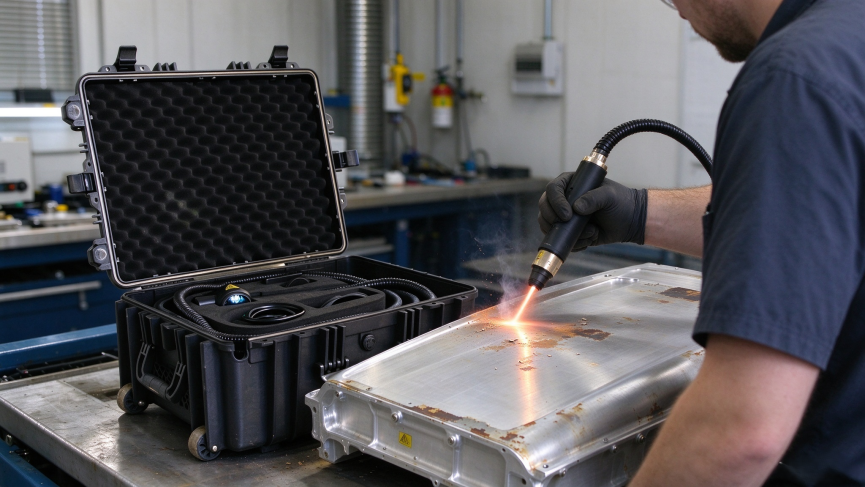
Identify whether the target is rust, paint, oxide, oil, or another contaminant. Record its thickness, adhesion, and any variation between components.
This information is important because two parts made from the same metal may require different cleaning processes if their coatings differ.
The substrate requirement should be measurable wherever possible. Depending on the application, this could involve surface roughness, dimensions, visual appearance, coating residue, or suitability for subsequent welding or recoating.
For example, removing paint from an aluminum component is not the same as removing an anodized layer that provides corrosion protection. The latter may be an intentional functional coating, not contamination.
A convincing demonstration should use the actual substrate and contaminant. Ask the supplier to record the settings, number of passes, cleaning time, and final surface condition.
Where surface integrity is critical, photographs alone are insufficient. Appropriate inspection may include microscopy, roughness measurement, dimensional checks, or other tests relevant to the component.
Measure how much time is required to produce a part that meets the specified cleaning criteria. Include loading, cleaning, inspection, repositioning, and any additional finishing.
A machine that cleans aggressively but causes surface defects may generate more rework than a slower, controlled process. The useful metric is the cost of obtaining an accepted surface, not simply the area cleaned per minute.
Before committing to a 300W pulse laser cleaning machine, establish three acceptance criteria.
Contaminant removal: The unwanted layer must be removed to the required level. Remaining residue can affect welding, recoating, adhesion, or component performance.
Substrate integrity: The cleaning process must not cause unacceptable changes to the base material. This should be verified using inspection methods appropriate to the application.
Production repeatability: The result must remain consistent across representative samples and normal operating conditions.
These requirements should be evaluated together. A process that removes the coating completely but damages the surface has failed. A process that protects the substrate but leaves unacceptable residue has also failed.
For demanding applications, the best result comes from defining the cleaning window, documenting the parameters, and establishing a clear stopping point before production begins.
Related guide:Best Laser Cleaning Machine in 2026: How to Choose the Right Setup for Eco-Friendly, Precision Rust & Paint Removal
No. It can provide controlled contaminant removal under suitable conditions, but damage depends on the material, contaminant, and laser parameters. Testing and appropriate surface inspection are necessary when substrate integrity is critical.
It can be suitable for selected rust-removal and paint-stripping applications. The actual result depends on coating thickness, adhesion, substrate material, scanning speed, and the required finish. Heavy contamination over a large area may justify evaluating a higher-throughput system.
Laser cleaning does not rely on conventional chemical stripping or abrasive blasting media to remove contaminants. However, it still requires suitable laser safety controls, protective equipment, and management of the particles and fumes generated during processing.
A 300W pulse laser cleaning machine is worth considering when a manufacturer needs to remove contaminants while maintaining tight control over the underlying surface. Its suitability depends on the cleaning window between complete contaminant removal and unacceptable substrate alteration.
MimoWork lists pulsed fiber laser cleaning configurations from 100W to 500W at a 1064nm wavelength. The 300W option should be evaluated according to the actual substrate, contaminant, surface-finish requirements, and production target.
Explore the MimoWork Pulsed Laser Cleaning Machine and compare it with the Continuous-Wave Laser Cleaning Machine. Provide the base material, coating type, coating thickness, and required cleaning area when requesting a sample test.
News | Oct-17-2026
News | Aug-6-2026