Blog
In a field that evolves daily, staying ahead means staying informed.
Explore in-depth articles designed to help you solve complex challenges,
maximize your machine’s ROI.
Stay ahead in a competitive market.


In a field that evolves daily, staying ahead means staying informed.
Explore in-depth articles designed to help you solve complex challenges,
maximize your machine’s ROI.
Stay ahead in a competitive market.
News | Oct-20-2026 | Mimowork
Quick Answer
A 60W MOPA fiber laser is worth the upgrade when your business needs more control over metal-marking appearance, particularly for black marking on suitable anodized aluminum, color marking on stainless steel, and detailed product identification. Its adjustable pulse duration provides more process flexibility than a conventional fixed-pulse approach. However, 60W is not automatically better for every job. The investment makes sense when it improves marking quality, production throughput, or the range of products you can offer.Explore MimoWork’s laser marking machine solutions to compare available options for your application.
A 60W MOPA fiber laser offers two advantages that buyers should evaluate separately: output power and pulse control.
Power affects how much laser energy the system can deliver. MOPA technology allows operators to adjust pulse duration, providing additional control over how energy interacts with the material. Depending on the source, frequency, and machine configuration, these controls can help produce different surface effects without relying solely on deep engraving.
That flexibility matters when the appearance of the mark is part of the product’s value. A manufacturer marking electronic housings may need clean, readable identification. A promotional-products business may need dark logos on anodized aluminum. A premium metal-accessory manufacturer may want colored marks on stainless steel.
A conventional fiber laser can still perform standard identification marking very well. The case for MOPA becomes stronger when the job requires specific contrast, controlled surface heating, or a wider range of marking effects.
Yes, under suitable material and process conditions. Black marking on anodized aluminum and color marking on stainless steel are different applications, so they should not be treated as interchangeable capabilities.
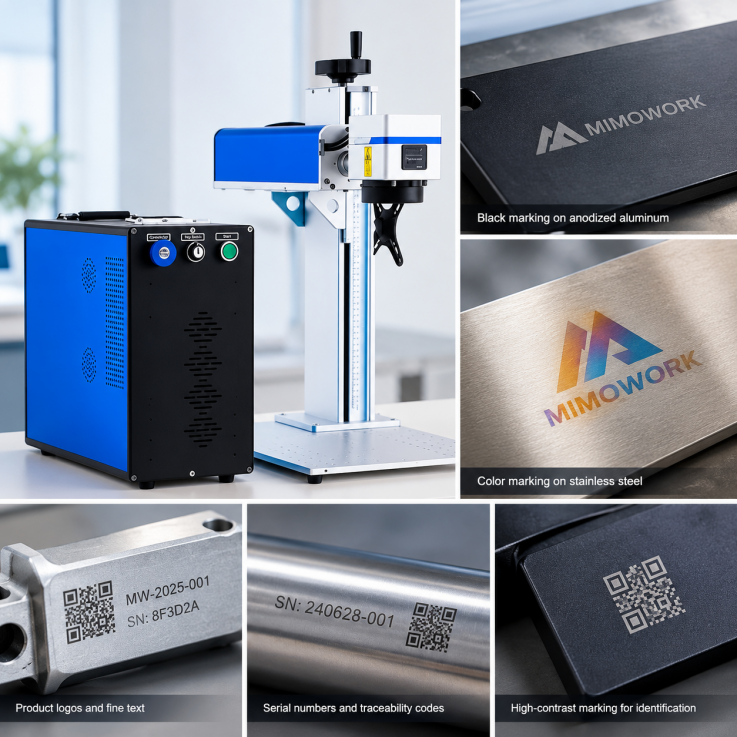
On anodized aluminum, a suitable MOPA process can create dark marks by changing the coating’s appearance. Depending on the coating and settings, the result can range from gray to deep black. This is useful when a product needs a high-contrast logo or identification mark without the appearance of conventional engraving.
Stainless steel color marking works differently. Controlled laser heating can create surface oxide effects that produce visible colors. The result depends on the alloy, surface finish, pulse settings, and scanning strategy. A color that looks consistent on polished stainless steel may not look the same on brushed or differently finished material.
Trotec’s technical guide provides a practical example of black marking on anodized aluminum with a 20W MOPA laser. It demonstrates why buyers should evaluate the marking process rather than assume that higher power is always necessary.
| Application | Potential advantage of MOPA | What to validate |
| Black marking on anodized aluminum | Dark, high-contrast marks on compatible coatings | Coating type, darkness, uniformity, and surface integrity |
| Color marking on stainless steel | Greater control over laser-induced surface effects | Available shades, repeatability, and alloy compatibility |
| Product logos and fine text | Flexible adjustment of marking parameters | Edge definition, readability, and minimum detail |
| Serial numbers and traceability codes | Permanent identification with consistent contrast | Code readability and production cycle time |
| Deep metal engraving | Additional process flexibility for suitable applications | Required depth, number of passes, and removal rate |
A sample that looks excellent on one material does not guarantee the same result on another. Request tests on the actual production parts before selecting the machine.
Sometimes, but the difference depends on the job. Higher output power can help reduce cycle time when the application can use the additional energy effectively. It does not guarantee a faster result for every design or marking effect.
Simple serial numbers and large filled areas may respond differently from intricate logos or color-marking jobs. The latter may require carefully controlled scanning conditions that limit the benefit of additional power.
A fair comparison should use the same material, marking file, lens, target quality, and inspection criteria. Record the complete cycle time, including loading, positioning, marking, and any inspection required.
| Buying consideration | 30W MOPA | 60W MOPA |
| Standard text and identification | Often sufficient | Also suitable, with more output headroom |
| Color or black marking | Suitable for many compatible applications | Worth evaluating when power or throughput is a constraint |
| Higher-volume production | Depends on actual cycle time | May improve throughput on suitable jobs |
| New marking services | Depends on the source and application | May offer useful flexibility for expanding workloads |
| Investment justification | Attractive when current productivity meets demand | Stronger when testing demonstrates measurable gains |
These are general selection guidelines, not guaranteed performance results. The correct comparison is between tested configurations, not wattage figures alone.
Pulse duration, frequency, power, scanning speed, and fill spacing all influence the final mark. Their effects interact, so changing several variables at once makes it difficult to identify why a sample improved or deteriorated.
Start by identifying the required result: blackness, color, contrast, engraving depth, or readability. Establish a baseline using the supplier’s application guidance, then adjust one parameter at a time.
For black anodized aluminum, fill spacing can be particularly important because it affects how closely adjacent scan lines overlap. A tighter fill may create a darker appearance, but it also increases processing time. For stainless steel color marking, changes in heat input can shift the resulting color or affect uniformity.
The winning settings should be recorded and tested on multiple parts. A repeatable process is more valuable than one impressive sample produced under conditions that cannot be maintained in production.
A 60W MOPA system is most attractive when it solves a specific business problem. That might be inconsistent black marks, limited ability to offer color-marking services, excessive cycle times, or a need to process a wider variety of parts.
Before purchasing, compare the expected improvement against the complete cost of ownership. Include the machine, required accessories, training, setup time, maintenance, and the labor needed to develop reliable marking parameters.
The upgrade is harder to justify when most work consists of basic serial numbers and logos that your current system already produces efficiently.
A useful purchasing test is to calculate the additional contribution from new applications and any verified time savings. If the new machine does not materially improve output or expand profitable services, the higher initial cost may not be worthwhile.
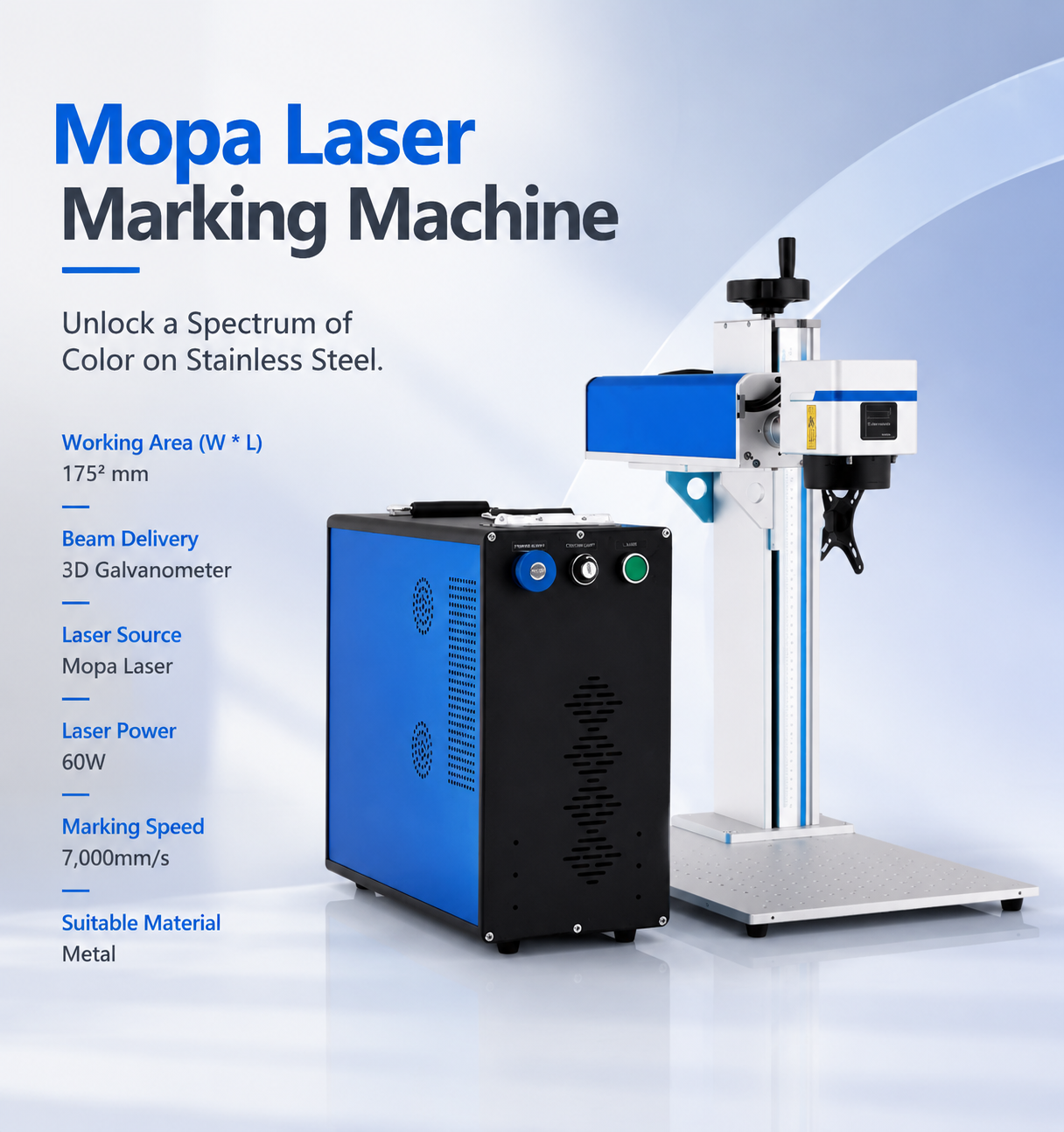
MimoWork offers laser marking solutions for manufacturers evaluating different marking requirements. Its 60W MOPA configuration is listed with a 175 × 175 mm marking area, a 3D galvanometer system, and marking speeds of up to 7,000 mm/s. These specifications provide a starting point for evaluating whether the machine fits your workpieces and production workflow.
The published maximum marking speed should not be interpreted as the guaranteed cycle time for every job. Actual performance depends on the artwork, material, settings, and quality requirements.
Before making a decision, ask MimoWork to evaluate representative stainless steel or anodized aluminum samples. Confirm the available pulse controls, working area, lens configuration, and expected cycle time. This makes the purchase decision about a demonstrated production result rather than a specification sheet.
Explore the MimoWork website to review its laser-processing solutions and discuss the configuration appropriate for your application.
Related guide:What is a Fiber Laser Marking Machine? The Ultimate Guide to Industrial Precision
Yes, it can produce color effects on suitable stainless steel through controlled laser-induced surface oxidation. The available colors and consistency depend on the alloy, finish, and process parameters.
MOPA offers additional pulse-duration control, which can be valuable for certain surface effects and specialized marking tasks. A conventional fiber laser may still offer better value for standard identification marking.
Request samples using your actual material and artwork. Compare contrast, edge quality, cycle time, repeatability, and surface condition, and ask for the tested settings to be documented.
News | Sep-11-2026
News | Sep-14-2026