Blog
In a field that evolves daily, staying ahead means staying informed.
Explore in-depth articles designed to help you solve complex challenges,
maximize your machine’s ROI.
Stay ahead in a competitive market.


In a field that evolves daily, staying ahead means staying informed.
Explore in-depth articles designed to help you solve complex challenges,
maximize your machine’s ROI.
Stay ahead in a competitive market.
News | Sep-26-2026
Glass and crystal are widely used for decorative products, packaging, awards, optical components, and customized consumer products. However, creating precise and attractive markings on these materials can be challenging with conventional engraving methods. Choosing the right Laser Marking Machine is therefore important when manufacturers need consistent results on delicate or transparent materials.
A green laser engraving machine provides a specialized solution for marking glass and other transparent or reflective materials. With a wavelength around 532 nm, green laser technology can interact with materials that may be difficult to process with some other laser sources.
For manufacturers producing glassware, crystal gifts, decorative products, or precision components, selecting the appropriate laser wavelength and Laser Marking Machine configuration is an important part of achieving consistent engraving quality.
Glass is transparent, brittle, and sensitive to concentrated thermal energy. These characteristics make it different from common materials such as wood, acrylic, or ordinary metals.
When unsuitable laser parameters are used, glass processing may result in:
Traditional mechanical engraving can also create physical stress on the material and may be less suitable for intricate designs or high-volume customization.
A green laser engraving machine approaches the problem differently by using a shorter wavelength that can interact more effectively with certain transparent materials.
A green laser engraving machine uses a green laser source, typically operating at a wavelength of approximately 532 nm, to create marks on suitable materials.
The shorter wavelength provides different absorption characteristics compared with infrared laser sources.
This makes green lasers particularly useful for applications involving:
The actual engraving result depends on the material composition, thickness, surface condition, laser parameters, and desired marking effect. Material testing is therefore important before selecting a production system.
One of the main reasons manufacturers consider green laser technology is its interaction with transparent materials.
Certain glass and crystal products can be difficult to process consistently using conventional laser wavelengths. A green laser can provide a more suitable energy absorption profile for these applications.
This makes it useful for detailed decorative and identification marking.
Glass engraving often involves relatively intricate patterns rather than simply removing large amounts of material.
Green laser systems can be used for applications such as:
The non-contact process also eliminates mechanical tool wear at the engraving point.
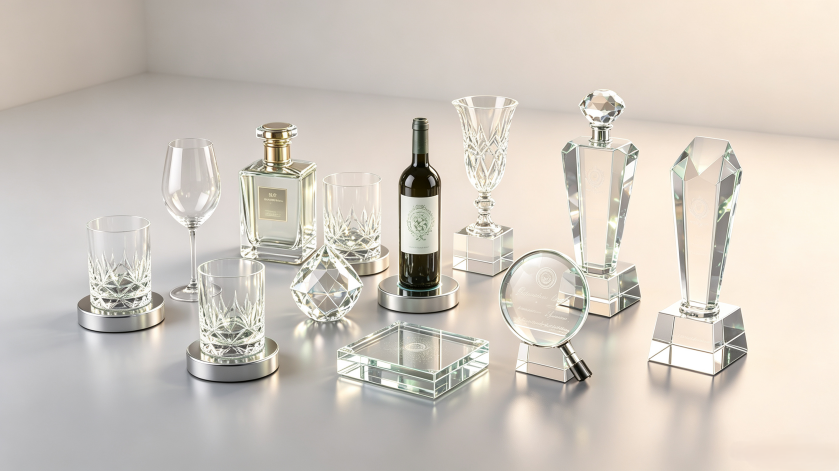
Manufacturers can use green laser engraving to add customized designs to glass products.
Applications include drinking glasses, bottles, decorative objects, and personalized gifts.
Because the marking process is digitally controlled, manufacturers can change designs without producing new physical engraving tools.
Crystal awards often require fine logos, names, dates, or decorative patterns.
Green laser engraving can support detailed personalization while maintaining the visual quality expected from premium glass and crystal products.
Beyond decorative products, laser marking can also be used for identification and traceability applications where glass components need permanent markings.
Depending on the material and application, manufacturers may use laser engraving for product codes, identification information, or other markings.
The best laser source depends on the material and the required marking effect. There is no single laser wavelength that is suitable for every glass-processing application.
| Laser Type | Typical Characteristics | Potential Glass Applications |
| Green Laser | Shorter wavelength, suitable for certain transparent materials | Fine glass and crystal marking |
| CO₂ Laser | Strong absorption by many non-metallic materials | Surface marking and processing of some glass applications |
| Fiber Laser | Primarily optimized for metals | Limited suitability for untreated transparent glass |
| UV Laser | Short wavelength and high precision | Fine marking of sensitive or specialized materials |
For glass and crystal applications where fine marking quality is important, a green laser can be considered when its wavelength and processing characteristics match the material.
Green laser engraving does not require a physical engraving tool to touch the glass surface.
This eliminates mechanical tool wear and reduces the risk of scratches caused by direct contact.
Designs can be prepared digitally and sent directly to the engraving system.
This makes the technology suitable for customized production, where different names, graphics, or product codes need to be processed in the same production workflow.
Glass and crystal products are often sold based on appearance and customization.
A precise engraving process can add product differentiation without requiring a separate mechanical mold or engraving tool for every design.
Choosing a green laser engraver should begin with the material rather than the machine’s headline power.
Not all glass behaves identically under laser irradiation. Composition, thickness, coating, transparency, and surface condition can influence the final result.
Before purchasing equipment, manufacturers should test representative samples of the actual glass or crystal products they intend to process.
The required working field depends on product dimensions and production workflow.
For small customized products, a compact marking area may be sufficient. Larger glass products may require a larger working field or a different positioning configuration.
For personalized products, marking speed affects how many units can be processed during a production shift.
Manufacturers should evaluate the complete workflow rather than comparing laser power alone.
| Buying Factor | What to Evaluate |
| Material | Glass type, crystal, coating, and transparency |
| Marking Area | Size of the products and graphics |
| Detail | Text, logos, patterns, or identification codes |
| Production Volume | Samples, customization, or continuous production |
| Laser Source | Whether green wavelength is suitable for the material |
| Automation | Manual positioning or automated production |
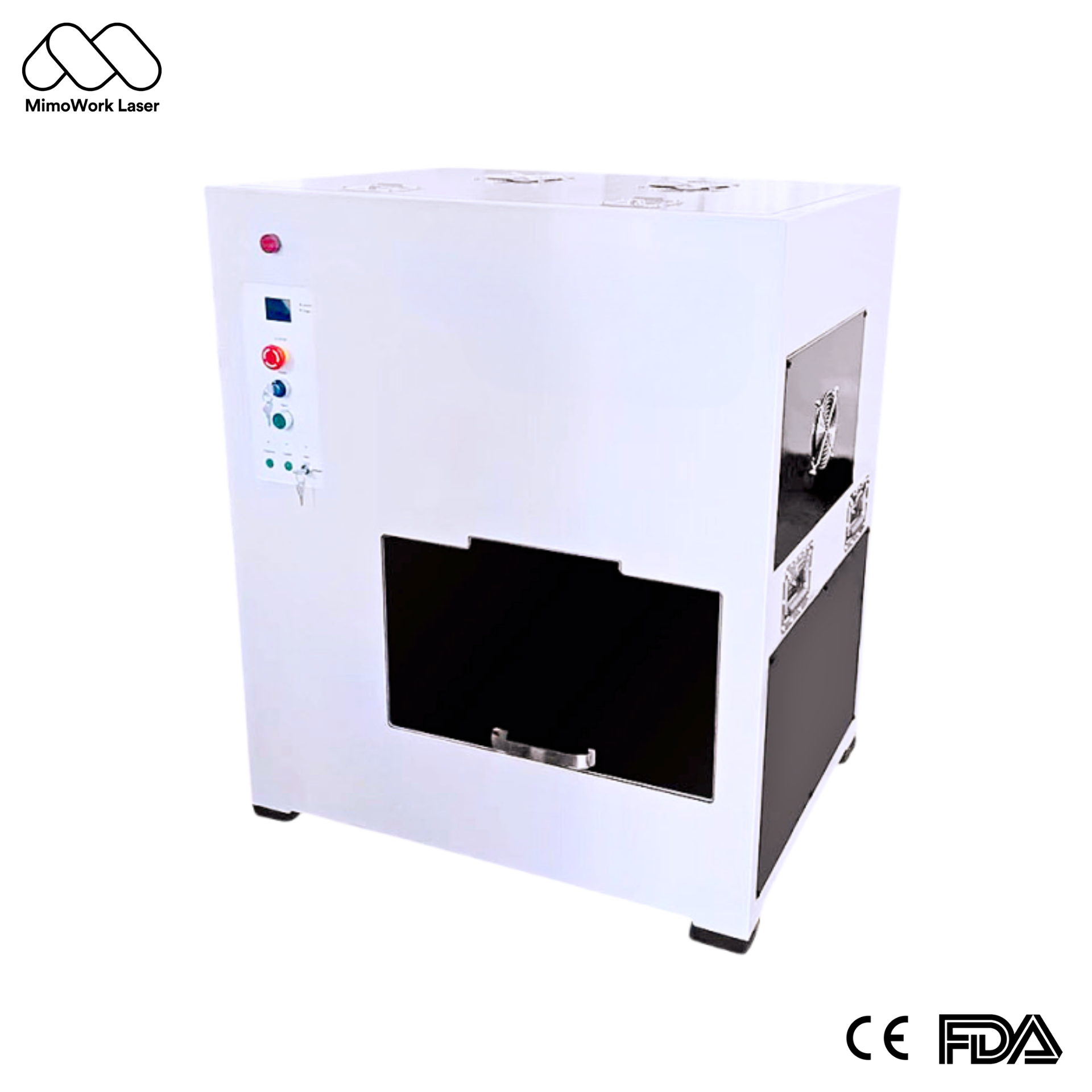
MimoWork offers a Green Laser Engraving Machine designed for precision marking applications involving materials such as glass and other transparent or sensitive materials.
The MimoWork Green Laser system is available with 5W, 10W, 15W, and 20W power options, with a working area of 400 × 600 × 120 mm and a marking speed of up to 3,500 points/s.
These configurations provide flexibility for manufacturers handling different glass engraving requirements, from customized products and decorative designs to industrial identification applications.
For companies considering a green laser engraving machine for glass, MimoWork’s Green Laser solution can be evaluated based on the specific material, marking area, required detail, and production volume.
Related Guide:How to Color Engrave Stainless Steel with a MOPA Fiber Laser (Step-by-Step)
Yes. Green laser systems can be used for certain glass and crystal engraving applications. The final result depends on the composition and characteristics of the material, so sample testing is recommended before production.
Fiber lasers are primarily designed for metal marking and generally have limited direct interaction with transparent glass. A green laser uses a shorter wavelength that can be more suitable for certain transparent-material applications.
Yes. Green lasers can be used for certain crystal engraving applications, including customized designs, text, and decorative markings. The exact result depends on the crystal material and engraving method.
The required power depends on the glass material, engraving depth or effect, marking speed, and design requirements. Higher power is not automatically better, so manufacturers should select power based on the actual application.
Laser engraving can create permanent markings on suitable glass and crystal products. The appearance and durability depend on the processing method and the characteristics of the material.
A green laser engraving machine for glass provides manufacturers with a specialized option for precision marking on glass, crystal, and other materials that can be challenging for conventional laser wavelengths.
With non-contact processing, digital design flexibility, and a wavelength suited to certain transparent materials, green laser technology can be used for decorative products, personalized glassware, crystal awards, and industrial identification.
For manufacturers choosing a green laser engraver, the most important considerations are the actual material, marking area, required detail, production volume, and desired marking effect. Testing representative samples before purchasing the machine is the most reliable way to determine whether a particular green laser configuration meets the production requirement.
News | Sep-14-2026
News | Sep-4-2026