Blog
In a field that evolves daily, staying ahead means staying informed.
Explore in-depth articles designed to help you solve complex challenges,
maximize your machine’s ROI.
Stay ahead in a competitive market.


In a field that evolves daily, staying ahead means staying informed.
Explore in-depth articles designed to help you solve complex challenges,
maximize your machine’s ROI.
Stay ahead in a competitive market.
News | Nov-21-2026 | Mimowork
Laser marking carbon fiber is possible, but achieving a clean, permanent mark without weakening the composite requires careful control of laser energy and processing conditions.
UV lasers are worth evaluating for fine markings and applications where limiting thermal effects is important.
Fiber lasers can be considered for surface ablation and industrial marking, but their heat input must be carefully controlled.
The best machine should be selected according to the resin system, carbon fiber structure, required marking depth, and acceptable surface damage—not laser power alone.
Carbon fiber reinforced polymer (CFRP) behaves differently from ordinary plastics because it contains two materials with different physical properties: carbon fibers and a polymer matrix, commonly epoxy resin.
This creates a particular challenge during laser processing. The laser may remove or decompose the resin while exposing the underlying fibers. Excessive energy can also cause fiber degradation, surface cratering, delamination, or discoloration.
Unlike conventional metal marking, where the objective is often to create a consistent contrast or engraved depth, carbon fiber processing must also preserve the composite’s structural integrity.
Three factors determine whether the result is acceptable:
This is particularly important for automotive, aerospace, and sporting equipment components, where surface appearance cannot come at the expense of mechanical performance.
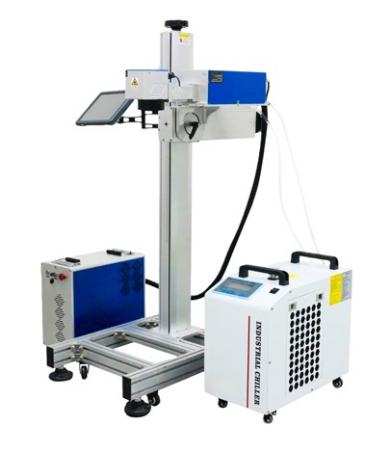
UV and fiber lasers are two technologies worth evaluating for CFRP marking, but neither is universally suitable. Their performance depends on the desired marking effect and the composite’s material composition.
A UV laser is a strong candidate when the application requires small text, fine graphics, or controlled surface modification.
Its shorter wavelength allows different material interactions compared with conventional infrared fiber lasers. UV processing can be useful when minimizing excessive thermal effects is a priority.
However, UV does not automatically mean damage-free processing. Research on UV laser treatment of CFRP has identified potential resin residue, surface defects, and subsurface damage under certain conditions.
Small identification codes or detailed logos are required.
The component has a sensitive resin surface.
Surface appearance and dimensional accuracy are important.
The application requires controlled, shallow material removal.
MimoWork offers a UV Laser Marking Machine for applications involving sensitive materials. Its suitability for a particular carbon fiber composite should be confirmed through sample testing.
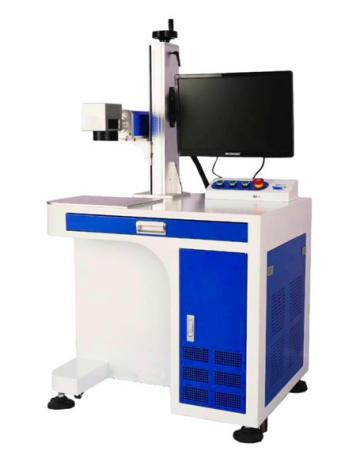
Fiber lasers use an infrared wavelength, commonly around 1064 nm, and are widely used for industrial marking and material ablation.
For carbon fiber composites, they can be evaluated for permanent identification, surface structuring, and selective resin removal.
However, the high energy concentration can cause thermal degradation when the processing parameters are unsuitable. The result may include excessive resin removal, exposed fibers, or localized surface damage.
Production requires repeatable industrial identification.
The composite has demonstrated acceptable results in preliminary testing.
Higher throughput is important.
The required marking effect involves controlled surface ablation.
MimoWork’s Fiber Laser Marking Machine is primarily positioned for industrial metal marking. For CFRP applications, the actual material response should be validated before selecting this configuration.
| Selection factor | UV Laser | Fiber Laser |
| Wavelength | Typically 355 nm | Typically 1064 nm |
| Main advantage | Fine, controlled processing | Industrial marking and ablation capability |
| Thermal considerations | Often preferred for heat-sensitive applications | Requires careful heat-input management |
| Fine graphics | Worth evaluating | Depends on spot size and parameters |
| Resin removal | Application-dependent | Application-dependent |
| Main concern | Residue and subsurface damage | Thermal degradation and fiber damage |
| Best starting point | Fine, sensitive-surface applications | Validated industrial marking applications |
Neither technology should be selected based on wavelength alone. A sample test using the actual composite is more valuable than a general material compatibility claim.
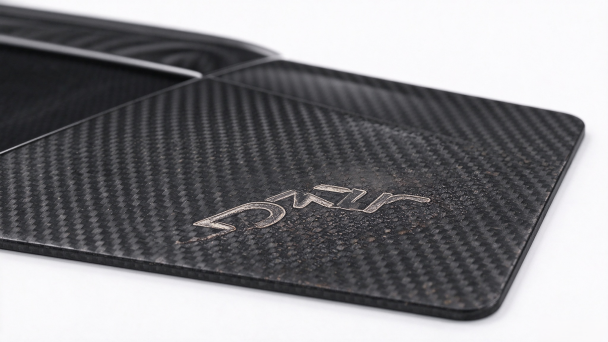
Laser marking is particularly useful when carbon fiber components need permanent identification without adding labels or mechanical contact.
Several industries have practical reasons to mark CFRP components.
| Industry | Typical marking requirements | Key consideration |
| Automotive | Part numbers, logos, traceability codes | Preserve surface quality |
| Aerospace | Component identification and tracking | Avoid structural damage |
| Sporting goods | Branding and product identification | Maintain appearance |
| Industrial equipment | Serial numbers and specifications | Repeatability |
| Electronics | Small identification graphics | Fine marking accuracy |
One additional application is laser surface treatment before adhesive bonding.
In this process, the laser selectively removes or modifies the resin-rich surface to create a suitable bonding texture. This is different from conventional logo marking: the objective is to improve surface preparation rather than produce a visually attractive mark.
The required process parameters and acceptance criteria are therefore different.
The most important step is to control the energy delivered to the composite rather than simply reducing or increasing laser power.
A practical testing process should include the following considerations.
Start by confirming whether the material uses epoxy, thermoplastic resin, or another matrix.
Also check whether the surface contains a protective coating, clear resin layer, or additional finishing treatment. These layers can significantly change laser absorption and marking behavior.
Laser power and scanning speed determine how much energy is delivered to a given area.
Higher power combined with slower scanning can increase material removal and heat accumulation. Faster scanning may reduce exposure, but could also produce weak or inconsistent marks.
Test several combinations rather than adjusting only one parameter.
For pulsed lasers, pulse duration, frequency, and pulse overlap influence how energy accumulates on the surface.
Excessive overlap can increase local heating and resin degradation. Insufficient overlap may produce discontinuous markings.
These parameters should be optimized together with scanning speed and focal position.
A visually clean marking does not necessarily mean the composite remains undamaged.
Resin discoloration and surface residue.
Exposed, fractured, or degraded fibers.
Surface pits and cracks.
Heat-affected zones.
Delamination or subsurface defects where structural integrity is important.
For load-bearing components, additional microscopic inspection or non-destructive testing may be necessary.
Buyers should prioritize verified processing results, parameter flexibility, and application support rather than choosing the highest-power machine available.
A machine that performs well on stainless steel or ordinary plastic is not automatically suitable for CFRP.
| Buying factor | What to verify | Why it matters |
| Laser source | UV or fiber compatibility with the actual composite | Determines material interaction |
| Pulse control | Available frequency and pulse-width adjustments | Helps control heat input |
| Galvo system | Scanning accuracy and working field | Affects marking consistency |
| Extraction system | Suitable filtration for composite processing emissions | Protects the working environment |
| Sample testing | Actual marking samples and inspection results | Reduces purchasing risk |
MimoWork provides several laser marking configurations, including fiber, UV, CO₂, green, and MOPA systems. However, carbon fiber should be treated as a specific application requiring validation rather than assumed to be compatible with every laser source.
Before purchasing, request sample processing using your own CFRP material. A useful evaluation should include the marking image, processing parameters, surface inspection, and repeatability across multiple samples.
For production involving structural components, also establish acceptable damage limits with your engineering or quality-control team.
Related guide: How Much Does a Laser Wire Marking Machine Cost in 2026?
Yes. Laser engraving and surface ablation are possible on carbon fiber composites. However, excessive material removal can damage the resin matrix and reinforcing fibers. Shallow, controlled processing is generally a better starting point.
It can. Excessive heat or unsuitable laser parameters may cause resin degradation, fiber damage, surface cracking, and delamination. The risk depends on the composite structure and processing conditions.
UV lasers are worth testing for fine, sensitive-surface applications, while fiber lasers may be suitable for industrial surface marking and ablation. Neither is universally superior. Actual composite testing should determine the choice.
Yes. Laser-induced surface modification can create permanent logos and identification marks. The achievable contrast depends on the resin, surface finish, and processing parameters.
Not reliably. Different resin systems, fiber orientations, surface coatings, and laminate structures can produce different results. Each material specification should be tested before mass production.
Carbon fiber laser marking offers a practical way to create permanent identification, branding, and surface modifications without mechanical contact. However, its biggest challenge is balancing marking quality with material integrity.
UV and fiber lasers are both worth considering, but the final decision should come from testing the actual composite, evaluating the surface condition, and confirming that the process meets the component’s performance requirements.
Planning to mark carbon fiber components? Contact MimoWork with your CFRP material specifications, desired marking effect, and production requirements. Our team can help evaluate suitable laser configurations and arrange application testing before you commit to a machine.
Schanz et al. (2022) – Laser Surface Treatment of Carbon Fiber Reinforced Polymer Using Near-Infrared Laser Wavelength
On the Ablation Behavior of Carbon Fiber-Reinforced Plastics during Laser Surface Treatment Using Pulsed Lasers
News | Nov-14-2026
News | Sep-11-2026