Blog
In a field that evolves daily, staying ahead means staying informed.
Explore in-depth articles designed to help you solve complex challenges,
maximize your machine’s ROI.
Stay ahead in a competitive market.


In a field that evolves daily, staying ahead means staying informed.
Explore in-depth articles designed to help you solve complex challenges,
maximize your machine’s ROI.
Stay ahead in a competitive market.
News | Jun-22-2026
If you’ve looked into color marking on stainless steel, you’ve probably run into the term MOPA pretty quickly — and maybe gotten a bit lost in the acronym soup. MOPA stands for Master Oscillator Power Amplifier, but what actually matters isn’t the name. It’s what this type of laser source lets you do that a standard fiber laser can’t.
This guide breaks down what MOPA actually changes at a technical level, where it makes a real difference in production, and what to think about when evaluating a MOPA system for your application.
A standard Q-switched fiber laser has a fixed pulse structure — the pulse width is locked in by the design of the laser itself, and you’re working within that constraint no matter what material you’re processing. A MOPA fiber laser, by contrast, separates the pulse generation from the amplification stage. That separation allows pulse width and frequency to be adjusted independently, rather than being tied together.
It sounds like a small architectural difference, but it changes what’s actually possible on the same machine. Instead of one laser tuned for one type of result, you get a laser that can be tuned differently for each job.
Adjustable pulse width. This is the headline feature, and it’s what everything else builds on. Being able to widen or narrow the pulse changes how energy is delivered to the material — short pulses for gentle, surface-level interaction; longer pulses for stronger thermal effects.
High peak power. Even with narrow pulse widths, MOPA sources maintain high peak power. This combination — short pulses with high energy density — is part of what makes fine detail work and delicate material processing possible without excessive heat spreading into the surrounding material.
Wide frequency range. Pulse frequency can be tuned independently from pulse width, giving you a much broader operating window than a fixed-pulse laser. In practice, this means the same machine can run a fast, light marking job and then switch to a slow, deep-engraving job without swapping the laser source.
Here’s the part that connects the technology to the result people actually care about. Color marking on metal isn’t done with ink or pigment — it works by precisely controlling how much heat goes into the metal’s surface oxide layer. Too little heat, and you get nothing. Too much, and you blow past the color range into burning or ablation. The color appears in a fairly narrow thermal window, and hitting that window consistently requires exactly the kind of pulse control that MOPA provides.
A fixed-pulse laser can’t hit that window reliably across different metals and surface conditions. A MOPA laser can — and that’s the entire reason color marking became commercially viable on a wide scale.
By tuning pulse parameters precisely, a MOPA laser can produce permanent colors — black, red, gold, blue, and others — directly on metal surfaces like stainless steel and anodized aluminum, without any pigments or dyes involved. The mechanism is the oxide layer: different combinations of pulse width, frequency, and power produce different oxide layer thicknesses, and different thicknesses refract light differently, which is what produces the visible color.
The result is a smooth finish with no texture change — the surface feels the same as before, it just looks different. That makes it a strong fit for product branding, decorative work, and anywhere the aesthetic matters as much as the identification function.
The other major use case is the opposite of subtle — deep, dense black marks with maximum contrast against the base material. This is achieved through a different pulse configuration than color marking, but it’s the same underlying flexibility that makes both possible on one machine. High-contrast black marking is widely used for barcodes, data matrix codes, and any application where scan reliability depends on the mark standing out clearly against the background.
Gold, silver, copper, and aluminum are all more reflective than steel at the laser’s wavelength, which makes them harder to process consistently with a fixed-pulse source — too much of the energy bounces away rather than being absorbed. MOPA’s pulse control gives more room to find settings that work reliably on these materials, which is part of why MOPA systems show up frequently in jewelry and decorative metalwork applications.
Tuning the laser to interact with a coating layer without significantly affecting the base metal underneath — for example, removing a gold-plated layer to reveal the copper substrate beneath — is a precision application that depends on exactly the kind of fine energy control MOPA provides. Getting this right means the laser has to “know when to stop,” in effect, and that’s a pulse-tuning problem.
At the narrow end of the pulse width range, MOPA systems can perform fine cutting and micro-drilling on thin metal sheets — small holes, fine slots, and detail work where a broader pulse would cause excessive heat spread and ruin the precision. This isn’t the primary use case for most MOPA systems, but it’s a capability that exists within the same hardware.
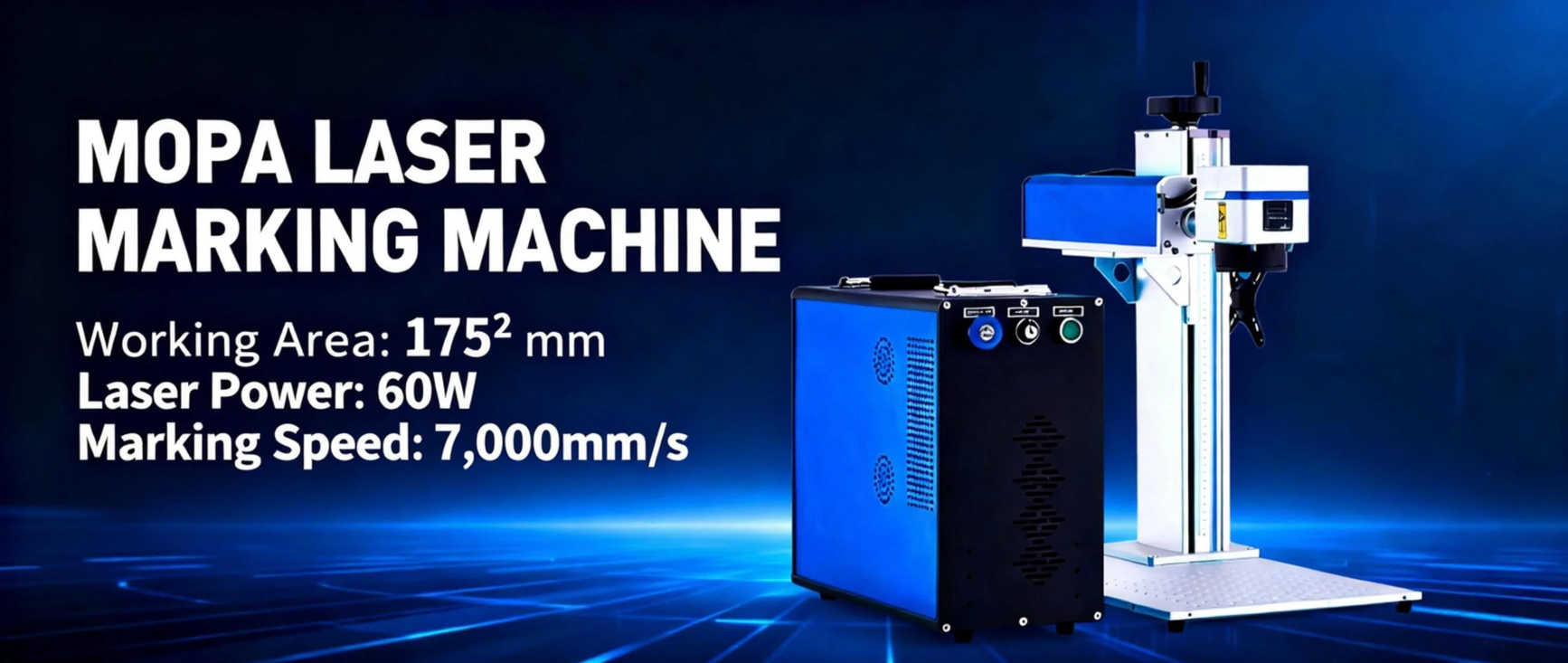
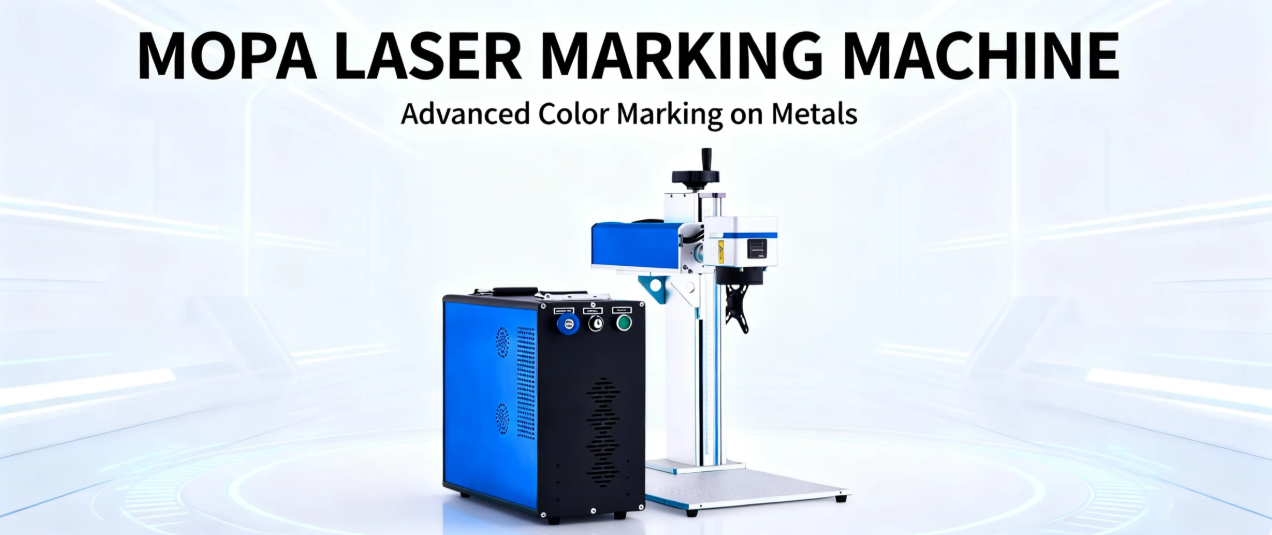
Mimowork’s MOPA laser marking machines are built around a MOPA fiber laser source. A representative configuration runs at 60W, with a marking speed of up to 7,000mm/s and a working area of 175mm × 175mm — directed through a 3D galvanometer beam delivery system that handles both the high-speed and the slower, precision-focused work within the same setup.
Supporting components matter as much as the laser source itself. An ultra-high-speed galvo scanner is what actually delivers on the laser’s range — capable of both very fast marking and slower, more controlled passes. A high-resolution F-theta lens maintains spot size and detail consistency across the full marking field, which matters for color work, especially where uniformity across a larger surface is part of the quality bar.
One practical note: modern MOPA sources are efficient enough that most standard-power configurations use integrated air cooling rather than an external water chiller. That simplifies installation and ongoing maintenance compared to water-cooled systems.
While metal color marking gets most of the attention, MOPA’s tunability extends to a wider materials range than people often expect — including various plastics such as ABS, PC, and acrylic, and anodized aluminum, coated metals, and some ceramics. The same adjustable pulse parameters that enable color on stainless steel also enable gentler processing on materials that would be damaged by a fixed, higher-energy pulse.
One important caveat: processing PVC or PTFE generates hazardous fumes. If your material range includes either of these, appropriate PPE and a high-efficiency fume extraction system are mandatory — not optional. A compact extractor with HEPA filtration positioned at the source protects both the operator and the machine’s optics, which also helps keep mark quality consistent over time.
A MOPA marking machine doesn’t have to be a standalone purchase. For shops already running other laser processes — CO₂ cutting, fiber cutting, laser cleaning — a MOPA marking station integrates as the identification and decorative-finishing step in a broader workflow. Parts get cut or cleaned on one system and marked, colored, or coded on the MOPA system before moving to the next stage.
Stainless steel is the primary one, and it’s where MOPA color marking is most established and most reliable. Anodized aluminum is the other major surface — though the mechanism there is more about producing deep black contrast than a full color range. Titanium can also take color marking under the right parameters, though it’s less commonly the focus compared to stainless steel. If color marking on a specific alloy or surface treatment is the goal, testing on the actual material is the only way to confirm the result before committing to a production run — surface condition and alloy composition both affect how the color develops.
No — and this is one of the most important things to understand about how MOPA color marking actually works. The color isn’t a coating sitting on top of the metal; it’s produced by altering the oxide layer of the metal itself through controlled heating. Because the color is part of the material’s surface structure rather than something applied to it, it doesn’t peel, fade under normal use, or wear away the way a printed or painted mark would. It holds up to the kind of handling and environmental exposure the base metal itself would experience.
Fiber laser sources in general — and MOPA sources are no exception — are built for long operational life with minimal day-to-day maintenance. There’s no laser tube to replace the way there is with CO₂ systems, and no consumable optics in the direct beam path under normal operation. The air-cooling used in most standard configurations also means there’s no water-cooling system to maintain. Day-to-day upkeep is mostly about keeping the lens and optical path clean — the kind of routine care any laser marking system needs, regardless of source type.
Yes, with the right setup. The galvanometer system handles the beam positioning across a flat field, but for cylindrical parts — rings, pens, tubes, and similar — a rotary axis attachment rotates the workpiece in sync with the marking pattern, effectively “unwrapping” a curved surface into something the galvo can mark accurately. This is a common configuration addition rather than a separate machine, and it’s worth specifying up front whether cylindrical parts are part of your production mix, since the marking parameters for color work may need adjustment to account for the curvature.
MOPA isn’t a different category of laser so much as a more flexible version of the fiber laser you already know — the pulse control is what unlocks color marking, high-contrast black marks, and better results on tricky materials, all from one machine. If color marking on stainless steel or anodized aluminum is on your roadmap, a MOPA configuration is generally the right starting point rather than something to add later.
If you want to see how this performs on your actual parts and materials, Mimowork can walk through configuration options and arrange sample testing before you commit.
News | Jun-15-2026
News | Jun-5-2026
News | May-14-2026