Blog
In a field that evolves daily, staying ahead means staying informed.
Explore in-depth articles designed to help you solve complex challenges,
maximize your machine’s ROI.
Stay ahead in a competitive market.


In a field that evolves daily, staying ahead means staying informed.
Explore in-depth articles designed to help you solve complex challenges,
maximize your machine’s ROI.
Stay ahead in a competitive market.
News | Oct-7-2026
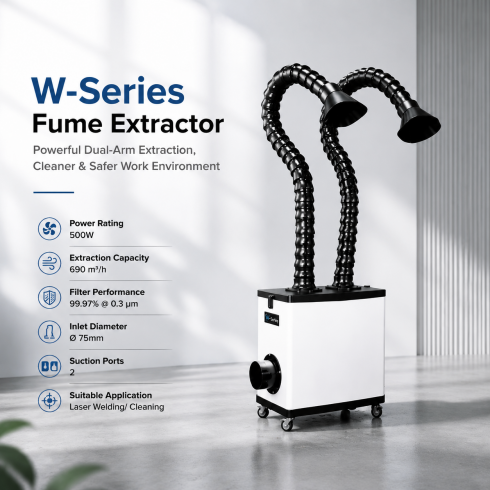
A fume extractor is used to capture fumes and fine particles generated during laser welding before they spread through the workspace. For laser welding applications, a welding exhaust fume extractor should be selected based on the welding material, extraction position, airflow, filtration, and filter loading rather than simply the highest airflow rating.
Because laser welding creates a concentrated heat source, source capture is especially important. OSHA recommends positioning local exhaust ventilation as close to the work as practical to control welding fumes at the source.
Laser welding heats a small area of metal rapidly. Depending on the base metal, filler material, surface coating, and welding conditions, the process can generate fine metal particles and gases.
A properly selected laser welding fume extractor captures these emissions near the weld instead of allowing them to spread around the workshop.
Fume composition varies with the material being welded.
Stainless steel, galvanized metal, aluminum, coated materials, and other alloys can produce different types and amounts of airborne contaminants. Paint, oil, plating, and other surface treatments can also affect the extraction requirements.
For this reason, the material and coating should be considered before selecting the filter configuration.
General ventilation moves air around the room, but it may not capture the fume where it is generated.
Local exhaust ventilation takes a different approach. A hood, flexible arm, or other capture device is positioned near the welding area to remove contaminants before they spread into the surrounding workspace.
For a fixed welding station, this type of source capture is usually more practical than relying on room ventilation alone.
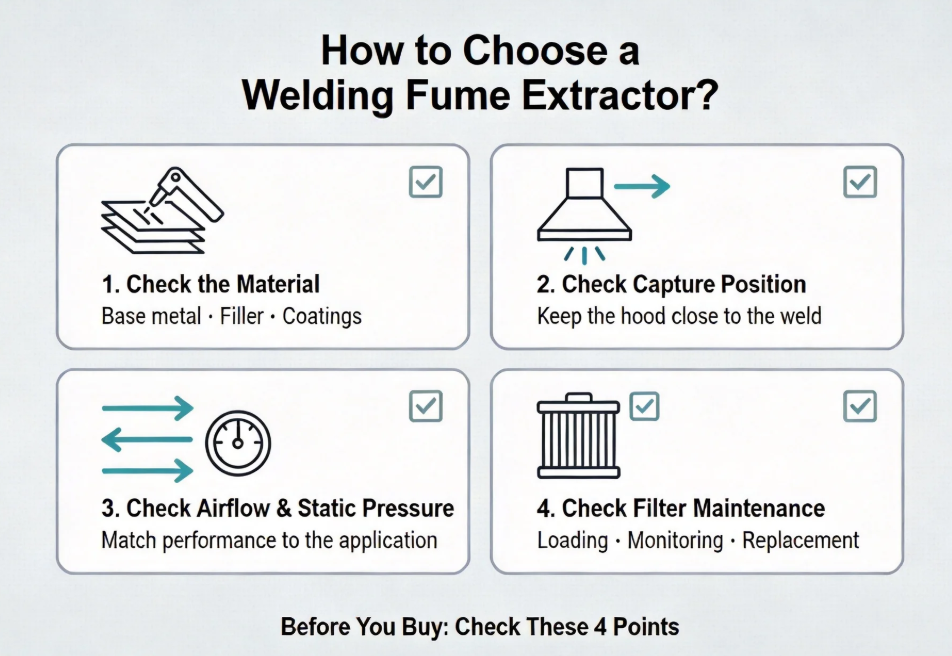
When considering how to choose a welding fume extractor, start with the actual welding process rather than the extractor’s maximum airflow.
Identify the base metal, filler material, coatings, and welding conditions. This information helps determine the type of filtration and extraction capacity required.
A laser welding fume extractor works best when the capture point is close to the emission source.
The extraction arm or hood should be positioned as close to the weld as practical without interfering with the operator, shielding gas, laser head, or workpiece.
Higher airflow does not automatically mean better fume capture.
The system must maintain sufficient airflow under actual operating conditions, including resistance from the hood, arm, ducting, and filters. For this reason, compare both airflow and static pressure when evaluating an industrial welding fume extractor.
Filters collect particles over time, so their resistance can increase during continuous production.
For regular welding operations, check how the system monitors filter loading and how easily filters can be serviced or replaced. A pressure indicator or filter monitoring system can make maintenance more predictable.
So, how close should a welding fume extractor be to the weld?
There is no universal distance for every setup. The general rule is to keep the capture point as close to the emission source as practical without disrupting the welding process.
For a flexible extraction arm, the operator can reposition the hood as the workpiece changes. In repetitive production, a fixed or purpose-designed capture point may provide more consistent extraction.
Simply increasing extractor power cannot fully compensate for poor capture positioning.
| Setup | Typical Use | Main Consideration |
| Flexible extraction arm | Single welding station | Easy positioning |
| Fixed extraction point | Repetitive welding | Consistent capture |
| Multiple extraction points | Several workstations | Total airflow capacity |
| Centralized extraction | Larger production areas | Duct design and airflow balancing |
For one operator working at a defined station, a flexible source-capture system can be straightforward to configure. For several stations, the duct layout, pressure loss, and total airflow become more important.
Welding fumes can contain very fine particles, so filtration should be selected according to the contaminants produced by the specific application.
A pre-filter can capture larger particles before they reach finer filtration stages. This can help reduce the particle load on the main filter.
For production welding, monitor filter condition rather than waiting until airflow noticeably drops.
Not every welding application produces the same gaseous contaminants.
If the materials or coatings generate gases or strong odors, additional gas-phase filtration may need to be considered. Particle filtration alone should not automatically be assumed to address every contaminant.
MimoWork’s W-Series is designed for applications such as laser welding and laser cleaning, where process fumes and fine particles need to be captured close to the source.
The system uses multiple filtration stages to handle different particle sizes and contamination loads. The configuration should still be matched to the material and application rather than selected from airflow specifications alone.
For laser welding, extractor placement is just as important as extractor capacity. The setup should account for the welding position, operator movement, workpiece size, and available space around the extraction arm.
So, do laser welders need fume extraction? Laser welding can produce airborne fumes and fine particles, so extraction requirements should be assessed according to the material, process, workplace conditions, and applicable regulations. Local exhaust is commonly used to capture welding emissions at the source.
Keep the capture point as close to the welding area as practical without interfering with the welding process, shielding gas, operator, or workpiece.
It may be possible, but the contaminants generated by each process should be evaluated first. Welding fumes, coating residues, and cleaning particles may require different filtration considerations.
There is no fixed replacement schedule for every application. Filter life depends on operating hours, material, particle loading, airflow, and working conditions. Monitoring filter loading or following the manufacturer’s service recommendations is more reliable than replacing filters on an arbitrary schedule.
Choosing a welding exhaust fume extractor for laser welding is about more than maximum airflow. The key factors are capture position, airflow, static pressure, filtration, filter loading, and maintenance.
For a specific laser welding application, consider the material, workpiece size, welding process, operating hours, and proposed extraction position. These details provide a more practical basis for selecting a welding fume extractor than laser power alone.
Need help choosing a fume extraction system for your laser welding application? Contact MimoWork to discuss your material, workspace, and extraction requirements, or request a material test to find a suitable fume extraction solution.
Related Guide: https://www.mimowork-laser.com/blog/the-essential-role-of-a-laser-marking-fume-extractor-in-modern-manufacturing-2
News | Sep-30-2026
News | Aug-14-2026
