Blog
In a field that evolves daily, staying ahead means staying informed.
Explore in-depth articles designed to help you solve complex challenges,
maximize your machine’s ROI.
Stay ahead in a competitive market.


In a field that evolves daily, staying ahead means staying informed.
Explore in-depth articles designed to help you solve complex challenges,
maximize your machine’s ROI.
Stay ahead in a competitive market.
News | Sep-1-2026
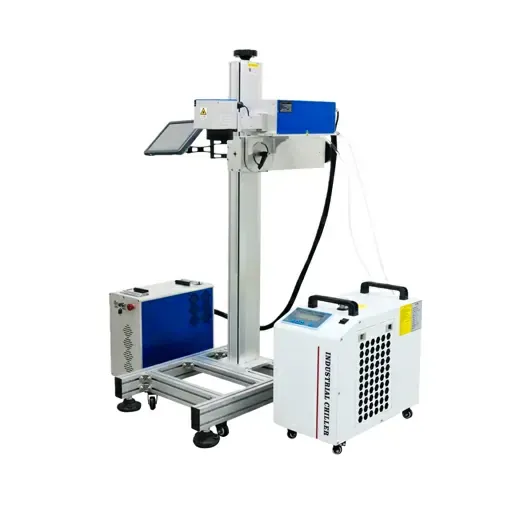
Have you ever tried to mark a piece of clear glass or white plastic, only to watch the laser beam slide right off—or worse, leave behind a blurry, burnt, or cracked surface?
That’s the problem infrared lasers (like CO₂ and fiber) often run into. They generate heat. A lot of it. And heat is the enemy of delicate materials.
Enter the UV laser marking machine.
Instead of burning the surface, a UV laser uses a cold beam of light—at a wavelength of just 355nm—to break molecular bonds directly. No melting. No scorching. Just crisp, permanent marks on materials that used to be impossible to mark cleanly.
And among the UV laser lineup, the 5W UV laser marking machine sits right in the sweet spot. It’s powerful enough for industrial production, yet precise enough for micro-marking on medical devices, PCBs, and luxury packaging.
In this guide, you’ll learn:
Why 5W is the most popular UV laser power
How it compares to fiber and CO₂ lasers—so you can pick the right one
Let’s start with the most important question first: how does a UV laser actually work?
A UV laser marking machine works by directing a focused ultraviolet laser beam onto the material surface. The high-energy UV photons interact with the surface layer and create a visible mark through controlled material modification.
Unlike traditional engraving methods that physically remove material through mechanical force, UV laser marking is a non-contact process.
The main advantages include:
The short 355nm wavelength allows the laser beam to achieve a smaller marking spot, making it suitable for:
UV laser marking generates less heat compared with many thermal marking methods, helping reduce:
The laser mark becomes part of the material surface, providing long-lasting identification without the need for ink or consumables.
UV laser marking machines are available in different power configurations, including 3W, 5W, and 10W models.
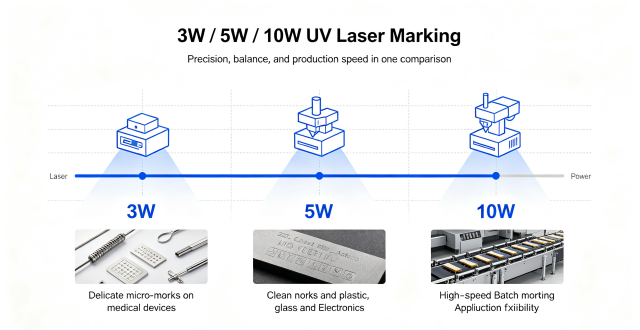
Among these options, a 5W UV laser marking machine is a popular choice for many precision marking applications.
| UV Laser Power | Suitable Applications |
| 3W UV Laser | Fine marking on sensitive materials with lower processing requirements |
| 5W UV Laser | General industrial precision marking, including plastics, glass, and electronic components |
| 10W UV Laser | Higher-speed production and applications requiring increased marking efficiency |
A 5W UV laser provides a good balance between:
It produces fine and clear marks while maintaining excellent detail resolution.
Compared with lower-power UV lasers, a 5W system provides higher processing efficiency for daily production tasks.
It can handle a wide range of materials without requiring excessive laser power.
Different laser marking technologies are designed for different materials and applications.
| Feature | UV Laser (355nm) | Fiber Laser (1064nm) | CO2 Laser (10.6μm) |
| Main Application | Precision marking | Metal marking and engraving | Non-metal processing |
| Best Materials | Plastics, glass, electronics, sensitive materials | Stainless steel, aluminum, metals | Wood, acrylic, leather, fabric |
| Heat Effect | Low | Higher | Higher |
| Marking Detail | Very fine | Fine | Medium |
| Main Advantage | High precision with reduced thermal impact | Fast metal marking | Strong absorption on organic materials |
A simple selection guide:
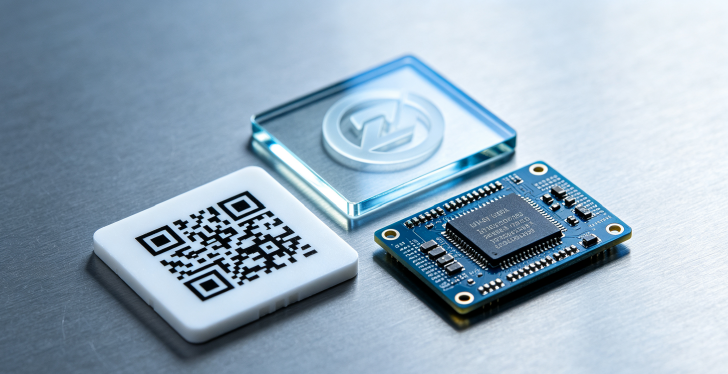
A 5W UV laser marking machine is suitable for many materials that are difficult to process with traditional thermal methods.
UV lasers are commonly used for marking:
Typical applications include:
The low heat impact helps maintain the original appearance and structure of plastic surfaces.
Glass can be challenging for traditional marking methods because excessive heat may cause cracks or surface damage.
UV laser marking can create:
Applications include:
Electronic products require high-resolution marking in limited spaces.
A 5W UV laser can mark:
Its fine marking capability helps manufacturers add traceability information without affecting sensitive components.
Medical devices and pharmaceutical packaging often require permanent and reliable identification.
UV laser marking is used for:
The non-contact process helps avoid physical damage caused by traditional marking methods.
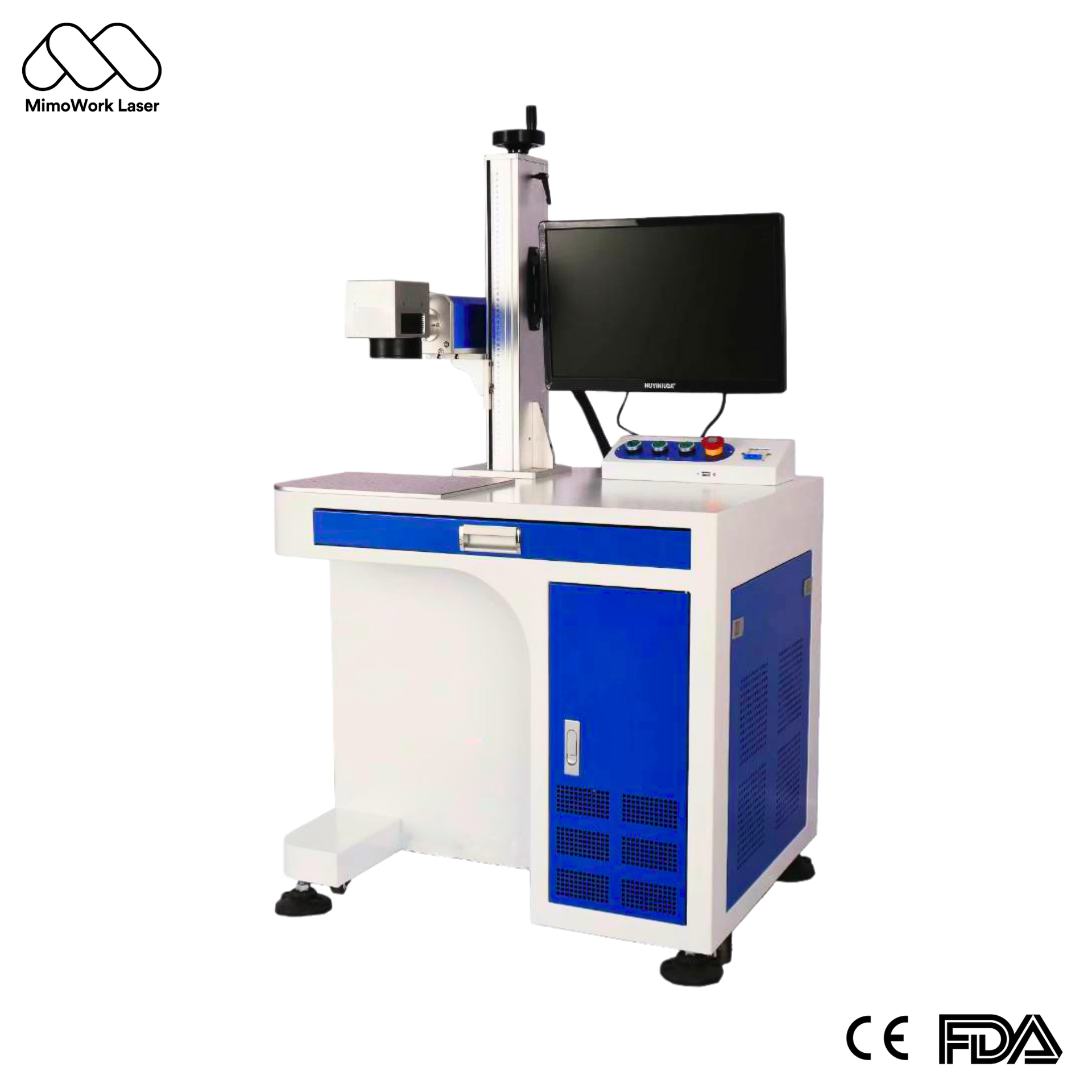
For manufacturers requiring high-precision marking, Mimowork provides UV laser marking solutions designed for applications involving delicate materials and detailed patterns.
Mimowork UV laser marking systems feature:
Whether used for product identification, fine engraving, or precision marking applications, UV laser technology provides manufacturers with a reliable solution for materials where traditional marking methods may create unwanted damage.
A UV laser marking machine is mainly used for high-precision marking on materials such as plastics, glass, electronics, and other heat-sensitive products. Common applications include QR codes, serial numbers, logos, and product identification.
A 5W UV laser marking machine provides a balance between marking speed, precision, and flexibility, making it suitable for many industrial marking applications.
Yes. UV lasers can create permanent marks on glass surfaces with reduced thermal impact compared with traditional high-heat marking methods.
UV lasers are mainly used for delicate materials requiring fine marking, while fiber lasers are commonly used for metal engraving and high-speed industrial marking.
A UV laser marking machine uses 355nm ultraviolet laser technology to create precise, permanent marks on materials that require careful processing.
Among different configurations, a 5W UV laser marking machine offers a practical combination of precision, flexibility, and processing efficiency for applications involving plastics, glass, electronics, and other sensitive materials.
By selecting the right laser technology for the material and application, manufacturers can achieve high-quality marking results while maintaining product integrity.
News | Jul-24-2026