Blog
In a field that evolves daily, staying ahead means staying informed.
Explore in-depth articles designed to help you solve complex challenges,
maximize your machine’s ROI.
Stay ahead in a competitive market.


In a field that evolves daily, staying ahead means staying informed.
Explore in-depth articles designed to help you solve complex challenges,
maximize your machine’s ROI.
Stay ahead in a competitive market.
News | Sep-18-2026
Laser welding is no longer limited to highly specialized manufacturing lines. From sheet metal fabrication and automotive repair to jewelry manufacturing and automated industrial production, a Laser Welding Machine can deliver highly concentrated heat exactly where a joint needs to be formed.
But buying a laser welder is not simply a matter of choosing the highest wattage available. A portable repair job, a jewelry workshop, a repetitive production line, and a large 3D assembly may all require completely different welding systems.
The real question is not “How powerful should the laser be?” but rather: What material are you welding, how thick is it, what does the joint look like, and how repetitive is the process?
A laser welding machine uses a focused laser beam to generate localized heat and melt the material at the joint. As the molten area cools, the two workpieces form a welded connection.
Unlike conventional arc welding, where heat is distributed over a comparatively larger area, laser welding concentrates energy into a small spot. This makes it possible to control heat input more precisely and reduce unnecessary thermal influence on the surrounding material.
In fiber laser welding, the laser source generates the beam and delivers it through an optical fiber to the welding head. The focusing optics then concentrate the beam onto the workpiece.
When the energy density is high enough, the material forms a molten weld pool. Under suitable conditions, deeper penetration can be achieved through keyhole welding, while lower-energy processes can be used for thinner or more delicate materials.
The result depends on much more than laser power. Material reflectivity, thickness, joint design, focal position, welding speed, shielding gas and beam movement all affect the final weld.
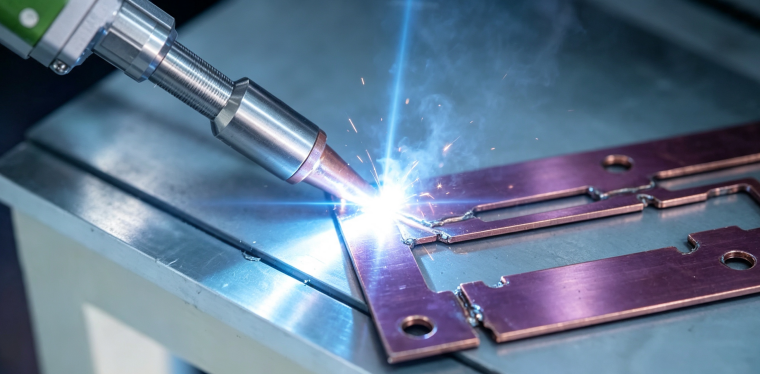
Although the process looks simple from the outside, several physical processes happen within a very small area.
First, the laser beam is focused onto the joint. The metal absorbs part of the laser energy and begins to heat rapidly.
As the temperature reaches the melting point, a small molten pool forms. With sufficient energy density, vaporization can create a narrow cavity known as a keyhole. The laser moves along the joint while molten metal flows around the keyhole and solidifies behind it.
This controlled heat input is one of the main reasons laser welding can produce narrow welds and relatively small heat-affected zones.
For thin materials, however, simply increasing power is not necessarily the solution. Excessive energy can cause burn-through, excessive penetration or an unstable weld pool. Good laser welding is therefore a balance between power, speed, focus and material response.
The appeal of laser welding comes from the way it changes the welding process rather than simply making an existing process faster.
A concentrated heat source can reduce unnecessary heating around the joint. This is particularly useful when the finished part needs to maintain dimensional accuracy or a clean appearance.
Laser welding can also reduce the amount of post-weld finishing required in suitable applications. A controlled weld with limited spatter can mean less grinding, polishing and rework after welding.
Another important advantage is process flexibility.
A handheld system allows an operator to move around large or awkward workpieces. A gantry system can repeat the same welding path automatically. A robotic manipulator can reach complex three-dimensional joints. A specialized jewelry welder can work on extremely small areas where conventional welding would introduce too much heat.
This is why “laser welding machine” should be treated as a category rather than one single type of machine.
MimoWork’s laser welding solutions are designed around different welding environments rather than forcing every application into the same machine configuration.
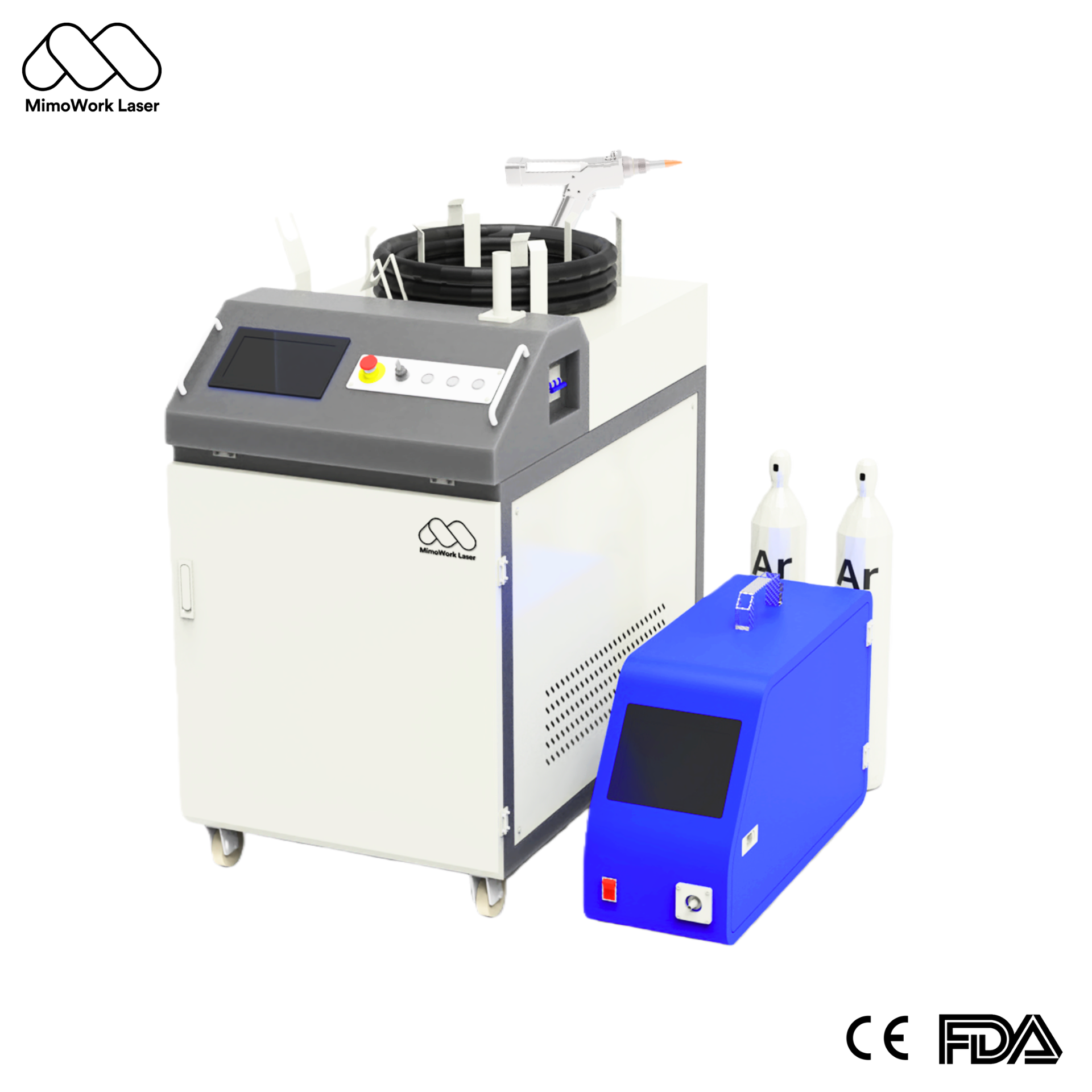
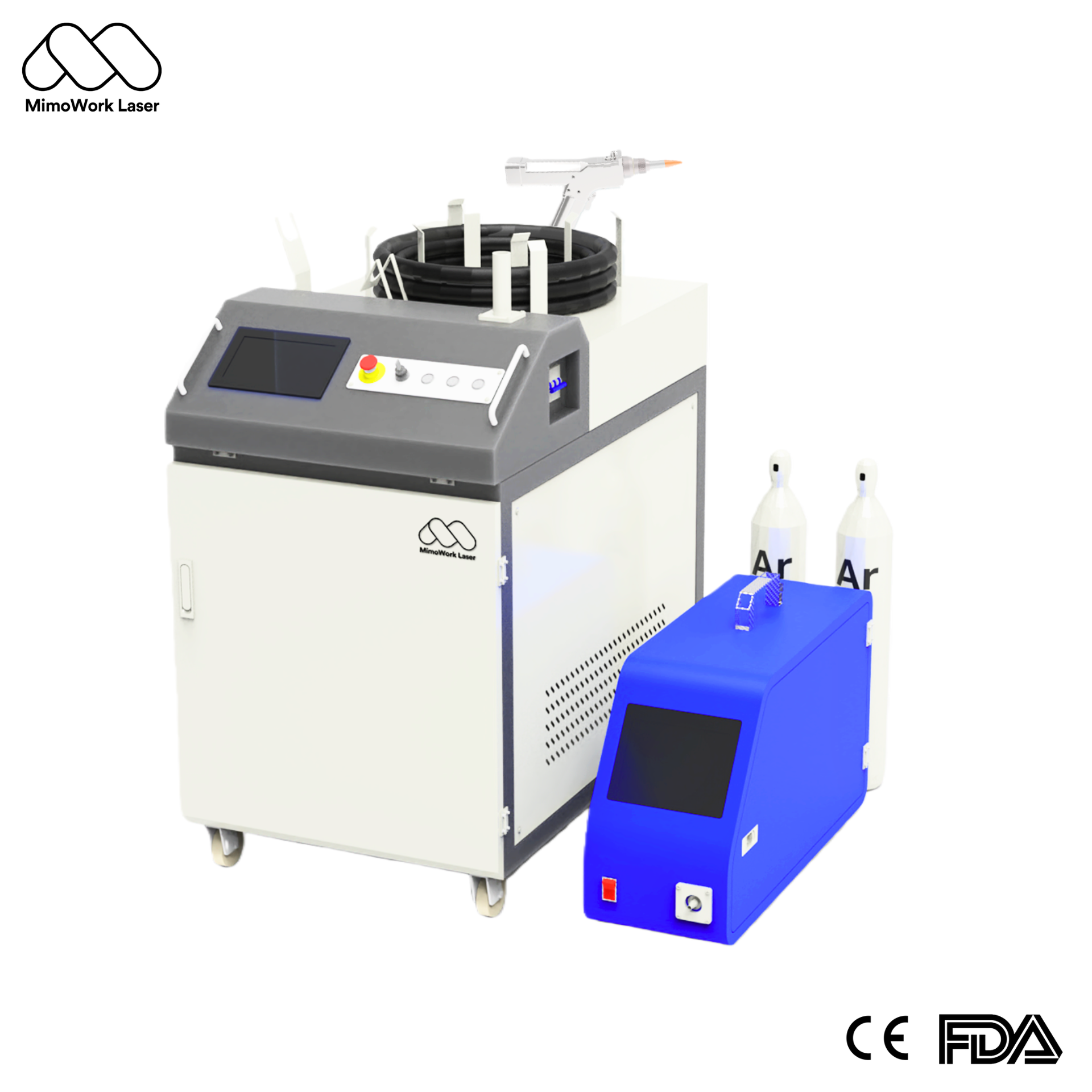
The Handheld Laser Welding Machine is designed for flexible fabrication, repair and applications where the operator needs to bring the welding head directly to the workpiece.
MimoWork’s current configuration uses a continuous/modulated fiber laser with 1000–1500W power and water cooling. The system can be used for materials such as steel, aluminum and copper alloys, while an integrated wire feeder can provide filler material when required.
The biggest advantage is mobility.
A large cabinet, vehicle component, structural part or machine assembly may be difficult to position under a fixed welding system. With a handheld laser welder, the welding head moves instead.
This makes the configuration particularly relevant to repair shops, fabricators and workshops handling varied jobs rather than thousands of identical parts.
Related Guide:How Does Laser Welding Work? The Ultimate Guide to Handheld Fiber Laser Technology
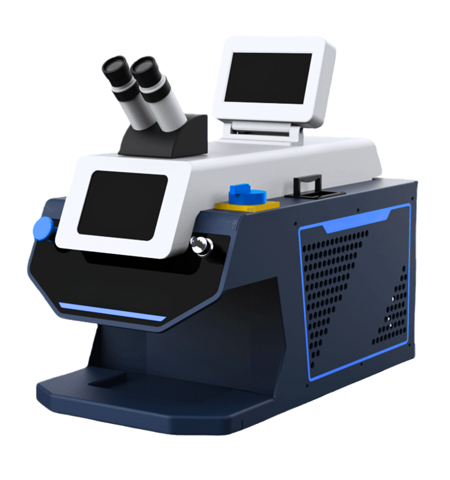
Jewelry requires a completely different approach.
A jewelry workshop may need to repair a prong next to a gemstone, reconnect a delicate chain, modify a ring or work on a small area of gold, silver or platinum. High heat spread can damage surrounding details that cannot simply be replaced.
MimoWork’s Jewelry Laser Welding Machine uses a pulsed fiber laser with a 60–200W power range. It incorporates microscope-based observation, fine focusing and argon gas protection for controlled work on precious metals.
The purpose here is not high production power. It is precision.
A small, controlled pulse allows the operator to place energy exactly where it is needed while limiting unnecessary thermal influence on nearby areas.
When welding becomes repetitive, manual flexibility starts to become less important than repeatability.
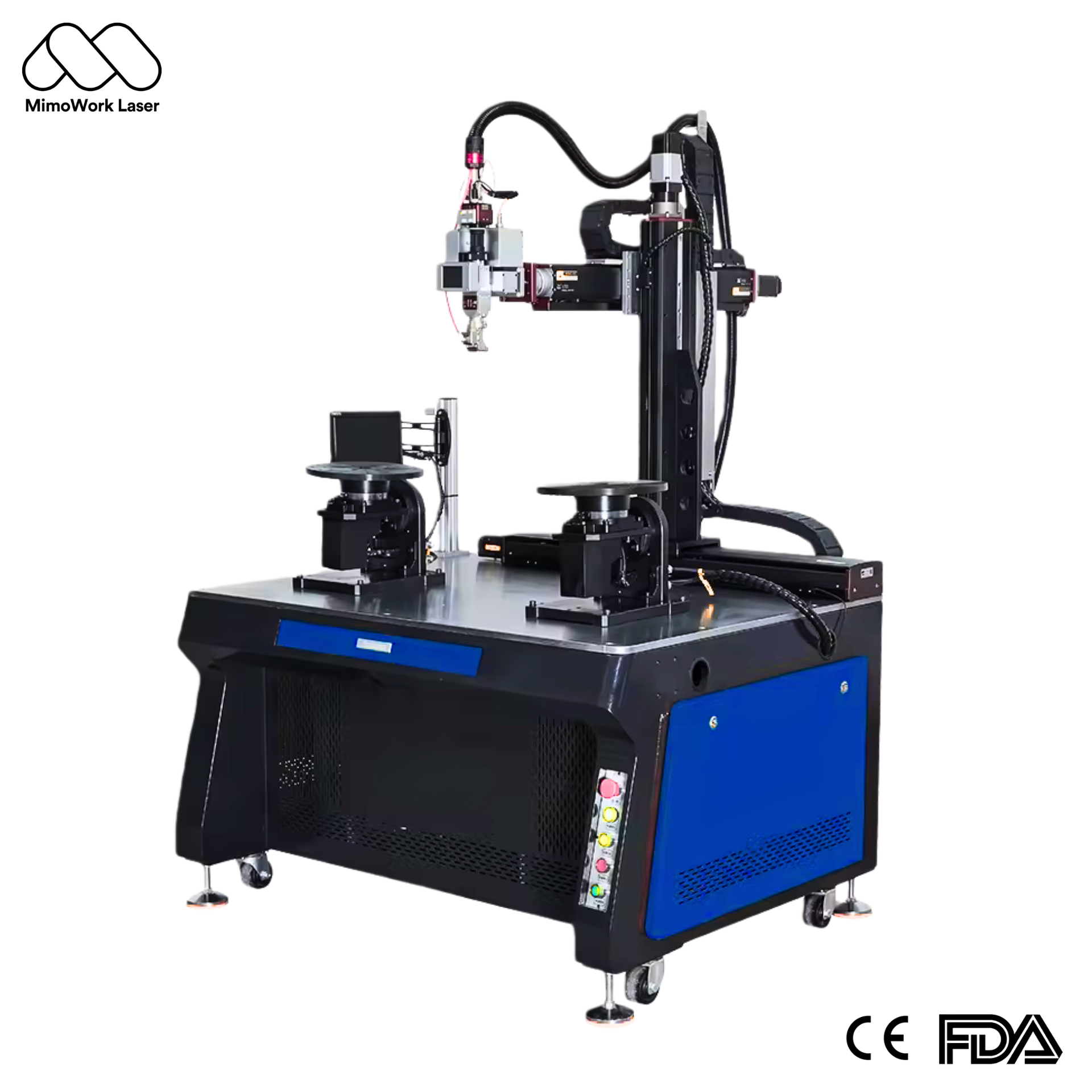
The 4-Axis Gantry Laser Welding Machine uses CNC-controlled movement across X, Y, Z and rotary axes. It is designed for automated, high-precision welding of small to medium-sized production parts.
This type of system makes sense when the same component must be welded repeatedly and the welding path can be defined in advance.
Instead of relying on an operator to reproduce the same movement hundreds or thousands of times, the machine follows a programmed path.
Applications can include components, enclosures, housings and other parts where consistent positioning and repeatable weld paths are important.
Related Guide:How to Laser Weld Cast Iron: Methods, Settings and Tips
Large and complex three-dimensional components create another challenge: access.
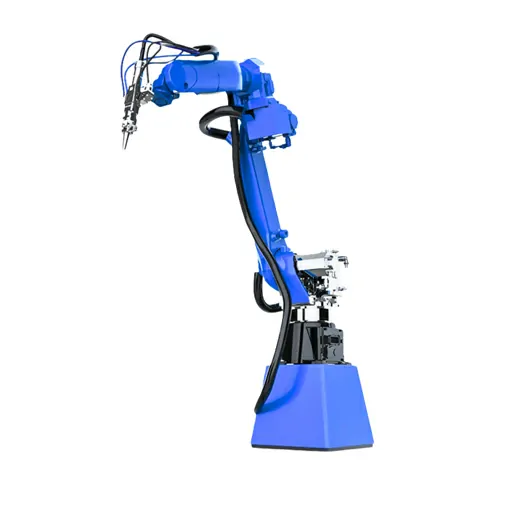
A traditional welding head or simple gantry may not easily reach every joint on a large assembly. MimoWork’s Manipulator Laser Welding Machine combines a high-power continuous-wave fiber laser with a multi-axis robotic arm.
The current product configuration supports 1000–4000W laser power and is intended for large 3D components.
The robotic arm can approach joints from different angles and follow complex contours, making the configuration suitable for applications where geometry is more difficult than the welding process itself.
For high-mix production, the ability to reprogram the welding path can also be important.
Laser welding should not be treated as a universal replacement for TIG, MIG or other welding technologies.
Instead, the useful comparison is based on the characteristics of the job.
| Factor | Laser Welding | Traditional Arc Welding |
| Heat concentration | Highly localized | Generally broader |
| Weld appearance | Often clean and narrow | May require more finishing |
| Heat-affected area | Typically smaller | Generally larger |
| Automation | Highly adaptable | Depends on system |
| Small precision joints | Strong application potential | Can be more difficult |
| Large manual repairs | Handheld systems available | Established and widely used |
| Complex 3D production | Robotic systems available | Also possible with robotics |
The practical advantage of laser welding becomes more noticeable when distortion, appearance, repeatability or post-processing are important parts of the production cost.
Fiber laser welding is widely associated with metals such as stainless steel and carbon steel, but its application range extends further.
Depending on the machine configuration and welding procedure, applications can involve:
However, material compatibility should never be determined by a material name alone.
Two alloys with similar thicknesses can behave very differently during welding because of differences in reflectivity, thermal conductivity, composition and melting behavior.
For production work, sample testing is therefore more reliable than choosing parameters from a generic chart.
Start with the workpiece, not the machine.
If the parts are large, irregular or frequently changed, a handheld system may make more sense.
If the application involves very small precious-metal components, a specialized jewelry system with microscope observation and pulsed laser control is more appropriate.
If the same part must be welded repeatedly, automation becomes increasingly valuable, making a gantry system worth considering.
If the workpiece is large and three-dimensional, a robotic manipulator can provide the access and movement required.
Laser power is important, but it is only one part of the decision.
The more useful purchasing questions are:
What material are you welding?
What is the actual thickness?
Is the joint butt, lap, corner or another geometry?
How much variation exists between parts?
How many pieces must be welded per shift?
Does the operator need to move around the workpiece?
Can the welding path be programmed?
Answering these questions usually narrows the machine type before wattage becomes the final decision.
Laser welding performance is controlled by a group of interacting parameters rather than one number.
Power determines how much energy can be delivered to the workpiece. Higher power can support deeper or faster welding, but excessive power can create instability or excessive penetration.
Welding speed controls how long the laser interacts with each section of material.
Increasing speed reduces heat input per unit length, while slower movement increases the energy delivered to the joint.
The focal position affects energy density and penetration. A small change in focus can alter the appearance and stability of the weld.
Shielding gas protects the molten weld pool from atmospheric contamination and oxidation. Gas selection and flow should be matched to the material and process.
For joints with gaps or applications requiring additional filler material, a wire feeder can help build the weld profile and improve joint filling.
A good weld does not come from the machine alone.
The workpiece must be properly prepared, surfaces should be appropriately cleaned, joint fit-up should be controlled, and the welding parameters need to be validated for the specific material.
This is particularly important when welding reflective metals, dissimilar materials or heat-sensitive components.
For production environments, a small sample test can reveal problems that a specification sheet cannot: incomplete penetration, excessive heat input, unstable weld pools, surface oxidation or dimensional distortion.
That is why application testing should be part of the purchasing process whenever the welding requirement is complex.
Modern laser welding systems can simplify operation through parameter control and preset programs, but operators still need to understand material behavior, joint preparation, laser positioning and safety requirements.
Yes, cast iron can be laser welded, but it is considerably more sensitive to cracking and thermal stress than many common steels. Material grade, preheating strategy, filler selection and cooling behavior must be evaluated carefully.
There is no universal wattage. Required power depends on material, thickness, joint design, welding speed and the desired penetration. Sample testing is recommended before selecting production equipment.
It can be suitable for low- to medium-volume production, varied fabrication work and applications where operator flexibility is important. For highly repetitive production, automated gantry or robotic systems may provide better process repeatability.
A handheld system gives the operator direct control and mobility. A robotic system prioritizes repeatable programmed movement and access to complex geometries.
A Laser Welding Machine is not one universal piece of equipment. It is a family of technologies designed around different materials, geometries, production volumes and levels of automation.
MimoWork offers four distinct welding configurations: handheld, jewelry, 4-axis gantry and robotic manipulator systems. Each addresses a different production problem, from flexible repair and fabrication to precision jewelry work and automated 3D welding.
The best starting point is therefore not simply choosing the highest laser power. Define the material, thickness, joint geometry, production volume and required level of automation first. Then choose the welding configuration that fits the actual workflow.
News | Sep-1-2026
News | Aug-19-2026
News | Aug-6-2026