Blog
In a field that evolves daily, staying ahead means staying informed.
Explore in-depth articles designed to help you solve complex challenges,
maximize your machine’s ROI.
Stay ahead in a competitive market.


In a field that evolves daily, staying ahead means staying informed.
Explore in-depth articles designed to help you solve complex challenges,
maximize your machine’s ROI.
Stay ahead in a competitive market.
News | Oct-8-2026
Yes. CO₂ lasers can cut clear acrylic, and acrylic is one of the materials where CO₂ laser processing can produce particularly clean, visually attractive results.
However, “can a CO₂ laser cut acrylic?” is only the first question. The more important questions for buyers are whether the machine can produce the required edge quality, whether the sheet thickness is appropriate for the available laser power, how clear acrylic behaves compared with colored or opaque acrylic, and how speed, focus, air assist and material quality affect the final result.
Clear acrylic can produce polished-looking laser-cut edges, but that result is not guaranteed simply because the material is transparent.
Acrylic, commonly known as PMMA, interacts effectively with the wavelength used by CO₂ lasers.
This makes CO₂ laser systems particularly useful for processing acrylic sheets into signs, displays, letters, decorative components, prototypes and custom products.
The transparency of the sheet to visible light does not mean that it is transparent to the infrared wavelength used by a CO₂ laser.
That distinction is important.
When buyers ask whether a CO₂ laser can cut clear acrylic, they sometimes assume that a transparent material will allow the laser beam to pass through without sufficient absorption. In practice, the interaction between acrylic and the CO₂ laser wavelength allows the material to be heated and vaporized along the cutting path, making a CO2 Laser Cutter well suited for producing clean, precise cuts in clear acrylic.
This is one reason CO₂ laser cutters are widely used for acrylic fabrication.
For acrylic sheet cutting, CO₂ lasers have a practical advantage because acrylic responds well to their wavelength.
The choice is less about whether one laser is “stronger” and more about whether the laser source is appropriate for the material.
Acrylic fabrication often requires:
A machine can have sufficient nominal power and still produce poor results if the beam is poorly focused or the material is not stable.
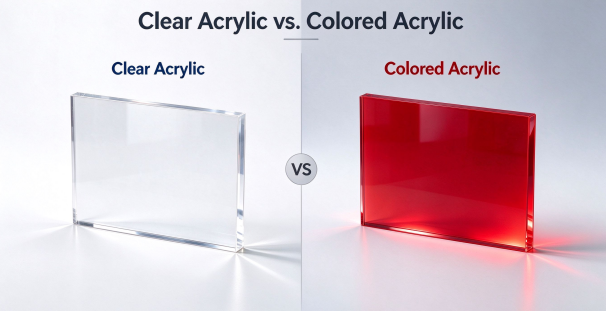
Not all acrylic sheets behave identically.
Clear acrylic is especially popular for:
Colored, frosted, translucent and opaque acrylic can also be laser processed, but optical appearance and heat absorption characteristics can vary between products.
This means that a cutting parameter tested on one sheet should not automatically be treated as a universal setting for every acrylic supplier.
Even within the same nominal thickness, different acrylic formulations, cast/extruded manufacturing methods, surface coatings and sheet quality can influence the result.
Recent acrylic processing guidance similarly emphasizes that laser settings should be treated as starting references rather than universal presets because material and machine conditions vary.
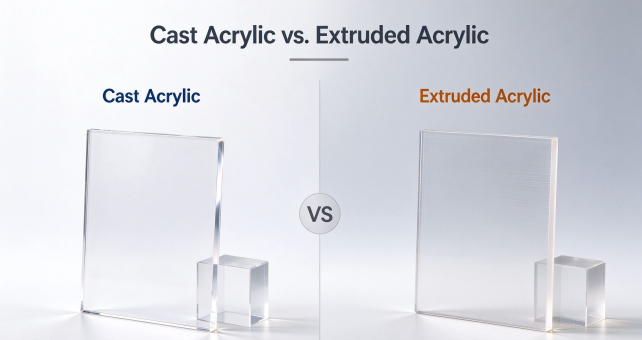
One of the most important distinctions for acrylic buyers is whether the sheet is cast or extruded.
Cast acrylic is often selected when appearance, engraving quality and dimensional stability are important. Extruded acrylic can offer advantages in cost and certain forming applications.
For laser cutting, the practical difference can show up in edge appearance, engraving behavior and how the sheet responds to heat.
If a business is producing premium display products, the edge quality may be more important than simply achieving separation of the sheet.
A slightly faster cutting process that leaves a poor edge may not be economically better if every part requires additional polishing.
Acrylic is unusual because a well-controlled CO₂ laser cut can create an edge that appears smooth and polished.
The visual result depends on several variables.
The focal position determines how concentrated the laser energy is inside the sheet.
If the focus is incorrect, the beam may not deliver energy efficiently through the material thickness.
Power determines the available energy while speed determines how long the laser interacts with a particular area.
Increasing power is not always the best solution.
A slower process can increase heat input and potentially affect the edge or surrounding material.
Air assist can influence the cutting process by helping manage heat, smoke and debris around the cutting zone.
The correct air-assist configuration depends on the machine and material.
As acrylic becomes thicker, maintaining complete penetration becomes more demanding.
The appropriate combination of laser power, focal configuration and cutting speed therefore changes with thickness.
Acrylic from different manufacturers can produce noticeably different results.
For production, material testing is often more useful than relying on a generic online parameter chart.
There is no universal table that says a specific wattage can always cut a specific acrylic thickness at a fixed speed.
A better way to think about the relationship is:
Laser power establishes the available processing capacity, while speed, focus and material characteristics determine how that capacity is converted into a usable cut.
For example, two machines with the same nominal laser power can produce different results because of differences in:
| Machine / Process Variable | Effect on Acrylic Cutting |
| Laser tube/source | Influences available optical output |
| Lens | Affects focal spot and depth of focus |
| Beam alignment | Affects energy distribution |
| Motion system | Influences repeatability |
| Focus system | Determines interaction with material thickness |
| Air assist | Helps manage the cutting zone |
| Exhaust | Removes smoke and vapor |
| Material quality | Influences melting and edge appearance |
This is why machine selection should not be based only on wattage.
Slower is not automatically better.
When a laser remains on one area for too long, heat can accumulate.
Depending on the acrylic and process, excessive heat may lead to:
The goal is not to maximize power or minimize speed.
The goal is to find a stable process window where the laser produces complete separation without unnecessary thermal damage.
If the laser moves too quickly for the available power and material thickness, the beam may not deliver enough energy through the sheet.
Typical symptoms include incomplete cuts, partially connected areas or rougher edges.
This is where test cutting becomes important.
Rather than immediately increasing power to its maximum, operators can establish a controlled parameter window and test progressively.
Acrylic cutting produces smoke and vapor that should be removed from the processing area.
This is not only a matter of operator comfort.
Deposits can accumulate around the machine, contaminate optics and affect the cleanliness of the work environment.
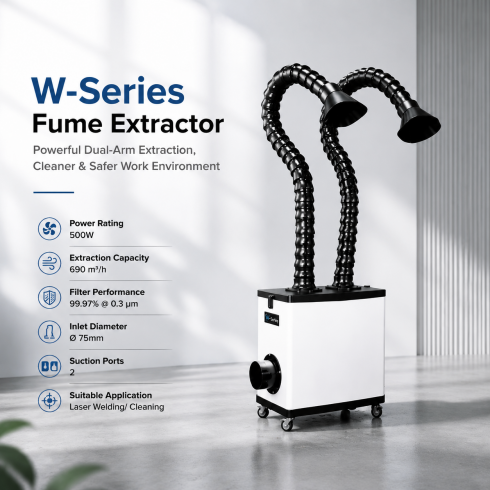
A dedicated extraction system should therefore be considered part of the CO₂ laser cutting system rather than an optional accessory.
MimoWork’s C-Series is positioned specifically for CO₂ laser cutting and engraving of materials including acrylic, wood, leather and fabric. Its published application information lists extraction capacity up to 5,000 m³/h for demanding non-metal processing environments.
The important point is to size extraction around the machine, enclosure, material and production conditions rather than choosing a fan independently from the laser system.
Often, yes.
One of the biggest advantages of CO₂ laser cutting acrylic is the possibility of obtaining a visually smooth edge directly from the cutting process.
However, the result depends strongly on the process window.
If the material is incorrectly focused, overheated or poorly supported, additional finishing may still be necessary.
For premium retail displays or transparent components, edge appearance should therefore be included in the machine evaluation.
Ask for actual samples rather than relying only on specifications.
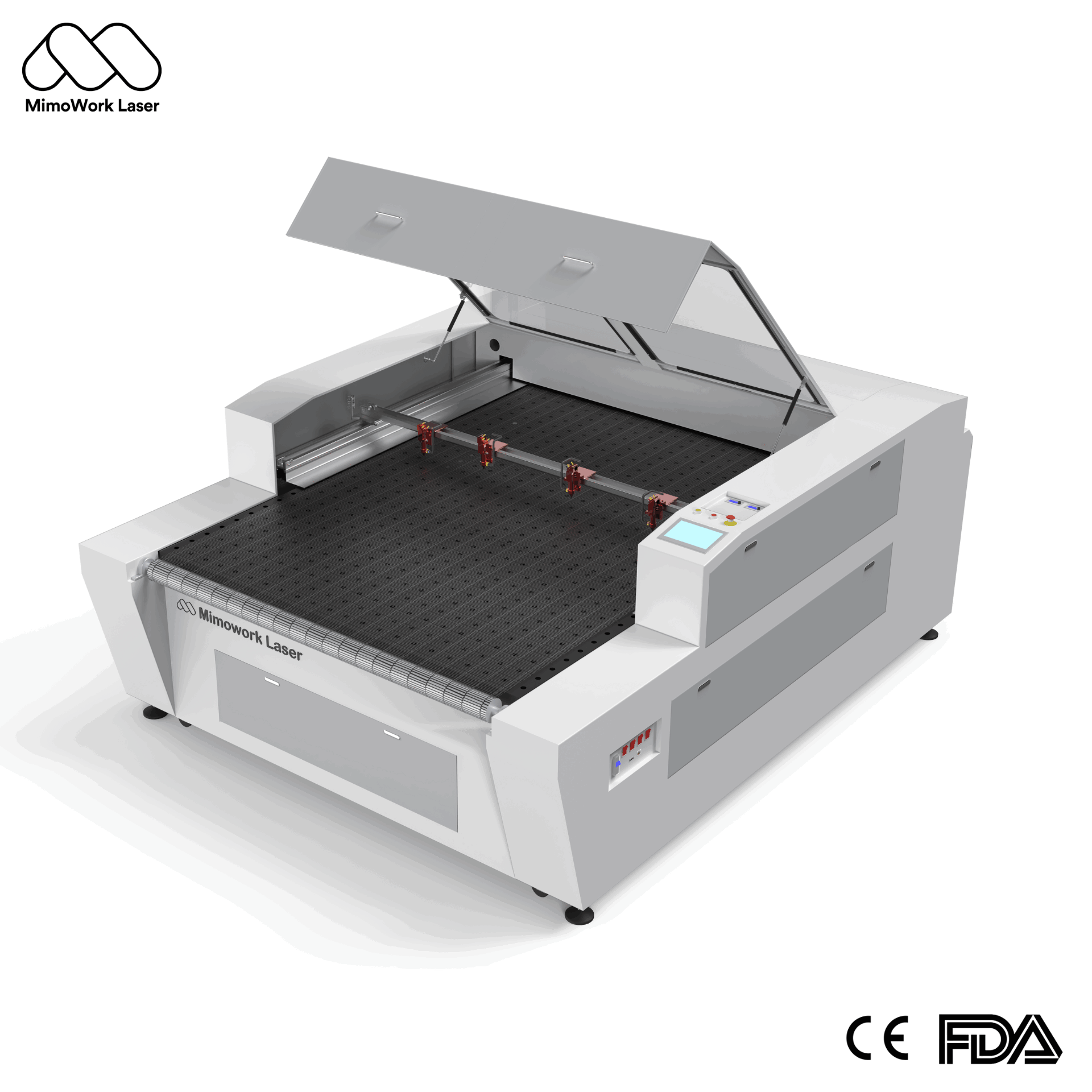
MimoWork offers several CO₂ laser cutter configurations that can be matched to different acrylic production requirements.
The F60 provides a 600 × 400 mm working area and is positioned as a desktop laser for smaller applications.
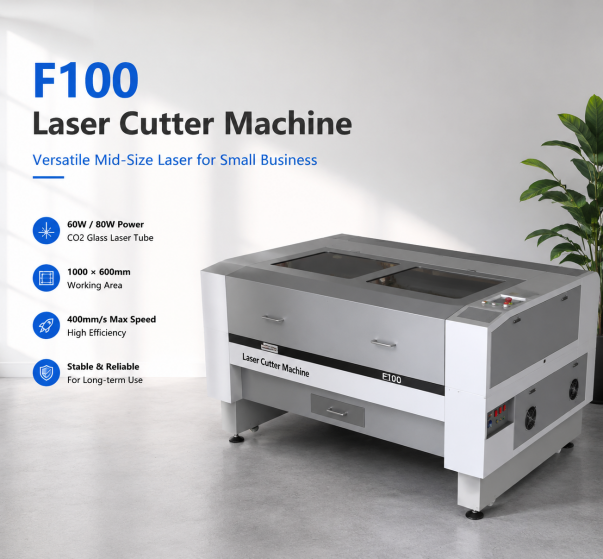
The F100 expands the working area to 1000 × 600 mm and is positioned for small-business production.
For larger acrylic signage, displays and repeated production, the F130 provides a 1300 × 900 mm working area with 60W–150W CO₂ laser options.
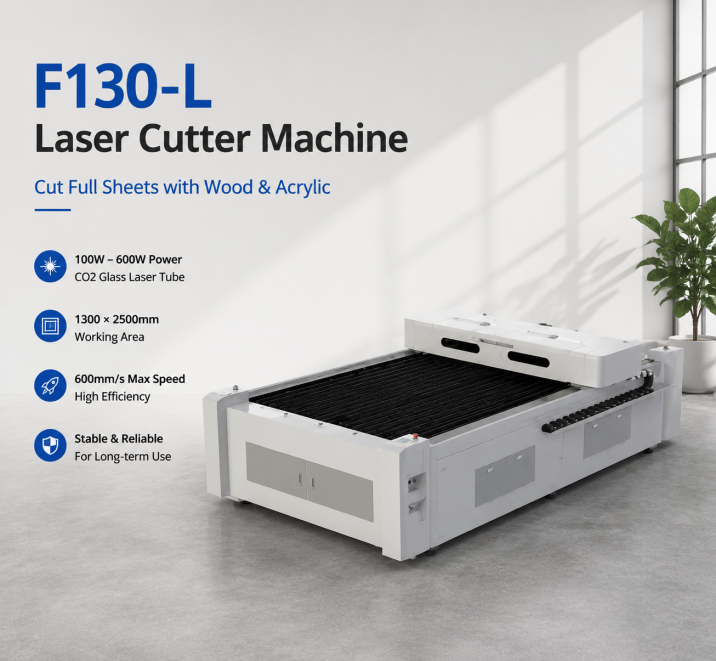
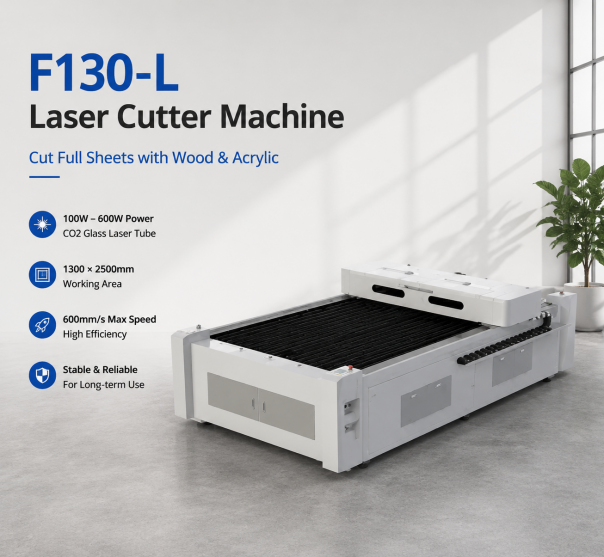
For businesses working with full-size sheets, the F130-L provides a 1300 × 2500 mm working area with 100W–600W laser power options.
This range is useful because acrylic buyers do not necessarily need the same machine.
A small gift shop producing personalized acrylic products has a very different requirement from a signage manufacturer processing full sheets.
| Production Requirement | More Relevant Consideration |
| Small personalized acrylic products | Compact working area and manageable footprint |
| Small-business signage | Medium working area and flexible power |
| Large acrylic signs | Larger bed and higher production capacity |
| Full-sheet acrylic production | Large working area and sheet-handling workflow |
| Repetitive commercial production | Motion system, cooling, extraction and automation |
| High-quality transparent displays | Focus stability and process repeatability |
The important point is that a machine should be selected around the production workflow, not simply around the maximum wattage.
Yes.
Clear acrylic can be engraved, although the visual result differs from cutting.
Because clear material allows light to pass through, engraving may be more visually subtle than engraving opaque acrylic.
Many manufacturers therefore use techniques such as backing the acrylic with a contrasting surface or combining engraving with cutting to create visual depth.
For commercial products, the combination of engraving and cutting can be particularly useful for:
customized gifts.
illuminated signs;
nameplates;
awards;
retail displays;
decorative panels;
The most reliable approach is to establish a material-specific process rather than relying on generic settings.
Start with a clean sheet and confirm its thickness.
Then verify focus, use an appropriate cutting lens, establish an initial speed-power combination and inspect the edge.
If the edge shows excessive melting, do not immediately assume that more power is required.
The issue may be excessive heat input, incorrect focus, unsuitable airflow or material characteristics.
Likewise, incomplete penetration does not always mean that maximum power is necessary.
The goal is a balanced process.
This can indicate an unstable process, unsuitable parameters, poor material quality or an optical/focus issue.
This may occur when too much heat is delivered to a small area.
This generally indicates insufficient effective energy reaching the full material thickness, although focus, beam alignment and material variation should also be checked.
Related Guide: Best CO2 Laser Engraver for Small Business: A Practical Buying Guide
Yes. Clear acrylic is well suited to CO₂ laser cutting because acrylic absorbs the CO₂ laser wavelength sufficiently for the material to be cut and shaped. The final edge quality depends on laser power, focus, speed, air assist, sheet quality and extraction.
There is no universal maximum thickness because cutting capability depends on laser power, material formulation, lens configuration, speed and machine design. The safest way to establish production capability is to test the exact acrylic sheet that will be used in production.
Excessive heat input is one possible reason. Cutting speed, laser power, focus position, air assist and material type all influence the thermal balance. A slower cutting speed is not always better because it can increase heat accumulation.
CO₂ laser cutting acrylic is not simply a question of whether the material can be cut.
The real production question is whether the machine can produce the required edge quality, dimensional accuracy, throughput and repeatability for the acrylic products you sell.
For small products, a compact CO₂ laser may be enough. For signage and displays, a larger working area becomes more valuable. For full-sheet production, machine size and workflow integration can matter more than simply adding laser power.
For businesses considering a new acrylic laser cutter, sample testing with the actual sheet material remains one of the most useful steps before purchase.
News | Aug-31-2026