Blog
In a field that evolves daily, staying ahead means staying informed.
Explore in-depth articles designed to help you solve complex challenges,
maximize your machine’s ROI.
Stay ahead in a competitive market.


In a field that evolves daily, staying ahead means staying informed.
Explore in-depth articles designed to help you solve complex challenges,
maximize your machine’s ROI.
Stay ahead in a competitive market.
News | Oct-27-2026 | Mimowork
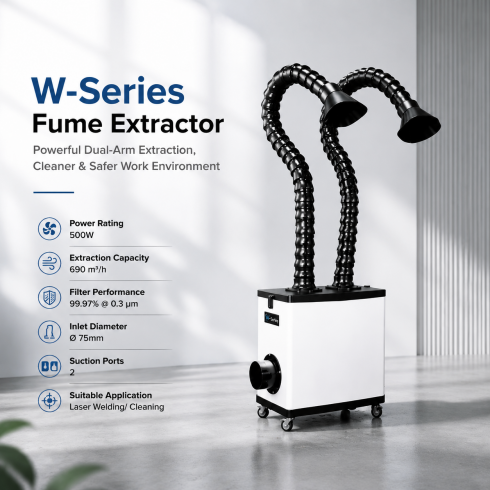
A welding exhaust fume extractor captures airborne fumes and fine particles before they spread throughout the workshop. For laser welding, the key is not simply removing visible smoke or choosing the highest airflow rating. The system must capture contaminants close to the weld, provide suitable filtration for the materials being processed, and maintain effective airflow under real operating conditions. MimoWork’s W-Series is designed for localized extraction during laser welding and laser cleaning.
Not necessarily.
A laser welding station may look cleaner than a conventional welding area because the process is precise and the visible smoke plume can be relatively localized. That appearance can create a misleading impression: if the smoke is barely visible, perhaps extraction is unnecessary.
But the absence of a thick visible plume does not establish that the air is safe. Welding can release fine airborne particles and other contaminants, depending on the base metal, surface coatings, filler materials, and process conditions.
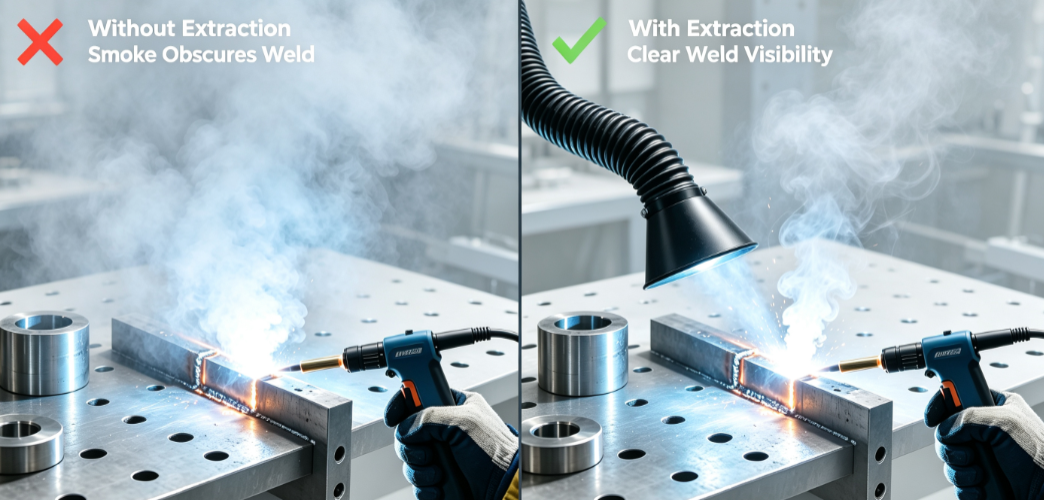
There is another practical problem. When smoke rises directly through the operator’s working area, it can obscure the weld pool and make it harder to see the seam clearly. In a process that depends on accurate positioning and consistent movement, that is more than a housekeeping issue.
A properly selected welding exhaust fume extractor addresses the problem at its source rather than waiting for contaminants to spread through the room.
General ventilation moves and replaces room air. Local exhaust extraction captures emissions near the point where they are generated.
That difference matters because a welding fume plume starts in a concentrated area. By the time it reaches a ceiling exhaust or distant ventilation inlet, it may already have passed through the operator’s breathing zone or dispersed across the workstation.
A source-capture system places the extraction inlet near the welding operation, allowing contaminants to be collected before they spread more widely.
| Approach | Main function | Limitation |
| General ventilation | Dilutes and removes contaminants from the room | May not capture a concentrated plume before it reaches the operator |
| Portable fan | Moves air away from a local area | Can redirect fumes rather than capture and filter them |
| Welding fume extractor | Captures and filters contaminants near the process | Performance depends on inlet placement, airflow, filtration, and maintenance |
An extractor is not automatically effective simply because it is running. The inlet must be positioned appropriately, and the system must be configured for the material and operating conditions.
For handheld laser welding, the workpiece and welding position may change throughout the shift. A fixed extraction inlet can struggle to follow that movement.
An articulated extraction arm makes it easier to position the hood near the weld without repeatedly rearranging the workstation. The hood should remain close enough to capture the plume while avoiding interference with the operator, welding gun, and shielding-gas arrangement.
A larger airflow figure does not automatically mean better capture at the weld. Hose diameter, duct length, inlet geometry, filter resistance, and hood distance all influence the airflow that reaches the extraction point.
Compare systems using their intended applications and installed configuration, not just the headline airflow number.
Metal fumes, coating-related emissions, and larger spatter particles do not all behave the same way. A filtration system must be selected according to the contaminants produced by the actual process.
Particle filtration should not automatically be assumed to remove every gas or vapor. If coated metals or other materials produce gaseous contaminants, determine whether additional gas-phase filtration or a different control approach is needed.
A unit that performs adequately during occasional short welds may face different demands in continuous production. Consider operating hours, filter loading, maintenance access, replacement-filter availability, and whether extraction performance remains suitable as filters accumulate contaminants.
These factors influence long-term reliability just as much as the initial equipment specification.
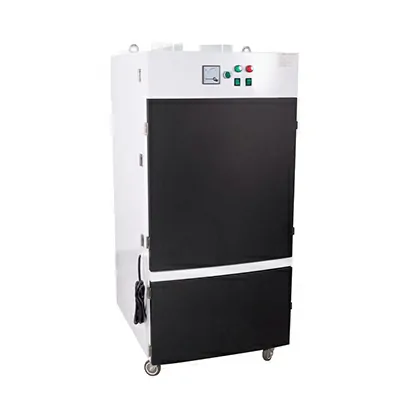
MimoWork’s W-Series Fume Extractor is designed for laser welding and laser cleaning, where concentrated fumes and fine particles are generated near the processing point.
Its articulated extraction arm allows the inlet to be positioned close to the weld or cleaning area. A staged filtration arrangement includes a primary particulate and spark-arresting filter, followed by a fine dust and fume filter cartridge.
Published W-Series specifications include:
| Specification | W-Series |
| Power rating | 500 W |
| Extraction capacity | 690 m³/h |
| Listed filtration performance | 99.97% at 0.3 μm |
| Inlet diameter | Ø75 mm |
| Suction ports | 2 |
| Intended applications | Laser welding and laser cleaning |
These figures provide a starting point for equipment evaluation, not a guarantee of exposure control under every condition. Actual performance depends on the installation, hood position, material, contaminant profile, and maintenance.
For manufacturers using handheld laser welding systems, the W-Series offers a dedicated option to consider when designing a cleaner and more controlled welding workstation.
Related Guide: Fume Extractor Guide: How to Clear Laser Cutting Fumes and Engraving Smoke
Before production: Identify the metals, coatings, and consumables being processed. Determine the likely emissions and establish the appropriate control and filtration requirements.
During setup: Position the extraction inlet near the source without disrupting the welding process. Check that the arm can accommodate the operator’s normal working range and the size of the workpiece.
During operation: Confirm that extraction remains effective as the operator changes position. Do not use the absence of visible smoke as the sole indicator of adequate control.
During maintenance: Follow the manufacturer’s procedures for checking airflow, inspecting filters, and replacing contaminated components. Filter changes should be managed safely to avoid releasing collected material back into the workplace.
The goal is a system that works with the production process, rather than an extractor that is installed once and gradually becomes less effective as working conditions change.
Laser welding can produce fine particles and potentially hazardous fumes, even when visible smoke is limited. Suitable local extraction is an important engineering control, with the final setup determined by the material, process, exposure assessment, and applicable workplace requirements.
The hood should be positioned as close as practical to the source while maintaining safe, unobstructed welding operation. The required distance depends on the hood design, plume behavior, and capture performance. Verify effectiveness under actual working conditions rather than relying on a universal distance.
Potentially, but the system must be designed for the combined airflow demand, duct resistance, operating schedule, and contaminant profile. Opening multiple extraction points can reduce the airflow available at each station if the system is not sized and balanced appropriately.
No. Filtration performance depends on the filter media and the contaminants present. Fine-particle filtration does not guarantee removal of every gas or vapor. Materials and coatings should be assessed before the extraction system is selected.
A welding exhaust fume extractor should be evaluated by how well it captures and controls the emissions generated in your actual workshop, not by appearance or airflow figures alone. Source capture, suitable filtration, practical positioning, and consistent maintenance all contribute to effective control.
If your production involves laser welding or laser cleaning, review the MimoWork W-Series Fume Extractor to explore its specifications and discuss whether it fits your workstation, materials, and extraction requirements.
News | Oct-14-2026
News | Oct-7-2026