Blog
In a field that evolves daily, staying ahead means staying informed.
Explore in-depth articles designed to help you solve complex challenges,
maximize your machine’s ROI.
Stay ahead in a competitive market.


In a field that evolves daily, staying ahead means staying informed.
Explore in-depth articles designed to help you solve complex challenges,
maximize your machine’s ROI.
Stay ahead in a competitive market.
News | Nov-6-2026 | Mimowork
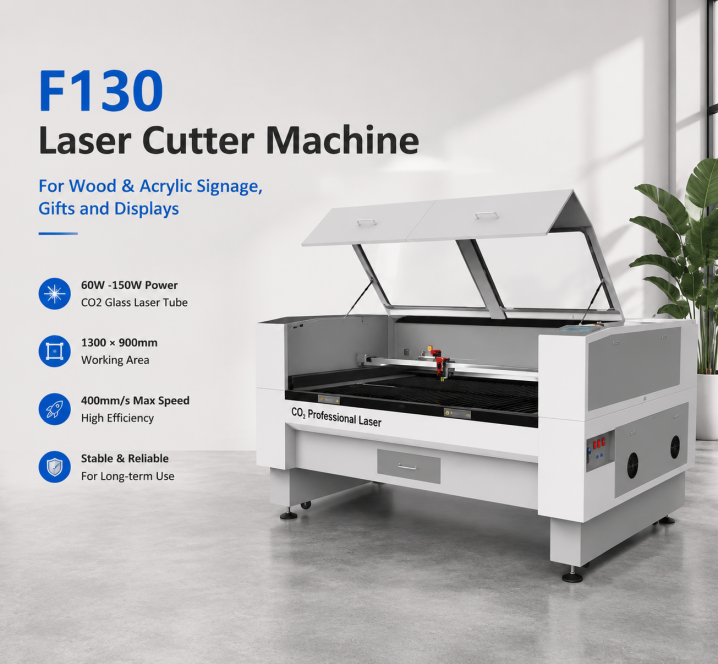
A 130 watt co2 laser cutter offers a practical balance between cutting capacity, processing speed, and equipment cost. It is suitable for workshops regularly processing acrylic, MDF, plywood, leather, and textiles. Compared with 100W systems, it provides more room to handle thicker materials or increase cutting speed, while avoiding some of the additional costs associated with higher-power equipment.
For manufacturers producing signage, displays, furniture components, or custom textile products, 130W is worth considering when production demand exceeds the capabilities of entry-level machines.
Laser power alone does not determine cutting thickness. Material quality, lens focal length, focus position, air pressure, and optical condition all affect the final result.
A 130W CO2 laser can cut thick acrylic, including some 15–20mm sheets, under suitable conditions. However, cutting speed decreases significantly as thickness increases. Cast acrylic generally produces smoother, glossier edges than extruded acrylic. For thick sheets, correct focusing and stable cutting parameters are essential to avoid taper, bubbles, and uneven edges. Always request a sample test using your actual acrylic material.
A 130W system can process 10–12mm MDF and wood, although results vary with density, moisture, and adhesive composition. Air assist helps remove burning debris from the cutting path, while correct focus and speed reduce excessive heat accumulation. Plywood requires particular attention because different adhesives can affect both cutting quality and emissions.
CO2 lasers are suitable for cutting natural leather, felt, polyester fabrics, and other compatible textiles. For synthetic materials, excessive heat can melt fibers and cause adjacent layers to stick together. Adjusting speed, power, and air assistance helps maintain clean edges. For continuous fabric production, a conveyor working table can also reduce manual material handling.
Glass-sealed CO₂ laser tubes generally have a shorter service life than RF metal tubes, although actual performance varies depending on tube quality, operating conditions, and maintenance. Frequent operation at high current, inadequate cooling, and unstable temperature control can accelerate tube degradation and reduce output power over time. Before purchasing a 130W CO₂ laser cutter, check the manufacturer’s rated tube lifespan, warranty coverage, recommended operating current, and replacement cost. These factors can help you estimate long-term maintenance requirements and avoid unexpected operating expenses.
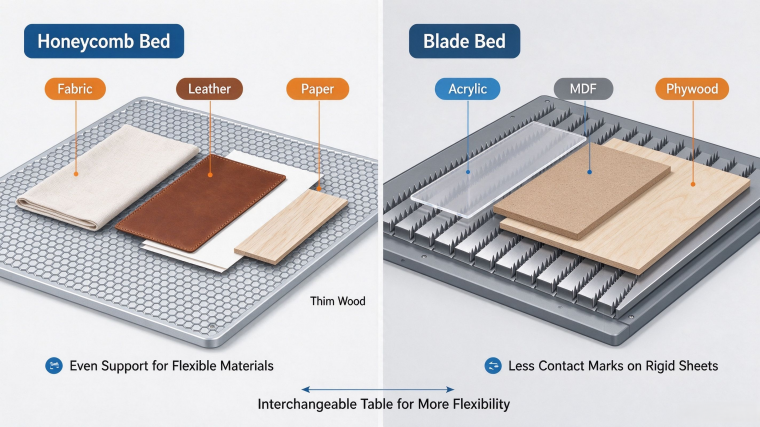
| Working Table | Recommended Materials | Main Advantage |
| Honeycomb bed | Fabric, leather, paper, thin wood | Supports flexible materials evenly |
| Blade bed | Acrylic, MDF, plywood | Reduces contact marks on rigid sheets |
If your workshop processes both flexible and rigid materials, an interchangeable working table offers greater flexibility.
Stepper motors are a cost-effective option for many standard CO2 laser applications. Servo motors offer feedback-based control and can provide better dynamic response for demanding production tasks. However, cutting accuracy also depends on gantry rigidity, belt tension, controller settings, and mechanical calibration. Choose according to actual production speed and positioning requirements rather than motor type alone.
Air assist directs compressed air toward the cutting point, helping remove smoke and debris from the kerf. This is particularly useful when cutting thick wood and MDF. Appropriate airflow can improve cutting consistency and reduce residue accumulation, but pressure should be adjusted according to the material and cutting conditions.
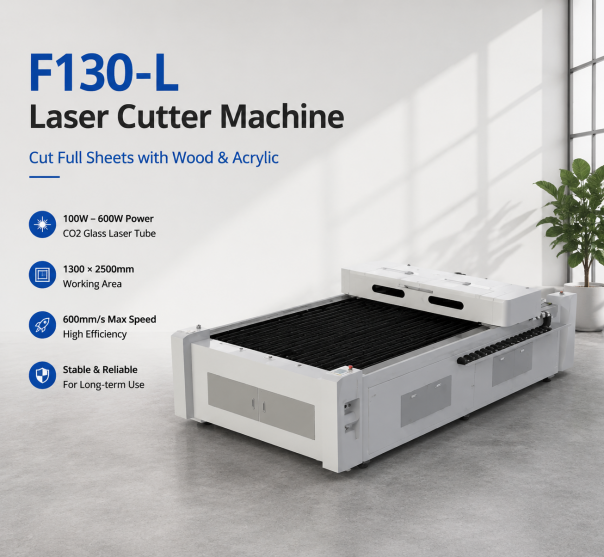
The MimoWork F130 is designed for industrial non-metal cutting and engraving, including wood and acrylic applications.
| Specification | F130 |
| Working area | 1300 × 900mm |
| Laser power | 60–150W |
| Laser source | CO2 glass tube |
| Maximum speed | 400mm/s |
| Maximum acceleration | 4000mm/s² |
The 130W configuration provides a practical option for workshops processing medium-to-large acrylic and wood sheets. Optional features such as autofocus, shuttle tables, and servo motor configurations can be considered according to production requirements.
Explore the MimoWork F130 Laser Cutter for more specifications.
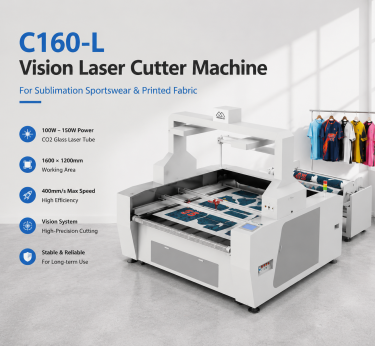
For printed textiles, accurate pattern recognition is often more important than additional laser power. A CCD vision system identifies printed features and aligns the cutting path with the actual pattern position. This is useful for sublimation sportswear, custom apparel, and irregular printed designs.
MimoWork’s C160-L Vision offers a 1600 × 1200mm working area and 100–150W CO2 laser options for camera-assisted textile cutting applications.Related guide: Understanding the 80 Watt CO2 Laser: Capabilities and Applications
Glass CO2 laser tubes have different rated lifespans depending on the manufacturer and operating conditions. Some are rated for approximately 2,000–4,000 hours, while other models advertise longer service lives. Reduced output, slower cutting speeds, and unstable power are signs that the tube may need inspection or replacement.
A standard 130W glass CO2 laser is designed primarily for non-metallic materials such as acrylic, wood, leather, and textiles. It cannot efficiently cut ordinary bare steel or aluminum sheets. Fiber laser systems are generally more suitable for metal cutting.
| Power | Main Advantage | Typical Application |
| 100W | Lower equipment investment | General acrylic and wood processing |
| 130W | Greater cutting capacity and speed flexibility | Regular medium-to-thick sheet production |
| 150W | More power for demanding cutting tasks | Frequent thick-material processing |
The best choice depends on actual material thickness, production volume, and required cutting speed. A higher wattage does not automatically guarantee better edge quality.
The TEYU CW-5200 is a common cooling option for DC CO2 laser tubes up to 130W. Its published cooling capacity is up to 1,430W, with temperature stability of ±0.3°C. However, always confirm the required cooling capacity, water flow, and operating temperature with the laser tube manufacturer.
A 130W CO2 laser cutter is a practical choice for businesses that regularly process acrylic, MDF, plywood, leather, and compatible textiles. Before purchasing, compare actual cutting samples, working area, motion control, cooling capacity, and maintenance costs. The best configuration is the one that meets your production requirements consistently without paying for unnecessary upgrades.
News | Oct-27-2026