Blog
In a field that evolves daily, staying ahead means staying informed.
Explore in-depth articles designed to help you solve complex challenges,
maximize your machine’s ROI.
Stay ahead in a competitive market.


In a field that evolves daily, staying ahead means staying informed.
Explore in-depth articles designed to help you solve complex challenges,
maximize your machine’s ROI.
Stay ahead in a competitive market.
News | Nov-18-2026 | Mimowork
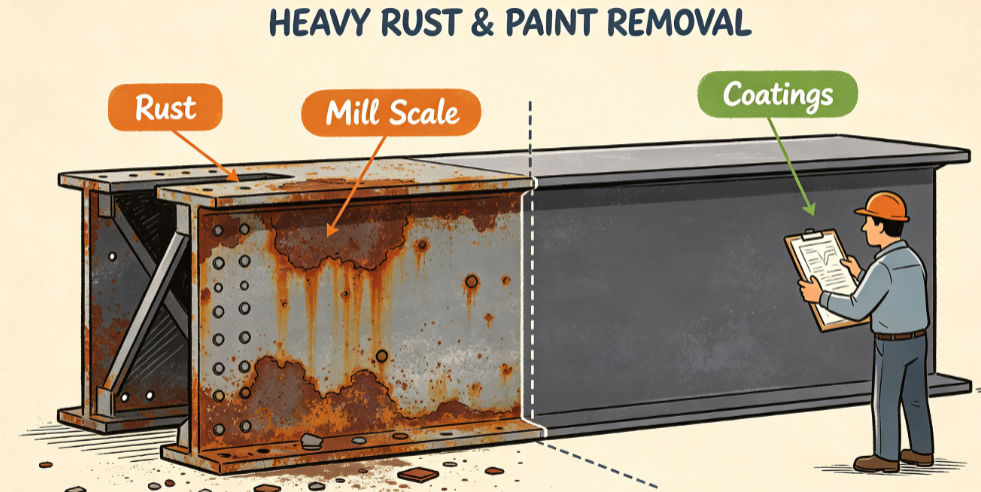
A continuous wave laser cleaner uses a constant laser beam to remove rust, paint, mill scale, and other surface contaminants from metal. With power configurations commonly ranging from 1000W to 3000W, CW fiber laser cleaning is designed for large workpieces and demanding industrial surface preparation where removal speed and production throughput are priorities.
Unlike pulsed laser cleaning, which delivers energy in short bursts, continuous wave (CW) systems maintain a steady output. This makes them suitable for many heavy-duty cleaning applications, but the sustained heat input requires careful control. Material thickness, contamination, scanning width, and required surface finish all influence the result.
Sandblasting and chemical stripping are widely used for industrial rust and paint removal. However, both methods bring additional operational requirements.
Abrasive blasting consumes media and generates dust that must be collected and handled. It can also alter surface roughness and may be unsuitable for components that require controlled material removal. Chemical stripping introduces solvent handling, ventilation, residue management, and waste disposal requirements.
Laser cleaning offers a different approach. It uses a focused beam to remove surface contaminants without relying on abrasive media or chemical stripping agents. The process still generates fumes and particles, so extraction and appropriate waste handling remain necessary.
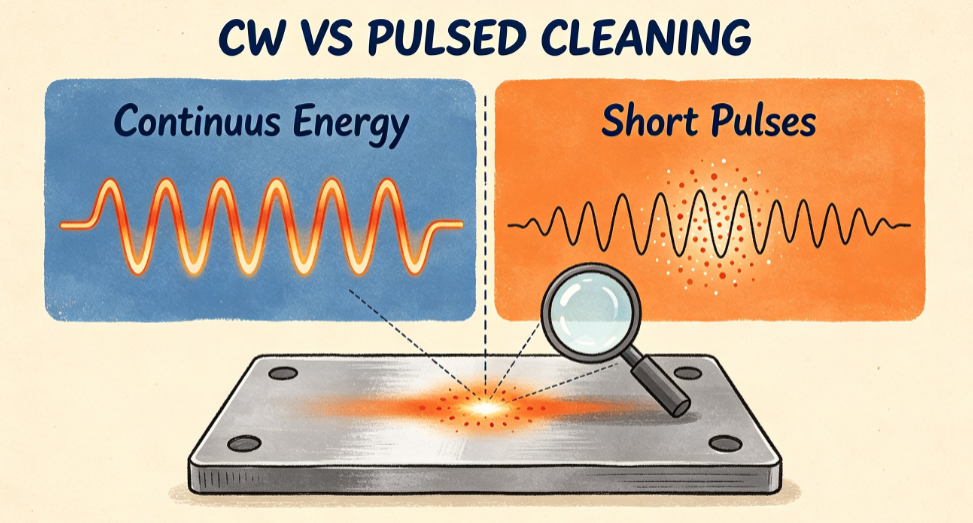
The main difference lies in how laser energy reaches the workpiece.
A CW laser delivers continuous energy, heating the contaminant until it is removed through thermal decomposition, vaporization, or other material-dependent removal mechanisms. A pulsed laser delivers energy in short bursts, allowing more controlled energy input and limiting heat transfer under suitable conditions.
| Feature | CW laser cleaning | Pulsed laser cleaning |
| Energy delivery | Continuous output | Short energy pulses |
| Typical power range | 1000–3000W | 100–500W |
| Main strength | High-throughput cleaning of large areas | More controlled precision cleaning |
| Typical applications | Heavy rust, mill scale, thick coatings | Molds, precision parts, sensitive surfaces |
| Main consideration | Heat accumulation | Processing time and removal efficiency |
Neither technology is universally better. CW systems are often more suitable for large, robust steel structures, while pulsed systems are worth evaluating when substrate protection and precise energy control are critical.
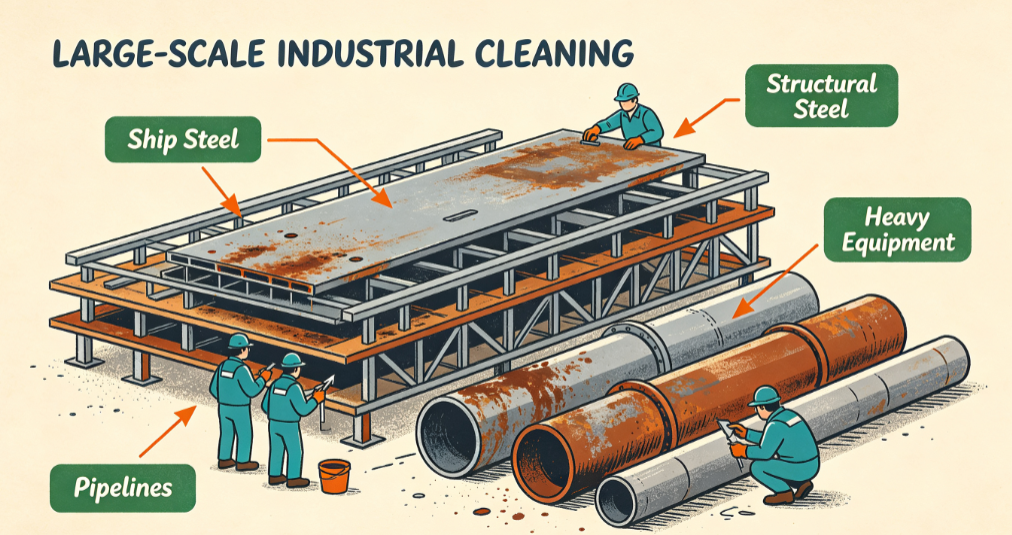
When manufacturers need to clean extensive steel surfaces, low-power precision processing may take too long. High-power CW systems provide continuous energy delivery and can cover larger areas with a suitable scanning head.
This makes them useful for shipbuilding, structural steel fabrication, pipeline maintenance, and large equipment refurbishment. The productivity advantage is most relevant when the substrate can tolerate the thermal input and the required finish is compatible with the cleaning process.
Related guide:https://www.mimowork-laser.com/solutions/laser-cleaning/continuous-wave-laser-cleaning-machine
Rust and mill scale can interfere with coating adhesion, welding preparation, and component refurbishment. A laser rust removal machine uses controlled laser exposure to remove these surface layers without abrasive contact.
CW cleaning is particularly relevant to large, relatively robust steel components. However, heavily corroded surfaces may have uneven profiles, deep pits, or varying oxide thicknesses. Cleaning parameters must be adjusted to avoid excessive heating or unwanted changes to the underlying metal.
Large industrial structures often require coating removal before repainting, inspection, or repair. A laser paint removal machine can be used to strip selected coatings from steel surfaces without generating spent abrasive media.
The result depends on coating chemistry, layer thickness, adhesion, and the substrate beneath it. Multi-layer industrial epoxy coatings may require multiple passes or staged processing. Operators should test the complete coating system before estimating production speed or assuming all layers can be removed in one pass.
Before welding, rust, paint, oil, and oxide contamination can affect joint preparation and process consistency. Laser cleaning can remove selected contaminants from the joint area, helping prepare the surface for welding.
After welding, it may also be used to remove oxidation or residue from suitable metal surfaces. The cleaning process must be matched to the base material and weld requirements. For critical joints, verify the resulting surface condition against the applicable welding procedure rather than assuming laser cleaning alone guarantees weld quality.
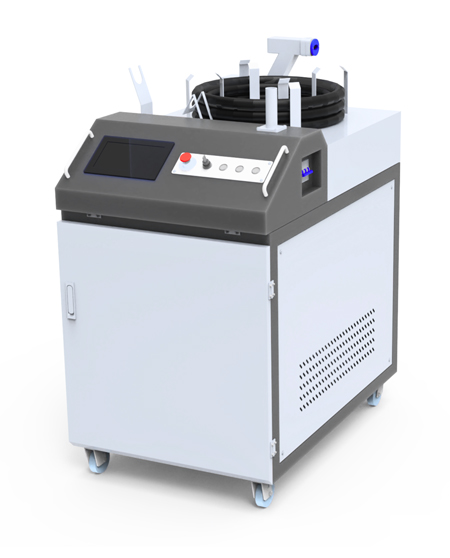
A handheld cleaning head gives operators flexibility when working on large structures, pipes, and irregular components. Adjustable scanning patterns and beam widths allow the operator to cover different surface areas.
MimoWork CW configurations support beam widths from 10 to 200 mm. A wider beam can cover more surface area per pass, but it does not automatically deliver better cleaning. Beam overlap, scanning speed, distance, and contamination thickness must be considered together.
Higher laser power can increase removal capacity, but actual productivity depends on the material and surface condition.
| Laser power | MimoWork listed cleaning speed | Typical evaluation focus |
| 1000W | Up to 20 m²/hour | General maintenance and moderate contamination |
| 1500W | Up to 30 m²/hour | Larger workpieces and heavier surface contamination |
| 2000W | Up to 50 m²/hour | Higher-throughput industrial cleaning |
| 3000W | Up to 70 m²/hour | Large-scale cleaning requirements |
These figures are listed equipment performance references, not guaranteed production rates. Actual results vary with rust thickness, coating type, substrate, geometry, scanning parameters, and the required surface finish.
MimoWork’s CW laser cleaning machine uses a 1070nm continuous-wave fiber laser with water cooling. Power selection should be based on sample testing and the required daily cleaning volume, not wattage alone.
Continuous energy input can cause heat accumulation. This is particularly important when cleaning thin sheet metal, delicate components, or materials with high thermal sensitivity.
Operators can evaluate lower power settings, faster scanning, suitable beam overlap, and controlled processing passes to manage heat input. For thin substrates or applications requiring minimal thermal impact, a pulsed system may be a more appropriate starting point.
Laser cleaning does not require blasting media or chemical stripping agents during the laser removal process. This can reduce recurring material consumption and some waste-handling tasks.
However, it does not eliminate operating costs. Electricity, extraction filters, protective optics, maintenance, cooling, and operator training must all be included when comparing cleaning methods.
The cost per square meter depends on more than rated laser power. Cleaning speed, setup time, operator handling, extraction requirements, and the number of passes all affect productivity.
A practical comparison should measure the time required to clean a representative workpiece to the required surface condition. Energy consumption should also account for the laser source, water chiller, extraction equipment, and other auxiliary systems.
Laser cleaning produces airborne particles and fumes that may contain hazardous substances from rust, coatings, paints, or surface residues. A suitable extraction and filtration system should be selected according to the material being removed and the working environment.
High-power CW systems also require strict laser safety controls. The 1070nm fiber laser wavelength presents an invisible beam hazard. Operators need wavelength-appropriate protective eyewear with suitable optical density, and the work area must be controlled to prevent unintended exposure. Enclosures, interlocks, beam stops, warning systems, and other safeguards should be incorporated where appropriate.
For repetitive production, robotic or mechanical handling can reduce operator exposure and improve process consistency. Any automated cell must include suitable laser safety protection and extraction.
Yes, excessive heat input can cause surface melting, discoloration, or changes to the material’s surface condition. The risk depends on power, scanning speed, exposure time, substrate thickness, and cleaning requirements. For critical components, inspect and test the cleaned surface before production approval.
There is no universal speed comparison. The result depends on rust thickness, surface area, blasting media, equipment setup, and the required surface finish. Compare both processes on the same workpiece and measure the time needed to reach the same cleaning standard.
Not necessarily. Thick or multi-layer coatings may require several passes or different processing parameters. Test the complete coating stack and underlying substrate before determining the number of passes and expected throughput.
Operators should regularly inspect the protective lens, optical components, cables, connectors, and cooling system. Protective windows may need replacement when contaminated, scratched, or damaged. Follow the equipment manufacturer’s cleaning and replacement procedures to avoid damaging optical components.
It can be used on selected aluminum and stainless steel applications, but the process requires careful parameter control. Reflectivity, thermal conductivity, surface finish, and material thickness affect cleaning behavior. For thin parts or applications requiring minimal surface alteration, pulsed laser cleaning may be a better option.
MimoWork offers high-power CW fiber laser cleaning configurations from 1000W to 3000W, designed for heavy rust, paint, mill scale, and large-area metal surface preparation. The systems use a 1070nm laser source, water cooling, and adjustable scanning configurations.
Before selecting a machine, provide your metal samples, contaminant type, coating thickness, workpiece dimensions, and target cleaning speed. The MimoWork team can evaluate removal quality, substrate condition, processing parameters, and practical cleaning throughput through sample testing.
Request a metal cleaning test and discuss an application assessment with the team. Actual test results can help determine whether a 1000W, 1500W, 2000W, or 3000W configuration is appropriate for your production requirements.
News | Oct-17-2026
News | Sep-24-2026