Blog
In a field that evolves daily, staying ahead means staying informed.
Explore in-depth articles designed to help you solve complex challenges,
maximize your machine’s ROI.
Stay ahead in a competitive market.


In a field that evolves daily, staying ahead means staying informed.
Explore in-depth articles designed to help you solve complex challenges,
maximize your machine’s ROI.
Stay ahead in a competitive market.
News | Sep-24-2026
Steel manufacturing and fabrication processes often leave behind a natural oxide layer known as mill scale. Although mill scale can provide temporary protection against further oxidation, it becomes a challenge when steel needs to undergo additional processing such as welding, coating, painting, or surface inspection.
For manufacturers, removing mill scale effectively is essential to achieve better coating adhesion, improve welding quality, and maintain consistent surface performance.
Traditional methods such as sandblasting, grinding, and chemical treatment have been widely used for steel surface preparation. However, these approaches often involve abrasive materials, dust generation, labor-intensive operations, or additional waste treatment.
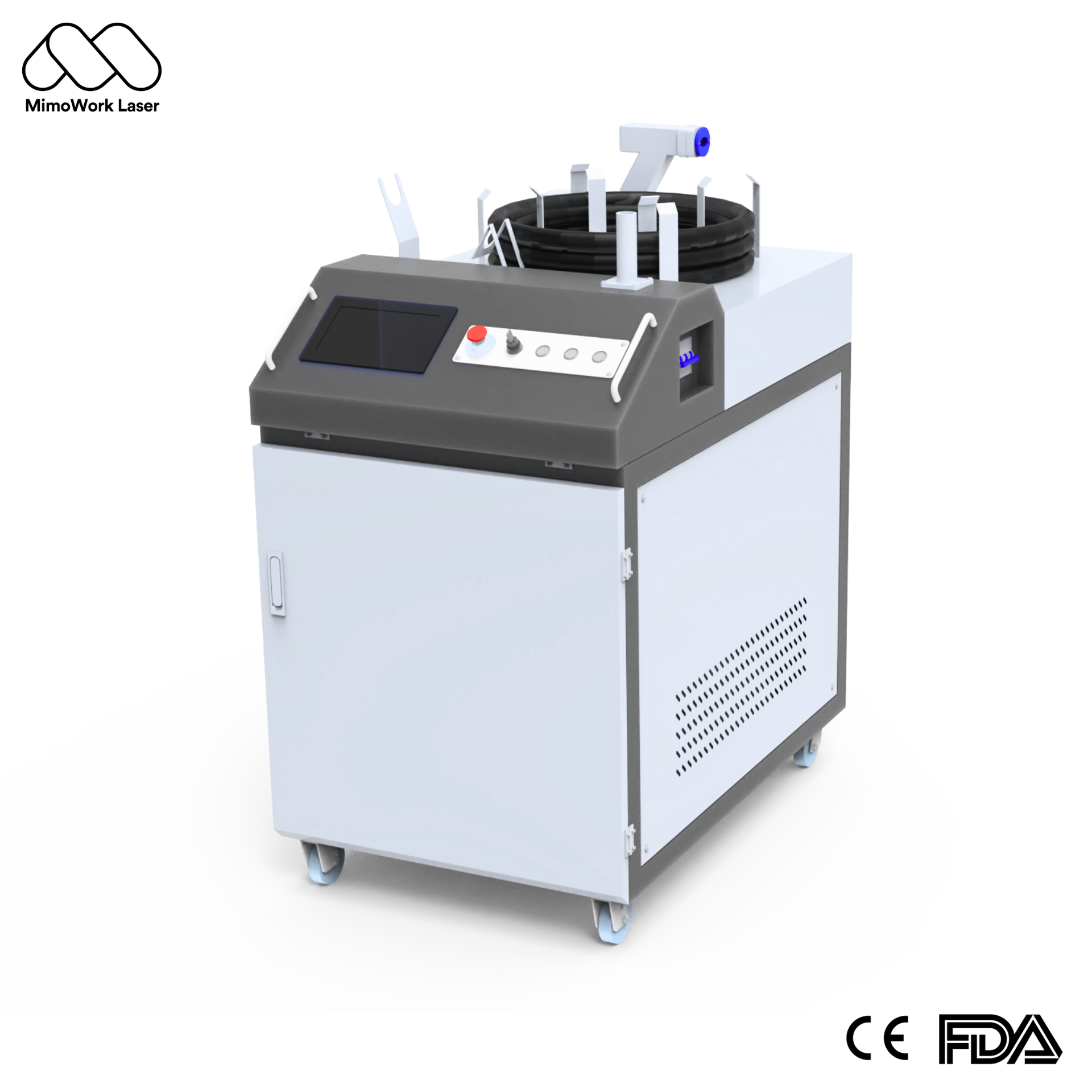
A laser cleaning machine for mill scale removal provides a modern alternative by using controlled laser energy to remove oxide layers and surface contaminants while preserving the steel substrate.
Mill scale is a hard oxide layer that forms on steel surfaces during hot rolling processes. When steel is heated to high temperatures during production, oxygen reacts with the metal surface and creates layers of iron oxides.
This layer is usually composed of different iron oxide compounds and appears as a dark gray or bluish-black coating.
Although mill scale can temporarily protect steel from corrosion, it can create problems during later manufacturing stages.
For example, when steel components need painting or coating, mill scale may reduce adhesion between the coating and the steel surface. In welding applications, unstable oxide layers can also affect weld quality and surface consistency.
Therefore, effective mill scale removal is an important step in steel surface preparation.
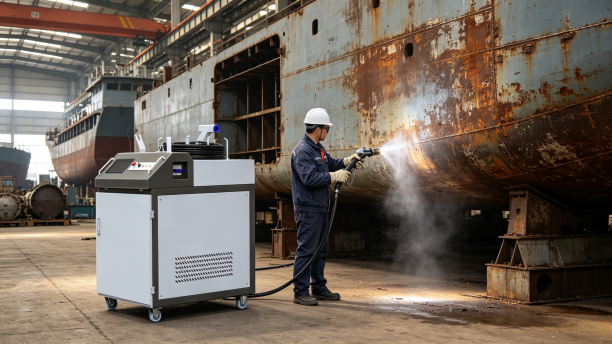
A laser cleaning machine removes mill scale by using high-energy laser pulses to interact with the oxide layer on the steel surface.
When the laser beam reaches the mill scale, the oxide layer absorbs the laser energy. The rapid energy transfer causes the unwanted layer to separate from the surface through thermal expansion, evaporation, or particle removal.
The process focuses on removing the surface contamination while minimizing impact on the underlying steel.
Compared with mechanical cleaning methods, laser cleaning provides greater control over the cleaning depth and treatment area.
| Cleaning Parameter | Impact on Mill Scale Removal |
| Laser Power | Determines the ability to remove thicker oxide layers |
| Scanning Speed | Influences cleaning efficiency and surface quality |
| Laser Frequency | Controls energy distribution during processing |
| Beam Coverage | Affects cleaning area and production efficiency |
By adjusting these parameters, manufacturers can optimize the cleaning process according to steel type, mill scale thickness, and production requirements.
Steel surface preparation is a critical step before many industrial processes. Poor surface conditions can lead to coating failure, welding defects, and additional rework.
Laser cleaning offers several advantages for manufacturers looking to improve surface preparation efficiency.
Coating and painting processes require a clean and stable steel surface.
Remaining mill scale, rust, or contaminants can create weak points between the coating and the metal substrate, causing problems such as peeling or reduced durability.
Laser cleaning removes unwanted surface layers and helps create a more consistent surface for subsequent treatment.
Traditional methods such as sandblasting rely on abrasive media to physically remove mill scale.
While effective, these processes consume additional materials and generate secondary waste.
Laser cleaning uses light energy instead of abrasive materials, reducing the need for consumables during the cleaning process.
Not all steel components require aggressive surface treatment.
For precision parts, laser cleaning allows operators to focus on specific areas without affecting surrounding surfaces.
This makes it suitable for applications where surface condition needs to be controlled carefully.
Different steel industries have different requirements for surface preparation. The most suitable method depends on production scale, surface quality expectations, and environmental considerations.
| Method | Working Principle | Main Considerations |
| Grinding | Mechanical removal using abrasive tools | Effective but may leave marks and requires manual operation |
| Sandblasting | Uses abrasive particles to clean surfaces | Fast for large areas but creates dust and consumes media |
| Chemical Treatment | Uses chemicals to dissolve oxide layers | Requires chemical management and waste handling |
| Laser Cleaning | Uses laser energy to remove surface layers | Precise, clean process with reduced consumables |
For manufacturers focusing on consistent quality and cleaner production processes, laser cleaning provides a flexible option for modern steel preparation.
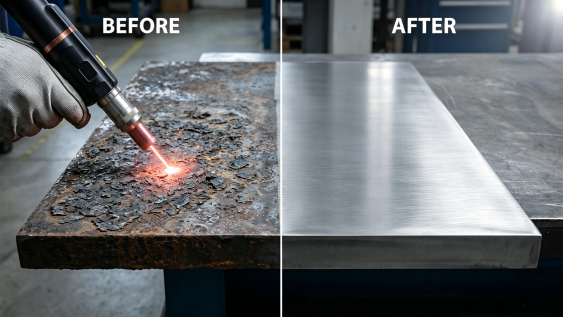
Steel structures often require surface preparation before painting or protective coating.
Applications include:
Removing mill scale helps improve coating adhesion and extend service life.
Fabricators often work with steel plates, pipes, and customized metal components.
Before welding, painting, or assembly, surface contamination needs to be controlled.
Laser cleaning can help manufacturers prepare localized areas without processing the entire component.
Large steel components used in shipbuilding and heavy equipment manufacturing require reliable surface treatment.
Laser cleaning can support maintenance, repair, and preparation processes where removing oxide layers is necessary.
Selecting a laser cleaning machine requires understanding the actual production environment.
A common mistake is choosing equipment only based on laser power. In reality, cleaning performance depends on multiple factors, including mill scale thickness, surface area, material type, and working speed requirements.
Light surface oxidation and thick mill scale require different cleaning settings.
Manufacturers should evaluate the actual condition of the steel surface before selecting equipment.
For occasional maintenance work, a portable laser cleaning system may provide sufficient flexibility.
For continuous industrial production, factors such as cleaning speed, operating stability, and integration capability become more important.
The required cleaning result depends on what happens after mill scale removal.
For example:
| Following Process | Required Surface Condition |
| Painting | Clean surface with improved coating adhesion |
| Welding | Reduced oxide contamination around joining areas |
| Inspection | Clear visibility of the steel surface |
| Bonding | Stable and contaminant-free surface |
Understanding the next manufacturing step helps determine the appropriate cleaning solution.
Related Guide: Best Laser Cleaning Machine in 2026: How to Choose the Right Setup for Eco-Friendly, Precision Rust & Paint Removal
MimoWork laser cleaning machines provide industrial users with an efficient solution for removing mill scale, rust, oxidation, and other surface contaminants.
The non-contact cleaning process helps manufacturers prepare steel surfaces while reducing dependence on abrasive materials and chemical treatments.
For steel fabrication, machinery manufacturing, and industrial maintenance applications, laser cleaning provides a cleaner approach to surface preparation with greater process control.
Yes. Laser cleaning systems can remove mill scale from steel surfaces. The suitable laser power and processing parameters depend on the thickness of the oxide layer and production requirements.
When properly configured, laser cleaning mainly targets the unwanted oxide layer while maintaining the original steel substrate.
Yes. Laser cleaning can be used for different industrial applications, including steel structures, fabrication components, and maintenance operations. The suitable machine configuration depends on the size and cleaning requirements.
Laser cleaning and sandblasting use different approaches. Sandblasting remains common for large-scale surface treatment, while laser cleaning provides advantages in precision, reduced consumables, and cleaner operation.
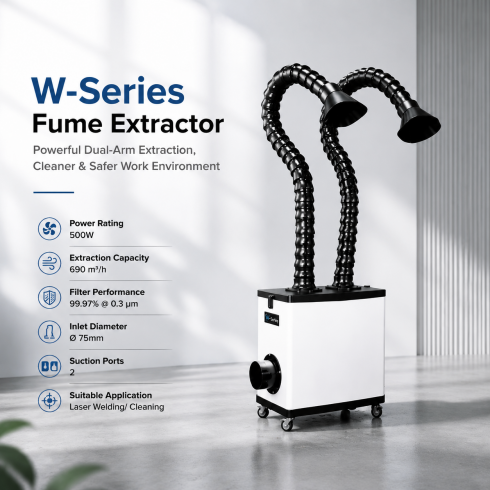
Industrial laser cleaning operations should include appropriate laser safety protection and fume extraction equipment to manage particles generated during the cleaning process.
A laser cleaning machine for mill scale removal provides manufacturers with a precise and efficient solution for steel surface preparation.
By removing oxide layers, mill scale, and surface contaminants without abrasive materials, laser cleaning helps improve coating preparation, welding quality, and overall manufacturing consistency.
For companies working with steel fabrication, industrial components, and surface treatment applications, laser cleaning offers a modern alternative to traditional preparation methods and supports cleaner, more controlled production processes.
News | Sep-4-2026